Nice to sneak this out just before Christmas: solid and actionable advice on designing and implementing LHC — and beyond — ML analysis strategies that can be re-used and combined, to deliver more impact (and citations...) https://t.co/UyYIo7NMi7
Are you looking for a postdoc in HEP and also want to push the boundaries of AI in a dynamic new group? Then check out this posting: https://t.co/0VnteN7ep0
Showcasing the first measurement, by @CMSexperiment, of the top-quark pair production cross section at a centre-of-mass energy of 13.6 TeV, TOP 2022 kicked off the #LHCRun3 top-quark physics programme
https://t.co/dJAfyESLbJ
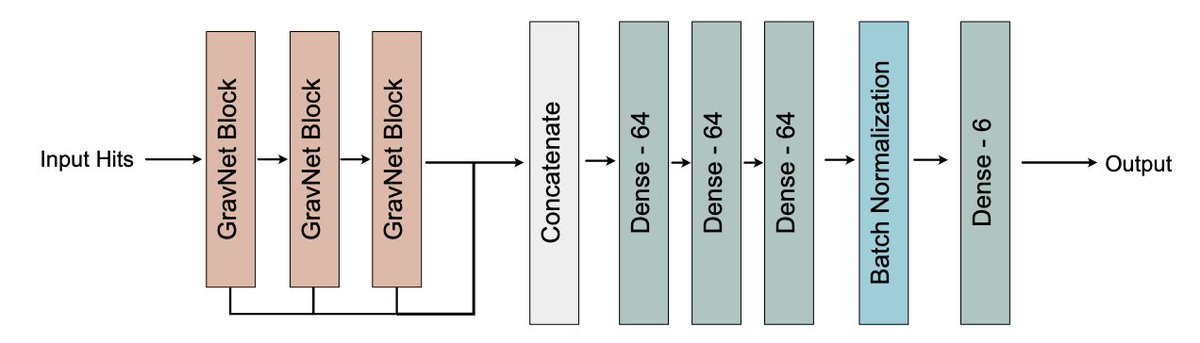
First single-shot reconstruction of about 1000 particles at once in 200 PU in a high granularity calorimeter using machine learning, featuring GravNet and Object Condensation. Great work from @ShahRukhQasim and the whole team!
https://t.co/IUviktqb41
Thrilled to announce that our white paper on End-to-End Optimization of Particle Physics Instruments with Differentiable Programming is finally out at https://t.co/xkZYK4wtjy !!!
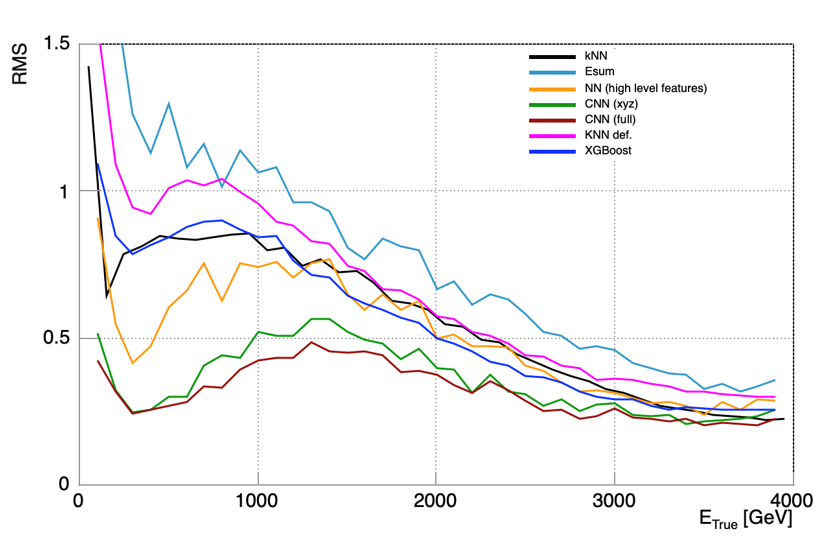
Deep learning 66M parameters with a SGD-optimized nearest neighbor gets you to the same performance of NNs and BDTs! The power of ML is in differentiable calculus, as expected. https://t.co/BdvOOGB3tw
https://t.co/WpC4ZMyka8
Will AI design our future detectors for us? One small step out of many steps towards AI helping us with design decisions is described in this paper, where we show how it can be used to easily compare different design options for measuring particle energies
🧪️ Engineers at the CERN LHC use TensorFlow to reconstruct thousands of particles in one go.
Learn how in this guest article by Jan Kieseler ↓ https://t.co/iXo6FFCOfU