First sim-to-real transfer for muscle-actuated robots 🦾
Muscle-actuated robots are powerful but hard to model. GeAN addresses this longstanding challenge by learning muscle and tendon dynamics, enabling sim-to-real transfer.
https://t.co/atqlgZic4W
https://t.co/02UdwQ2QG4
🧵👇
(4/5)
Deploying the GeAN with a GPU-based simulator enables massive parallelization and efficient RL training. The learned policies transfer zero-shot to the real robot (4-DoF, tendon-driven, actuated by pneumatic artificial muscles), producing dynamic and precise motions.
(3/5)
GeAN uses the known arm dynamics to learn the mapping from commands to joint torques from joint position trajectories alone. No torque sensors needed → the method is applicable to a wide range of robots (with all kinds of actuators).
(2/5)
Our method first collects a dataset of randomized open-loop motions to explore the robot's actuator dynamics. This data is used to train the Generalized Actuator Network (GeAN).
Pushing for #icra but still missing real robot experiments? 😰
Skip the ROS headaches — get your Franka robot running in minutes with franky! 🦾
Super beginner-friendly, Pythonic, and fast to set up.
🔗 https://t.co/Modc3KX2TY
@ias_tudarmstadt@Jan_R_Peters
🧵👇
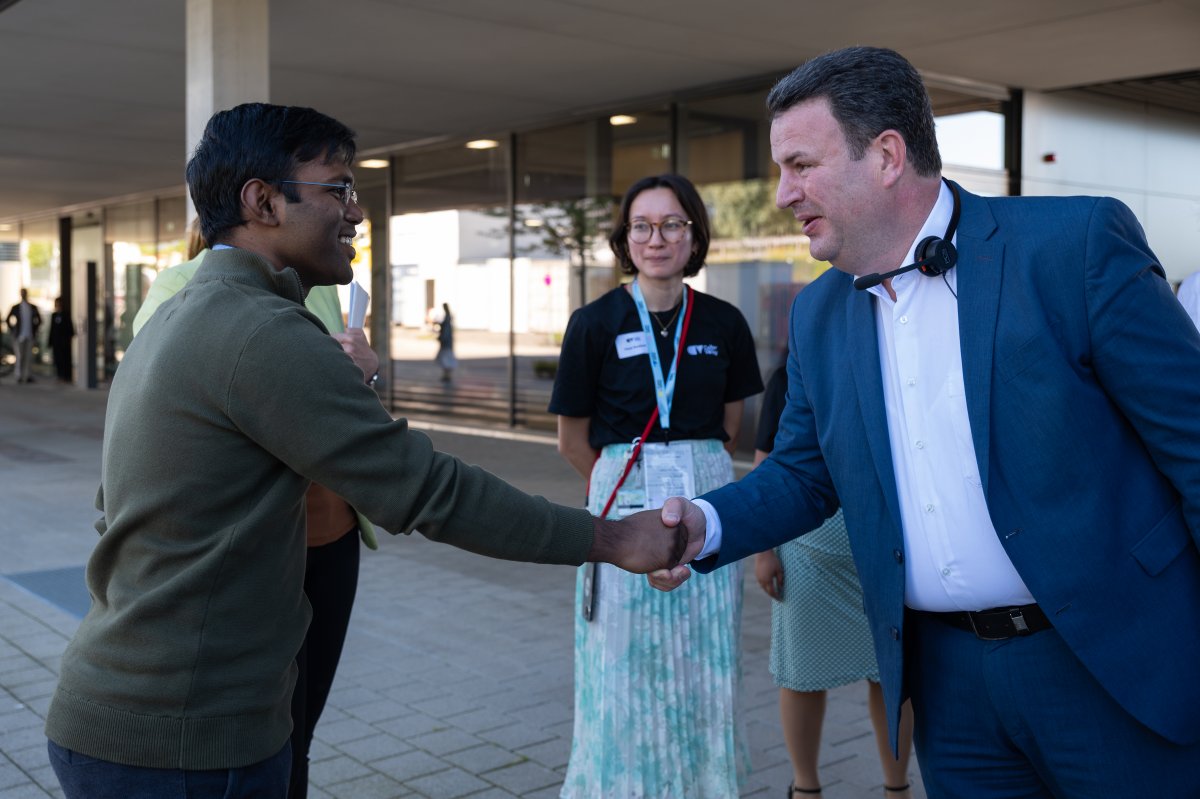
#ThrowbackThursday: We welcomed Federal Minister Hubertus Heil to Cyber Valley! After viewing projects from @MPI_IS, he spoke with the Cyber Valley Community about the challenges faced by qualified specialists from abroad 👉 https://t.co/5K8Hl9lbXK #BetterTogether#AI#AIFuture
Learning to play the piano with two robot hands is super challenging, even in simulation! It requires coping with bimanual coordination at high speed to achieve human-level dexterity. We introduce RP1M, a large-scale robot piano-playing motion dataset, featuring ~1M trajectories over 2k music pieces.
Website: https://t.co/Bvk90MV6KH
Paper: https://t.co/45j6y1NncI
We presented our work on a novel open-source (mostly) 3D-printable tendon-driven robot arm at #RSS2024 today. Our design enables safety through reduced inertia and passive compliance, while addressing challenges regarding friction and robustness
https://t.co/pI4HyAnDdM
If you are at #ICLR2024 and want to hear more about our work on gradient subspaces for RL, come to poster #167 tomorrow from 10:45 to 12:45. Looking forward to chatting with you!
Gradient subspace optimization unlocked for RL 🔒➡️🔓
Used only for supervised learning so far, our #ICLR2024 paper illustrates that policy gradients evolve in a small, slowly-changing subspace, opening up many opportunities for more efficient RL.
https://t.co/jVwdOL9cOw
Gradient subspace optimization unlocked for RL 🔒➡️🔓
Used only for supervised learning so far, our #ICLR2024 paper illustrates that policy gradients evolve in a small, slowly-changing subspace, opening up many opportunities for more efficient RL.
https://t.co/jVwdOL9cOw