Vibe-trading digital oil is like vibe-hedging in treasuries during Hormuz risk-off. Both share one house of cards that works on paper.
Difference: oil at least has Dated Brent. Treasuries? Vibes all the way down.
EUCRBRDT Index GP <GO>
It’s frankly nauseating to see ppl misleading the public with MarineTraffic’s free-tier data just bc they’re too cheap to pay for a $100 subscription.
Since everyone is obsessively posting MarineTraffic screenshots, I’ll step in and filter the noise myself—though I don’t typically rely on this platform.
To get a real picture, we need to ignore Handysize tankers as they are practically irrelevant here; I’m focusing only on MR tankers and above(MR: 40k–55k DWT, LR1: 55k–80k DWT, Aframax: 80k–120k DWT).
Under normal steaming conditions, MR/LR1s cruise at 12.5–14.5 knots, Aframaxes at 12–14 knots, and VLCCs at 13–15 knots. Speeds vary based on eco-speeding or load status—ballast vessels typically run about 1 knot faster than laden ones.
Since our focus is whether the market will be flooded with oil, we must look exclusively at laden tankers. Specifically tankers carrying cargo and transiting the Strait from West to East. We also need to exclude vessels drifting near ports or those at anchor; we only care about those actually underway.
While 12–15 knots is standard, given the current friction in the Strait, I’ve set a conservative filter of 6 knots or higher to capture only those vessels definitively in transit.
The results are exactly what you see in the image. I don’t believe AIS is the ultimate truth, but I have to ask: why are ppl posing as shipping experts when they don't even know the basics of what to look for?
Yes, product tanker traffic has ticked up—it looks higher than this week’s average. But for those curious about crude? Ask yourselves how much a few Aframaxes can truly move the needle.
Furthermore inbound transits remain extremely low—nowhere near the numbers required to support a meaningful restart in production. And one last thing: did anyone even bother to check the sanction status? I suppose that’s too much to ask.
#oott #iran
"Oil is below $100."
That's the Brent futures price for June delivery. A financial contract.
Physical Forties crude (actual barrels, prompt delivery), hit $148 this week, an all-time record.
Those are the prices refineries and traders are actually paying in the real world.
That's a $50 gap between the headline price and the physical price.
The dislocation between the paper oil price and the physical oil price has never been greater.
The US Interior Secretary confirmed the government has discussed using futures market intervention to suppress oil prices.
Coincidence or not?
BREAKING: "Rich Starry," a Chinese oil tanker sanctioned for shipping Iranian oil, flying the flag of Malawi — a country with no coastline — just sailed through America's blockade of the Strait of Hormuz. The Navy, with its many "big beautiful ships," issued repeated warnings. Reportedly, The tanker's captain upgraded to premium to skip the ads.
EDIT: We're being told the blockade only applies to countries the US isn't afraid of. That list used to be long. It now fits on Trump's McDonald's receipt, Delivered by DoorDash.
I feel like the oil market has already crossed the point of no return, regardless of how this war plays out.
At first this wave just swallowed up everything East of Suez. We saw force majeures popping up all over Asia and premiums going through the roof.
But now the Atlantic wall has officially crumbled. Only oil nerds like us are checking this stuff lately, but seriously—just look at the North Sea Platts window and the USGC diffs.
This is nowhere near normal. I know some ppl are getting all hyped up every time a single Handy tanker or LPG carrier squeaks through Hormuz, even claiming there’s a secret fleet of tankers slipping through.
I highly doubt it. If supply was actually fine, Atlantic physical diffs wouldn't be screaming like this. These numbers only happen when you're hitting a massive supply shock.
Like some of smart guys have noted, once you pass a certain threshold, it doesn't even matter if Hormuz reopens—the logistical bottlenecks will make it impossible to absorb the shock anytime soon.
I’m pretty sure we’ve already crossed that line.
#oott #iran
After a certain age, your parents slowly become your children. They ask simple questions, repeat stories, and depend on your patience the way you once depended on theirs. Very few understand this role reversal.What looks like innocence or inconvenience is really time coming full circle. Don't correct them harshly. Don't rush them. Care for them the way they once protected you. This is not a burden. It is repayment.
We had said that the Islamic Republic of Iran does not forget his friends.The first Malaysian ship passed through the Strait of Hormuz
Kami telah mengatakan bahawa Republik Islam Iran tidak akan melupakan rakan-rakannya.Kapal Malaysia yang pertama yang telah melalui Selat Hormuz
300 years before Christianity was invented by paul and co, 1000 years before Islam was invented by prophet Mohamed, An ancient Chinese philosopher said,
" pray all you want, heaven can't hear you... It's not going to stop the winter because you are cold, and it's not going to make the earth smaller because you don't want to walk so far
you pray for rain and it rains, but your prayer has nothing to do with it...sometimes you dont pray for rain and it rains anyways. What do you say then?
educate yourself , and think carefully about the consequences of your actions"
- xun zi
Even if the war ends TODAY, full Gulf oil & gas restoration will take:
• Oil shipping: 1-2 weeks
• Production: 2-8 weeks (most back in 2 months)
• LNG: 3-5+ YEARS (Qatar damage is bad)
Full exports to all countries? 3-6+ months minimum.
Oil prices stay high even after ceasefire:
Brent likely $90–120+ through mid-2026.
Why? Lingering tightness + damaged facilities.
Pre-war $75–80 current $100+.
Prices only drop hard once Gulf flows exceed demand.
Economic ripple effects (post-war):
• Global inflation +0.5–1.5%
• Higher fuel, food, transport costs
• GDP drag 0.2–0.6% (Asia/Europe hit hardest)
• Stagflation risk central banks may delay rate cuts.
If war drags on:
+1 month $110–130 oil
+2 months $130–150
+6 months $150+ (recession risk)
+1 year deep global stagflation & 2%+ GDP loss
Longer more damage, slower recovery.
Quick end still means months of pain. Prolonged war means 1970s-style energy crisis.
An aphorism from I don’t know who/when: “When people are worried about the future, they buy gold. When people are worried about the present, they sell gold.”
Will be interesting to see if that plays out.
Petrol prices in Malaysia.
1. Global oil price jumped 30% to USD100 per barrel.
2. Malaysia RON95 maintained at RM1.99 per litre, while unsubsidized petrol rose RM0.68 to RM3.27 per litre.
3. Diesel maintained at RM1.88 in Peninsula and RM2.15 in Sabah and Sarawak. Unsubsidized diesel rose to RM3.92 from RM3.04, up RM0.88 per litre.
4. This will lift total fuel subsidy to RM3.2 billion per month from RM700 million before the conflict.
5. In 2025, Malaysia imported RM54.11 billion woth of crude petroleum (69% from Middle East).
6. In 2025, exorts were Rm23.76 billion (26% Thailand, Australia 26%, Japan 16%
7. Why Malaysia imports oil? It's because oil in Malaysia is of higher grade and higher price. It makes economic sense to export. Thus, Malaysia imports to lower grade and mix them with higher local oil and processed them into Petrol for cars.
8. Malaysia importers are: PETRONAS, Hengyuan Refining, Petron and Vitol.
9. Malaysia refining companies: Petronas Chemicals
10. Malaysia petrol products marketers: Petronas Dagang
11. Malaysia petro stations: Petron, PETRONAS, Hengyuan to Shell and Vitol to BHPetrol.
12. Malaysia is not a member of the IEA, which requires membeers to hold 90 days min of stocks. Malaysia relies on commercial storage for reserves. Does not hold reserves in a traditional sense.
13. Based on estimates, Malaysia holds about 1-2 months of refined product. Japan 8 months, South Korea 7 monts, China 3 months, Indonesia 23 days, Thailand 3 months, Singapore same as Malaysia.
14. Commercial storage players: Dialog, operates about 5.14 million cu m in capacity, 51% for short term clietns and 49% for long term clients.
15. Petrol Stations hold about 2 months supply, in line with storage capcity.
16. Hengyuan storage capacity is about 2 weeks.
17. PETRONAS has directed Malaysian crude to domestic refineries to maximise production for local consumption.
18. Historically, 20% of Malaysian crude is sold on the spot market. The rest on long term contracts.
19. IEA members have agreed to release 400 million barrels (about 30%), which could cover 20 days of shortage.
20. FOr Malaysia, the issue is about price, not on supply. Using local oil is more expensive as they are of higher grade.
21. In a worst case scenario, aka prolonged supply uncertainty could trigger export ban. Malaysia govt can direct PETRONAS to prioritse doemstic supply over export contracts, although this is unlikely at unless the crisis escalates.
22. In short, Malaysia is better positioned than pure importers like Singapore, Phillipines.
23. Despite that, Malaysia has room to improve in formal strategic reserves - it should benefit storage players.
Everyone talks about Iranian oil in barrels. Nobody talks about what is inside them. That difference is why Western refineries have been running shadow networks through Dubai for twenty years to get it despite the sanctions.
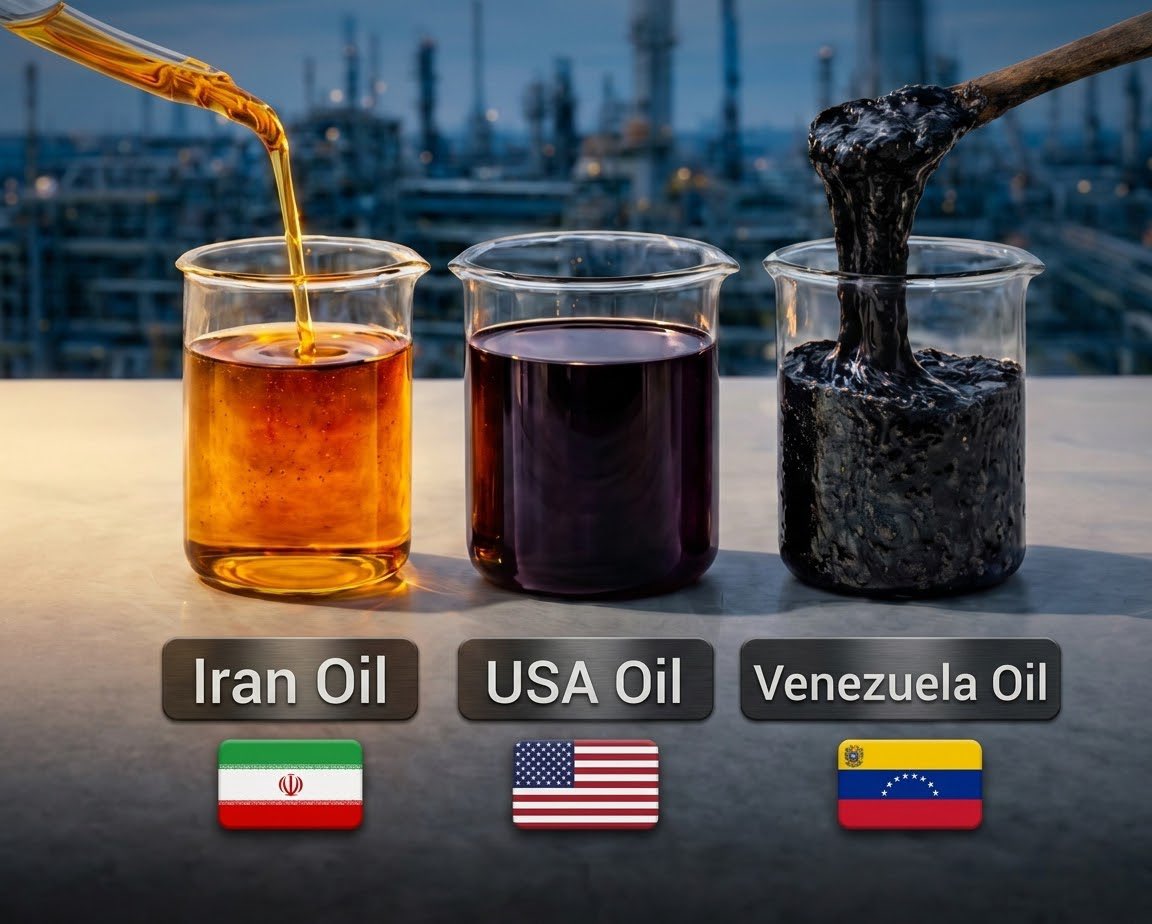
Crude oil is not a uniform commodity. It is a spectrum of hydrocarbons with different molecular weights, and the composition of a given crude determines how easily it converts into the products refineries actually want to sell: gasoline, diesel, jet fuel, heating oil. The measurement that captures this is API gravity. Higher API gravity means lighter crude with shorter carbon chains, which means lower energy cost to crack, lower processing cost to refine, and higher yield of the light distillates that carry premium pricing. Lower API gravity means heavier crude requiring more energy, more processing steps, more capital equipment, and producing a higher share of lower-value residuals.
Iranian Light crude runs at 33 to 36 degrees API gravity with sulfur content between 1.36 and 1.5 percent. That is the refinery sweet spot. It is light enough to yield high fractions of gasoline and middle distillates without excessive processing costs, but heavy enough to produce the full range of products that complex refineries are designed to process. It is what petroleum engineers call an optimal blend crude.
Now compare the alternatives.
Venezuelan Merey heavy crude runs at approximately 16 degrees API gravity with sulfur between 3 and 5 percent. Refining it profitably requires a coking unit, a hydrocracker, and an extensive desulfurization train. The equipment exists. The economics work for refineries purpose-built around Venezuelan feedstock. It is not a substitute for Iranian crude. It is a different product requiring different industrial infrastructure.
US West Texas Intermediate runs at 39 to 40 degrees API with sulfur below 0.25 percent. In theory, the cleanest and easiest crude to process. In practice, it is so light that it does not yield the heavier middle distillates a complex refinery needs to run at full capacity. European and Asian refineries built around medium crudes cannot switch to WTI without blending it with heavier crudes to achieve the molecular weight distribution their process units require. WTI is not a drop-in replacement for Iranian medium.
Iranian oil fits where both US shale and Venezuelan heavy do not. It is the liquid that flows through the middle of the global refining system without requiring either the coking infrastructure for heavy crudes or the blending operations for ultra-light shale. That molecular fit is why it commands a persistent premium above comparable grades. It is why Indian refineries maintained Iranian crude purchases through every round of sanctions and negotiated the logistics to keep that flow moving. It is why the Dubai shadow banking and trading network that the UAE is now considering dismantling existed in the first place.
The Strait of Hormuz does not just carry oil. It carries the specific category of oil that the global refining system was built to process most efficiently. Closing it does not just reduce supply. It removes the grade of crude that the system runs best on and forces every refinery in the world to run less efficiently on whatever it can find as a substitute.
That is the premium embedded in the $82 oil price. Not just volume. Molecular weight.
https://t.co/ULBgEzZ3A8