I'm an Australia who has lived in China and has been pushing back against the Australian media's misrepresentation of China since 2017. In fact I was one of the first cabs off the rank to do so. But one area I was afraid to examine was Chinese revolutionary history. As an Australian, to consider the topic outside the West's Cold War narrative was to move too far out of the "Overton Window". To have an open and inquisitive mind towards the subject feels like you are open to "ideological contamination" and being "unAustralian".
That changed last week when I travelled in China's Guizhou province. By coincidence, I was two days behind @AndyBxxx's tracks through Guizhou learning about one of the most important events in Chinese revolutionary history - the Zunyi Conference. I will share some photos and some thoughts in this thread...
This is some of the most mature and fair-minded reflection about the Mao-era famines I’ve read.
Those who use the Mao-era disasters to try and incite more chaos in China are truly wicked even if they imagine themselves so pure.
“The Chinese nation, since modern times, has endured too much suffering and truly cannot afford to be tossed about again and again. For our generation of young people, the most important thing is not to fall into endless hero worship of historical figures or emotional vilification, but to earnestly understand history, draw lessons from it, and devote our energy to national construction and social development.”
Kishore Mahbubani tells a story you won't read in Western papers.
Former US ambassador to China Stapleton Roy, fluent in Mandarin, told him that at a meeting with Obama, "maybe 2014", Xi Jinping offered to demilitarize the South China Sea.
"The United States, instead of accepting the offer, rejected the offer. And that's why the militarization began."
What is on record : September 2015, White House Rose Garden, Xi says China "does not intend to pursue militarization" in the Spratlys.
Washington's answer was more patrols, then years of "China lied" headlines.
Mahbubani's other point >
> China is "the world's number one trading power"
> so it has "a greater vested interest in freedom of navigation than the United States"
I have heard the "China will block the sea lanes" line for years. Block its own trade ?
So was there an offer on the table ? And if there was, who walked away ?
Sari doesn’t think that Chinese people are real.
At least, they’re not real without the intercessions of civilized angels of democracy like Sari to ensoul them and tell them what they’re really thinking.
The young ppl of China might be way more enthusiastic about Mao than the party, certainly more than Xi, who suffered terribly under the cultural revolution. But there’s no way they organically came to this conclusion on their own.
“The communist party gave them no alternatives”
The poor dears are suffering from false consciousness. They might not be aware, but their buried true selves are yearning to become a real boy like Joshua Wong one day.
Until then you can go ahead and ignore what they say, what they do, how they feel. It’s all inauthentic and fake. Instead, listen to white NGO professionals like Sari who can tell you how the Chinese are yearning to be liberated.
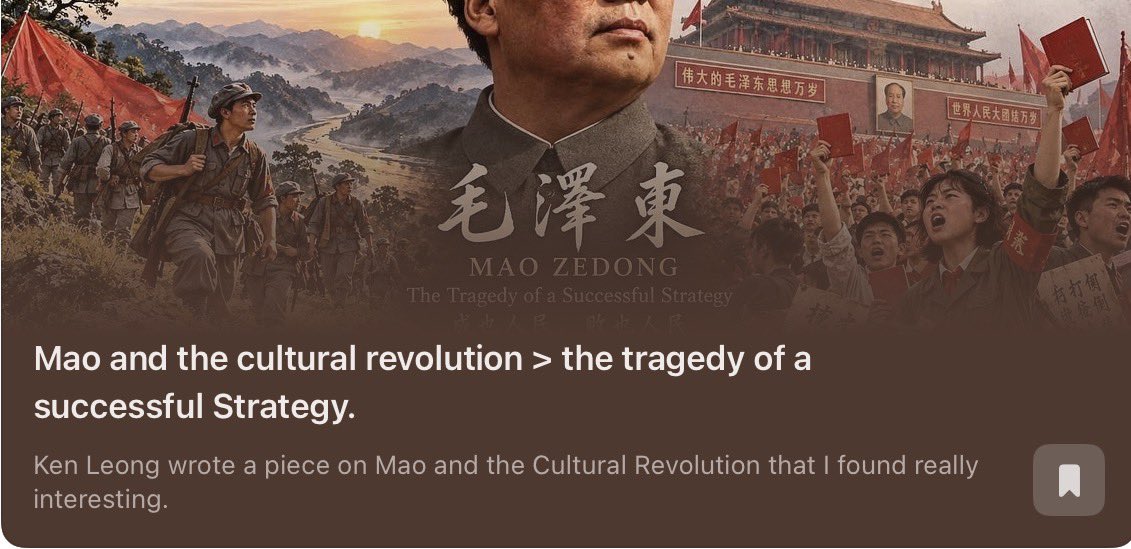
𝗠𝗔𝗢 𝗔𝗡𝗗 𝗧𝗛𝗘 𝗖𝗨𝗟𝗧𝗨𝗥𝗔𝗟 𝗥𝗘𝗩𝗢𝗟𝗨𝗧𝗜𝗢𝗡: 𝗧𝗛𝗘 𝗧𝗥𝗔𝗚𝗘𝗗𝗬 𝗢𝗙 𝗔 𝗦𝗨𝗖𝗖𝗘𝗦𝗦𝗙𝗨𝗟 𝗦𝗧𝗥𝗔𝗧𝗘𝗚𝗬
Most Western writing on the Cultural Revolution stops at "Mao was a monster". That's easy to say, and it explains nothing.
Ken Leong wrote a piece that asks a better question. Why would the man who used the people to win a revolution then turn those same people loose on the state he had built himself?
I mostly agree with his answer. Mao was outgunned and outnumbered, and he won by going around power instead of hitting it head on, a bit like water around a rock. After 1949 he was the rock. When he feared the Party was turning into a new privileged elite, he went back to the method he trusted most, which was mobilising the people against the bureaucracy.
In my view it was at its root an attempt to shake up an old and corrupt system. The cost was real, though, and I don't brush it aside.
It's also one of the most divisive topics in China, and I write about it humbly.
But I don't think the story ended in 1976. Deng kept the foundation and dropped the chaos. Today China debates inside the system, reaches consensus, and puts engineers in charge who test policies before rolling them out. The revolution didn't stop, it just got pragmatic.
People in the West love to say strongmen never learn. China did.
My full take, inspired by Ken Leong's article:
https://t.co/EihmsCkkpc
Be informed, not entertained.
@RnaudBertrand Finally some in the pro-China camp speaking with nuance about Mao. The way the Chinese state media staff have been going on about him this week has been over the top!
I know a lot of people in the West are baffled by the Mbappé-Mao storm in China - which in itself shows that Mbappé's ignorance doesn't come out of nowhere...
To understand it, here's the best analogy I could think of: imagine the biggest Chinese star in the NBA, with sponsorship deals all over the US. One day he's asked for his favorite meme of himself. He giggles: "the one where they put my face on some guy, I think he was an American slave owner." When the "some guy" in question is George Washington.
Whatever you think of the label, you know exactly how that would land in the US: an ungrateful foreigner getting rich off Americans, laughing at the country's founding father in an offensive way - at least to a big share of the population - without even knowing his name.
A founding father is the story a nation tells itself about where it comes from. Laugh at him as a foreigner while cashing in on that nation's consumers, and that's not going to go well in any country.
The label is also extremely un-nuanced: yes, all important historical figures have their share of darkness and Washington and Mao are no exception.
China actually recognizes this: the official line is that he was "70% right and 30% wrong," and the Party's 1981 resolution condemned how his "personal arbitrariness gradually undermined democratic centralism in Party life and the personality cult grew graver and graver" (https://t.co/gH2rs1FZqW)
Same for Washington: it's officially acknowledged too. Or at least it was until this year: in January, the National Park Service tore down an exhibit in Philadelphia about the people Washington enslaved there, under a Trump executive order targeting content that "inappropriately disparage[s]" Americans (https://t.co/MRLTnnllfq). Which goes to show China isn't uniquely touchy about its founding father...
In 1975, US Christian nationalist Jack Chick warned the world that China was planning to take over Asia, including Australia. Most people in that generation knew this was fearmongering rubbish. Today, 50+ years later, the Australian mainstream media is doing the exact same trick