Nah. One truly great thing about American exceptionalism is that it doesn’t “seek inspiration” from other countries. It seeks to inspire them. America is not perfect and is self aware of this; but it charts its own course, and it’s all the better for it.
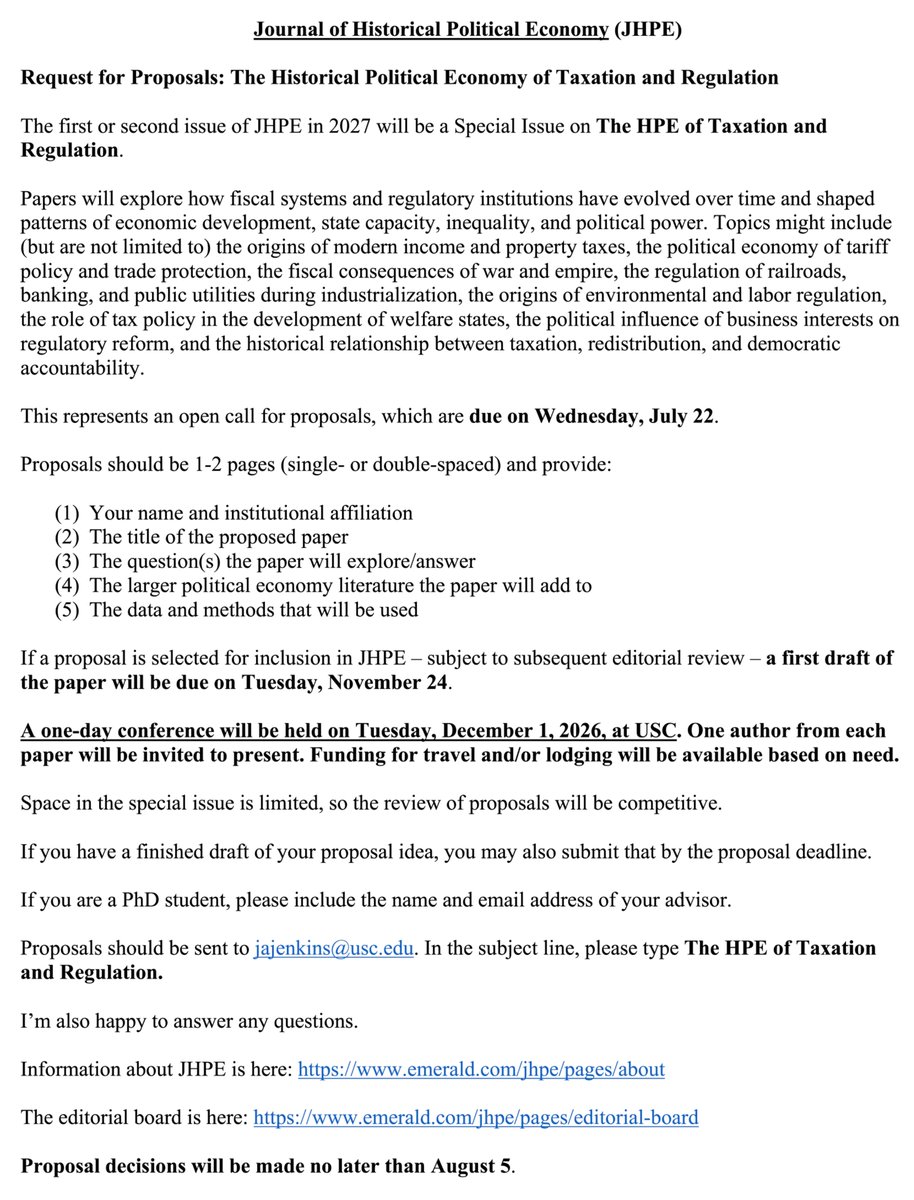
Request for proposals:
Special Issue of @JHPE_journal on The HPE of Taxation and Regulation.
Details below. Proposal deadline: July 22. Conference @USCPrice: December 1.
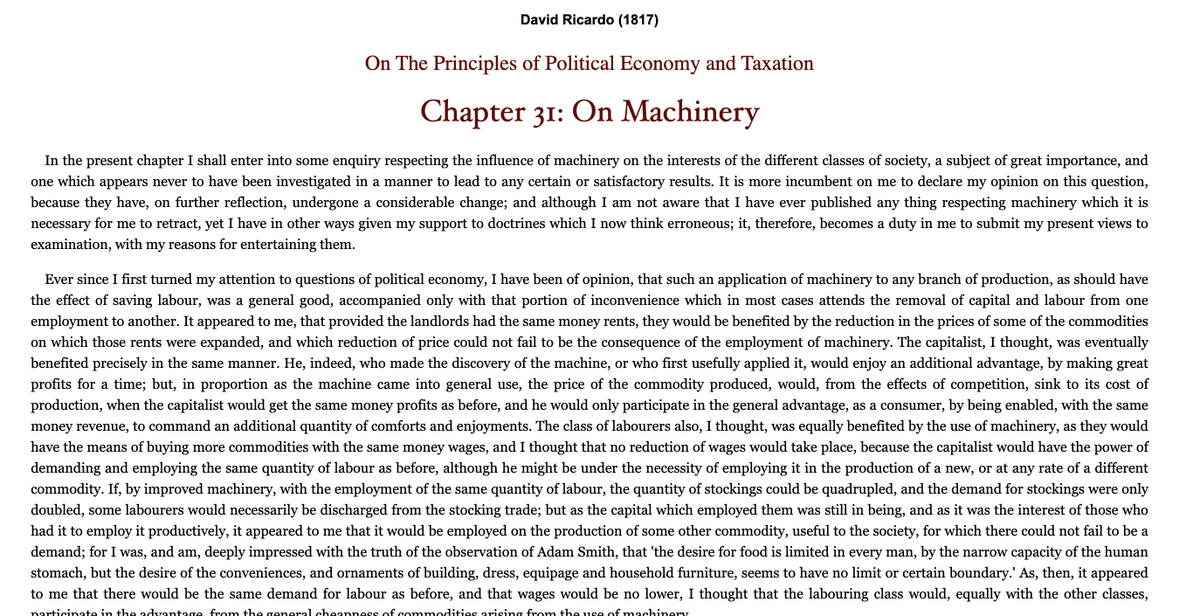
New rule: Anyone who is about to write a "all workers will be replaced by machines" essay needs to first read On Machinery by David Ricardo (yes, that David Ricardo), because he probably wrote your essay...in 1817.
Deeply respect Paul, but he's wrong and a bit too late to this conversation. Humanities academics for whom writing is like 95% of their job are already scandalized beyond what's possible, while STEM people are quietly improving their research and writing using AI, and nobody cares.
There are important concerns about one-shot AI slop even in STEM, but they're about poor substance and have nothing to do with writing per se. And, on the merits, when it comes to formulaic write-ups of your lab results, you shouldn't care whether it was your human RA or AI who did it. You should care whether it's true and useful.
Didn't plan to write 4K words against evidence-based policy, but here we are. Three years after we declared the pandemic over, the people who spent it demanding we "follow the science" still haven't reckoned with how badly they failed.
Now they're trying to do the same with AC.
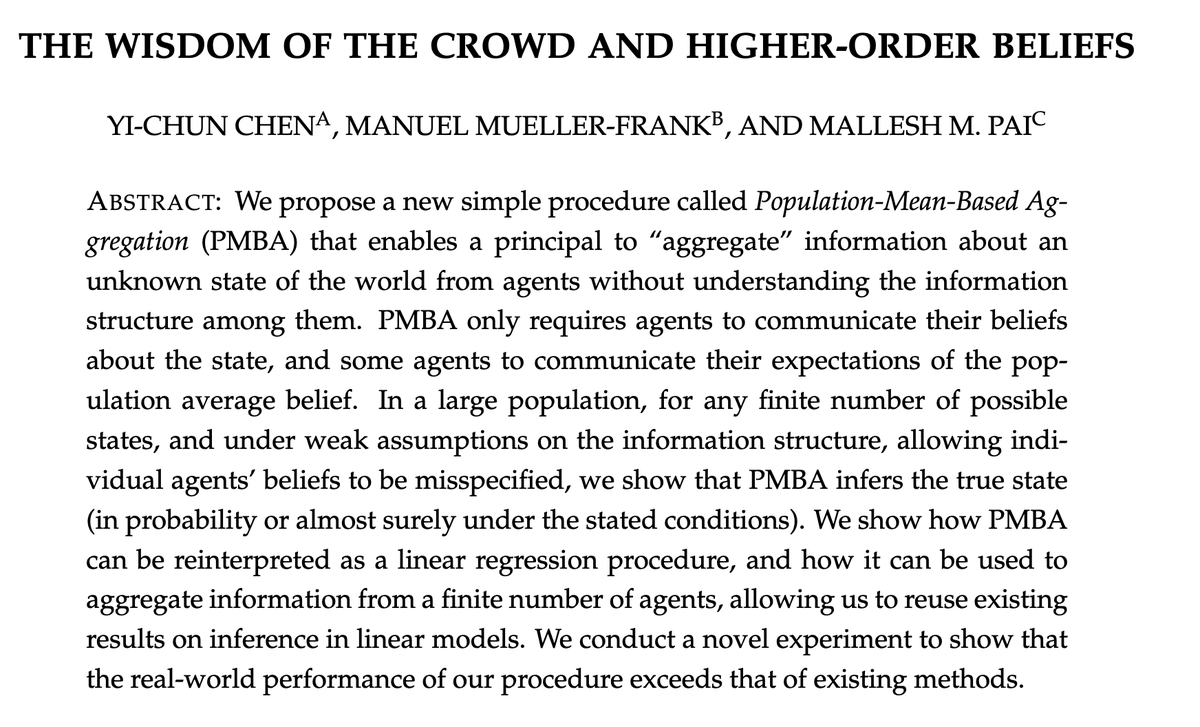
Updated Paper 🚨 (with Yi-Chun Chen and @ProfMMF)
The “wisdom of the crowd” is one of the oldest and prettiest ideas in social science: Ask enough people, average their answers, and the random errors cancel out. Underlies Aristotlean philosophy, Galton and the Ox, and these days, Prediction Markets.
Beautiful, magical when it works, but sometimes… completely wrong! 🧵
hey folks, some personal news: I am not going on leave to work for OpenAI or Anthropic. I understand this may surprise and disappoint my students and colleagues at Princeton, but I hope they’ll come to understand it’s for the best and support me at this time of non transition
Yes, there are some arts (as Aristotle observes) where an amateur knowledge makes one a better judge of professionals. There would be fewer ugly buildings, me'thinks, if an amateur understanding of archictecture was more widespead.
To my surprise, the “best arguments against great books teaching” thing going around has been a useful exercise. In my view, the strongest response is there isn’t any alternative that’s both superior and plausible at significant scale in this country.
I want to introduce you to Steve. He’s 83. His wife died a few months ago and he comes to this lodge in Spring Mill, Indiana and draws. He taught art in Terre Haute, IN his whole life. He also did courtroom sketches in court cases. In the comments I’ll share some pics from his sketchbook. He was excited when I said I was going to share his sketches with the world.
@akoustov@laderafrutal I actually use this paper as an example of flawed empirical work in the intro stats class I teach. Nevertheless, there are some interesting ideas here that can be more rigorously tested with the right natural experiment.
The University of Chicago is not "surrendering to bots." It is providing resources for students, faculty, and staff to adapt in the AI era of higher education. Imagine if the same fear mongering was applied to computers or the Internet.
Fable is a huge leap forward in terms of how much you can post about it doing stuff. A lot of people don't have access to it, or get auto kicked off back to Opus, so you can basically write what you like. It just made me a million dollars. you can see why openAI is nervous.
I never met Gordon Wood, but I have a story about him.
In one of my grad school seminars, we read Wood’s Creation of the American Republic. The sheer erudition and evidentiary depth of the book bowled me over.
Back then, before kids and before life accelerated to warp speed, I used to call my mother every Sunday to catch up. Lots of times, we ended up talking about what I was reading that week in my grad seminars or for leisure. Mom had an omnivorous mind, and she was always looking for something else to read. She was a true intellectual—curious about almost everything, always eager to integrate new arguments or ideas into her existing schemas of how the world worked or to have those schemas challenged and changed.
When we talked that particular Sunday, I think I tried to describe to her part of Wood’s argument about the relationship between the state constitutions during the Articles of Confederation era and the federal Constitution. Maybe I was tired, maybe I didn’t completely understand her questions, but the end result of the conversation was that Mom had questions about Wood’s argument that I didn’t answer satisfactorily. I told her that she should probably just read the book, and we said goodbye.
She did eventually read the book, but the next Sunday, Mom started our conversation by saying, “Well, I had a lovely conversation with Gordon Wood this week.” For a split second, I thought she was joking, but then I remembered who I was dealing with. I started to sweat. “How?” I asked. A whole variety of unlikely scenarios in which the foremost historian of the American Revolution and my mother, who lived in Wichita, Kansas, might have met ran through my mind. “Oh, I just looked up his office phone number on Brown’s website and called, and he picked up!” Mom said. I decided I would have to find another profession.
As it ended up, Gordon Wood spent about an hour on the phone with my mother answering her questions about the Constitution. Ever since, I’ve had a soft spot for the man when I imagine him picking up the phone in Providence and finding Becky Elder from Wichita on the other end of the line. His generosity in that moment spoke very well of him.
Rest in peace, professor.
I played a very small part in putting this together with many other colleagues. How LLMs play into the scientific workflow is an open and evolving question. But I hope this is a helpful start.
Academics write for each other, not for people.
Steven Pinker has spent over four decades doing the opposite, and thinks current academic writing is "enormous wasted effort."
"There's an awful lot of brilliant work, really smart people in academia. Why are they doing it? Just to entertain each other? Taxpayers pay for it. It should be accessible. Why should I have to read a paragraph five or six times?
It gets under my skin when academics devote so much brainpower into the scholarship and then just blow off the essential task of letting the world know what you've done."
I have often heard academics say something like, "in the AI era, simply being hyper-productive is no longer a useful signal. It's all going to be about the quality of the ideas now."
I think there's a nugget of truth there.
However, this take is, ultimately, incomplete. Finishing high quality research projects is still a very important learned human skill!
I'm hoping that AI will put an end to bean counting. Cranking out lots of articles at low-ranked journals is a losing strategy and won't cut it in the AI era since it will become a much weaker signal of quality. Since AI still relies on the principle of garbage in-garbage out, people with good ideas who can execute them well will likely crowd out space in the top journals leading to a more stark division between "elite" and "average" scholars.