Economist William Nordhaus has passed away.
He's the author of one of my favorite papers on the economics of innovation, "Schumpeterian Profits in the American Economy: Theory and Measurement" (2004), in which he estimates how much of the social surplus (a rough measure of how much value is created for society) generated by innovation accrues to entrepreneurs and innovators. His answer? Only about 2.2%.
That is, innovators, as economists like Julian L. Simon continually stressed in their writings, end up leaving the world a far better place. And this is important because many see wealthy innovators as a drag on the economy, with some even wanting to heavily tax their gains according to some ideal scheme of redistribution. And yet, these people are not social drags, but great social benefactors.
In 2007, 520 students competed at the International Mathematical Olympiad in Vietnam.
The final problem defeated almost everyone.
473 contestants scored zero. Only five earned full marks.
One of those five was Peter Scholze, who would receive the Fields Medal in 2018.
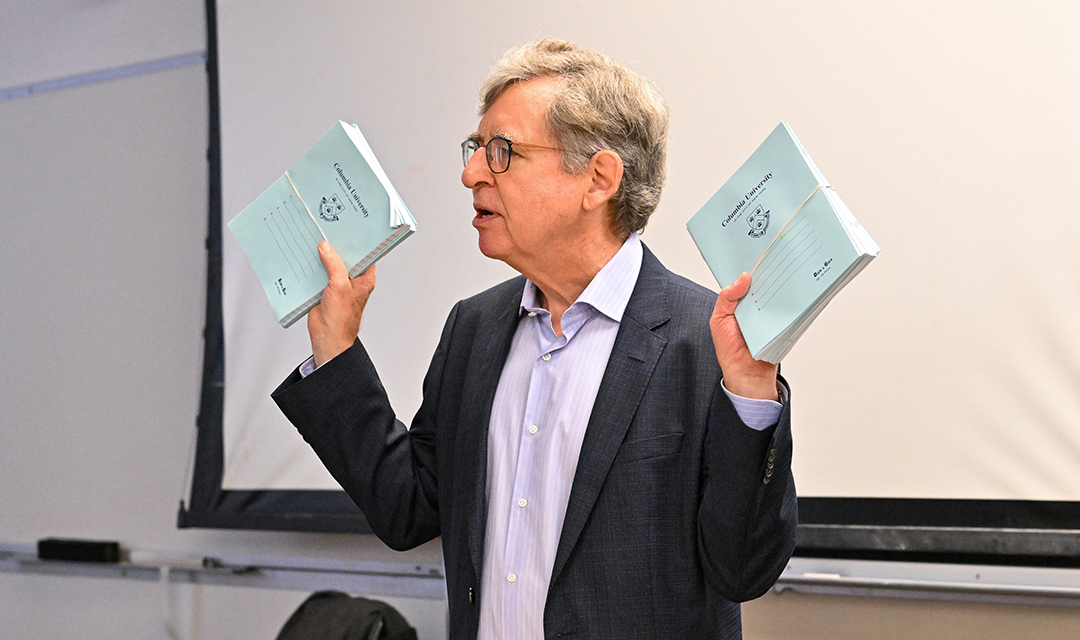
A moment to celebrate! Members of the Columbia community gathered to honor Professor Michael Woodford after he received the @NobelPrize in Economic Sciences earlier today, including President Jennifer L. Mnookin, Provost Angela Olinto, Executive Vice President of Arts and Sciences Amy Hungerford, and Nobel laureates Joseph Stiglitz and Martin Chalfie. Congratulations, Professor Woodford!
📹 Columbia University
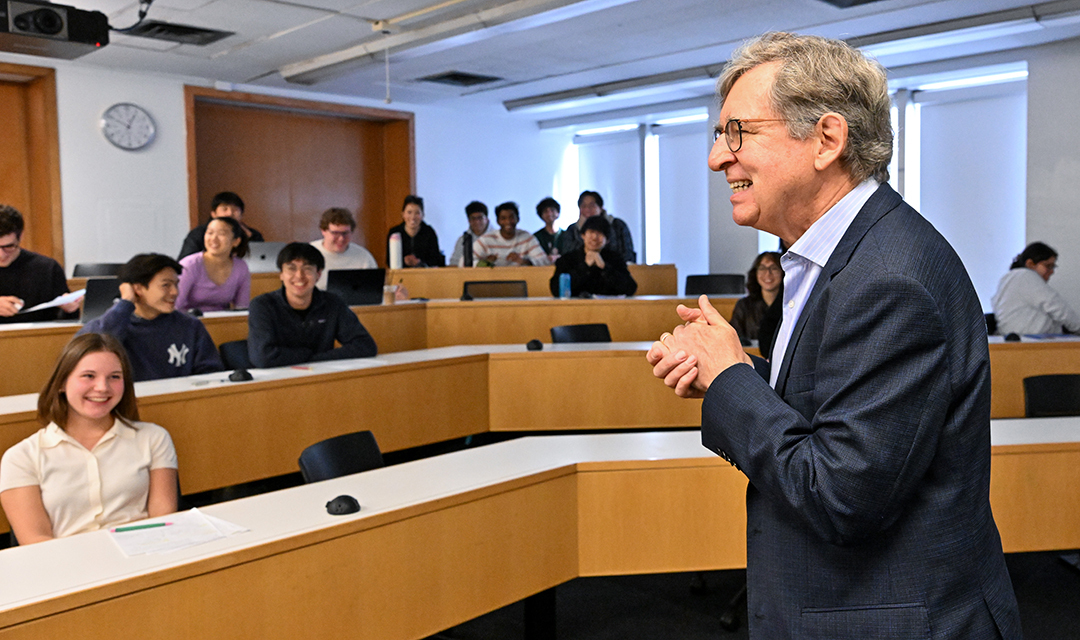
What do you do after winning the @NobelPrize? If you're Columbia Professor Michael Woodford, newly named a Nobel laureate in Economic Sciences, you head to Uris Hall and give your students an exam. Woodford entered the classroom to cheers and applause from the students in his course “Cognitive Mechanisms and Economic Behavior.”
“It's just a staggering piece of news,” Woodford said of receiving the honor. He is the 16th Columbian to receive this prize in economics, and the University's 89th Nobel laureate.
Hear more from Woodford about the award: https://t.co/fvqtEQakBh
📹 Columbia University
📷 Diane Bondareff/Columbia University
2026 economic sciences laureate Robert E. Hall’s hypothesis was that changes in consumption could not be predicted because they depend on new – and thus unpredictable – information.
Hall presented his results in an article in 1978, which was something of a eureka moment for research. His work became key to the development of modern research on consumption.
#NobelPrize
2026 economic sciences laureate Michael Woodford’s economic model has made it possible to respond to supply shocks more effectively.
Various types of shocks can disrupt the balance between supply and demand. A negative supply shock could be a commodity shortage, while a positive supply shock could be a technological breakthrough that makes the production of large volumes cheaper and easier. A positive demand shock could be good news about the future that increases households’ consumption, and a negative one the opposite news. If the balance is disrupted, it can be reset using a stabilisation policy that reduces demand (to the left) or increases it (to the right).
#NobelPrize
BREAKING NEWS
The Royal Swedish Academy of Sciences has decided to award the 2026 Sveriges Riksbank Prize in Economic Sciences in Memory of Alfred Nobel to Robert E. Hall and Michael Woodford “for microeconomic foundations of macroeconomic stabilisation.”
#NobelPrize
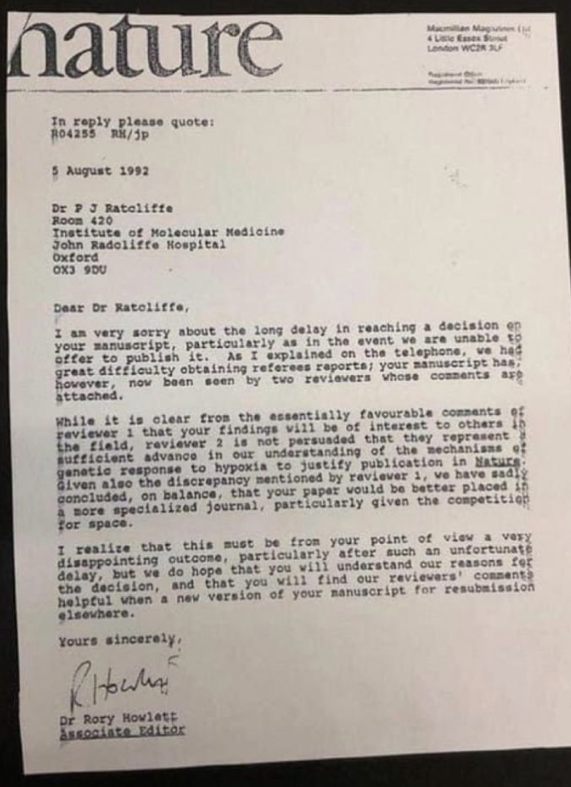
In 1992 Peter Ratcliffe received this rejection from Nature.
Almost 30 years later he won the Nobel Prize for the same discovery.
Don't lose faith in the things you believe in.
Save the date for the announcement of this year's prize in economic sciences.
Watch the breaking news at https://t.co/ooNEngIcep and right here @NobelPrize: https://t.co/rTh6kJrQyt
#NobelPrize
Una nueva ruta para avanzar hacia la energía de fusión acaba de ser publicada en Physical Review Letters (@PhysRevLett).
Detrás del estudio está Luis Felipe Delgado-Aparicio, egresado de Física PUCP y autoridad en la Universidad de Princeton. ¿Qué propone su equipo?
Abrimos hilo 🧵.
He tenido la suerte de conocer a varios economistas con los más altos honores académicos. Julio Velarde no tiene nada que envidiarles; en el uno a uno impresiona como pocos.
Qué triste ver cómo los políticos buscan generar ruido para atraer la atención de ese pequeño porcentaje de gente contraria a todo.
We’re sharing a solution to the Navier-Stokes Millennium Prize Problem, one of the deepest problems at the frontier of mathematics.
The proof was produced by a group of agents, using an OpenAI next-generation model significantly more capable than GPT-6 Astra.
The problem concerns whether the description of smooth three-dimensional fluid motion modeled by the Navier-Stokes equations can break down. It has remained unresolved for roughly 90 years.
@mlkovach1@ben_golub@benleo_econ@alexolegimas@johnjhorton@BenSManning I think you've already seen this one, but I found it very clear and recommend to our grad students for sure:
Kireyev, Pavel and Maura Rivero, Roberto Rafael,
From Microeconomics to AI Research: A Guide for Economists (June 15, 2026).
https://t.co/4eEFEkCYIu
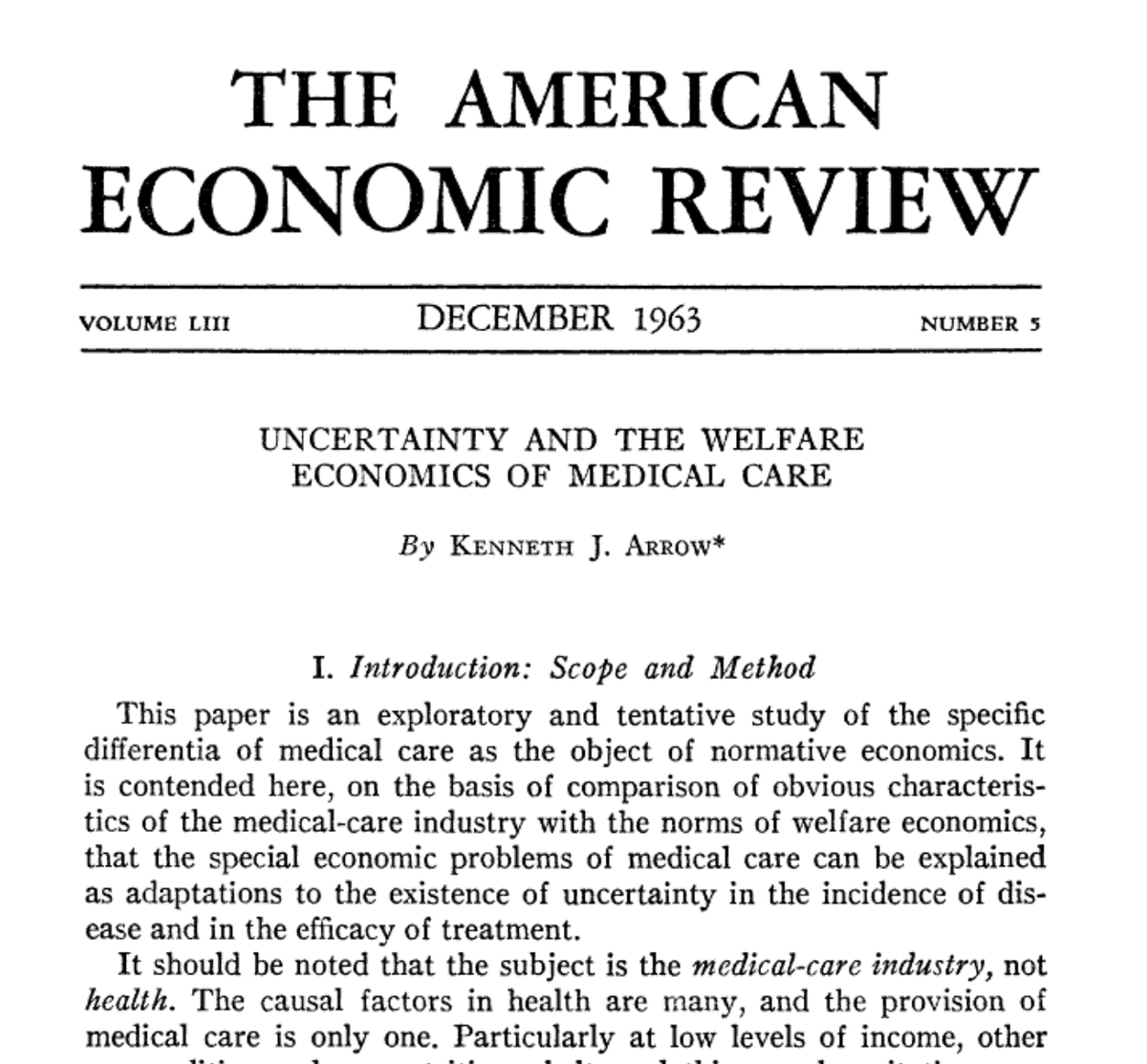
Este es el paper clásico que demuestra que, en un mercado sanitario privado, los incentivos no suelen alinearse.
No existe ningún país de renta alta con un sistema sanitario privado en sentido estricto (no, no Estados Unidos ni Singapur lo son), y esa ausencia no es casualidad.
La combinación de selección adversa, riesgo moral, información asimétrica y una elasticidad renta de la demanda de salud próxima o superior a 1 hace que los mercados de seguros no financiados converjan hacia una cobertura incompleta.
Además, la evidencia empírica es aplastante: la correlación positiva entre el PIB per cápita y el gasto en sanidad es muy fuerte. Quien defienda la privatización como mecanismo de contención de costes tiene que explicar ese dato antes que cualquier otro.
A beautiful article on whether AI can "do mathematics" by the legendary Peter Sarnak, Prof. at Princeton and Ph.D. supervisor of at least two Fields Medallists. For anyone interested in such philosophical issues, it is a must read.
https://t.co/AIa6MNPNLV
Oh, I don't know. So many!!!!!!
A few favorite of mines that any student can read and get 95% out of them:
George Akerlof (1970), "The Market for 'Lemons': Quality Uncertainty and the Market Mechanism," QJE
Michael Spence (1973), "Job Market Signaling," QJE
Gary Becker (1973), "A Theory of Marriage: Part I," JPE
Robert Lucas (1978), "On the Size Distribution of Business Firms," Bell Journal of Economics
Sherwin Rosen (1981), "The Economics of Superstars," AER
Douglas Diamond and Philip Dybvig (1983), "Bank Runs, Deposit Insurance, and Liquidity," JPE
Thomas Schelling (1971), "Dynamic Models of Segregation," Journal of Mathematical Sociology
Martin Weitzman (1974), "Prices vs. Quantities," Review of Economic Studies
William Baumol (1967), "Macroeconomics of Unbalanced Growth: The Anatomy of Urban Crisis," AER
Kevin Murphy, Andrei Shleifer and Robert Vishny (1989), "Industrialization and the Big Push," JPE
Michael Kremer (1993), "Population Growth and Technological Change: One Million B.C. to 1990," QJE
A young person asked me today for a few papers that would be great to read early on in one’s career. Here is a list I came up with (I posted a shorter list earlier in reply to a comment). There are many other great papers (and I apologize if I didn’t include yours), but my goal was to focus on papers that a 21-year-old undergrad would enjoy a lot. A paper on the asymptotic properties of the bootstrap or on some subtle point about New Keynesian models, as important as it might be, is not what I am looking for. Also, of course, the list reflects my deeply biased taste. So, feel free to add in the comment section other papers you love!
Philippe Aghion and Peter Howitt (1992), “A Model of Growth Through Creative Destruction,” Econometrica.
George A. Akerlof (1970), “The Market for ‘Lemons’: Quality Uncertainty and the Market Mechanism,” Quarterly Journal of Economics.
Armen A. Alchian (1950), “Uncertainty, Evolution, and Economic Theory,” Journal of Political Economy.
William J. Baumol (1967), “Macroeconomics of Unbalanced Growth: The Anatomy of Urban Crisis,” American Economic Review.
Gary S. Becker (1973), “A Theory of Marriage: Part I,” Journal of Political Economy.
Douglas W. Diamond and Philip H. Dybvig (1983), “Bank Runs, Deposit Insurance, and Liquidity,” Journal of Political Economy.
Xavier Gabaix (1999), “Zipf’s Law for Cities: An Explanation,” Quarterly Journal of Economics.
Xavier Gabaix and Augustin Landier (2008), “Why Has CEO Pay Increased So Much?,” Quarterly Journal of Economics.
Luis Garicano (2000), “Hierarchies and the Organization of Knowledge in Production,” Journal of Political Economy.
Edward L. Glaeser, Bruce Sacerdote and José A. Scheinkman (1996), “Crime and Social Interactions,” Quarterly Journal of Economics.
Sanford J. Grossman and Joseph E. Stiglitz (1980), “On the Impossibility of Informationally Efficient Markets,” American Economic Review.
Oliver Hart and John Moore (1990), “Property Rights and the Nature of the Firm,” Journal of Political Economy.
Friedrich A. Hayek (1945), “The Use of Knowledge in Society, American Economic Review.
Bengt Holmström (1979), “Moral Hazard and Observability,” Bell Journal of Economics.
Charles I. Jones (1995), “R&D-Based Models of Economic Growth,” Journal of Political Economy.
Charles I. Jones (2005), “The Shape of Production Functions and the Direction of Technical Change,” Quarterly Journal of Economics.
Michael Kremer (1993), “Population Growth and Technological Change: One Million B.C. to 1990,” Quarterly Journal of Economics.
Michael Kremer (1993), “The O-Ring Theory of Economic Development,” Quarterly Journal of Economics.
Paul Krugman (1991), “Increasing Returns and Economic Geography,” Journal of Political Economy.
Robert E. Lucas, Jr. (1978), “On the Size Distribution of Business Firms,” Bell Journal of Economics.
Kevin M. Murphy, Andrei Shleifer and Robert W. Vishny (1989), “Industrialization and the Big Push,” Journal of Political Economy.
Paul M. Romer (1990), “Endogenous Technological Change,” Journal of Political Economy.
Sherwin Rosen (1981), “The Economics of Superstars,” American Economic Review.
Alvin E. Roth (2007), “Repugnance as a Constraint on Markets,” Journal of Economic Perspectives.
Thomas C. Schelling (1971), “Dynamic Models of Segregation,” Journal of Mathematical Sociology.
Andrei Shleifer and Robert W. Vishny (1993), “Corruption,” Quarterly Journal of Economics.
Michael Spence (1973), “Job Market Signaling,” Quarterly Journal of Economics.
Robert M. Townsend (1979), “Optimal Contracts and Competitive Markets with Costly State Verification,” Journal of Economic Theory.
Martin L. Weitzman (1974), “Prices vs. Quantities,” Review of Economic Studies.
Today, we are contributing to the modernization of Peru’s official statistics through the rebasing of the National Accounts, by developing the methodologies and procedures that will support the implementation of the new base year for the Production Volume Index! @INEI_oficial
https://t.co/a43Xr3X64c
Archive of macroeconomic models based on a common computational platform that provides various tools for model comparison. It contains over 160 published DSGE and other structural macroeconomic models drawn from academic papers and central bank research.