Agentic search is AI that retrieves, evaluates, and acts on information on behalf of users.
A search engine retrieves what you ask for.
A chatbot generates an answer.
An agent breaks your goal into steps, uses external tools and live websites, and adapts when something changes.
It researches, compares, and increasingly takes action – booking, purchasing, planning.
What changes for brands is where the evaluation happens:
Traditional search → a person visits your site and makes a judgment
AI search → the AI composes an answer that may or may not include you
Agentic search → the AI researches you across multiple sources, compares you, and may take action – before a human is involved
As agents take on more complex tasks, they test whether they can:
• find you
• understand you correctly
• validate you through independent sources
• trust you enough to act
See how it works ↓
https://t.co/epABKo3NLF.
In the last 6 months at @Ahrefs, we analyzed over 1 billion data points across 14 studies. Here's what we learned about AI search optimization:
1) "Best X" blog listicles are the single most prominent content format cited by AI chatbots. They make up 43.8% of all page types cited by ChatGPT specifically.
2) 67% of ChatGPT's top 1,000 citations come from sources marketers can't influence: Wikipedia (29.7%), homepages (23.8%), app stores (6.6%). Only 32.3% are influenceable content like educational pages, reviews, news, and blog posts.
3) 28.3% of ChatGPT's most-cited pages have zero Google organic visibility. These pages get cited repeatedly by ChatGPT despite not ranking in Google at all. A completely separate discovery layer.
4) ChatGPT only cites about 50% of the URLs it retrieves. It fetches dozens of pages per query but uses half as background context without attribution. This means that being retrieved and being cited are very different things.
5) Adding schema markup had zero meaningful impact on AI citations. AI Overviews actually dipped −4.6%, while AI Mode (+2.4%) and ChatGPT (+2.2%) showed changes indistinguishable from zero.
6) YouTube mentions have the highest correlation (0.737) with AI brand visibility out of all the factors we studied (including all the conventional SEO metrics like backlinks, page count, DR, etc). This held true for both Google-owned and OpenAI products.
7) AI Overviews reduce clicks to the #1 result by 58%. That’s up from 34.5% just 10 months earlier. The trend is accelerating.
8) 99.9% of AI Overviews appear on informational intent queries. Transactional, navigational, and local searches are almost entirely AIO-free. Shopping triggers AIOs just 3.2% of the time.
9) For a given search query, Google’s AI Mode and AI Overviews reach the same conclusions 86% of the time — but cite almost entirely different sources (only 13.7% citation overlap).
10) AI Overviews change every 2.15 days on average, with 70% of content differing between consecutive observations. But semantic similarity stays at 0.95. The words, sources, and entities constantly shuffle, but the actual meaning barely moves.
My Winning SEO Funnel Strategy (BOFU, MOFU, TOFU):
To win in SEO, you need to go after the right keywords.
And you need to understand how the SEO funnel works.
So you go after keywords that actually create revenue.
Here's the breakdown:
TOFU
→ “Top of funnel”
→ To build awareness.
→ People learning a topic. Not looking to purchase.
→ Builds authority w/ educational content
→ Most impacted by Google’s AI Overviews
→ Ex: “what is link building in seo?”
MOFU
→ “Middle of funnel”
→ People researching + comparing options.
→ Best for comparisons, “how-to’s”, case studies.
→ Ex: “best link building tools in 2025”
BOFU
→ “Bottom of funnel”
→ People searching for a solution
→ Ready to buy. High intent.
→ Ex: “link building agency detroit”
STRATEGY
→ BOFU 1st until you’re out
→ Then MOFU to fill the funnel
→ Leave TOFU for AI
→ 5+ pieces of content per month
→ Build links to BOFU pages
---
Are you following this SEO strategy?
♻️ Repost if you think this could help someone else.
P.S. Want an SEO growth offer you won't refuse? Book a call w/ me: https://t.co/uIexj9oU9h
Claude Code Cheat Sheet 🧠💻
Master workflows with:
• /skills
• /agents
• /plan
• /compact
• MCP tools
• Memory & hooks
Best practices:
✔️ Review diffs
✔️ Plan before coding
✔️ Compress context
✔️ Automate repetitive work
AI coding is all about systems.
this is f*cking gold
20 AI concepts nobody explains properly
if I had this a year ago, I would've skipped months of confusion
understand these once, and AI finally starts making sense:
Claude Code Cheat Sheet 🧠💻
Master workflows with:
• /skills
• /agents
• /plan
• /compact
• MCP tools
• Memory & hooks
Best practices:
✔️ Review diffs
✔️ Plan before coding
✔️ Compress context
✔️ Automate repetitive work
AI coding is all about systems.
40 Terms you must know to master Claude in 2026:
Most people know 5. Maybe 10.
Here is the full glossary you should have saved: 👇
1. Chat → Claude at claude. ai
2. Token → Smallest text unit
3. API → Developer access point
4. Prompt → Text you send Claude
5. Vision → Reads images and PDFs
6. Memory → Remembers between sessions
7. Styles → Saved tone and format presets
8. Skills → Slash-command triggered workflows
9. Plugins → Bundled Skills and Connectors
10. Streaming → Word-by-word response
11. Research → Deep multi-source exploration
12. Cowork → Automates files and tasks
13. Dispatch → Phone app for desktop Claude
14. Artifacts → Docs and apps, side pane
15. Projects → Memory across all chats
16. Connectors → Links Claude to your apps
17. Vibecoding → Build by describing it
18. MCP → Connects Claude to external systems
19. Temperature → Creativity vs predictability dial
20. Embeddings → Measures text similarity
21. SKILL. md → File holding Skill instructions
22. CLAUDE. md → File Claude Code reads first
23. Claude Opus → Maximum reasoning power
24. Claude Haiku → Fastest, most compact model
25. Claude Sonnet → Balanced speed and capability
26. Claude Code → Claude built for developers
27. Claude Mobile → Native app, iOS and Android
28. Claude Desktop → Native app, Mac and Windows
29. Claude Design → Builds websites and slides
30. Computer Use → Claude clicks your screen
31. Web Search → Pulls live internet results
32. Context Window → Total text Claude reads at once
33. Batch Processing → Multiple requests, lower cost
34. Extended Thinking → Reasons before it answers
35. Function Calling → Triggers actions in external tools
36. System Prompt → Instructions shaping Claude's behavior
37. Claude in Excel → Claude inside spreadsheets
38. Claude in Chrome → Browses the web for you
39. Global Instructions → Prompt for every Cowork task
40. Custom Instructions → Prompt scoped to one Project
Save this. Share it with anyone still Googling Claude terms.
For more Claude breakdowns like this: 👇
→ Go to substack. com/@ humzakhalid
→ Subscribe to my free newsletter (don't pay anything)
→ Get more free and daily cheatsheets
How many did you already know? Drop your score below. 🤯
♻️ Repost to give your network an unfair advantage.
Most SEO teams start the same way.
They lock in SEO basics and manage to show up in Google. They test AI search. And then… they get stuck 🙃
Here's your path to actually be found in search. On what level is your team right now?
Semrush One and Semrush Enterprise help you make that jump ↓
https://t.co/OUMWwtbNnU.
Google shows you in a list. AI tells buyers who to choose.
That's the difference between SEO and AEO.
And most marketers aren't ready.
I run SEO across 6 businesses. TrioSEO alone has 30+ clients.
The SEO playbook still works.
Rank on Google. Drive traffic. Convert.
But something shifted over the last 12 months.
Buyers stopped only searching. They started asking.
"What's the best SEO agency for B2B SaaS?"
That used to go into Google.
Now it goes into ChatGPT. Perplexity. Gemini. Claude.
Those tools don't return 10 blue links.
They return one answer. With a recommendation.
Your brand is in that answer or it isn't.
No page 2. Mentioned or invisible.
That's AEO. Answer Engine Optimization.
Here's what most teams need to understand:
1/ SEO + AEO work together
→ SEO gets you ranked. AEO gets you recommended.
→ SEO is the foundation. AEO is the new layer on top.
2/ AI cites citable content
→ Structured, authoritative content that directly answers buyer questions
→ Clear headings, specific data, expert perspective. "Best of" lists. Topical depth.
3/ Authority signals feed AI recommendations
→ Backlinks, brand mentions, third-party citations
→ Guest content, partnerships, digital PR, podcast features
4/ Content format matters for AI
→ FAQ sections AI crawlers can parse. Schema markup.
→ Clear answers in the first 100 words. Structure pages for extraction.
5/ You need to track AI visibility like Google rankings
→ Monitor which prompts mention your brand
→ Track competitor citations. Measure changes monthly.
Most teams track Google obsessively but are completely blind to AI search.
You can't improve what you can't see.
@HubSpot just launched HubSpot AEO.
It shows you how your brand appears across ChatGPT, Gemini, and Perplexity.
Where you show up. How you compare. What to do next.
No technical background needed. No HubSpot subscription required.
Start your free 28-day trial: https://t.co/ECHrnidTQx
#HubSpotMediaPartner #ad
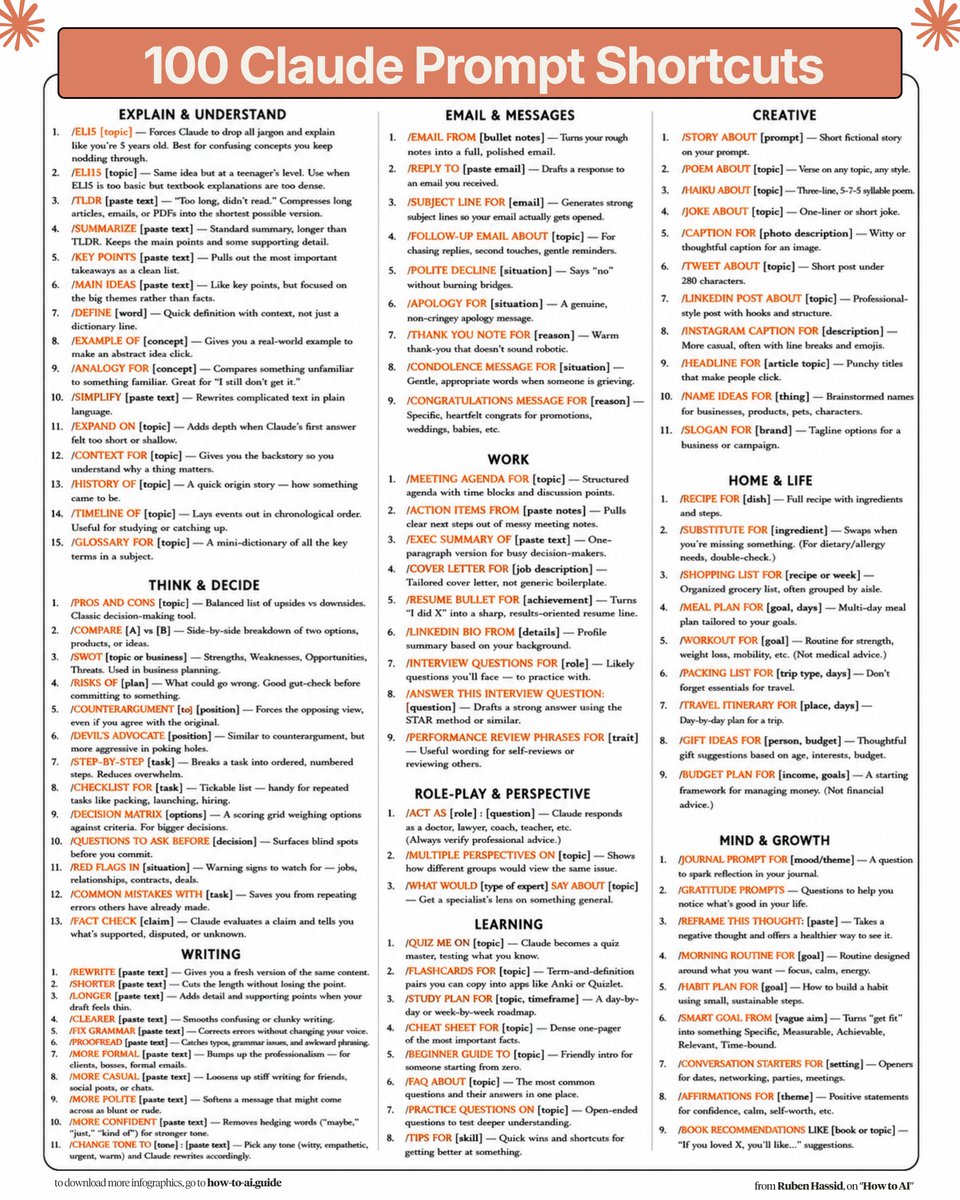
Stop typing long prompts to Claude.
Save this image for 100 prompt shortcut hacks:
1 - Download this infographic. Send it to your team.
2 - Add these at the very start of your prompt.
3 - Pro tip: Use /TLDR for long articles. /ELI5 for confusing concepts. /STEP-BY-STEP for any task you're stuck on.
To (actually) learn how to prompt Claude properly.
Read my free guide here: https://t.co/Sw2tg2QkBK
To copy-paste all of these prompt shortcuts:
Step 1. Go to https://t.co/psB7XxB2Y4.
Step 2. Subscribe for free. Don't pay anything.
Step 3. Open my welcome email (most skip this).
Step 4. Hit the automatic reply button inside.
Step 5. Go to the Notion link.
Step 6. Open the "Claude cowork" folder.
Step 7. Locate "PROMPT SHORTCUTS" toggle list.
♻️ Repost this to save your team 10 hours a week.
7 Claude Prompts to Rank on LLMs (Not Just Google):
(Steal these to start showing up in AI search)
Most SEOs are still optimizing for Google.
Smart SEOs are optimizing for Claude, ChatGPT, and Perplexity too.
Here are 7 prompts I use weekly:
1. LLM Visibility Audit
"Act as a B2B buyer searching for [your service]. List the top 10 companies you'd recommend and why. Then explain what content made each one stand out."
2. Competitor Mention Analysis
"What companies come up most often when users ask about [your category]? Break down what type of content (blogs, listicles, case studies, reviews) makes them the default answer."
3. Authority Gap Finder
"I run [company name] in the [industry] space. Compare my online presence to [competitor 1] and [competitor 2]. Where am I missing in terms of content, backlinks, and brand mentions?"
4. "Best Of" List Targeting
"List the top 20 'best of' articles ranking for [your main keyword]. For each, tell me the publication, the criteria they use, and how a brand could pitch to be included."
5. Prompt-to-Content Mapping
"Generate 25 prompts a [your ICP] would type into ChatGPT when researching [your service]. Then suggest a content piece I should create for each prompt."
6. Schema & Structure Optimization
"Review this blog post: [paste URL or content]. Suggest schema markup, FAQ sections, and structural changes that would make it easier for LLMs to cite as a source."
7. Citation-Worthy Content Brief
"Build me a content brief for '[target keyword]' designed to be cited by LLMs. Include: data points to reference, expert quotes to gather, original frameworks to introduce, and structural formatting LLMs prefer."
---
Ranking on LLMs isn't magic.
It's the same SEO playbook with new inputs.
Authority. Content. Structure. Mentions.
Start running these prompts weekly and you'll see your brand pop up in AI answers within 90 days.
---
Which prompt are you stealing first?
Repost if you think more SEOs need to wake up to LLM optimization.
P.S. I break down AI + SEO strategies every Sunday in The Savvy SEO newsletter. Join 7,000+ readers:657
https://t.co/5W8RMmTwNx
Many people use ChatGPT for writing or research.
Top performers use ChatGPT as a thinking partner.
Here are 8 prompts for planning, decision making and strategic thinking:
[ 🔖 bookmark this post for later ]
1. Stress-Test My Thinking
This is the plan I’m working on: [insert your idea, plan, or strategy]. Act as a reasoning analyst. Evaluate my logic, assumptions, or potential flaws, but don’t make edits. I want to pressure-test my thinking, not to explore new ideas.
2. Shift the Perspective
Here’s the main idea I’m working with: [insert your idea]. Act as a perspective strategist. Explore new ways to present it, such as targeting a fresh audience, using a different emotional driver, or shifting the brand message.
3. Translate My Gut Feeling
Something about this doesn’t feel right, but I can’t explain it: [describe the situation, message, or tactic]. Act as a clarity finder. Help me figure out what feels off, what could be confusing, out of place, or sending mixed signals.
4. Organize My Messy Thoughts
Here’s a rough mix of my thoughts and notes: [insert notes, fragments, half-formed ideas]. Act as a structure builder. Take what I’ve shared and turn it into a clear outline, but keep my tone and don’t add anything new.
5. Help Me Face the Decision
Here’s the situation I’m dealing with: [insert project or context]. Act as a decision coach. Show me where I might be stalling, overthinking, or avoiding a clear choice, and reflect on what’s keeping me stuck.
6. Surface the Deeper Question
Here’s the situation I’m working through: [insert idea or challenge]. Act as a strategic advisor. Help me uncover the core question behind this. What bigger issue or choice should I really be focusing on?
7. Spot Execution Risks
Here’s the plan I’m about to put into action: [insert strategy or outline]. Act as an operations analyst. Review my plan and call out where it could fall apart, like missed timelines, lack of resources, coordination issues, or anything else that might delay execution.
8. Make Sense of My Instinct
Here’s the idea I’m leaning toward, and it feels right: [insert your idea or insight]. Act as a reasoning guide. Help me explore what’s behind my instinct, what signals, patterns, or logic might be driving this choice.
Make better decisions.
Use ChatGPT as your thinking partner.
📌 Get Advanced ChatGPT Guide (free): https://t.co/kOBWfKrBaX
👉 Follow me @AndrewBolis for more and 🔄 Repost this to help others use AI
My Monthly "Ecommerce SEO Workout" Routine:
(How I treat SEO like the gym and why it works)
I've been working out consistently for 10+ years.
I've been running SEO for my ecommerce businesses just as long.
And the more I do both, the more I realize they're the same game.
Building muscle and building rankings follow the exact same rules.
Show up consistently. Hit every muscle group.
Track your progress. Don't skip the hard stuff.
Most ecommerce brands treat SEO like a New Year's resolution.
Go hard for a month. Burn out. Disappear for 3 months. Start over.
That's like hitting the gym in January and quitting by February.
You wouldn't expect a six-pack from that. Don't expect page one rankings either.
Here's how I train my ecommerce SEO every single month:
1/ Keyword Research = Your Training Plan
↳ Nobody walks into the gym without knowing what muscle group they're hitting
↳ Same with SEO — research BOFU & MOFU keywords monthly
↳ Your plan determines your results before you even start
2/ Content Creation = Reps & Sets
↳ In the gym, reps build muscle. In SEO, content builds authority
↳ Publish 5+ quality pieces per month
↳ Hit different muscle groups — product pages, blogs, comparisons, guides
3/ Backlink Building = Progressive Overload
↳ To grow stronger, you add more weight over time
↳ To rank higher, you build more quality backlinks over time
↳ 10+ per month. DR 30+. Relevant to your niche.
4/ Technical SEO = Stretching & Recovery
↳ Skipping stretching leads to injuries. Skipping technical SEO leads to broken rankings
↳ Fix crawl errors, speed issues, mobile UX every month
↳ It's not exciting. But without it, everything else falls apart
5/ On-Page Optimization = Proper Form
↳ In the gym, bad form means wasted reps and potential injury
↳ In SEO, bad on-page means wasted content and lost rankings
↳ Optimize titles, headers, internal links, metadata — that's your form check
6/ GEO & AI Visibility = The New Muscle Group
↳ Like when functional fitness added mobility work to the routine
↳ GEO is the new muscle group most ecommerce brands aren't training yet
↳ Optimize for ChatGPT, get on "best of" lists, build AI-ready content
7/ Analytics = Tracking Your Progress
↳ Every serious lifter tracks their numbers. Sets, reps, weight, PRs
↳ Every serious SEO tracks theirs. Rankings, clicks, traffic, conversions
---
Here's what the gym taught me about SEO:
You don't get results from one great workout.
You get results from 100 average ones.
Skipping leg day catches up with you.
So does skipping technical SEO.
There's no hack. No shortcut. No supplement that replaces the work.
Just a routine you follow every single month without fail.
Consistency compounds. In the gym and in SEO.
What does your monthly SEO routine look like?
♻️ REPOST if you agree that SEO is a long game.
P.S. My company, TrioSEO, builds monthly SEO routines for ecommerce brands. Book a call to learn more:
https://t.co/uIexj9oU9h
UK Accountants Flag Rising AI Risks as Usage Surges Across the Profession - I have a press release that encloses more details about this with expert commentary. You can contact me via DM for more info. #PRRequest#Journorequest
When Washing Machines Walk and Cows Attack: The UK's Most Bizarre Insurance Claims Revealed - I have a press release with more details about this, and expert commentary. You can contact me via DM to run this feature. #PRRequest#Journorequest
Steal my Ecommerce SEO Cheat Sheet for 2026:
Most ecom brands are still running 2022 playbooks.
Here's what's actually working now:
1/ Technical Foundation
- Fast load times (under 2s)
- Clean URL structure per product/category
- Schema markup on every product page
- Fix crawl errors before adding content
2/ Keyword Research
- Target buying intent first (BOFU)
- Go after "[product] + best, buy, reviews, near me"
- Find long-tail gaps competitors ignore
- Refresh your list every quarter
3/ Product Page SEO
- Unique descriptions — no manufacturer copy
- Primary keyword in H1, URL, and meta title
- Add FAQs with schema to capture featured snippets
- Use real customer language in the copy
4/ Category Page SEO
- Treat category pages like landing pages
- 200-300 words of optimized intro copy above the fold
- Internal link to top products and related categories
- Build backlinks directly to these pages
5/ Content & Blog Strategy
- Write for your buyer, not just your keyword tool
- Target comparison and "best of" keywords at MOFU
- Build topic clusters around your core product lines
- One strong blog per week beats five weak ones
6/ Link Building
- Guest posts in your niche
- Get listed on industry round-ups and "best of" lists
- Partner with complementary brands for content swaps
- Digital PR around data, launches, or brand stories
7/ AI & LLM Visibility
- Optimize for ChatGPT and Perplexity, not just Google
- Structured, clear content wins in AI-generated answers
- Get mentioned on authoritative sites in your space
- Clean formatting matters more than it ever did
Ecommerce SEO in 2026 is not about gaming the algorithm.
It's about building a brand Google and AI actually want to recommend.
The brands winning right now started 12 months ago.
---
Is your ecom SEO built for 2026 or 2022?
Repost ♻️ if this gives your team something to work with.
P.S. My agency, TrioSEO, runs SEO for ecom brands ready to grow. Book a strategy call at https://t.co/KoNhcsQS1c.
How To Learn Claude ✳️
Everything you need to know about Claude.
━━━━━━━━━━━━━━━━━━━
1. Chat
🔺https://t.co/WE3nBA4QCT
The starting point. Ask anything, write anything, analyse anything: drafts, research, strategy, legal review, thinking out loud.
✅BEST FOR:
Everyone. If you use the internet, you should be using this.
━━━━━━━━━━━━━━━━━━━
2. Reasoning
🔺Extended Thinking
Claude works through a problem step by step before answering. Use it for complex decisions where a quick answer isn't good enough.
✅BEST FOR:
●Founders and analysts stress-testing a big decision, a deal, or a financial model.
━━━━━━━━━━━━━━━━━━━
3. Developer
🔺API
Access Claude directly to build products, automate workflows and run Claude inside your own tools.
✅BEST FOR:
Developers and technical teams building AI-powered products or internal tools.
━━━━━━━━━━━━━━━━━━━
4. Build
🔺Artifacts
Claude builds interactive files, dashboards, trackers and tools directly in the chat. Live outputs you can use, edit and download.
✅BEST FOR:
Anyone who needs a working deliverable, a budget calculator, a tracker, a planner, anything non-text based.
━━━━━━━━━━━━━━━━━━━
5. Automation
🔺Cowork
A desktop tool that reads your actual files and creates real documents, Excel, Word, PDF, directly into your folder.
✅BEST FOR:
Ops managers and executive assistants handling high volumes of documents daily.
━━━━━━━━━━━━━━━━━━━
6. Coding
🔺Claude Code
A command line tool for agentic coding. Claude reads your codebase, writes code, runs tests and ships changes autonomously.
✅BEST FOR:
Developers and technical founders who want to move faster without sacrificing quality.
━━━━━━━━━━━━━━━━━━━
7. Browser
🔺Claude in Chrome
A browsing agent that operates inside Chrome. Claude searches, reads pages and completes web tasks on your behalf.
✅BEST FOR:
Researchers and strategists who spend hours manually pulling information from the web.
━━━━━━━━━━━━━━━━━━━
8. Instructions
🔺Skills
Reusable instruction packs that auto-load for specific tasks. Claude knows your tone, rules and workflow without you having to explain them every session.
✅BEST FOR:
Marketing leads and brand managers who need Claude to write consistently in a specific voice.
━━━━━━━━━━━━━━━━━━━
9. Integrations
🔺Connectors
Link Slack, Google Drive, Notion and 50+ tools. Claude searches them mid-chat, no uploading, no screenshots.
✅BEST FOR:
Teams working across multiple platforms who want one place to find everything.
━━━━━━━━━━━━━━━━━━━
10. Context
🔺Projects
Save your files and instructions once. Every new chat inside that Project picks up exactly where you left off.
✅BEST FOR:
Anyone doing recurring work: content teams, legal, finance, client servicing.
━━━━━━━━━━━━━━━━━━━
❤️ Like
🔁 Retweet
🔖 Bookmark
Follow👤
@sakhil_ai
for more such posts


![ConnorGillivan's tweet photo. 7 Claude Prompts to Rank on LLMs (Not Just Google):
(Steal these to start showing up in AI search)
Most SEOs are still optimizing for Google.
Smart SEOs are optimizing for Claude, ChatGPT, and Perplexity too.
Here are 7 prompts I use weekly:
1. LLM Visibility Audit
"Act as a B2B buyer searching for [your service]. List the top 10 companies you'd recommend and why. Then explain what content made each one stand out."
2. Competitor Mention Analysis
"What companies come up most often when users ask about [your category]? Break down what type of content (blogs, listicles, case studies, reviews) makes them the default answer."
3. Authority Gap Finder
"I run [company name] in the [industry] space. Compare my online presence to [competitor 1] and [competitor 2]. Where am I missing in terms of content, backlinks, and brand mentions?"
4. "Best Of" List Targeting
"List the top 20 'best of' articles ranking for [your main keyword]. For each, tell me the publication, the criteria they use, and how a brand could pitch to be included."
5. Prompt-to-Content Mapping
"Generate 25 prompts a [your ICP] would type into ChatGPT when researching [your service]. Then suggest a content piece I should create for each prompt."
6. Schema & Structure Optimization
"Review this blog post: [paste URL or content]. Suggest schema markup, FAQ sections, and structural changes that would make it easier for LLMs to cite as a source."
7. Citation-Worthy Content Brief
"Build me a content brief for '[target keyword]' designed to be cited by LLMs. Include: data points to reference, expert quotes to gather, original frameworks to introduce, and structural formatting LLMs prefer."
---
Ranking on LLMs isn't magic.
It's the same SEO playbook with new inputs.
Authority. Content. Structure. Mentions.
Start running these prompts weekly and you'll see your brand pop up in AI answers within 90 days.
---
Which prompt are you stealing first?
Repost if you think more SEOs need to wake up to LLM optimization.
P.S. I break down AI + SEO strategies every Sunday in The Savvy SEO newsletter. Join 7,000+ readers:657
https://t.co/5W8RMmTwNx](https://pbs.twimg.com/media/HG_n0npXsAA0GEy.jpg)
![AndrewBolis's tweet photo. Many people use ChatGPT for writing or research.
Top performers use ChatGPT as a thinking partner.
Here are 8 prompts for planning, decision making and strategic thinking:
[ 🔖 bookmark this post for later ]
1. Stress-Test My Thinking
This is the plan I’m working on: [insert your idea, plan, or strategy]. Act as a reasoning analyst. Evaluate my logic, assumptions, or potential flaws, but don’t make edits. I want to pressure-test my thinking, not to explore new ideas.
2. Shift the Perspective
Here’s the main idea I’m working with: [insert your idea]. Act as a perspective strategist. Explore new ways to present it, such as targeting a fresh audience, using a different emotional driver, or shifting the brand message.
3. Translate My Gut Feeling
Something about this doesn’t feel right, but I can’t explain it: [describe the situation, message, or tactic]. Act as a clarity finder. Help me figure out what feels off, what could be confusing, out of place, or sending mixed signals.
4. Organize My Messy Thoughts
Here’s a rough mix of my thoughts and notes: [insert notes, fragments, half-formed ideas]. Act as a structure builder. Take what I’ve shared and turn it into a clear outline, but keep my tone and don’t add anything new.
5. Help Me Face the Decision
Here’s the situation I’m dealing with: [insert project or context]. Act as a decision coach. Show me where I might be stalling, overthinking, or avoiding a clear choice, and reflect on what’s keeping me stuck.
6. Surface the Deeper Question
Here’s the situation I’m working through: [insert idea or challenge]. Act as a strategic advisor. Help me uncover the core question behind this. What bigger issue or choice should I really be focusing on?
7. Spot Execution Risks
Here’s the plan I’m about to put into action: [insert strategy or outline]. Act as an operations analyst. Review my plan and call out where it could fall apart, like missed timelines, lack of resources, coordination issues, or anything else that might delay execution.
8. Make Sense of My Instinct
Here’s the idea I’m leaning toward, and it feels right: [insert your idea or insight]. Act as a reasoning guide. Help me explore what’s behind my instinct, what signals, patterns, or logic might be driving this choice.
Make better decisions.
Use ChatGPT as your thinking partner.
📌 Get Advanced ChatGPT Guide (free): https://t.co/kOBWfKrBaX
👉 Follow me @AndrewBolis for more and 🔄 Repost this to help others use AI](https://pbs.twimg.com/media/HGWDOf_a4AAxIb8.jpg)

![ConnorGillivan's tweet photo. Steal my Ecommerce SEO Cheat Sheet for 2026:
Most ecom brands are still running 2022 playbooks.
Here's what's actually working now:
1/ Technical Foundation
- Fast load times (under 2s)
- Clean URL structure per product/category
- Schema markup on every product page
- Fix crawl errors before adding content
2/ Keyword Research
- Target buying intent first (BOFU)
- Go after "[product] + best, buy, reviews, near me"
- Find long-tail gaps competitors ignore
- Refresh your list every quarter
3/ Product Page SEO
- Unique descriptions — no manufacturer copy
- Primary keyword in H1, URL, and meta title
- Add FAQs with schema to capture featured snippets
- Use real customer language in the copy
4/ Category Page SEO
- Treat category pages like landing pages
- 200-300 words of optimized intro copy above the fold
- Internal link to top products and related categories
- Build backlinks directly to these pages
5/ Content & Blog Strategy
- Write for your buyer, not just your keyword tool
- Target comparison and "best of" keywords at MOFU
- Build topic clusters around your core product lines
- One strong blog per week beats five weak ones
6/ Link Building
- Guest posts in your niche
- Get listed on industry round-ups and "best of" lists
- Partner with complementary brands for content swaps
- Digital PR around data, launches, or brand stories
7/ AI & LLM Visibility
- Optimize for ChatGPT and Perplexity, not just Google
- Structured, clear content wins in AI-generated answers
- Get mentioned on authoritative sites in your space
- Clean formatting matters more than it ever did
Ecommerce SEO in 2026 is not about gaming the algorithm.
It's about building a brand Google and AI actually want to recommend.
The brands winning right now started 12 months ago.
---
Is your ecom SEO built for 2026 or 2022?
Repost ♻️ if this gives your team something to work with.
P.S. My agency, TrioSEO, runs SEO for ecom brands ready to grow. Book a strategy call at https://t.co/KoNhcsQS1c.](https://pbs.twimg.com/media/HFYneG2XwAAe01w.jpg)


