Roughly a year of chip PPA progress in under 5 months.
That's one result OpenAI just shared on using its models in chip design:
• Jalapeño, its first custom inference chip: a model-redesigned multiplier with ~15% less cell area, one clock cycle instead of two
• With AMD: up to 14% PPA improvement on flagship GPU IP vs. heavily optimized baselines
I keep thinking about what this means for roadmaps. Here's my 2-minute explainer, no EE degree needed. 👇
Will future chips be designed mainly by AI?
Source: OpenAI, Nov 18, 2026. Views are based on public information only. Not investment advice.
#AI #Semiconductors #ChipDesign
一颗顶级 AI 芯片,业内觉得一年半到两年流片就算快,OpenAI 和博通这颗只用了 9 个月,帮手之一正是 AI 自己。设计、制造、封装,再回到 AI 芯片本身,AI 已经走进产业链四站,连成一个圈。但厂商口中的“50 倍”要打折看:今天的 AI 是超级助手,还不是总设计师。你觉得 AI 多久能独立设计芯片?评论区聊聊。本视频仅为知识科普,��构成任何投资或专业建议。
#AI芯片 #半导体 #芯片设计 #EDA #台积电 #英伟达 #先进封装 #科普
How does ChatGPT actually learn? 🌙
It doesn't memorize the internet. It plays one game, trillions of times: guess the next word.
A calm 2-minute line-art explainer, with English + Chinese subtitles. Perfect before bed.
#AI#ChatGPT#LLM#MachineLearning
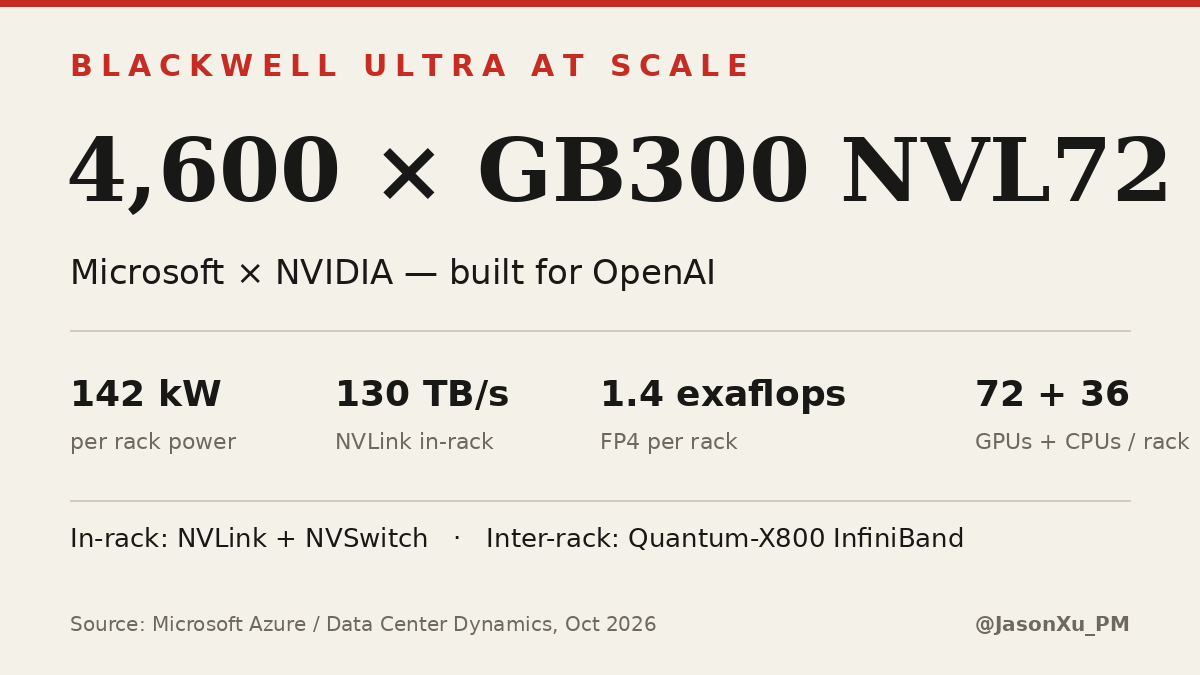
Microsoft just stood up 4,600 GB300 NVL72 systems for OpenAI — the first at-scale Blackwell Ultra production cluster.
The numbers that matter:
• 142 kW per rack
• 130 TB/s NVLink in-rack, Quantum-X800 InfiniBand between racks
• 1.4 exaflops FP4 per rack — 1.5x the AI compute of Blackwell
Nvidia's Ian Buck: the engine "needed for OpenAI to serve multitrillion-parameter models."
Two things stand out. First, Microsoft calls this the "first of many," targeting hundreds of thousands of Blackwell Ultra GPUs — the interconnect and power story has moved from roadmap to baseline engineering. At 142 kW/rack, liquid cooling and new power distribution models are no longer optional.
Second, Lambda stood up at least one GB300 NVL72 last month, so "first at scale" is doing some marketing work — but 4,600 systems in a single deployment is the real signal. Blackwell Ultra has moved from qualification to volume.
Founders and investors mapping AI infra — happy to compare notes. DMs open.
@AndrewLewixx It is just how the vendor works. But Nvidia also contribute to open ecosystem like OCP as well. There are already other GPU, TPU, or protocol being developed to counter exclusive monopoly
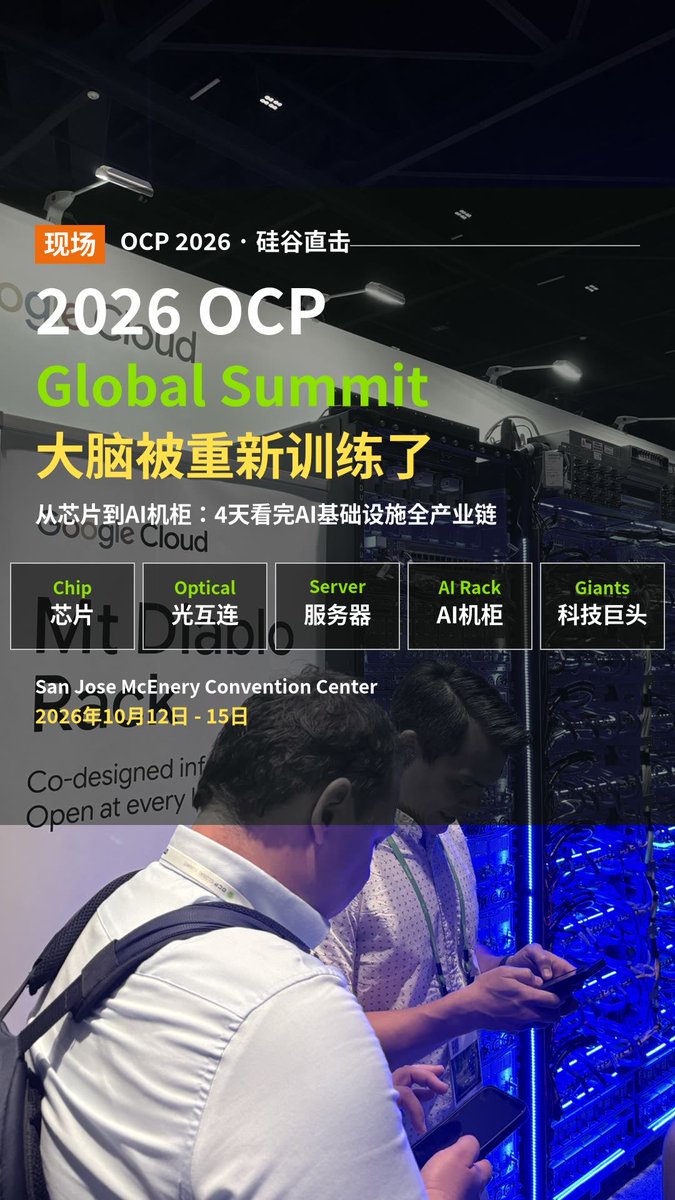
Wrapping up an incredible week at #OCP2026 in San Jose!
From silicon and interconnects to rack-scale systems and hyperscalers, it felt like feeding my brain a massive new training dataset.
My brain was the GPU. OCP was the training data.
Now heading back to Canada with updated model weights, fresh perspectives, and plenty of new ideas to put into practice.
Model updated. Ready for inference. 🚀
#OCPGlobalSummit #AIInfrastructure #Semiconductors
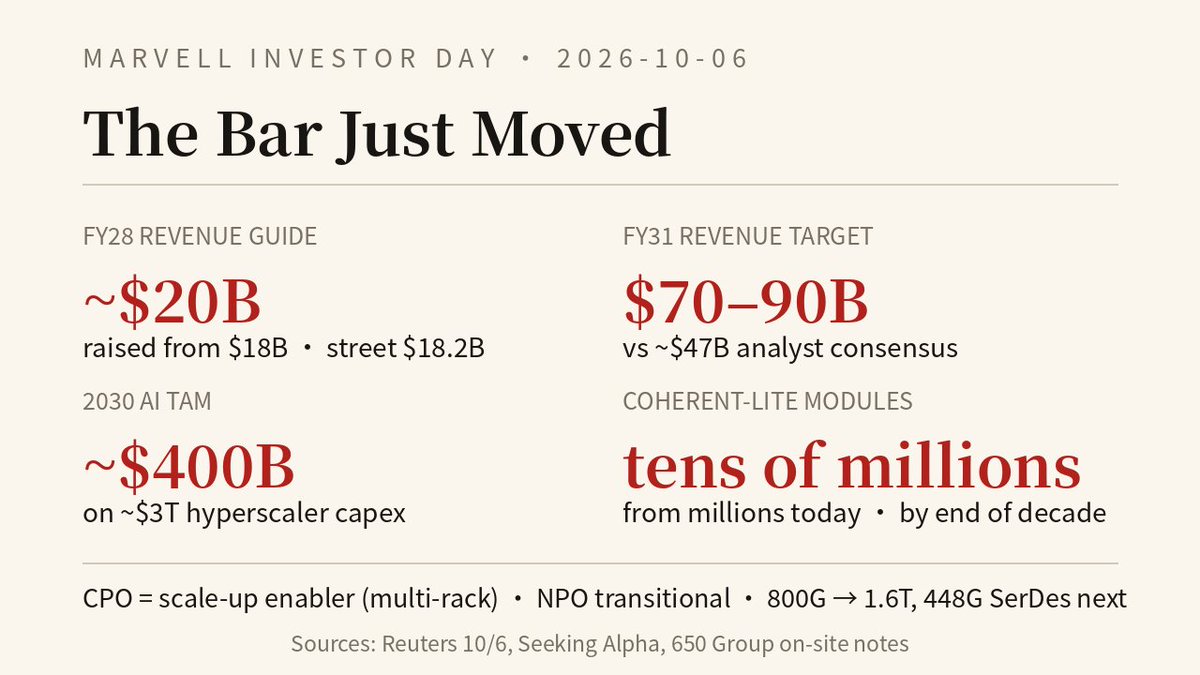
Marvell Investor Day reset the bar:
• FY28 revenue guide raised to ~$20B (from $18B; street had $18.2B)
• First-ever FY31 target: $70–90B vs ~$47B analyst consensus
• 2030 AI TAM framed at ~$400B, backed by ~$3T hyperscaler capex
• Coherent-lite modules: millions → tens of millions by end of decade
• CPO = the scale-up enabler (multi-rack); NPO transitional
The interconnect story keeps getting bigger.
I track interconnect, power, memory, and compute across the AI supply chain. Founders and investors mapping AI infra — happy to compare notes. DMs open.
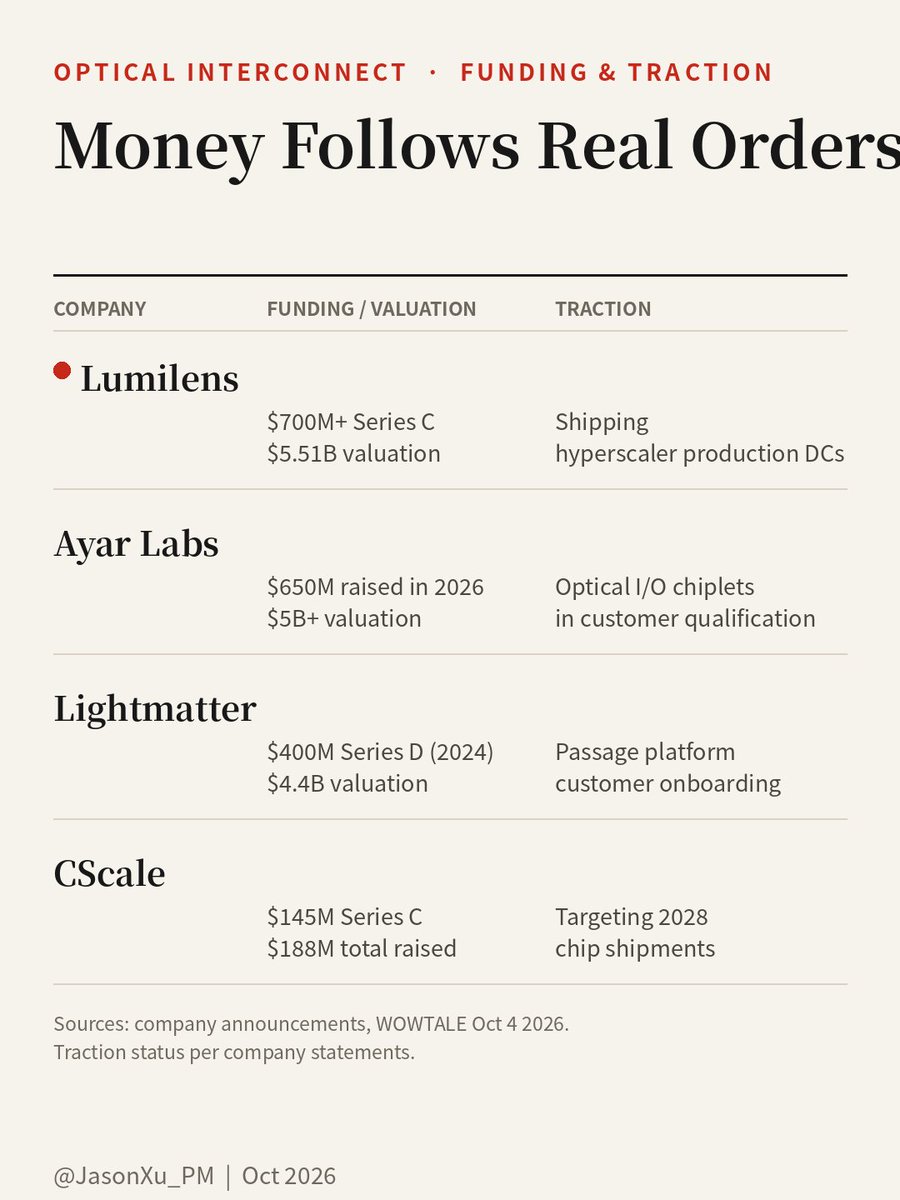
Money in optical interconnect is flowing to one thing: real orders.
Four players, four stages of proof:
🔴 Lumilens — $700M+ Series C at $5.51B; already shipping into a hyperscaler's production AI data centers
🔴 Ayar Labs — $650M raised in 2026 at $5B+; optical I/O chiplets in customer qualification
🔴 Lightmatter — $400M Series D (2024) at $4.4B; Passage platform in customer onboarding
🔴 CScale — $145M Series C ($188M total); targeting chip shipments in 2028
The pattern: the further along the traction curve, the bigger the check. Lumilens went from founding to production in two years — in optics, that timeline is unheard of.
McKinsey's math explains the urgency: 800G transceiver supply could fall 40–60% short of demand through 2027. A single 400K-GPU data center needs 2.4M+ transceivers.
I follow the interconnect, power, memory, and compute supply chains closely. Founders and investors mapping AI infra — happy to compare notes. DMs open.
#opticalinterconnect #CPO #AIinfrastructure
Micron is challenging Samsung and SK hynix — with custom memory for Nvidia.
On its Sept 30 earnings call, Micron confirmed it's co-developing custom HBM4E with Nvidia. The battleground isn't the DRAM stack — it's the base die, the logic layer underneath.
HBM4 doubles the interface to 2048-bit I/O (vs 1024 on HBM3E). Legacy DRAM processes can't hold the power and thermals, so the base die has to move to advanced logic. Three routes:
🔴 Samsung: in-house logic base die
🔴 SK hynix: logic base die with TSMC
🔴 Micron: custom HBM4E co-developed with Nvidia, TSMC as foundry
The advantage: memory tailored to the AI chip. Customization is sinking from the GPU into the memory layer — interconnect is next.
I follow the memory/compute supply chain closely. Founders and investors mapping AI infra — happy to compare notes. DMs open.
#HBM4 #Micron #Nvidia #semiconductors
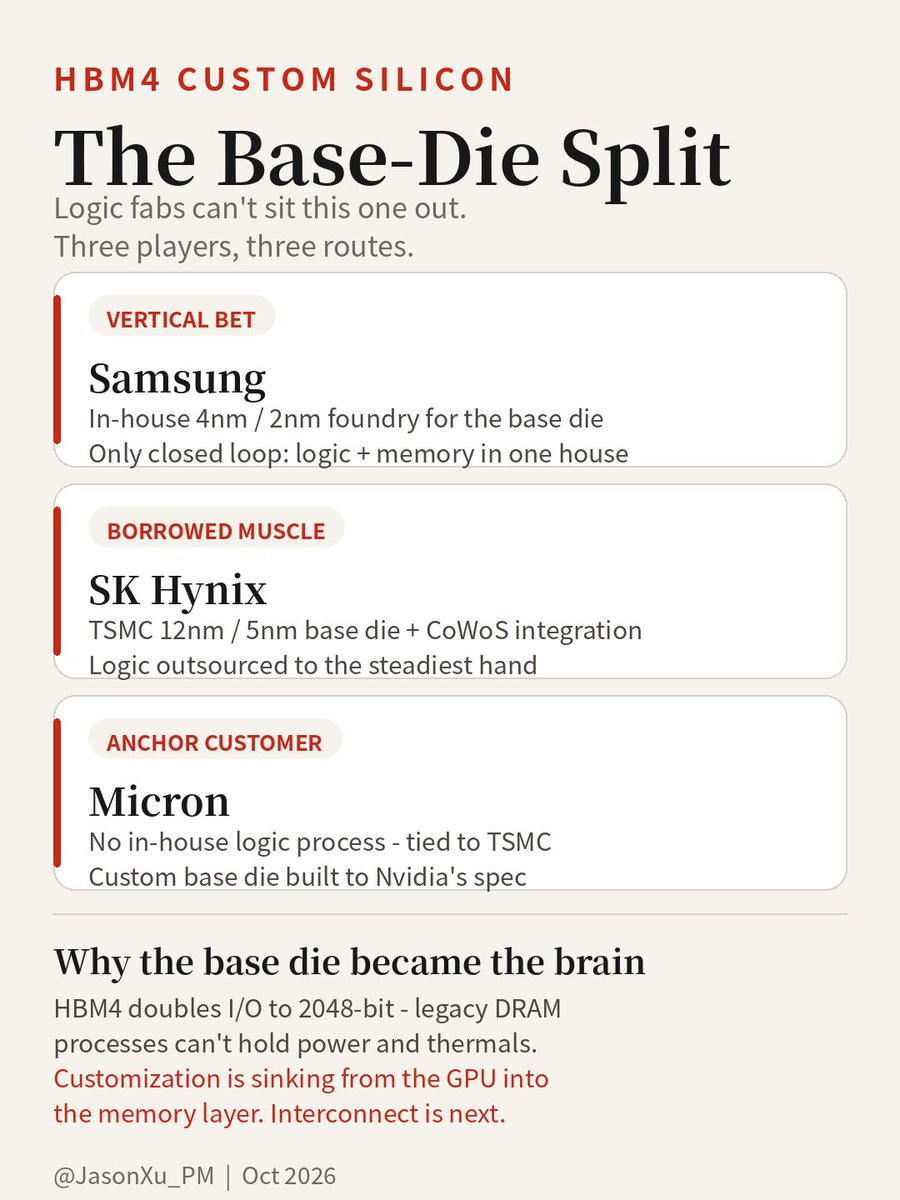
HBM4's real battle isn't capacity. It's the base die.
Micron confirmed on its Sept 30 earnings call that it's co-developing custom HBM with Nvidia — from the base-die stage, built to Nvidia's spec.
HBM4 doubles I/O width to 2048-bit. Legacy DRAM processes can't contain the power and thermals, so the base die has to move to advanced logic nodes. Three players, three routes:
🔴 Samsung: in-house 4nm/2nm foundry — the only closed loop, logic + memory under one roof
🔴 SK Hynix: TSMC 12nm/5nm base die + CoWoS — outsourcing logic to the steadiest hand
🔴 Micron: no in-house logic, tied to TSMC — betting on the anchor customer
The pattern to watch: customization is sinking from the GPU into the memory layer. Interconnect is next — optical DSPs, CPO engines, all in line.
I follow the memory/compute supply chain closely. Founders and investors mapping AI infra — happy to compare notes. DMs open.
#HBM4 #semiconductors #AIinfrastructure #Nvidia
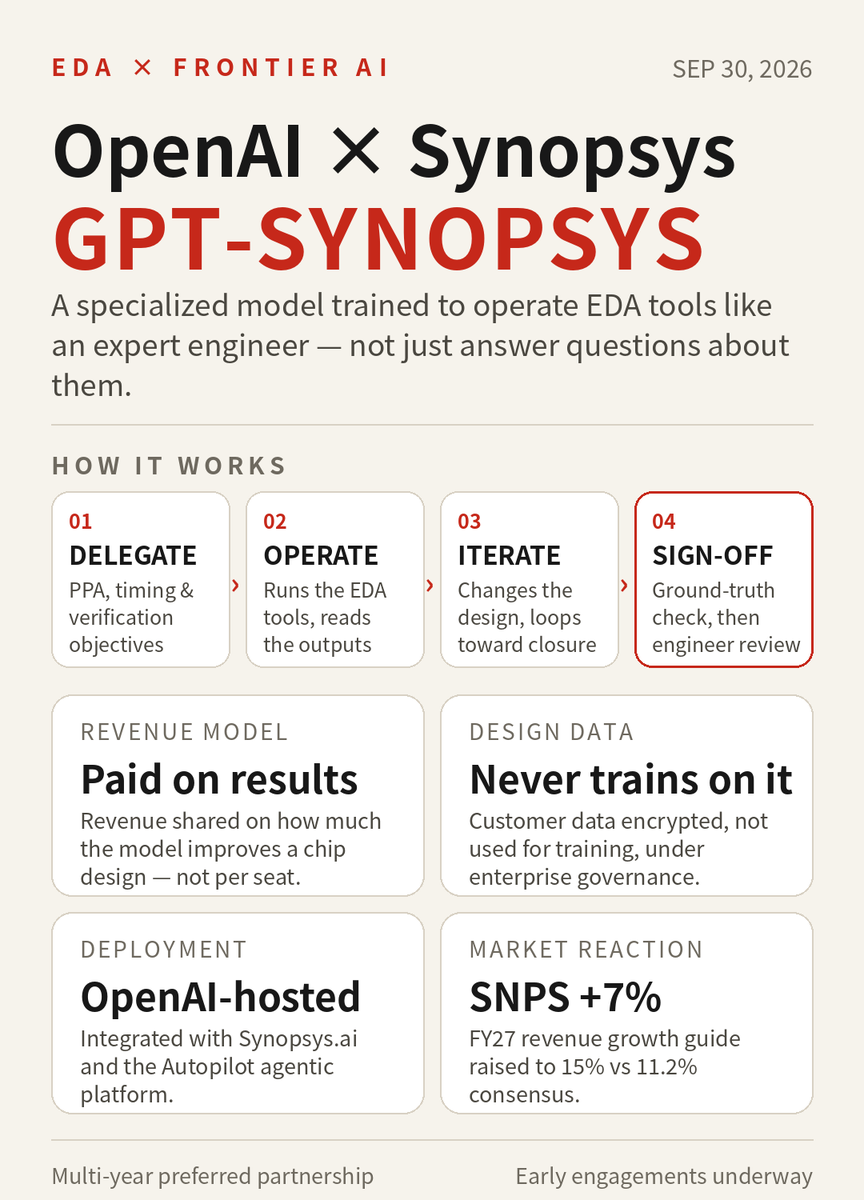
OpenAI × Synopsys: GPT-Synopsys
Announced today — a multi-year partnership to build a specialized model trained to operate Synopsys EDA tools the way an expert engineer would.
The shift: today's agentic AI connects a general-purpose model to EDA tools. GPT-Synopsys trains the frontier model on the tools themselves — running them, interpreting outputs, and iterating on PPA, timing and verification closure, with results delivered for engineer review. Traditional sign-off stays the ground truth; the model's work is still checked against physics.
The commercial structure is the interesting part. OpenAI pays Synopsys a training subscription fee, and once customers use the product, the two share revenue based on how much the model improves a chip design. Payment tied to measured design improvement, not seats.
It runs on OpenAI-hosted infrastructure, integrates with https://t.co/QiPc4QuBjU and Autopilot, and customer design data is never used for training. Early engagements with leading chip customers are already underway.
Brockman's pitch: shave weeks to months off the design cycle. Synopsys also raised its FY27 revenue growth outlook to 15%, above the 11.2% consensus — shares rose as much as 7% on the day.
AI designing the chips that run AI is not new. What's new is the EDA layer becoming a revenue-sharing partner in that loop.
$SNPS #Semiconductors #EDA #ChipDesign
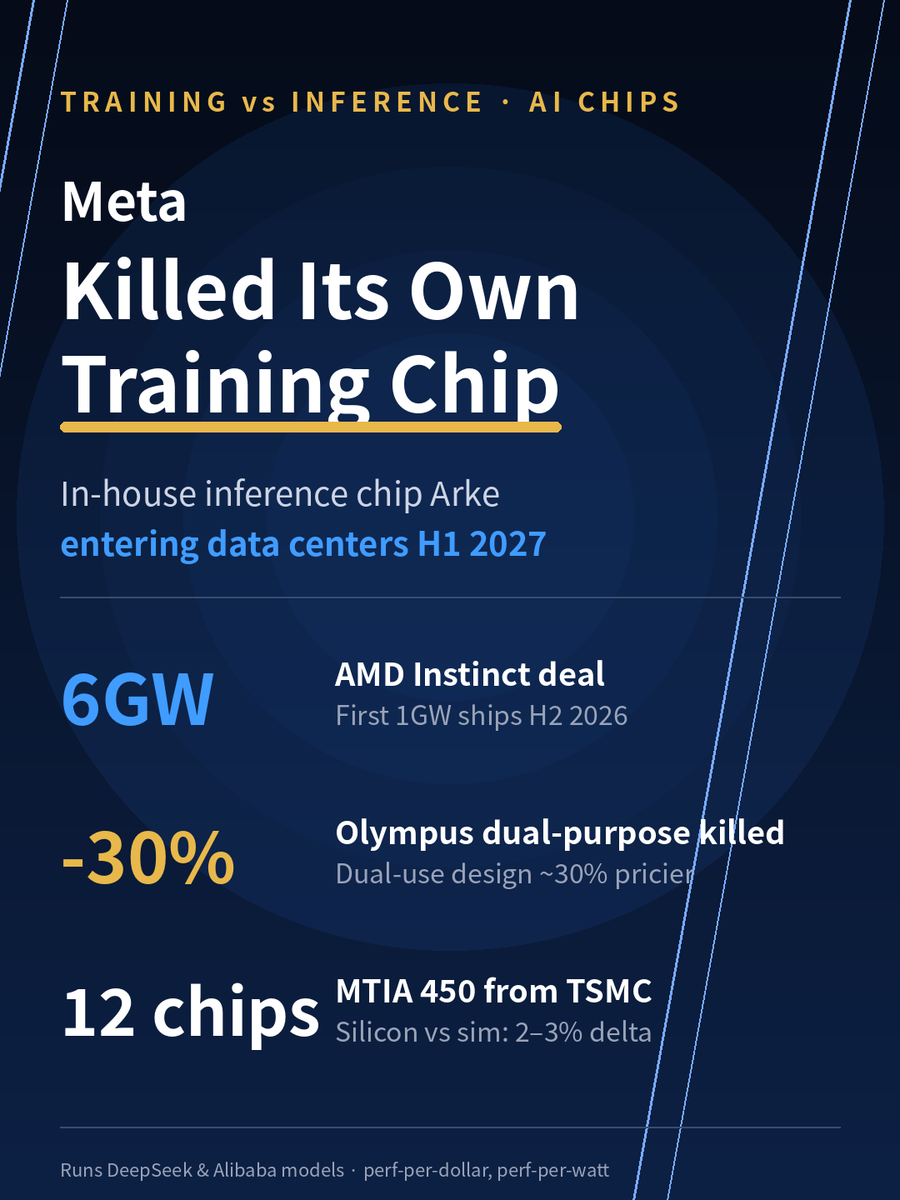
Meta killed its own training chip — and told us exactly where the AI silicon war goes next.
The third-gen MTIA, codenamed Arke, is inference-only. It lands in Meta data centers in H1 2027, tuned for perf-per-dollar and perf-per-watt on generative-AI inference.
The dual-purpose Olympus (training + inference, slated for 2028/29) is dead. Dual-use silicon runs ~30% more expensive — a tax Meta won't pay at gigawatt scale.
12 Arke chips arrived from TSMC on Sep 1. Early silicon matched pre-tapeout simulation within 2–3%, and already runs DeepSeek and Alibaba models.
Training gets outsourced: Meta signed up to 6GW of AMD Instinct, with the first 1GW shipping this H2.
Build your own for inference. Buy for optionality. That's the new hyperscaler playbook.
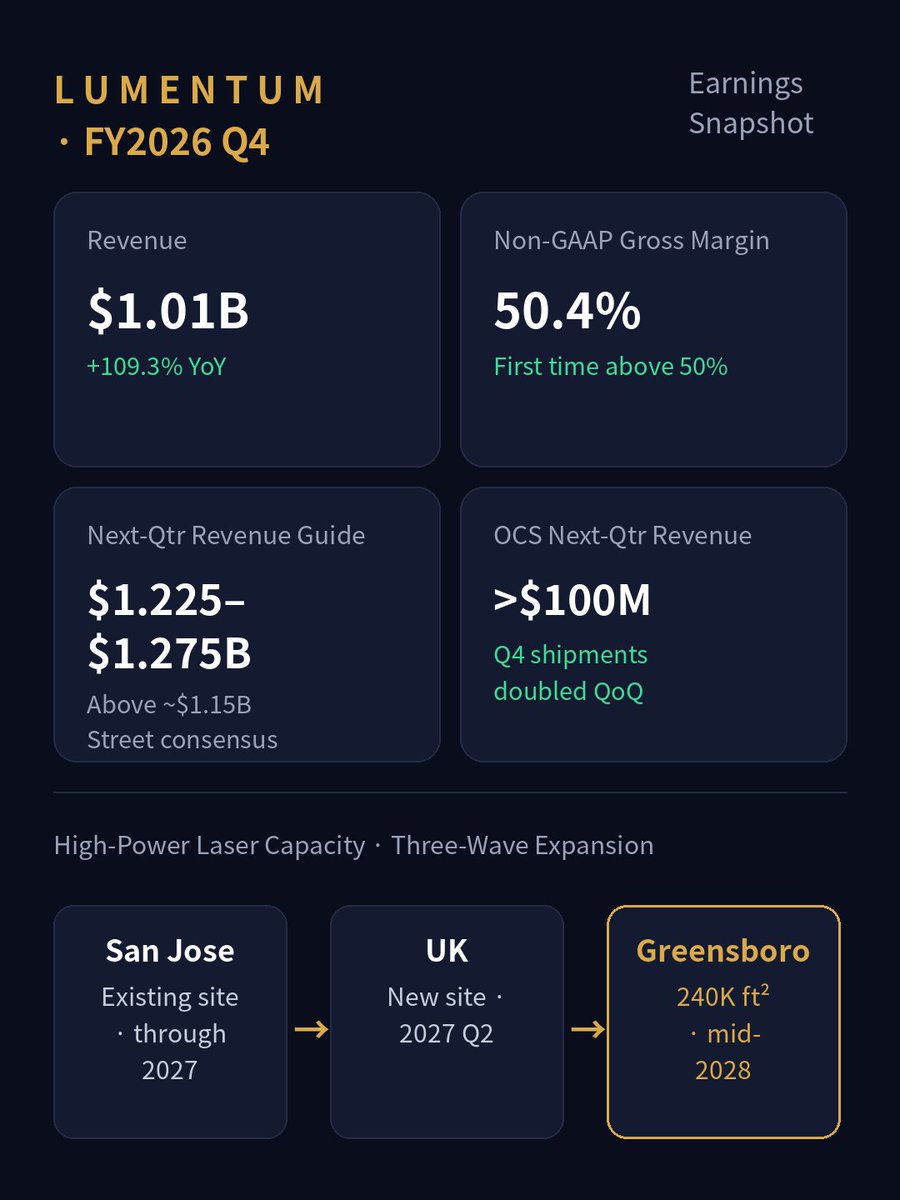
Lumentum FY2026 Q4: revenue +109.3% YoY (per Zacks, Sep 21), gross margin at an all-time high. Demand is shifting from demos to purchase orders: OCS shipments doubled QoQ, with next-quarter revenue expected to top $100M for the first time. 1.6T has started shipping and ramps in 2027 as hyperscalers upgrade custom AI clusters from 800G. On the supply side, ultra-high-power laser capacity for CPO/NPO expands in three waves — San Jose, the UK, and the new Greensboro InP fab coming online in 2027, 2027 Q2, and mid-2028, all incremental capacity rather than repurposed lines.
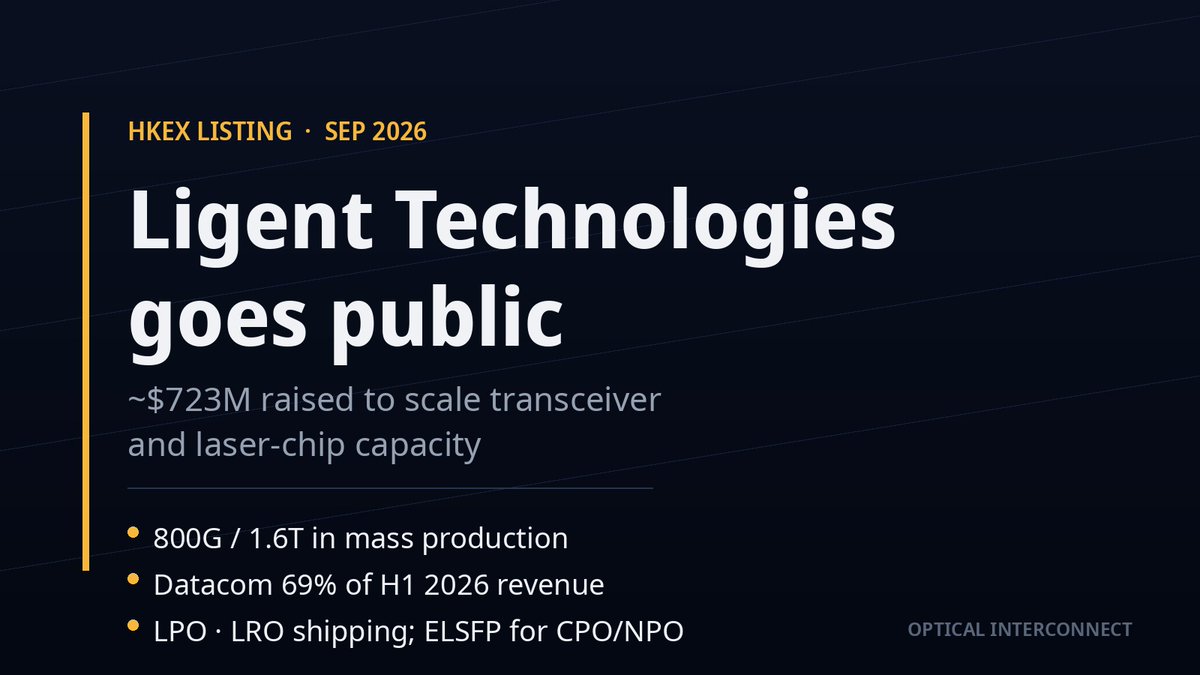
Ligent Technologies went public on HKEX this week — ~$723M raised to scale optical transceiver and chip capacity.
A few numbers that stood out:
• Datacom now 69% of revenue (H1 2026), vs a telecom-led mix in 2023
• 800G / 1.6T in mass production; 3.2T, 6.4T NPO, 12.8T XPO in R&D
• LPO/LRO already shipping; ELSFP light sources for CPO/NPO in early commercialization
• Vertically integrated lasers: 100G EML done, 200G EML and 400G InP in development
Another sign that AI interconnect demand is pulling the whole supply chain public — and into capacity expansion.
https://t.co/iW47IJGErk