This works really well btw, at the end of your query ask your LLM to "structure your response as HTML", then view the generated file in your browser. I've also had some success asking the LLM to present its output as slideshows, etc.
More generally, imo audio is the human-preferred input to AIs but vision (images/animations/video) is the preferred output from them. Around a ~third of our brains are a massively parallel processor dedicated to vision, it is the 10-lane superhighway of information into brain. As AI improves, I think we'll see a progression that takes advantage:
1) raw text (hard/effortful to read)
2) markdown (bold, italic, headings, tables, a bit easier on the eyes) <-- current default
3) HTML (still procedural with underlying code, but a lot more flexibility on the graphics, layout, even interactivity) <-- early but forming new good default
...4,5,6,...
n) interactive neural videos/simulations
Imo the extrapolation (though the technology doesn't exist just yet) ends in some kind of interactive videos generated directly by a diffusion neural net. Many open questions as to how exact/procedural "Software 1.0" artifacts (e.g. interactive simulations) may be woven together with neural artifacts (diffusion grids), but generally something in the direction of the recently viral https://t.co/z21CP5iQfu
There are also improvements necessary and pending at the input. Audio nor text nor video alone are not enough, e.g. I feel a need to point/gesture to things on the screen, similar to all the things you would do with a person physically next to you and your computer screen.
TLDR The input/output mind meld between humans and AIs is ongoing and there is a lot of work to do and significant progress to be made, way before jumping all the way into neuralink-esque BCIs and all that. For what's worth exploring at the current stage, hot tip try ask for HTML.
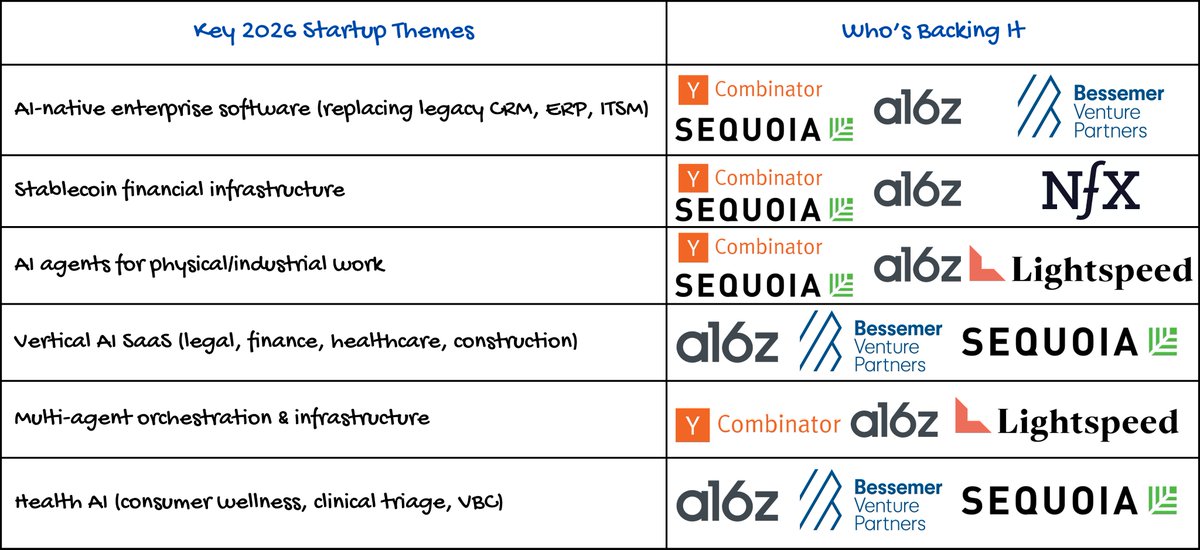
In 2026, for the first time in recent memory, every major VC firm is saying the same thing.
YC wants AI agents that replace service workers. So does a16z.
Sequoia wants stablecoins as financial infrastructure. So does YC.
Everyone wants AI applied to the physical world - factories, defense, construction, energy.
The consensus is so complete that you could swap the logos on their published theses and most readers wouldn’t notice.
That's why the most valuable software companies of the next decade will not look like software companies.
They’ll look like law firms, factories, hedge funds, and government agencies - run by teams of ten.
"If you really want to make money, found an agentic AI company.
I mean, build an agent to do something. This is the agentic period in AI. Everyone's going to build agents. The agents are all going to compete."
~ Eric Schmidt, Ex Google CEO.
Mark Cuban just described the largest wealth transfer of the AI era.
Almost nobody understood what he said.
Cuban: “There are 33 million companies in this country. Aren’t going to have AI budgets. Aren’t going to have AI experts.”
Not tech startups.
The shoe store. The regional trucking outfit. The accounting firm with 12 employees.
The businesses that actually run the physical economy.
They know AI is coming. They have no idea what to do with it.
Cuban: “You’ve got the head of Microsoft saying software is dead because everything’s going to be customized to your unique utilization.”
Software is dead.
The SaaS era ran on one rule. Build a generic product. Force millions of companies to bend their workflows around it. Charge rent forever.
AI ends the contract.
The business stops bending to the software. The intelligence bends to the business.
But customized by whom.
The third-generation manufacturer cannot tell Claude from Gemini. The county hospital is staring at a reactor asking where the light switch is.
Cuban: “Who’s going to do it for them?”
That question is worth more than the frontier models themselves.
Hundreds of billions are being burned to build the foundation. The smartest engineers alive are locked in a bloodbath over who owns the base layer.
Let them fight.
Let them burn the capital. Let them drive the cost of raw intelligence toward zero.
Because the wealth does not collect where the brain is built.
It collects where the brain meets the business.
Every ambitious kid in college right now thinks survival means a seat at OpenAI or Anthropic.
Cuban is staring at the other 99 percent of the economy.
Learn the models. Then learn the messy, unglamorous reality of how a 50-person company actually operates.
Walk through the door. Understand their problems. Wire the intelligence directly into their revenue.
That is not a job title. That is an entire economic class being born.
You do not need to build the brain. You need to build the nervous system.
The biggest winners of the electricity era were not the engineers who built the generators. They were the ones who walked into dark factories and showed the owners where to plug in.
33 million companies are standing in the dark right now.
Silicon Valley is racing to build the god. The fortunes will belong to whoever teaches him a trade.
ANTHROPIC ENGINEER DROPPED A 14-MINUTE GUIDE.
This is the fastest way to understand how real agents are built.
Bookmark this for the weekend.
14 minutes.
Real architecture.
No fluff.
What actually works.
Agents → Structure → Tools → Execution → Systems → Money
VERCEL GOT HACKED
ShinyHunters - the group behind the Ticketmaster breach - is selling Vercel's internal database for $2M on BreachForums
here's why every developer should care:
- they have NPM tokens and GitHub tokens
- Vercel owns Next.js - 6 million weekly downloads
- one malicious push = global supply chain attack
- Vercel confirmed the breach today, April 19
- they literally DMed the hackers on Telegram asking them to stop
rotate your env variables RIGHT NOW
the most dangerous thing about claude:
it's the world's most convincing YES-MAN
so i built a "board of advisors" skill that makes 5 agents attack your idea from 5 different angles:
• one assumes your idea will fail and tries to prove it
• one strips away your assumptions and rebuilds the problem from scratch
• one hunts for the bigger opportunity you're too close to see
• one has zero context about you and responds like a complete stranger
• one only cares about what you actually do next
then...
1. all 5 responses get anonymized and peer-reviewed blind
2. a chairman agent reads everything and synthesizes the final verdict
after a few minutes, you get one recommendation you can *actually* trust.
free skill + full breakdown:
Introducing Claude Design by Anthropic Labs: make prototypes, slides, and one-pagers by talking to Claude.
Powered by Claude Opus 4.7, our most capable vision model. Available in research preview on the Pro, Max, Team, and Enterprise plans, rolling out throughout the day.
Anthropic just dropped their March Economic Index.
Experienced AI users have a 10% higher success rate than new users, even on the same tasks.
Translation: the people using AI now are building a compound advantage that's hard to catch up to later. 👀
https://t.co/9FjOcTzpO5
Researchers trained a humanoid robot to play tennis using only 5 hours of motion capture data
The robot can now sustain multi-shot rallies with human players, hitting balls traveling >15 m/s with a ~90% success rate
AlphaGo for every sport is coming
I accidentally discovered how to compress a semester of learning into 48 hours.
A grad student at MIT showed me his NotebookLM setup. I thought he was just organized. Then I watched him pass a qualifying exam on a subject he'd never studied before.
Here's exactly what he did:
First: he didn't upload a textbook.
He uploaded 6 textbooks, 15 research papers, and every lecture transcript he could find on the subject.
Then he asked NotebookLM one question:
"What are the 5 core mental models that every expert in this field shares?"
Not "summarize this." Not "explain this topic."
Mental models. The stuff that takes professors years to develop.
But the next part is what broke my brain.
He followed up with:
"Now show me the 3 places where experts in this field fundamentally disagree, and what each side's strongest argument is."
In 20 minutes he had a map of the entire intellectual landscape of the field:
the debates, the consensus, the open questions.
Most students spend a full semester just figuring out what those debates even are.
Then he did something I've never seen before.
He asked:
"Generate 10 questions that would expose whether someone deeply understands this subject versus someone who just memorized facts."
He spent the next 6 hours answering those questions using the source material. Every wrong answer triggered a follow-up:
"Explain why this is wrong and what I'm missing."
By hour 48, he could hold a conversation with his thesis advisor without getting destroyed.
The tool didn't change. The questions did.
Most people treat NotebookLM like a fancy highlighter.
These students are using it like a private tutor who has read everything ever written on the subject.
The difference between a semester and 48 hours isn't the amount of content.
It's knowing which questions to ask.