When did you last see an African problem solver at work?
We are introducing Groundwork, a mini-film series from Zeitgeist Now @thezeitgeistnow about the Africans working in science, technology, and industry who are solving hard problems on the continent and across the diaspora.
In each episode, we go inside the labs, factories, and corridors where the work happens and stay with the scientists, engineers, and founders doing it.
The first episode drops on 26 November. Join the Zeitgeist Now newsletter to get it in your inbox the day it lands, and follow us on YouTube to watch it there. Links in the comments.
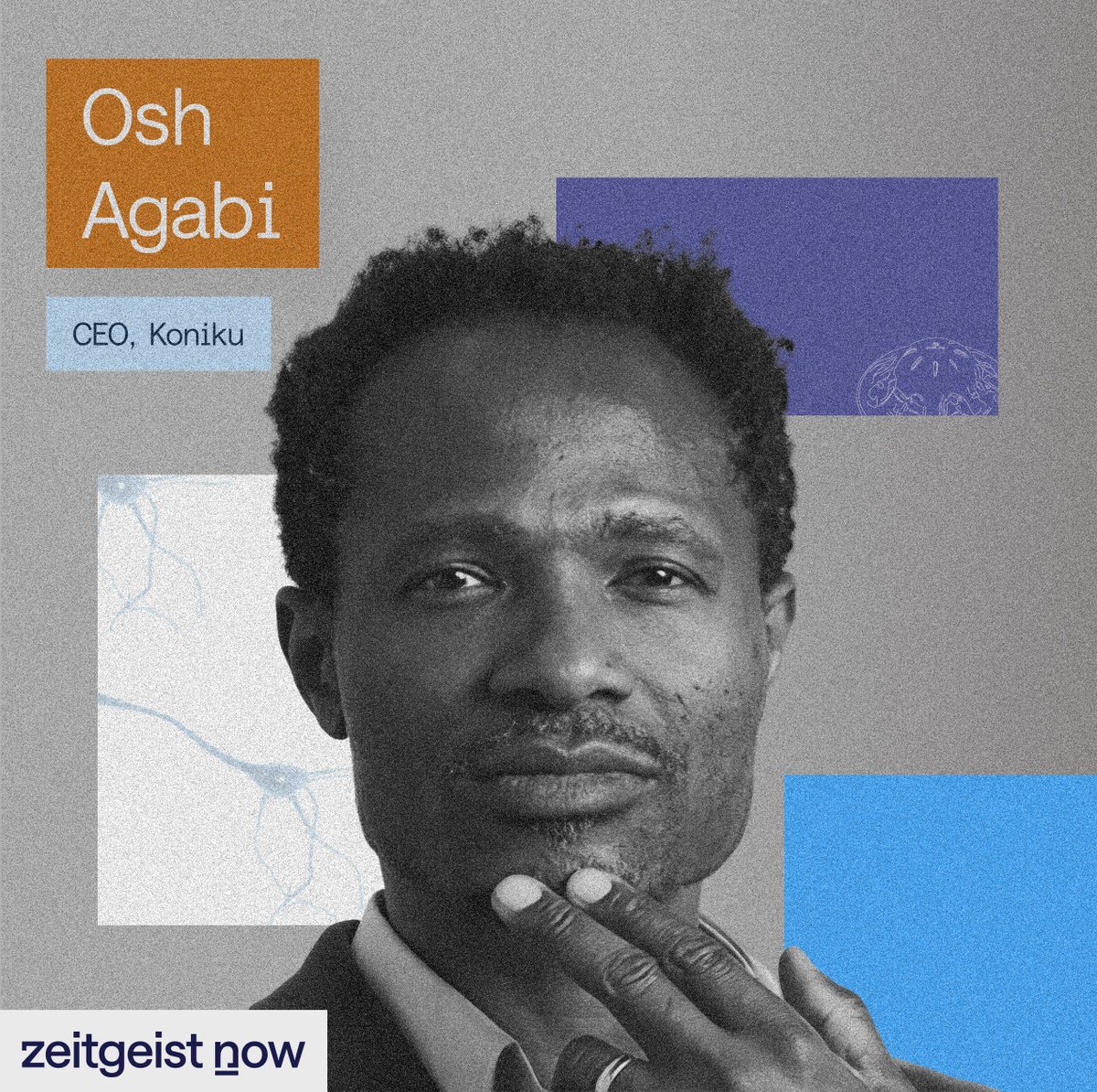
Meet Osh Agabi @Onikuo, a Nigerian-American computational neuroscientist, bioengineer, and entrepreneur, the founder and CEO of Koniku @_koniku, a pioneer of wetware technology in Silicon Valley, and one of the first people in the world to build computer chips that run on living neurons.
Undoubtedly, he is one of the boldest scientific minds to come out of Africa, doing pioneering work in synthetic biology and biocomputing. He began with a bachelor’s at the University of Lagos, then programmed robots at Neuronics in Zurich under the guidance of neuroscientist and roboticist Hansruedi Früh. He went on to become the first researcher to apply Liquid State Machines (LSM) directly to live biological neurons, and to do research at ETH Zurich and Imperial College London. His journey culminated in Koniku, the company he now runs from California.
Currently, he leads Koniku, tackling one of the hardest problems in sensory technology, which is detecting and digitising smell, by building a new class of processors called BPUs (Biological Processing Units) that run on living neurons.
For the second episode of Zeitgeist Now: The Interview, I sat down with Osh for an insightful conversation on topics from the importance of imagination in technology, to Africa’s need to create foundational technology, to what it takes to build a computer out of living neurons and why the next great leap in computing may come from biology. The episode drops on November 12th.
Link in the comments. Pre-save the premiere.
Some thoughts tonight, and I will probably have more tomorrow. First of all, even after watching hundreds of simulations of how the ship would fly home, I was still shocked when I saw it falling through the sky. And yes, all of us in the control room were also terrified that it looked like we were a little too far away from the tower (there was a moment when I thought we were about to crater the pad).
Raptor team killed it today. Restarting a full flow staged combustion dual cryogenic rocket engine after 20 hrs in orbit is an amazing achievement. When I turned around after the catch a solid half of the Raptor team had tears in their eyes, and for good reason. They earned this day.
So many people working so hard to bring a future we believe in to life, where we explore the stars and feel our dreams are limitless. Humanity as a spacefaring society starts today.
And to all my fellow Starbasers, just a simple thank you for everything. It is my great honor to work with you every day.
If you're looking to build a career in HSE, Operations, or the Oil & Gas industry, PAUSE. This is for you.
Operational safety is critical in high-risk industries such as oil & gas, power generation, manufacturing, petrochemicals, and other industrial environments.
Understanding how hazards are identified, controlled, and mitigated is essential for protecting people, assets, and the environment.
I have a TotalEnergies Operational Safety Training Guide covering key topics such as:
✅ Downgraded situation management
✅ Isolation, inhibition & LOTO procedures
✅ SIMOPS (Simultaneous Operations) safety requirements
✅ Hazardous area classification—Zones 0, 1 & 2
✅ Emergency Shutdown (ESD) & Fire and Gas Systems
✅ Safety barriers & risk-control measures
Want a copy?
RETWEET and comment “I'm interested” and I'll share access with you.
Back in 2003, a German film crew filming in the Gobi Desert captured an incredibly moving moment: after a tough two-day birth, a mother camel rejected her newborn. A nomadic family then performed the ancient Hoos singing ritual passed down for generations. Once the song ended, the camel shed tears and finally accepted her baby. This powerful scene became one of the most memorable parts of the Oscar-nominated documentary The Story of the Weeping Camel.
Nigerian Communications Satellite Limited (NIGCOMSAT) has selected the U.S. satellite communications company Hughes Network Systems JUPITER ground system to support the NIGCOMSAT-2A and 2B satellites Nigeria will be launching in 2028 and 2029. Hughes will provide technical and engineering support for a facility in Nigeria that will assemble satellite terminals.
With this, Nigeria will build local expertise in satellite hadware and create a base for servicing terminals across Africa.
When I started my hardware (as in metal) journey 3 years ago I thought that CAD/FEA was 80% of the work and then some machine just 'makes it'. Today I know that CAD/FEA is like 20% of the work and 80% is getting the part made to adhere to your design after dealing with all the stuff physics throws at you. The factory is really the product.
Dear @X fam. I got an offer to study at the @aebsonline (African Energy Business School) to study Operations and Project Management in Oil and Gas!🎉
That young engineer is me.
A week ago, I wrote about why Nigeria needs more young voices in the Oil & Gas industry.
Today, I’m taking a step toward becoming one of them.
Mostly true. What matters is securing the long-term future of consciousness, both on Earth and other heavenly bodies.
We cannot just focus on Earth, because there are irreducible external (eg massive meteor) and internal (eg global nuclear war) cataclysmic risks.
The Moon is faster to make self-growing, but is more susceptible to problems on Earth. Mars will take longer to make self-growing, because it is so hard to reach, but is more secure from Earth disasters for that same reason.
Both the Moon and Mars should have self-growing civilizations. Making this happen is the prime directive of SpaceX.
This is probably the best look at the shockwaves I’ve seen from the latest Starship flight.
Captured from a GoPro I clamped onto a proper camera to record simultaneous video. (I’ll show you the photo the better camera took in the reply)
When someone teaches you something you didn't ask to learn, your brain reacts like it's in physical pain. UCLA scientists watched it happen on brain scans in 2003. The same wiring that fires when you stub your toe also fires when someone treats you like you need fixing.
Naomi Eisenberger and Matthew Lieberman ran the study and published it in Science. The brain region is the dorsal anterior cingulate cortex, which is just the fancy name for your main pain alarm. It doesn't care whether the threat is a hot stove or a friend telling you how to live.
A neuroscientist named David Rock built a framework around this in 2008. Five things make the brain feel safe in social moments: status, certainty, autonomy, relatedness, and fairness. Take away any of those and the alarm fires. Rock wrote that one of the easiest ways to dent someone's status is to give them advice they didn't ask for. Even hinting that they're doing something wrong is enough.
When people are told what to do, they often do the opposite, even when the advice was good. The psychologist Jack Brehm noticed this in 1966, and sixty years of follow-up have confirmed it. The brain is trying to keep your life feeling like your own.
Close friends cut each other off with unsolicited advice in about 70% of supportive conversations, often before the friend has even finished explaining the problem. That number comes from a 2016 study by Bo Feng and Eran Magen in the Journal of Social and Personal Relationships. The closer the friendship, the worse it gets. And the advice tends to make them more stressed, more depressed, and more lonely, not less.
Giving advice gives the giver a sense of power, even when nobody asked for it. Michael Schaerer and his co-authors, working across Harvard, Duke, INSEAD, USC, and Singapore Management, published this in 2018 after four experiments with about 700 people. People who chase power volunteer advice more often than others. Whether the student actually improves is a side effect, if it happens at all.
So when you feel the urge to teach somebody who never asked, that urge is mostly about you. You walk away feeling a little more powerful. They walk away feeling like they were just told they can't run their own life. Most uninvited teaching is one person's ego dressed up as kindness.