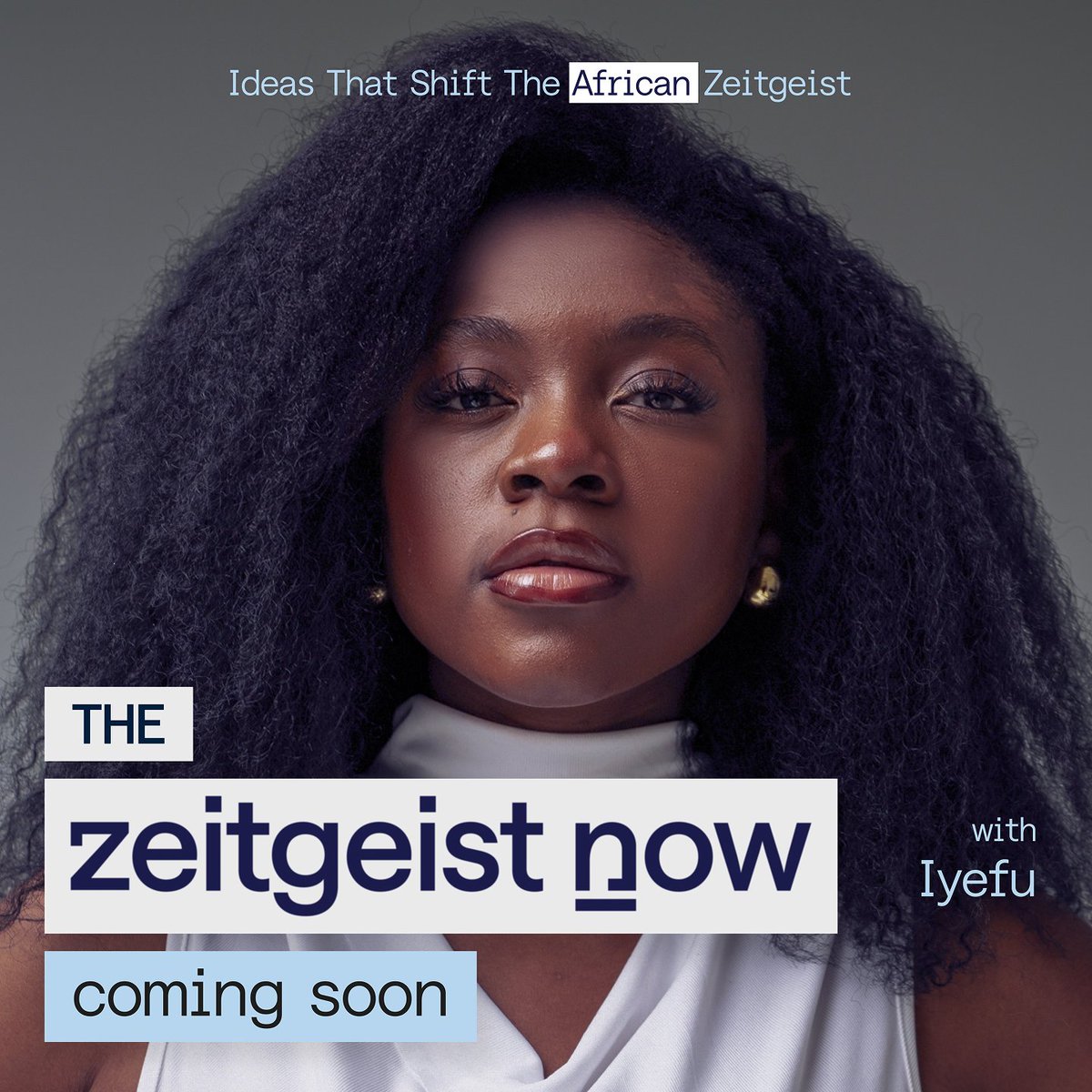
Hello everyone I'm Iyefu… a while back after keen observation I realised there is a deficit in problem solving & big ideas media in the African contemporary information landscape. Little room for conversation and spotlighting of the experts that shape the machinery of our society. From scientists, to researchers, policymakers, technologists, industrialists and educators who are solving some of the most difficult problems on the continent and in the diaspora.
And as a result, I assembled a team of young Africans and we're bootstrapping an independent, youth-powered media initiative to tackle this deficit. It's called Zeitgeist Now @thezeitgeistnow.
We have a lot coming soon, from rigorous interviews with the experts laying out fundamental problems and proposed solutions, documentaries highlighting African innovation and contributions, to analytical articles and op-eds with columnists.
The experts are the point. They are doing the work, and we are here to take them seriously.
We believe a culture that watches itself solve hard problems starts to expect more solved problems.
We are officially launching on the 1st of October, 2026.
The waitlist is open, link in the first reply ⬇️
Follow us: @thezeitgeistnow
Ideas move the world. Join the movement.
When did you last see an African problem solver at work?
We are introducing Groundwork, a mini-film series from Zeitgeist Now @thezeitgeistnow about the Africans working in science, technology, and industry who are solving hard problems on the continent and across the diaspora.
In each episode, we go inside the labs, factories, and corridors where the work happens and stay with the scientists, engineers, and founders doing it.
The first episode drops on 26 November. Join the Zeitgeist Now newsletter to get it in your inbox the day it lands, and follow us on YouTube to watch it there. Links in the comments.
That is, understanding the results exists at a much higher level of complexity because now someone needs to look at how everything is interacting in there to extract useful & reusable abstractions.
This is why I wouldn't call this superintelligent.
15 years later, from Lagos (uni) to Abuja (law school) to New York (school & teaching) , to moving to DC, London, Kenya & the UAE for work to now over a decade of advising on some of the most exciting deals that have been closed in the Nigerian tech ecosystem. A moving woman fr
@viyancefavour Thank you!
People might disagree about economic policies and their long-term effects or results, but any economic policy that requires a J-curve effect must preserve public trust and positive optics in a democratic nation.
This is fundamentally a linguistic confusion. Tech guys used human metaphors for computer operations, forgot they were metaphors, and then projected that back onto humans.
Africa holds extraordinary human genetic diversity, and Prof. Segun Fatumo and his colleagues argue that studying it at scale could improve the methods geneticists use everywhere, from sharper genetic mapping to better global risk prediction.
For Nigeria, that opportunity asks for more than supplying samples to international studies. If genetic predictions are to serve its own people, Nigerian researchers need to help shape the methods themselves. That takes scientists who can move between biology and mathematics, and genetic data linked to clinical outcomes.
Demilade Fate wrote about this for Science, but Next Door on @thezeitgeistnow.
Read the full article: https://t.co/yqyBWV70zv
scientists in biology: "we might have, possibly achieved a 0.07% faster digestion in a model organism after 3 years of wet lab work, but findings aren't final and further research is needed"
techbros in biology: "we SOLVED the code of LIFE with our Machine God, it's on an exponential trajectory dude, we might create a new form of life in under a month, bro our technical staff already solved every single human disease with AI, our benchmarks are telling us that we might also erase everyone from this planet man"
You read a philosophical argument concerning awareness and representation and you are asking about falsifiable prediction like this is a hypothesis about sensible phenomena?
A philosophical argument is not a hypothesis.
Africa holds extraordinary human genetic diversity, and Prof. Segun Fatumo and his colleagues argue that studying it at scale could improve the methods geneticists use everywhere, from sharper genetic mapping to better global risk prediction.
For Nigeria, that opportunity asks for more than supplying samples to international studies. If genetic predictions are to serve its own people, Nigerian researchers need to help shape the methods themselves. That takes scientists who can move between biology and mathematics, and genetic data linked to clinical outcomes.
Demilade Fate wrote about this for Science, but Next Door on @thezeitgeistnow.
Read the full article: https://t.co/yqyBWV70zv
Africa holds extraordinary human genetic diversity. Prof. Segun Fatumo and his colleagues argue that studying it at scale could improve the methods geneticists use everywhere.
As the continent builds its genomic resources, the next challenge is connecting genetic findings to how living bodies actually work.
Demilade Fate on African genomics and the research capacity Nigeria needs.
Read the full piece: link in the comments.
Across the Middle East, Christians continue to face the effects of war, persecution, instability, and poverty. Many have been obliged to depart from the lands in which their ancestors have lived and in which their Churches have proclaimed the Gospel since the earliest centuries of Christianity. When a Christian family is forced to leave its homeland, a community is weakened, a living tradition is placed at risk, and the presence of the Church is diminished. For this reason, accompanying Christians of the East in their homelands is an essential work of hope.