Fable 5.5 is coming today, as per sources.
Anthropic is reportedly about to launch Claude Fable 5.5, the follow up to Fable 5.1.
- It's said to be better at reasoning and intuition than current Claude models
- The focus is on understanding users more naturally, even when they don't explain everything perfectly
- Basically, you won't need long, detailed prompts. Even half-baked ones should be enough for it to figure out your intent
The signs have been here for all to see:
- On Oct 13, claude-fable-5-5 appeared in Azure's model catalog marked "Generally Available"
- Partners reportedly already have access
- New codenames "Onigiri" and "Verrine" surfaced in the Devin CLI
- Both previous Fable launches dropped on a Tuesday.
Today is Tuesday
It would also complete the 5.5 lineup after Opus, Sonnet and Haiku.
This direction isn't new either. Anthropic's Fable 5 prompting guide already says a short statement of intent can steer most of the model's behavior, and that overly detailed old-style prompts can hurt output.
I think we're moving into a phase where prompt engineering matters less for everyday tasks. You just describe what you want and the model figures out the rest.
The first Titan model is getting closer
You can now choose 12-hour prompt caching in the API.
Persistent agents, like dots, reuse context throughout the day.
You can keep shared instructions, tools, and context cached longer and pay the lower cached-input rate, even when requests are hours apart.
Anthropic is reportedly in talks for another ~$45B compute deal with Nscale, on top of existing agreements worth up to ~$44.6B.
That’s a strong signal of demand for future capacity. For Nscale shareholders, the next question is how much Anthropic pays upfront.
Customer prepayments could reduce borrowing needs and dilution risk. If Nscale has to fund the build before payments arrive, financing costs and delivery delays carry more weight.
I’d want those terms before marking up the valuation. Nearly $90B in potential business is a big number. The payment schedule helps tell us what it will cost shareholders to deliver it.
We’ve acquired Orchestra Bio, a platform that helps biopharma teams coordinate the complex process of drug development.
Together, we’ll build on Rosalind, our AI models and tools for life sciences research, to streamline those operations and help new treatments reach patients sooner.
Welcome @ashokaraj_ and team!
https://t.co/vi51OhznQn
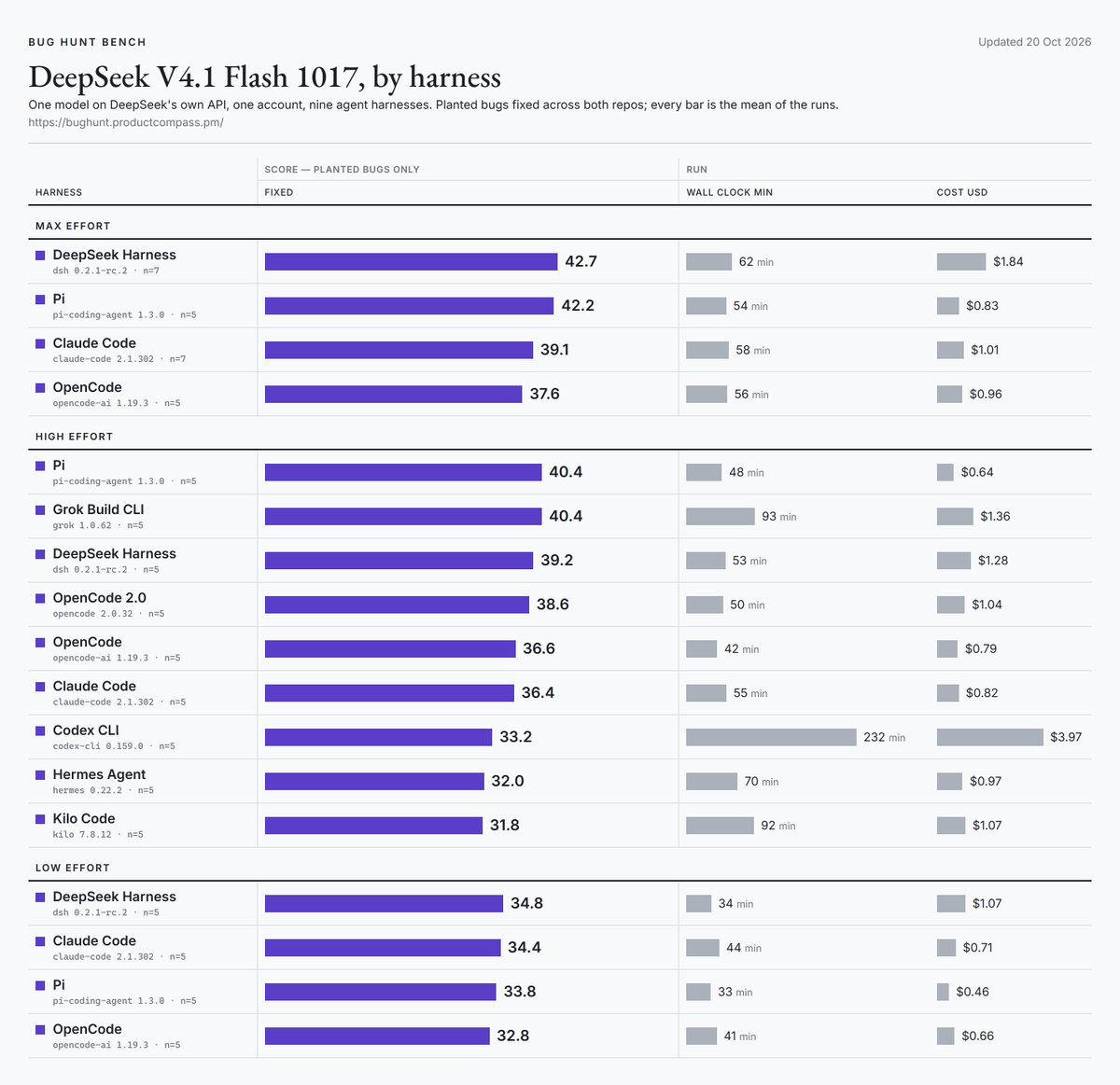
I repeated DeepSeek V4.1 Flash 1017 benchmark 89 times across 9 harnesses to understand which works best.
High effort, 5 attempts each:
Pi harness: 40.4
Grok Build CLI: 40.4
DeekSeek: 39.2
OpenCode 2.0: 38.6
OpenCode: 36.6
Claude Code: 36.4
Codex: 33.2
Hermes Agent: 32
Kilo Code: 31.8
Codex kept failing several times exceeding the allowed time per repo (3 hours) and was judged where it finished.
Based on what I tested, Pi, Grok Build CLI, and OpenCode 2.0 look like the strongest universal harnesses. This doesn't necessarily generalize.
A detailed table with every run in the response🧵