👋 Cyber Architect here.
Checkout https://t.co/eWX2Jujt8u for a sample.
I design and build secure, high-performance websites and web applications that actually scale and survive real-world threats.
Clean architecture, bulletproof security (zero-trust principles baked in), lightning-fast performance, and pixel-perfect experiences — all in one package.
No fragile templates. No security afterthoughts. I deliver digital products that protect your business while driving growth.
Whether you’re a startup launching your first app or an established brand needing a robust platform, I turn ideas into secure, reliable systems.
Follow for practical insights on modern web/app development, security-first architecture, and code that doesn’t break.
What website or app are you dreaming up (or need to fix) right now? Drop it below 👇
#WebDevelopment #AppDevelopment #CyberArchitecture #SecureByDesign #FullStack
REPEATED ATTACKS ON OUR SUPPORTERS IN DELTA STATE: AN URGENT APPEAL FOR ACTION
I am profoundly troubled by the continuing attacks against our supporters throughout Nigeria, especially the latest tragic incident in Delta State, in which four people were killed during an attack on supporters of the Nigeria Democratic Congress (NDC). I unequivocally condemn this senseless act of violence.
It is no longer sufficient for those responsible to fund the dissemination of false claims against the opposition. They have now escalated to the appalling practice of murdering innocent Nigerians solely because of their political affiliations. This is completely unacceptable.
The deceased include:
1. Hon. Moses Anaughe, immediate past Federal Commissioner, Federal Character Commission.
2. Comrade Akima Efenena Umukoro, former President of the Urhobo Progress Union (UPU), Youth Wing.
3. Nyoren Okoro, an NDC chieftain.
4. An additional victim whose identity has not yet been established.
Fifteen other people sustained critical injuries and were hospitalised. Among them are Hon. Evance Ivwurie, Chairman of Senator Ovie Omo-Agege’s Campaign Organisation, and Comrade Chuks Erhire, Director-General of the same organisation.
I offer my deepest condolences to the families of those who died and pray for a swift recovery for the injured.
I urge the security agencies to conduct a comprehensive investigation, identify those responsible and their sponsors, and ensure they face justice. The authorities must also act swiftly to safeguard Nigerians engaged in political activities.
Every Nigerian has a constitutional right to support any political party or candidate without fear of intimidation or violence. Political differences must be resolved through persuasion and the ballot, never through the use of bullets.
No political ambition is worth the life of even one Nigerian. -PO
Examine the records of the investment, including its commissioning and subsequent expansion.
Investigate the Agulu Lake Resort, the Protea Hotel project in Onitsha and the shopping mall initiatives in Awka, Onitsha and Nnewi. Establish which projects were completed, which were privately sponsored, which were abandoned and what happened to each of them.
Examine the records of the Onitsha Business Village, the LG World-ANIDS project and our engagements with Distell, Neimeth and other prospective investors. Establish which investment agreements were concluded, which projects commenced operations and which were still under development when we left office in March 2014.
Examine the Industrial Master Plan produced under our administration. Establish its objectives, the industrial opportunities it identified and the framework it provided for the long-term development of Anambra State.
Also examine the records of the Anambra State–Bank of Industry MSME Fund. Speak to the Bank and its beneficiaries about the partnership, the State's counterpart contribution and the businesses that accessed the facility. Examine the records of our collaboration with the Bank of Agriculture, including the agricultural credit facilities announced and made available to farmers.
I encourage journalists, researchers, business associations, industrialists and ordinary citizens to examine these records independently. They should speak to the manufacturers themselves, inspect the facilities and compare the situation before and after our interventions.
Our record should not be established by what we say about ourselves. It should be established by what can be seen, examined and independently verified.
The lesson is that government must move beyond celebrating commerce to deliberately building production. Anambra demonstrated that when government provides an enabling environment, supports indigenous manufacturers, attracts credible investors, facilitates access to finance and manages public resources prudently, enterprise can flourish and jobs can be created.
As President, I will work to replicate and expand this model across the country because Nigeria cannot achieve sustainable prosperity by consuming what it does not produce. We must transform Nigeria into a productive nation that manufactures, creates, innovates and exports. I will also ensure that specialised development finance institutions, particularly the Bank of Industry and the Bank of Agriculture, dedicate at least 20 per cent of their lending portfolios to Small and Medium-sized Enterprises (SMEs). These businesses deserve deliberate financial support because they are among the most important drivers of employment, enterprise and economic growth worldwide. We must empower them to grow, create jobs and contribute meaningfully to national development.
In the next instalment, NIGERIANS, GO AND VERIFY (9), we shall examine our achievements in sports development, including our investments in sporting infrastructure, support for athletes and initiatives to promote sporting excellence and position Anambra State on the national and international sporting stage. -PO
NIGERIANS, GO AND VERIFY (8)
TRANSFORMING COMMERCE, INDUSTRY AND INFRASTRUCTURE: BUILDING AN ECONOMY THAT WORKS
Peter Obi
I have always believed that economic development must go beyond the construction of roads and buildings. It must create opportunities, stimulate enterprise, support local industries, and improve the productive capacity of society. Government must not merely spend money; it must create the conditions that enable people and businesses to prosper.
When I assumed office in 2006, Anambra State already possessed enormous entrepreneurial energy. From Onitsha to Nnewi, Awka, and other commercial centres, our people had demonstrated remarkable ingenuity and enterprise. What was required was a government that could provide the infrastructure, institutional support, and enabling environment to harness this potential.
Under the Anambra Integrated Development Strategy (ANIDS), we therefore pursued a deliberate programme of commercial and industrial development, with particular emphasis on public-private partnerships (PPPs). Our objective was to modernise the business environment, attract investment, strengthen indigenous enterprises, and create employment.
Our approach was guided by a simple conviction: commerce must be supported by production, and industrial development must be supported by infrastructure. We could not continue to depend largely on buying and selling without deliberately creating the conditions for manufacturing, processing, and value addition.
MODERNISING COMMERCE: THE ONITSHA BUSINESS PARKS
Recognising Onitsha’s historical position as the commercial hub of the South-East, we initiated the First and Second Onitsha Business Parks. We wanted to provide organised, modern, and secure business environments capable of accommodating growing corporate and financial activities.
The parks attracted important financial institutions and corporate operations, including facilities for banks, alongside capital market operators and other businesses.
We also conceived the second phase of the Onitsha Business Village as a centre for information and communications technology-related activities. The intention was to move beyond traditional commercial arrangements and provide facilities that would accommodate emerging business opportunities and technology-driven enterprises.
Another initiative was the LG World-ANIDS project, conceived as a one-stop centre for electronic goods, services, and training. We wanted to connect commerce with technology, skills development, and modern business practices.
Our intention was to move commercial activities beyond the limitations of informal arrangements and provide the infrastructure necessary for modern corporate operations.
DEVELOPING HOSPITALITY AND TOURISM: AGULU LAKE RESORT AND PROTEA HOTEL
We also recognised that a growing commercial centre must have the hospitality infrastructure to support investors, business travellers, and tourists. A state that seeks to attract investment must be prepared to accommodate those who come to do business. This informed our conception of two important projects.
The Agulu Lake Resort was designed to harness the natural beauty and tourism potential of Agulu Lake, creating a destination for leisure, hospitality, and conferences. Beyond tourism, we saw the project as an opportunity to stimulate economic activities in the surrounding communities and create employment.
Similarly, the five-star Protea Hotel project in the GRA, Onitsha, was conceived as a public-private partnership to provide high-standard accommodation and hospitality services. We envisaged a facility that would serve investors, business travellers, and visitors while expanding the State’s hospitality infrastructure. Although the project was subsequently abandoned, its original conception reflected our determination to provide the facilities required by a modern commercial economy.
Leadership Beyond Identity: The Courage to Serve and Defend Humanity.
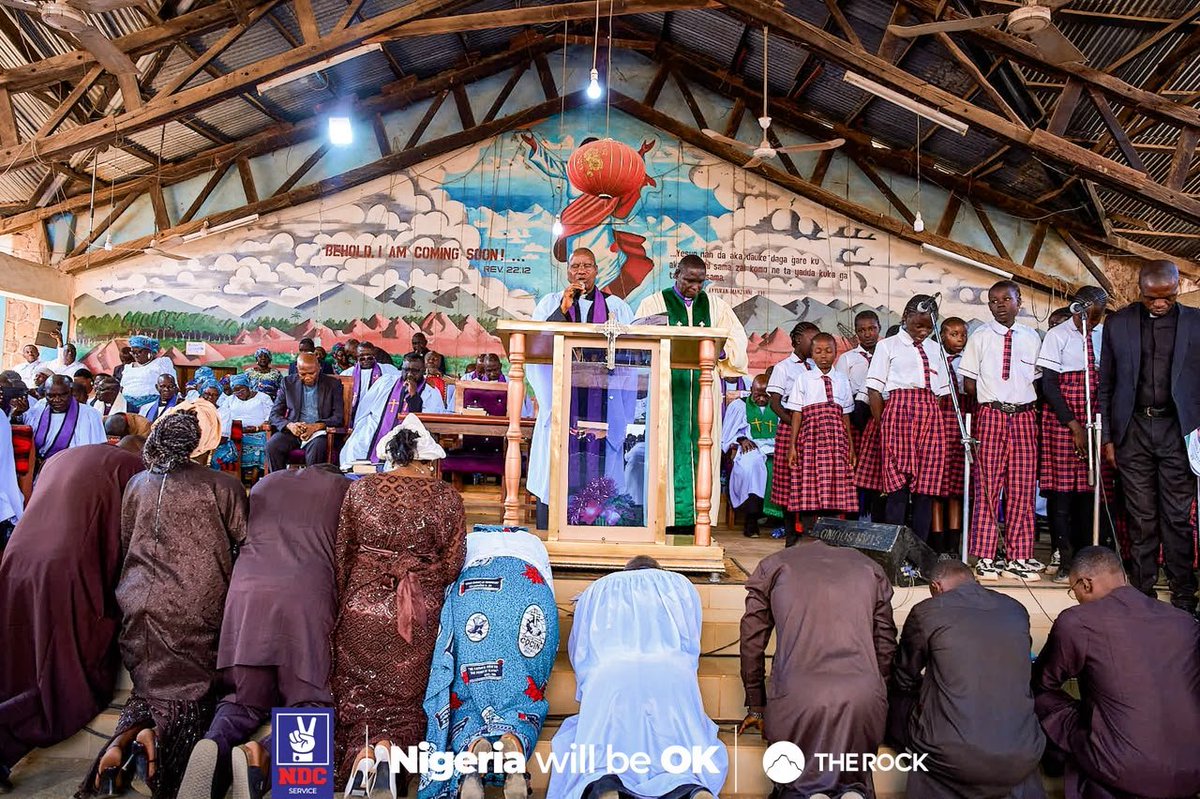
Yesterday, I was honoured to attend the retirement service of Reverend Ezekiel Dachomo in Plateau State. Although it was my first opportunity to meet him personally, I have long admired his courageous advocacy, his compassion for victims of violence, and his steadfast dedication to truth, justice, and the sanctity of human life.
Rev. Dachomo’s example reminds us that faith is expressed not only through what we profess in places of worship, but also through the courage to protect the vulnerable, challenge those in power with the truth, and uphold what is right, even when doing so is difficult or unpopular. The conclusion of formal service should not mark the end of one’s commitment to truth, justice, and humanity.
I also used the occasion to consider the leadership and choices Nigeria requires. Those who support me should not do so because I come from a particular tribe, belong to a particular religion, or benefit from personal sentiment. Their support should be based on my record, character, competence, and the principles I have consistently demonstrated in public service. Nigeria must move beyond identity-based politics and assess leadership according to the ability to deliver results, the integrity to account for public resources, and the compassion to serve those who depend most on government.
Our faith, ethnic identities, and political affiliations must never be used to divide us. Instead, they should reinforce our common humanity and our shared duty to create a nation in which every Nigerian, regardless of background, can live with peace, dignity, and opportunity.
I remain firmly convinced that Nigeria does not lack resources or potential. What we require is leadership that recognises public office as a responsibility rather than a privilege, and as a call to serve rather than an avenue for personal enrichment.
May God continue to strengthen Reverend Ezekiel Dachomo and all who, in their respective callings, remain steadfast in upholding truth, justice, and the dignity of every human being. May He also grant us the wisdom and courage to build the Nigeria we all deserve.
A New Nigeria is POssible. -PO
We started out doing the wrong search.
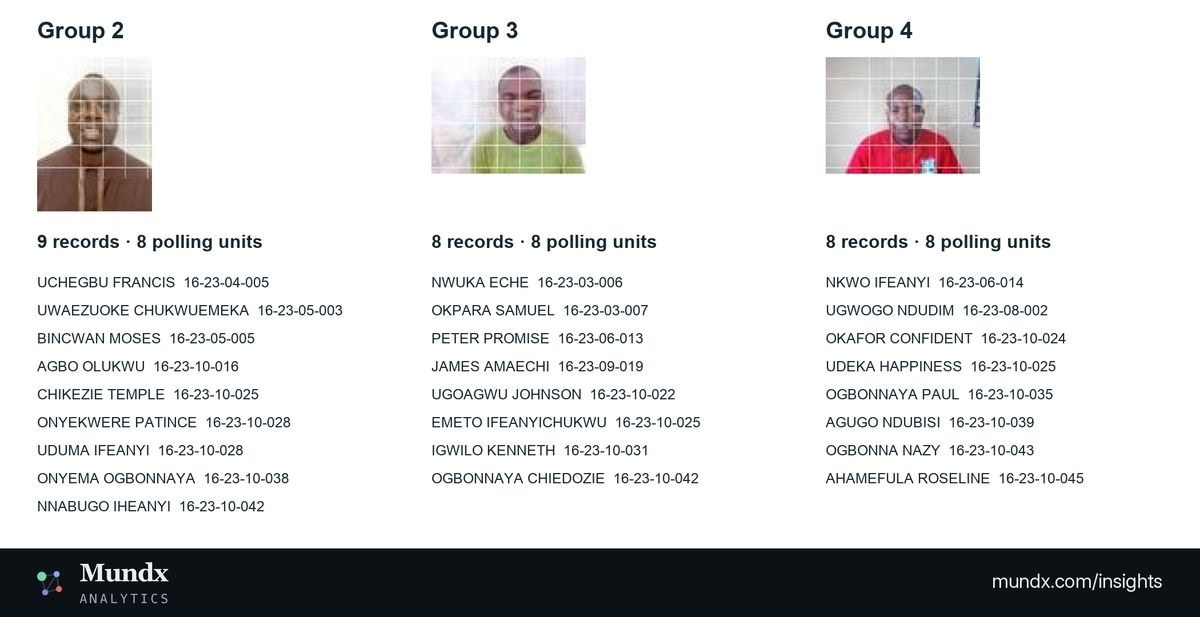
We were looking for the same photo repeated within one polling unit. The bigger problem is the same photo repeated across different polling units and different wards.
In Oru East LGA, Imo State, 18,966 voter records share just 7,580 distinct photos. The same image appears in several records, under different names, across different polling units and wards.
The image below is a sample of three of those photos.
@inecnigeria, please explain:
1. Will a PVC be issued for each of these records?
2. If one person ends up holding several PVCs, can they move from one polling unit to another on election day, get accredited, and vote at each one?
3. Why did INEC’s ABIS (Automated Biometric Identification System) not remove records that share the same photo?
4. Does BVAS compare a voter’s face and fingerprints against the whole register, or only against the register for the polling unit they show up at?
I have just received the terrible news of the challenges faced by President Tinubu. The lack of running water in Aso Rock is sad news to us all . I will encourage him to vote for Peter Obi in 2027 so that we can create a Nigeria that works.
SmartBallot : Towards credible and Transparent Ballot
I have consistently believed that technology, combined with the creativity and resourcefulness of young Nigerians, can help reinforce our democracy and advance free, fair, and credible elections.
I am pleased to endorse SmartBallot (https://t.co/YgbAq2cLxE), a platform developed to facilitate grassroots mobilization, civic engagement, and election monitoring.
I urge our supporters and NDC candidates to register on SmartBallot and examine how its tools can assist them in organizing their communities, coordinating voters and polling unit agents, expanding grassroots engagement, and supporting transparent election monitoring.
Through the effective use of technology and collective action, we can reinforce our democratic institutions and help ensure that every vote is counted.
Credible elections require preparation, active participation, and peaceful vigilance. Let us make full use of every available resource to create a more organized, engaged, and empowered electorate.
A New Nigeria is Possible. -PO
@Wizarab10 Since 2020, everything he writes is for attention. At a time he saw himself as one of the more relevant people on social media. He was regarded as intellectual because people favored him, but his relegation has exposed him, the likes of omojuwa and animal journalist
@IdrisZekeriJnr Why isn’t Nigeria supplying like 100k bpd of crude at a fixed highly subsidized price to let’s say dangote refinery for local consumption? If done well, I believe that can bring down the price of fuel at the same time easy to manage and monitor.
@Mo_Arsenal9 He doesn’t start over him in every match. Only the more important ones, where we need the best players. Havertz intelligence and team play will always put him ahead of Gyokeres in a team like arsenal, but not in teams like united or Liverpool who are more direct.
NIGERIA, WE MUST GET IT RIGHT THIS TIME. VOTE for Peter Obi
My dear Nigerians, the future of our country is too important for us to keep making the same mistakes.
As we approach another election, I urge everyone to look beyond political parties, tribal sentiments, religious differences and empty promises. Examine the candidates, their character, their records, their policies and their commitment to the welfare of ordinary Nigerians.
Ask yourselves: Who has a credible plan for security? Who can create opportunities for our young people? Who can strengthen our economy and protect the lives and rights of every Nigerian?
Do not sell your future for a bag of rice or a few thousand naira. Your vote is your voice, and it carries the power to shape the future of generations.
Let us pray, think carefully and vote wisely. Nigeria deserves leadership that serves the people. May God heal our nation. Amen 🙏 🇳🇬
The Anambra experience demonstrated that proper planning, accurate information, prudent management of resources, and genuine commitment to the welfare of citizens can make a meaningful difference.
What we achieved between 2006 and 2014 was not the elimination of poverty, but the establishment of a practical framework for confronting it. We can adapt and expand that experience nationally.
I have consistently spoken about the need to move millions of Nigerians out of poverty. In discussing this challenge, I have often drawn attention to the experiences of China and India, countries that have lifted hundreds of millions of their citizens out of poverty through sustained economic reforms, investment in productive sectors, infrastructure, agriculture, education, and deliberate policies that expanded economic opportunities.
Their experiences demonstrate that mass poverty is not an inevitable condition of a nation. It can be substantially reduced through purposeful leadership, long-term planning, productive investment, and the consistent implementation of policies that place people at the centre of development.
If China and India could undertake such transformations, Nigeria can also do so. We must study what worked in those countries, understand the differences in our circumstances, and adapt the lessons to our own environment. We do not need to reinvent the wheel; we need the commitment to make proven development strategies work here.
A country cannot be prosperous when millions of its citizens go to bed hungry. Our ambition must be to move Nigeria from managing poverty to systematically defeating it.
That is the Nigeria we must build: one where no citizen is abandoned, opportunity is not determined by geography, and the dignity of every Nigerian is protected.
In the next instalment, Series 8, we shall examine what we did in commerce and industry. -PO
Our objective was to improve agricultural productivity, facilitate access to markets, and ensure that farmers earned better incomes from their labour.
We understood that a farmer who cannot conveniently transport produce to the market remains poor, regardless of how much land he cultivates. This was why agricultural support had to go hand in hand with rural infrastructure.
4. EMPOWERING YOUTHS, SUPPORTING POOR HOUSEHOLDS, AND PERSONS WITH DISABILITIES
We established and equipped skill-acquisition centres to provide young people with vocational training and opportunities for self-employment.
Beyond training, we provided financial support to 500 youths who had acquired productive skills, giving each ₦100,000 to establish or strengthen their businesses. The intention was to move them from unemployment and dependence to productive enterprise.
We also distributed more than 500 specially designed wheelchairs to persons living with disabilities, improving their mobility, independence, and participation in society.
Through conditional cash-transfer programmes under the Millennium Development Goals framework, we provided financial assistance to extremely poor households. These interventions were designed to address immediate hardship while preventing poverty from being passed from one generation to another.
We believed that no young person should be condemned to poverty because of a lack of opportunity, and no person living with a disability should be excluded from society’s economic and social life.
5. RESTORING DIGNITY TO PENSIONERS AND PROTECTING THE ELDERLY
We inherited substantial pension and gratuity arrears owed to retired public servants. We embarked on their systematic liquidation. We spent over ₦35 billion to clear the stock of pension and gratuity arrears.
Beyond pensioners, we recognised another category of vulnerable citizens: elderly people who had neither pensions nor financially capable children to support them.
Consequently, we introduced a monthly social security stipend for indigent citizens aged 75 and above who were not retirees and had no successful children or dependable family support to meet their basic needs. The programme covered approximately 30,000 beneficiaries.
Importantly, we did not treat this as a temporary political gesture. We gave the initiative a legal foundation through the Anambra State Indigent Relief Law 2013, thereby institutionalising the state’s responsibility towards these vulnerable citizens.
We believed that growing old without a pension or family support should not condemn anyone to hunger and indignity. The government had a responsibility to provide a safety net for such citizens.
These interventions reflected our commitment to protecting both those who had served the state and those who, through no fault of their own, were without dependable means of survival.
CONCLUSION: FROM MANAGING POVERTY TO DEFEATING IT
Nigeria faces an alarming food and poverty crisis. According to the Food and Agriculture Organisation (FAO), approximately 36.3 million Nigerians, representing 17 per cent of the population covered by its analysis, faced severe acute food insecurity between June and August 2026, compared with 30.6 million during the corresponding period in 2025.
Behind these figures are families struggling to feed themselves, children facing nutritional deprivation, and farmers unable to earn adequate incomes.
We cannot confront this crisis through disconnected interventions, occasional cash transfers, and emergency food distribution alone. Nigeria needs a comprehensive strategy addressing the structural causes of poverty.
We must invest in agriculture, open up neglected rural communities, support small businesses, expand access to affordable credit, equip young people with practical skills, and establish effective social protection for the elderly, widows, persons with disabilities, and other vulnerable citizens.
NIGERIANS, GO AND VERIFY (7)
LIFTING THE VULNERABLE : ANAMBRA’S BLUEPRINT FOR POVERTY ALLEVIATION AND SUSTAINABLE EMPOWERMENT (2006–2014)
Economic growth that does not translate into improved living conditions for ordinary citizens is incomplete. This is one of our fundamental concerns with President Bola Ahmed Tinubu's government. Development must ultimately be measured by its impact on human lives, particularly those of the poor and vulnerable. This was underpinned by the Anambra Integrated Development Strategy (ANIDS). We believed that infrastructure, education, healthcare, agriculture, and social protection must reinforce one another. Poverty was not merely a shortage of money; it was also a lack of access to opportunities, productive resources, and the basic conditions necessary for a decent life.
Our poverty alleviation strategy, therefore, went beyond temporary handouts. It focused on restoring dignity, creating economic opportunities, and equipping vulnerable citizens with the means to become self-reliant.
Our approach attracted recognition beyond Anambra. In May 2010, Magnus Kpakol, then National Coordinator of the National Poverty Eradication Programme (NAPEP), commended our commitment to poverty reduction, declaring: “We are prepared to support you in the excellent work you are doing in Anambra State.”
1. POVERTY MAPPING: KNOWING WHERE POVERTY LIVES
We recognised that poverty could not be effectively addressed without knowing where it was concentrated and what caused it. We, therefore, undertook a poverty-mapping exercise to identify the most deprived local government areas and communities.
The exercise revealed that some of our poorest communities were also important food-producing areas. Their challenges included poor access to markets, agricultural inputs, electricity, water, and other economic opportunities.
Areas including Anambra West, Orumba South, Awka North, and Ogbaru required particular attention. The findings informed our development priorities, enabling us to direct roads, agricultural support, and social interventions toward neglected communities.
2. EMPOWERING WOMEN, WIDOWS, AND COOPERATIVES
We recognised that rural women, widows, and indigent households bore a disproportionate burden of poverty. Across the 21 local government areas, we provided financial assistance and productive support to thousands of beneficiaries.
Our administration provided financial assistance to support the establishment and expansion of small businesses and farming activities. We also introduced revolving loan schemes to promote enterprise development, economic self-reliance, and improved livelihoods.
We distributed productive equipment, including sewing machines, generators, ovens, cookers, hair dryers, shoe-making machines, and welding equipment. The objective was to help beneficiaries establish sustainable livelihoods rather than remain dependent on government assistance.
We also promoted access to microcredit and cooperative financing to enable small entrepreneurs to expand their businesses, improve their incomes, and create employment.
Our philosophy was simple: rather than merely giving people money to survive today, the government should help them acquire the means to earn a living tomorrow.
3. AGRICULTURE AND FADAMA: MAKING RURAL COMMUNITIES PRODUCTIVE
Agriculture was central to our poverty-reduction strategy because many rural households depended on farming.
Through partnerships with the Federal Government, the World Bank, and other development partners, particularly under the FADAMA programme, we supported farmers with finance and productive assets.
In November 2009, our administration disbursed millions to FADAMA Community Associations across the state. By October 2010, the National FADAMA office was commending Anambra’s commitment. Its National Project Coordinator, Buka Tijjani, represented by Charles Ugwuona, described Anambra as the leading state in the programme.