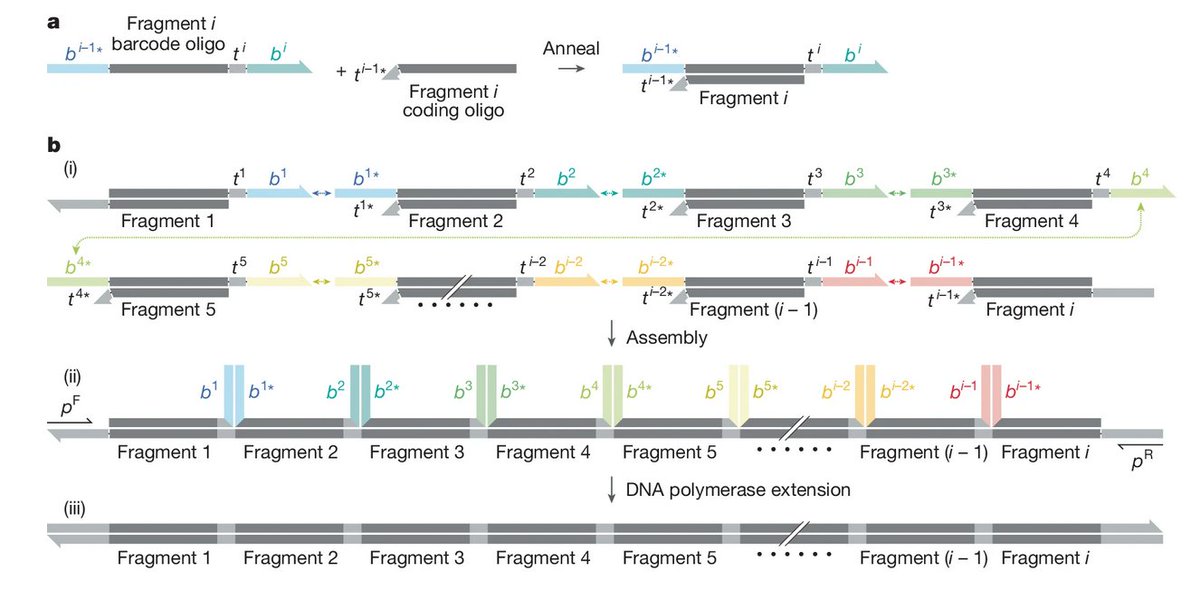
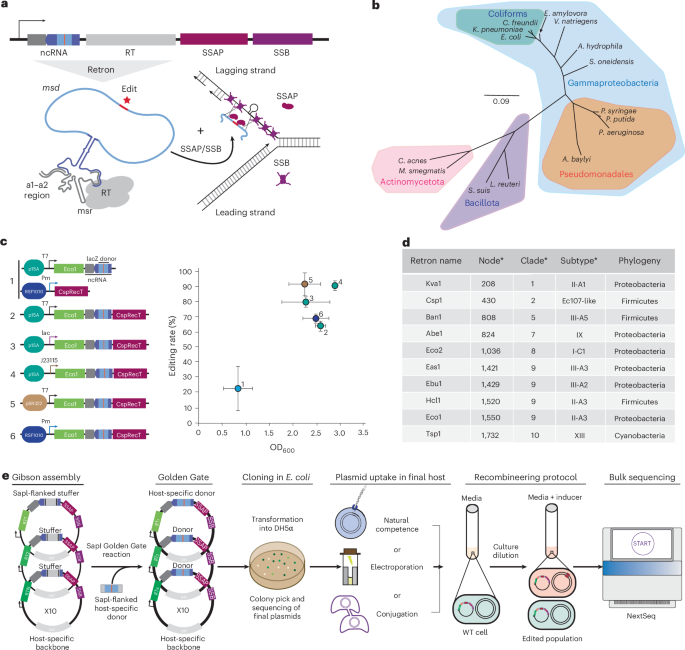
SPLICECRAFT v1.0 IS LIVE!!!!!!!!!!!!
Open your terminal and type in "pipx install splicecraft" if you want to try it out, then spam "splicecraft update" often as I push updates frequently. A labor of love for the community I adore. Enjoy! 💚
I asked Gemini to make an advert for hiring for a new postdoc to my lab. I gave it our recent group photo at Darwin's House and all the job details. It made some terrible ones, but I like this one best.
ok actually insane paper published yesterday
a research group in Korea built a gene switch you can control wirelessly using electromagnetic fields
they exposed mice to 60 hz EMF (same frequency as your wall outlet) using a pair of large coils that generate a uniform magnetic field around the animal, for cyclic 3-day on / 4-day off pulses
they showed this could:
- activate OSK to do epigenetic reprogramming in progeroid and aged mice, extending lifespan and reversing aging markers across multiple tissues
- conditionally switch on mutant amyloid genes only in aged mouse brains, letting them separate aging effects from amyloid effects to study AD biology in a way previous models couldn't
no drugs, no impacts, just a magnetic field from outside the body
Cranking out some heavy updates to my TUI plasmid viewer. Golden Braid part domesticator and MoClo assembly automation. All the tools I ever dreamed of are coming to fruition. Really thankful for Claude Code. Follow along here; rapidly changin development
https://t.co/3mkWtVqa1T
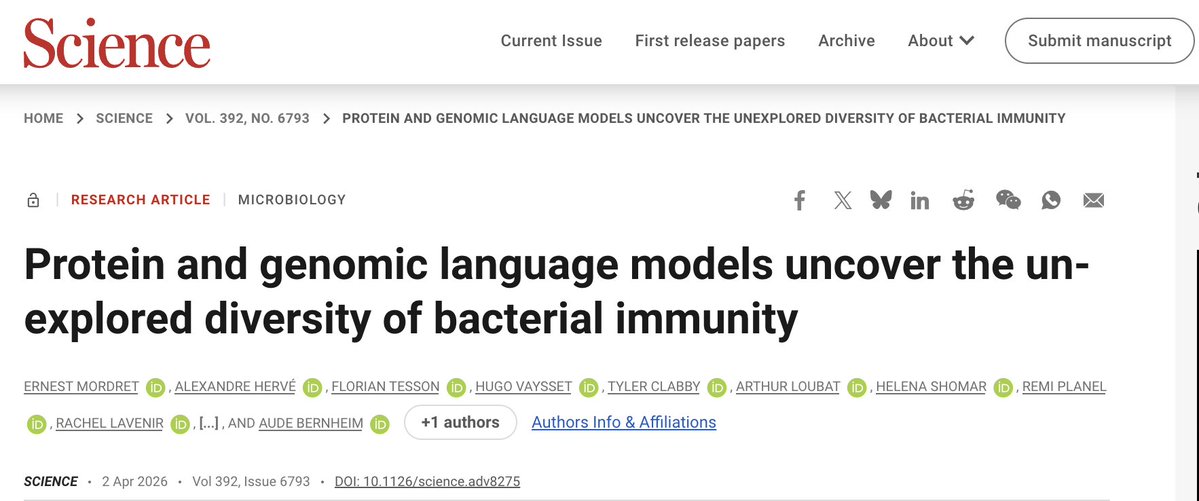
What happens when you train a transformer on 123 million bacterial proteins
Bacteria have been fighting viruses for billions of years. To do it, they have evolved a remarkable diversity of antiphage defense systems — molecular immune machines that detect and destroy invading phages. Yet fewer than 250 such systems had been experimentally validated. A new study in Science suggests we've barely scratched the surface.
Mordret and coauthors asked a simple but powerful question: can language models trained on protein sequences and genomic context learn the "grammar" of bacterial immunity well enough to predict entirely unknown defense systems at scale?
They developed three complementary deep learning models. ALBERTDF adapts the ALBERT transformer architecture to treat genes as words and genome neighborhoods as sentences — learning defensiveness from genomic context alone, without any sequence information. ESMDF fine-tunes the ESM2 protein language model with LoRA adapters to classify proteins as defensive or non-defensive directly from amino acid sequence — trained on a dataset of 123 million proteins drawn from 32,000 bacterial genomes. GeneCLRDF combines both signals through contrastive learning: it teaches the model that a gene's identity can be inferred either from its sequence or from the genomic neighborhood where it lives. This joint embedding achieves 99% precision and 92% recall on held-out benchmarks — far outperforming each approach independently.
The models aren't just impressive on paper. The authors experimentally validated 12 antiphage systems with no prior link to immunity, in both E. coli and Streptomyces albus. Some carry canonical defense domains; others involve proteins with no known association to antiphage function whatsoever.
Applied to over 32,000 bacterial genomes, GeneCLRDF predicts 2.39 million antiphage proteins. Around 1.5% of a typical bacterial genome is devoted to defense — three times previous estimates — and more than 85% of predicted protein families have no prior link to immunity.
The implications are immediate. The predicted atlas — including ~23,000 candidate operon families — is a ready-made discovery pipeline for novel nucleases, molecular effectors, and antimicrobial mechanisms directly relevant to phage therapy and programmable biologics. Language models are turning the bacterial pangenome into an actionable resource.
Paper: Mordret et al., Science (2026) — Science license | https://t.co/CzpyZWPNbO
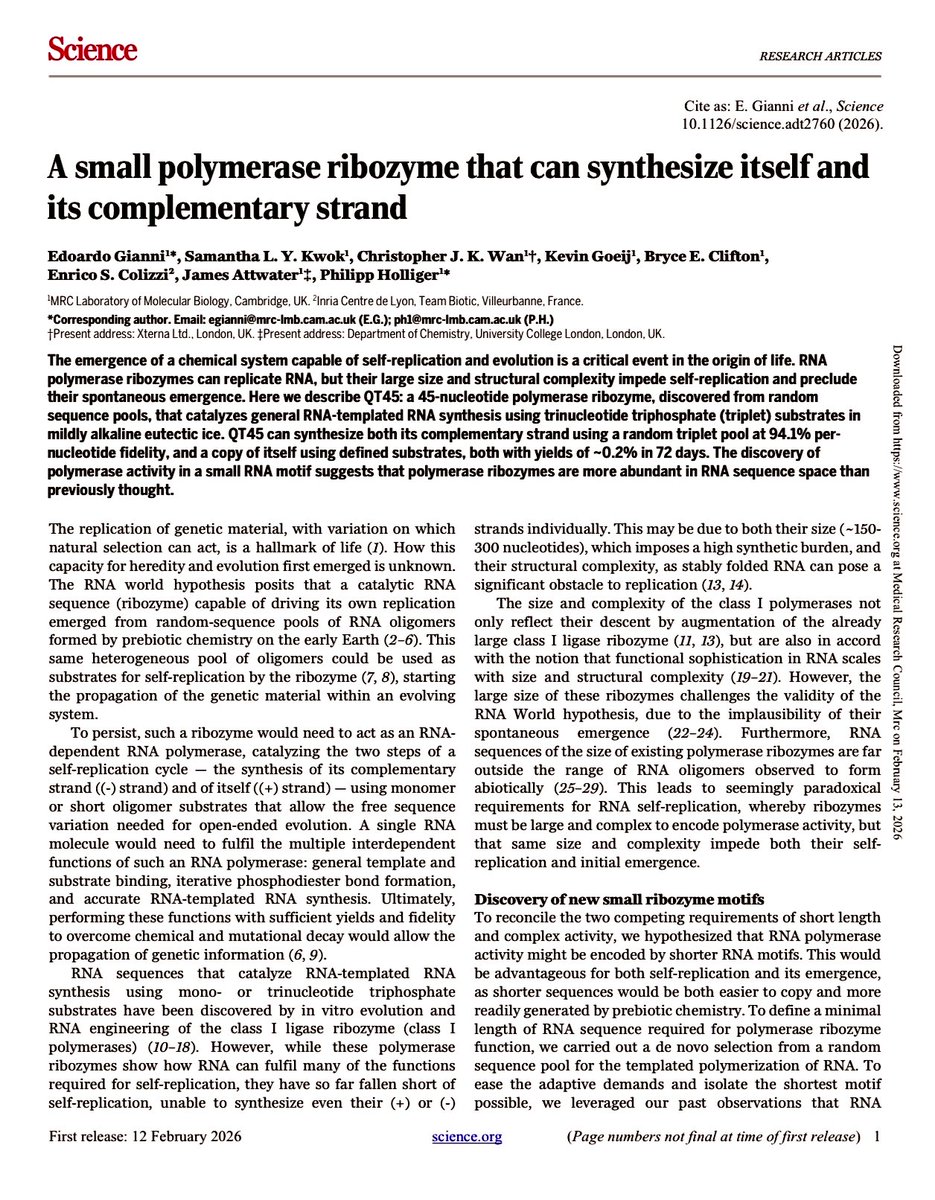
A major work from our lab is out in Science! @ScienceMag, another key step towards a true demonstration of RNA self-replication. https://t.co/2Fe8XonYst (1/6)
New perspectives paper from Anupama in our group - The new wardrobe: How engineered microbes are re-dressing fashion’s sustainability crisis https://t.co/rKPgegVgl3
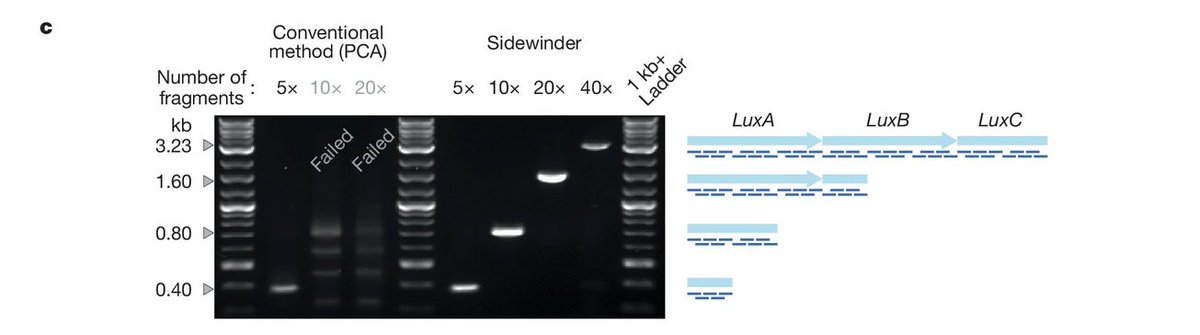
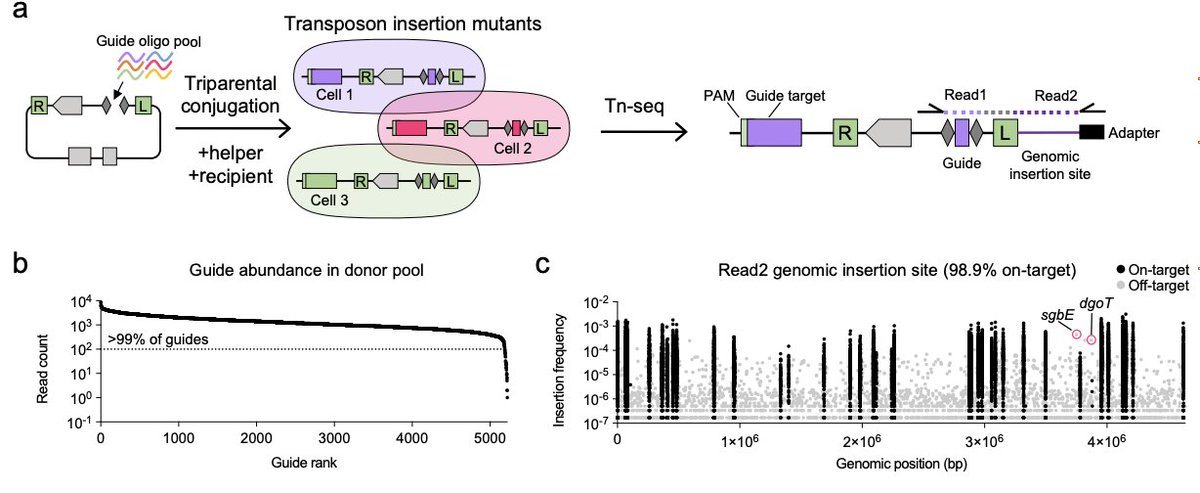
New work from Francesca Ceroni's mammalian #synbio group - really cool study by Tom Copeman with input from AstraZeneca. I've been lucky to be part of this one. @ceronifranci
Here are 30 great essays about biology. I consider these to be my "personal canon," and think that they are all basically perfect in their own ways, despite being different in form and style. All have shaped my own writing considerably.
I'm not including links here, but you can easily search and find these.
1. Diagnosing the decline in pharmaceutical R&D efficiency, Jack W. Scannell et al., 2012
2. Predictive validity in drug discovery: what it is, why it matters and how to improve it, Jack Scannell et al., 2022
3. Is the cell really a machine?, Daniel J. Nicholson, 2019
4. How academia and publishing are destroying scientific innovation: a conversation with Sydney Brenner, Elizabeth Dzeng, 2014
5. A Future History of Biomedical Progress, Adam Green (Markov), 2022
6. The pharma industry from Paul Janssen to today, Alex Telford, 2023
7. The Lives of a Cell, Lewis Thomas, 1974
8. The maddening saga of how an Alzheimer’s ‘cabal’ thwarted progress toward a cure for decades, Sharon Begley, 2019
9. The Scientific Virtues, Slime Mold Time Mold, 2022
10. First Clean Water, Now Clean Air, Fin Moorhouse, 2023
11. I should have loved biology, James Somers, 2020
12. The Baffling Intelligence of a Single Cell, James Somers & Edwin Morris, 2024
13. Biology is more theoretical than physics, Jeremy Gunawardena, 2013
14. Can a biologist fix a radio?, Yuri Lazebnik, 2002
15. Cells are very fast and crowded places, Ken Shirriff, 2011
16. Life at Low Reynolds Number, E.M. Purcell, 1976
17. Lena, qntm, 2021
18. Sequences and Consequences, Sydney Brenner, 2010
19. The NIH Report, Matt Faherty, 2022 (I edited this one)
20. Simplicity in biology, Uri Alon, 2007
21. A breakthrough from 60 years ago: “General nature of the genetic code for proteins” (1961), Matthew Cobb, 2021
22. Molecular “Vitalism”, Marc Kirschner, John Gerhart, Tim Mitchison, 2000
23. The Coming Technological Singularity, Vernor Vinge, 1993
24. Review of Scientific Self-Experimentation, Brian Hanley & William Bains & George Church, 2018
25. Coming full circle-from endless complexity to simplicity and back again, Robert Weinberg, 2014
26. Nothing in Biology Makes Sense Except in the Light of Evolution, Theodosius Dobzhansky, 1973
27. The Impersonator: The Fake Data Were Coming From Inside the Lab, Uri Simonsohn, 2024
28. The Longevity FAQ, José Luis Ricón (Nintil), 2020
29. The Perfect Human is Puerto Rican, Lior Pachter, 2014
30. No Evidence of Disease, Stephanie Bourque, 2012
Our new discovery that bacteria utilize extracellular vesicles to deliver RNAs into fungi substantially broadens the paradigm of Cross-Kingdom RNA communication! Big congrats to @J_NinoSanchez, @HuaitongW and all! Thanks for your hard work! https://t.co/7OAMaItcxa
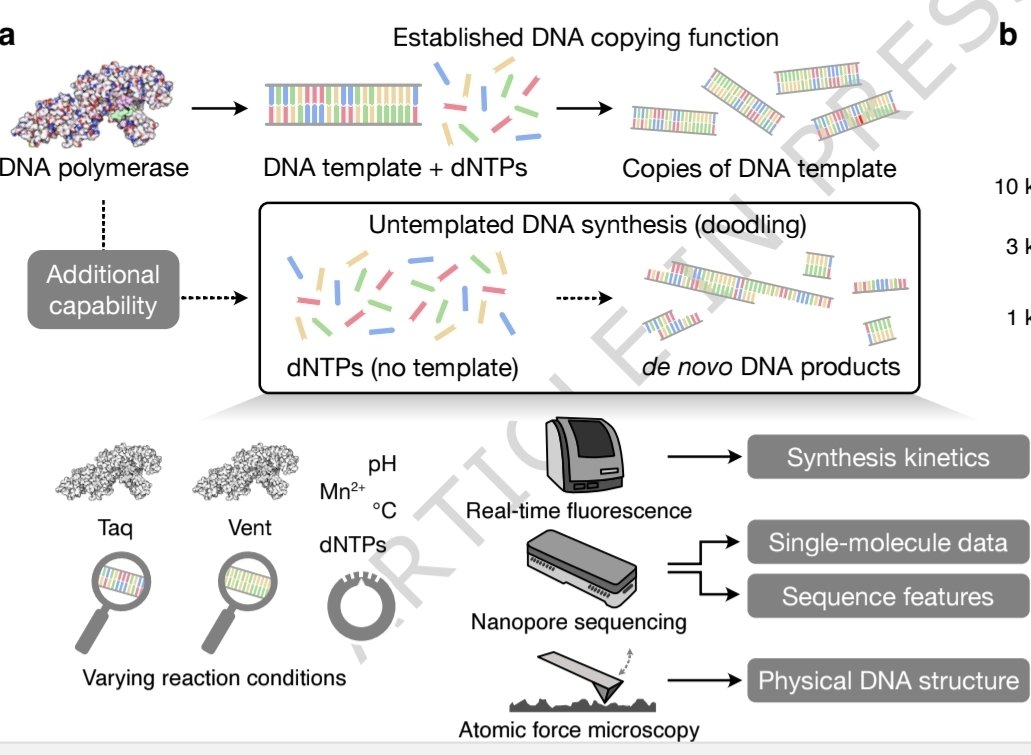
Our latest work in @J_A_C_S!
Artificial system that can sense, grow, and adapt—just like cells! Our droplets form directional filopodia in response to chemical cues- a step toward life-like materials. #ActiveMatter#SoftMatter#Emulsions#SelfAssembly
🔗https://t.co/vBBvnwtMYc