Assistant Professor at Wayne State University. Head & Neck Oncologic Surgeon. Health services, quality improvement & outcomes researcher. All opinions my own.
Are we finally seeing HPV+ and HPV-neg R/M HNSCC start to split into different treatment paradigms?
EGFR/MET bispecific + carbo/pembro (OrigAMI-4): ORR 29% HPV+ vs 77% HPV-neg
Nectin-4 ADC + pembro (EV-202): 82% HPV+ vs 23% HPV-neg
https://t.co/FFW2OKlFRz
https://t.co/Qov5Zr82Kv
#ESMO2026
Compelling data from investigators of KN412 on ctDNA to prognosticate
Baseline and rapid clearance of ctDNA were highly prognostic in HPV- HNSCC
More evidence supporting #PrecisionOncology in #HeadNeckCancer 💪🏻💪🏻💪🏻
Same target, same duct, different vectors. AAV2 has the larger, more mature dataset and 12-month durability. circRNA has faster onset and, being nonviral and transient, should be redosable. If RIX needs retreatment, that matters. Randomized phase 2 ongoing for AAV.
First-in-human circular RNA therapy lands in our field. circRNA encoding AQP1 injected into parotid in 6 patients with radiation-induced xerostomia. Restored flow up by day 7 and held to day 90. Small, uncontrolled, duration unknown. Still, congrats
https://t.co/gYgi2QOdTn
In a phase 1 study, RXRG001, a circular RNA encoding aquaporin-1, was administered to six patients with radiation-induced xerostomia. Measures of salivary flow improved, and adverse events were of grade 1 or 2 and transient. Full study results: https://t.co/YTOWkdaRcc
Tobacco, alcohol, HPV. Air pollution rarely makes our list of head and neck cancer risk factors. Our new paper in Laryngoscope adds to evidence that it should: each extra wildfire smoke day/yr was associated with higher 10-yr HNC incidence (RR 1.06) https://t.co/4dhAR6IDnl
@OTOjournals Why would a head & neck surgeon help lead a tinnitus guideline? Because someone has to keep asking “how good is this evidence, really?” Thanks to Meredith Adams and an outstanding multidisciplinary team for the 2026 tinnitus CPG. 12 years of research since the 2014 guideline
NEW: Clinical Practice Guideline Update on Tinnitus gives clinicians evidence-based tools for diagnosis and treatment, built on a decade of new research.
About 50% of adults with #tinnitus talk to a clinician, but only 20% seek treatment.
Explore the CPG: https://t.co/GaPDLn6z3y
2/ Part of why surgeons have been lukewarm on neoadjuvant IO is that we rarely see the tumor shrink. mPR was ~9% in KEYNOTE-689. Adding chemo changes what we see in the OR and in this study enabled response adapted surgery for HNSCC. I’d love to see a phase III in this space.
1/ REMATCH: neoadjuvant PD1 + chemo had a 94% ORR in LA-HNSCC (n=50). Responders got response adapted operations, with 90% 2-yr DFS. Congrats to the authors. #HNSCC https://t.co/ljnrCtmNwL
Really impressive work in @NEJM: bilateral laryngeal pacing for bilateral vocal fold paralysis. Both trach-dependent patients were decannulated, airflow improved & voice & swallowing preserved. Only 4 patients, but I'd love to see this move into practice.
https://t.co/GF9KjAqY4A
The ctHPV DNA draw I'd keep: 1 month after treatment. Positive then: HR 19.1 for OS. Still positive at 3 months: all 10 failed treatment or recurred. Serial testing for years? Less convinced. #HNSCC https://t.co/FHlSrkVJ2r
Big melanoma data in @NatureMedicine 👇
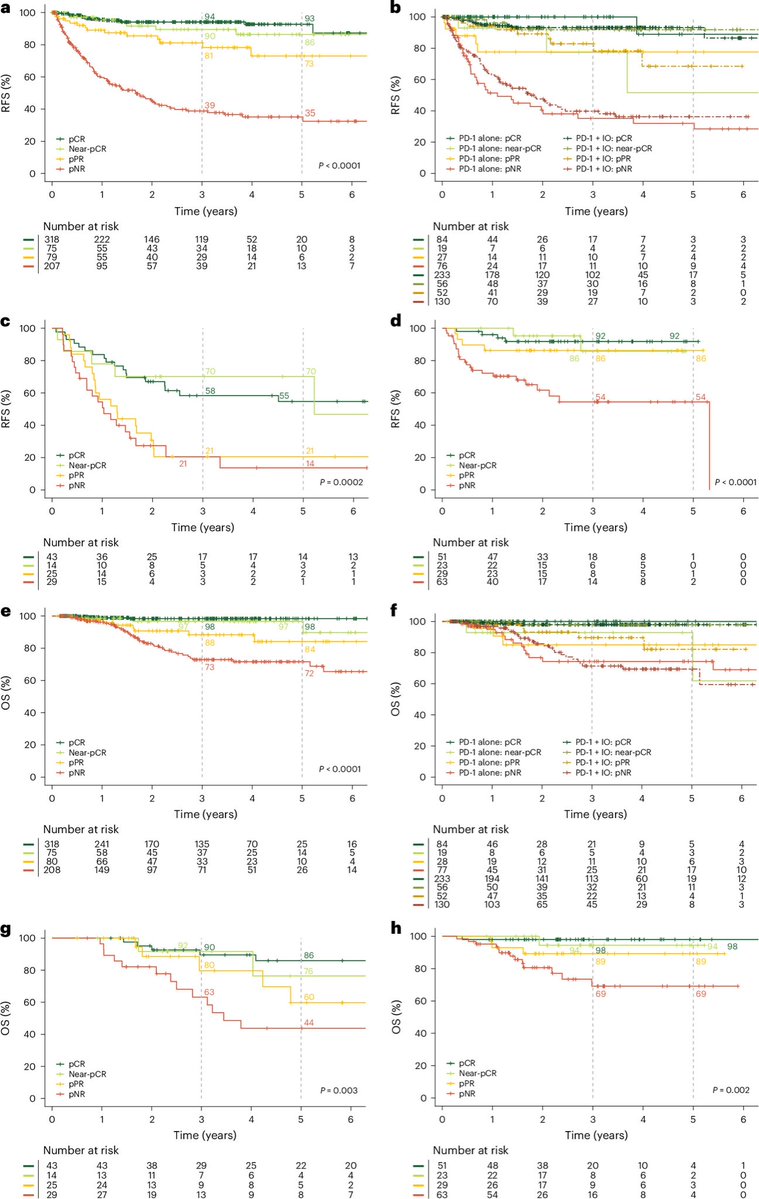
A pooled analysis of 1,038 patients with resectable melanoma treated before surgery. Among the 735 who received immunotherapy, 58% had little or no viable tumor left at surgery.
Those patients? ~98% alive at 5 years.
And their 5-year recurrence-free survival was similar with or without additional immunotherapy after surgery (90.8% vs 90.6%).
So if treatment already worked this well, do patients need more?
Not randomized, so prospective trials are needed. But very encouraging.
Exciting progress in bilateral vocal-fold paralysis! We show that bilateral neuromuscular laryngeal pacing can improve fbreathing, while preserving voice and swallowing. This reversible alternative t could be a game-changer for this disease #MedTwitter#LaryngealPacing#NEJM