This AI just exposed the BIGGEST legal insider trading operation in America.
A platform called GovGreed built a seven-layer machine learning system that cross-references every stock trade disclosed by every sitting politician against the bills their committees control, the campaign donations they receive, and the companies their votes directly impact.
It scored all 540 politicians currently in Congress. And the numbers are crazy:
56% of every stock purchase made by Congress in the last 16 months was on a stock directly affected by a bill the buyer later voted on. That is 6,170 out of 11,016 total purchases.
More than HALF of all congressional stock buys are on companies whose fate that same politician is about to decide.
343 of 540 Congress members actively trade stocks while holding access to nonpublic legislative information.
That is 63.8% of the entire legislature making market bets with an informational edge that would put any hedge fund manager in prison.
The AI identified 752 active "Triple Signals" in the current Congress. A Triple Signal fires when three conditions line up at once:
The politician sits on the committee controlling a bill, they traded stock in a company affected by that bill, AND they received campaign contributions from that same industry.
Bills carrying these insider indicators pass at 5.4 TIMES the normal rate.
Now look at the individual leaderboard:
- Nancy Pelosi's estimated portfolio sits at $194 million with a Greediness score of 98.1 out of 100
- Ro Khanna made 13,231 trades across 800+ different tickers
- Michael McCaul made 32,302 trades and filed 6,670 of them late
- Thomas Suozzi filed 86.4% of his trades late with an average delay of 396 days, meaning his disclosures landed over a YEAR after he made the trade
And then there is Lisa McClain, the fourth-ranking Republican in the House. She has made 1,443 trades in three years, more than 98% of all politicians tracked.
She violated the STOCK Act twice in a single year, disclosing up to $900,000 in trades months after the legal deadline. Her husband bought up to $250,000 in Elon Musk's xAI, which quietly converted into SpaceX equity before last Friday's $2 trillion IPO.
The penalty for all of this? A $200 fine.
The number of Congress members ever prosecuted under the STOCK Act since it passed in 2012? Zero.
And the cruelest part is this:
A bill to ban congressional stock trading was introduced in January 2026. It has bipartisan support. Over 80% of American voters want it passed.
But Congress is sitting on it, because the people who would have to vote yes are the same people making millions from the system staying exactly the way it is.
They write the insider trading laws, they exempt themselves from enforcement, they trade on the information those laws generate, and when they get caught, they pay a fine that is basically nothing.
The AI didn't discover anything Congress was hiding. It just organized what was already public into a pattern so obvious that nobody can pretend it isn't there anymore.
How AI mania is disguising big companies’ hit from Iran war — in charts https://t.co/q3zCc7NUuj via @ft
Would love to see this excellent analysis updated
In March 2000, one company became the most valuable on Earth.
It made the essential hardware behind the defining technology of its age. Revenue growing 50% a year. The undisputed leader. The picks-and-shovels play on a revolution that was unquestionably real.
Wall Street called it the safest way to own the future.
It was Cisco. The internet was real. The routers were real. The growth was real.
At the peak, Cisco traded at roughly 30x sales and over 150x earnings, worth about $555 billion. Analysts said it would be the first trillion-dollar company.
Then it fell 90%.
It took until December 2025 to see that price again. 25 years and 8 months. A quarter of a century to break even, even though the company nearly quintupled its revenue over the same period.
The business won. The stock took 25 years.
Now look at today.
The most valuable company on Earth makes the essential hardware behind the defining technology of its age. Revenue growing fast. The undisputed leader. The picks-and-shovels play on a revolution that is unquestionably real.
Wall Street calls it the safest way to own the future.
The internet was real. AI is real too.
That was never the question.
The question is what you pay for a certainty everyone already agrees on.
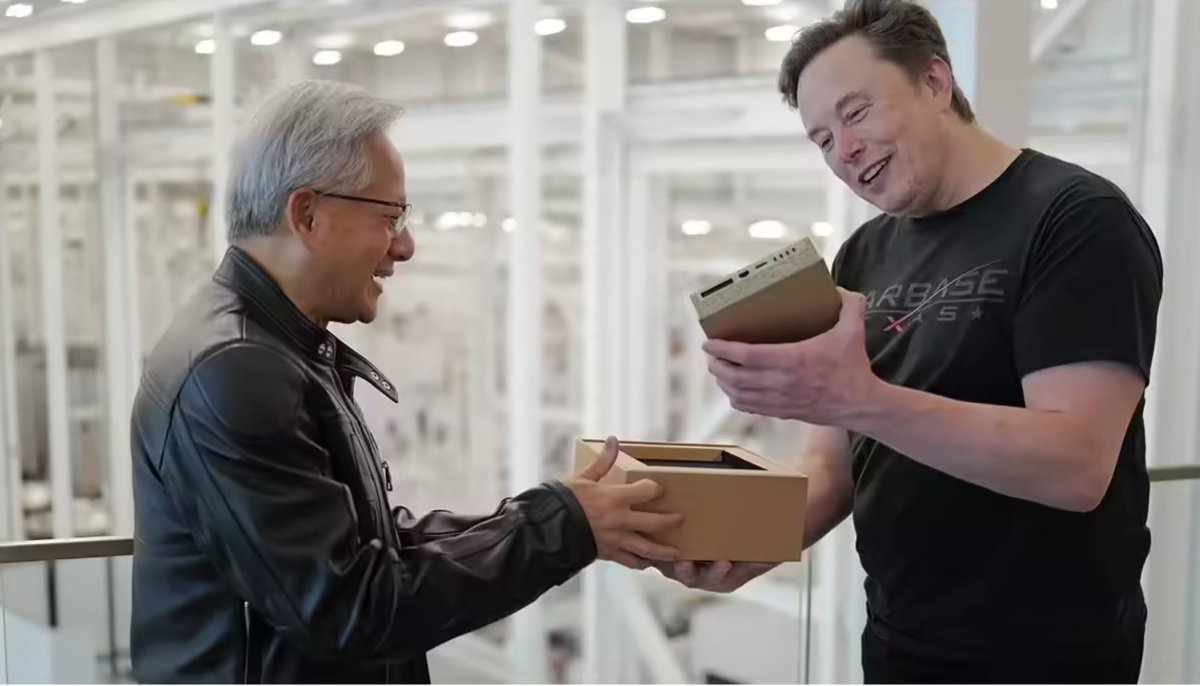
🚨Michael Burry just said Elon Musk and Nvidia's deal is built on fake numbers.
Burry published a detailed breakdown calling the entire structure "Fugazi", his word for fake.
He is alleging that billions of dollars in Nvidia chips are being hidden off balance sheets, and that American retirees are unknowingly funding the whole thing.
Nvidia, the world's largest AI chip company sold $5.4 billion worth of its most advanced GPUs, the GB200, to a company called Valor.
Valor is not a real operating business. It is a special purpose vehicle, a shell company created specifically to hold these chips and nothing else. Nvidia also invested $1.9 billion of its own money directly into Valor on top of the sale.
Those 100,000+ chips are now physically inside xAI's data center. xAI is Elon Musk's artificial intelligence company, the one that builds Grok. xAI is using every single one of those chips right now to run its AI models.
But here is what Burry is flagging.
Neither Nvidia nor xAI owns those chips on paper. Valor, the shell company holds legal title. That means $5.4 billion in GPU assets do not show up on Nvidia's balance sheet as inventory.
They do not show up on xAI's balance sheet as assets. They are legally invisible to both companies.
Nvidia gets to book the $5.4 billion as a completed sale and record it as revenue. xAI gets full use of the chips without owning them. And the risk disappears into a shell company in the middle.
Now here is where American retirees enter the picture.
Valor needed $3.5 billion in debt to fund this structure. Apollo provided it. Apollo is one of the largest asset managers on earth with $1.03 trillion under management and $834 billion specifically in private credit.
Apollo raised the $3.5 billion, packaged it into debt securities, and sold those securities to Athene.
Athene is Apollo's own insurance company. It sells fixed and indexed annuities, retirement savings products, to ordinary Americans.
When a retiree buys an Athene annuity, they believe their money is sitting in safe, stable investments. That money is now inside a structure funding Elon Musk's AI data center.
The numbers inside Athene are most alarming.
Athene holds $74.2 billion in reserves. It has moved $217 billion in assets into a captive insurer based in Bermuda, meaning those assets sit outside normal US insurance regulation and oversight.
Of the entire portfolio, 34.7%, equal to $103 billion, is classified as Level 3 assets.
Level 3 is an accounting classification that means there is no observable market price for these assets. No outside party can independently verify what they are actually worth.
The leverage sitting on top of those unpriced assets is 16 times.
Burry's says:
Every step of this structure is technically legal and publicly disclosed. But the entire thing was deliberately engineered across 8 to 12 steps to move credit risk off balance sheets and away from any market pricing.
- Nvidia books the revenue.
- Apollo collects the fees.
- xAI gets the computing power.
- And retirees sitting at the bottom of a 16x leveraged Bermuda insurance structure, holding $103 billion in assets with no market price carry the risk without knowing it exists.
That water clarity is an engineering decision, and the math behind it is wilder than the video.
Roman aqueducts ran on gravity alone. No pumps, no pressure systems. Engineers carved channels with a gradient so shallow it borders on absurd. The Pont du Gard in southern France drops 2.5 centimeters over 275 meters. That's roughly the thickness of a coin over the length of three football fields. They surveyed that accuracy with plumb lines and wooden leveling instruments.
The clarity you're seeing is a direct product of flow velocity. Too steep and the water erodes the channel walls, picks up sediment, turns brown. Too flat and it stagnates. Roman engineers targeted a slope of about 20 centimeters per kilometer, which kept the water moving fast enough to stay fresh but slow enough to stay clear. Before the water reached the city, it passed through multi-chamber settling tanks where velocity dropped near zero. Suspended particles sank. Clean water flowed out the top into the next chamber. Repeat three or four times.
Pliny specified the minimum slope in writing. Vitruvius published the exact mortar ratio for hydraulic cement: one part lime to two parts volcanic ash for underwater work. The pozzolana from Pozzuoli reacted with water to form a calcium-aluminum-silicate compound that actually gets stronger the longer it sits submerged. Modern concrete degrades in water. Roman concrete bonds with it.
Scale the whole system and it gets harder to process. Eleven aqueducts fed Rome at its peak. Combined output: roughly 1 million cubic meters of water per day. That works out to about 250 gallons per person for a city of one million. Modern New York delivers about 125 gallons per person per day. Ancient Rome had access to double the per capita water supply of the largest city in the United States, running entirely on slope and stone.
The Trevi Fountain in Rome is still fed by one of them. Two thousand years, same source, same gravity, same water.
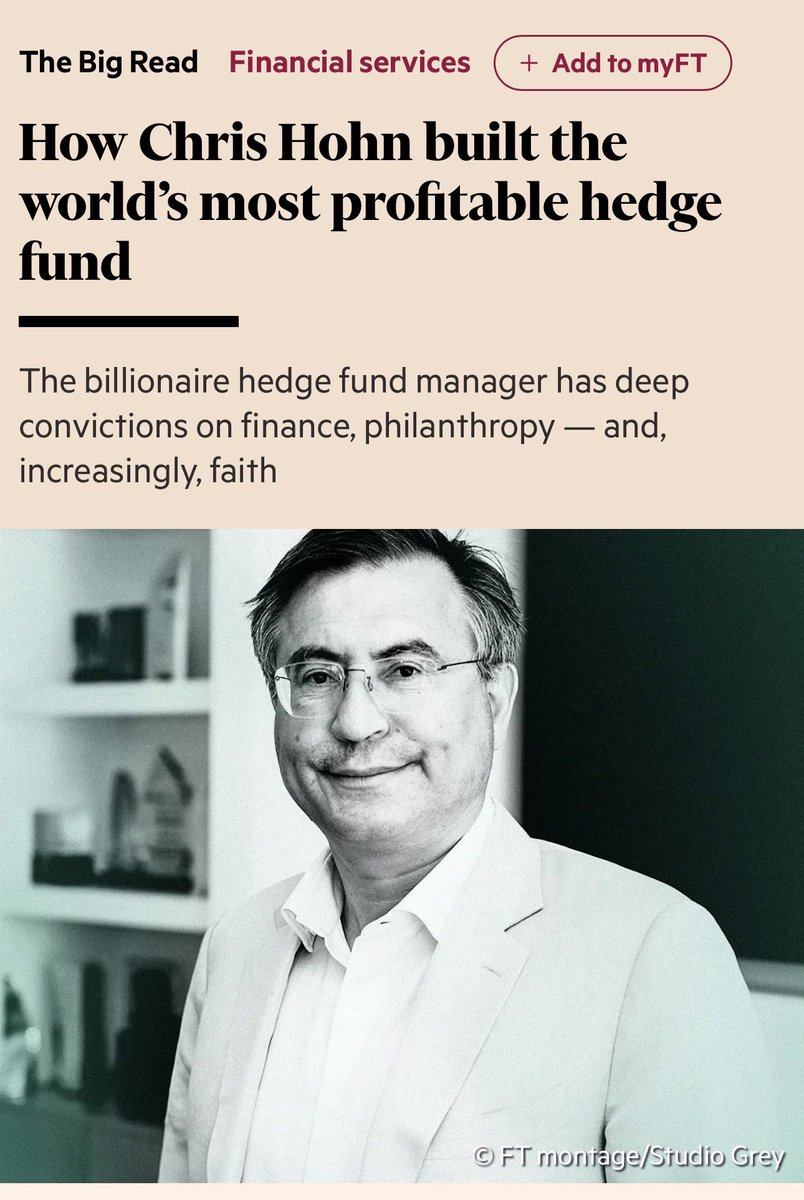
Chris Hohn did a 90-minute sit-down with Nicolai Tangen and then dropped an investor letter the FT got hold of last week.
You’d think the guy who printed a record $18.9B last year would be doing victory laps. Instead he’s quietly rewiring his whole portfolio.
My favorite takes from both:
1.The most important thing in investing isn’t growth. It’s barriers to entry. Growth without a moat is the airline industry: 5% volume growth for 100 years and basically zero cumulative profit.
2.There are only about 200 companies on earth he considers high-quality and investable. His fund holds 15.
3.Average holding period: 8 years. Some positions 13. “You have to hold the company forever, because the stock market may be at very bad prices when you want to sell.”
4.His real test for a moat: can the company price above inflation? A 20% margin business that prices 1% above inflation grows profits 5% faster than revenue. Forever. Almost no companies can do this.
5. Industries he won’t touch: banks, autos, retail, insurance, tobacco, asset managers, fossil fuel utilities, airlines, wireless telecom, media, advertising. On banks: “sooner or later someone without a lot of intelligence comes to run them, and then it can be toxic.”
6.On AI generally: call centers go bankrupt. Indian outsourcing coders are next. But for everyone else, AI lowers costs and raises productivity. Companies with real moats become MORE valuable.
7. Here’s the punchline. The FT got hold of his investor letter. He cut his Microsoft stake from 10% of the fund to 1%. Roughly $8B sold. He’d held it since 2017 through a 400% rally. His reason: AI could disrupt Office and Azure faster than the market thinks.
8.He moved that capital into Alphabet. Doubled it from 3% to 5%. Now his largest tech position. The world’s best quality investor sold Microsoft and bought Google because he thinks Google’s moat is more durable in an AI world. Not the consensus trade.
9.The underlying thesis: “AI eats software.” If AI agents do the work humans used to pay per-seat SaaS licenses for, the whole SaaS model gets re-rated. Oracle, Adobe, Salesforce all ~40% off highs. Microsoft 25% off. Market is starting to agree.
10.When to sell? Not when something gets expensive. When conviction drops. Valuation is one variable, conviction is the other. What kills you isn’t being wrong, it’s permanent loss of capital.
11.He admits hardcore activism doesn’t work anymore. Too much of the shareholder base is passive index funds. And even when activism wins, you usually win in a bad business. “The business always wins.”
12.Counterintuitive take: there are more good companies in public markets than in private equity. The best businesses are too big for PE to buy. And when public companies sell something to PE, they’re selling the assets they want to get rid of.
13.On intuition: “thinking without thinking.” Pattern recognition from 20 years of reps. It’s how he sniffed out Wirecard while the German establishment was defending it. “Most investors trust authority too much.”
14.He basically stopped shorting. “You’re going to be eventually right but not be able to fund the losses.” The first guy to short Wirecard had to cover 19 years before it hit zero. Buffett told him he and Charlie studied shorting and concluded it was too hard.
15.He gives almost everything away. ~$500M a year. $10 prevents an unwanted pregnancy in Africa. $40 saves a child from severe malnutrition. $50 prevents permanent blindness.
16.Tangen asks: advice to young people? Hohn, who runs the world’s most profitable hedge fund: “Go on a spiritual path.” The guy who made $18.9B last year ends the interview saying only purpose and meaning matter.
The headline: the world’s best quality investor just sold his biggest tech compounder because he thinks AI is breaking the moat. Quietly, with conviction, on an 8-year horizon, while everyone else is still buying the AI winners of 2023.
INSANE STAT: Aaron Rodgers could throw 50 straight interceptions and STILL finish with a higher career passer rating than Tom Brady.
Even if he threw 50 interceptions in a row without a single completion, his passer rating would remain above Brady’s career mark of 97.2.
Icon 🤯
Elon Musk avait dit un truc qui m'avait marqué sur l'allocation de ressources. En substance : passé un certain niveau de richesse, l'argent n'est plus de la consommation, c'est de l'allocation de capital.
Cette phrase change tout.
L'économie, dans le fond, c'est juste un problème d'allocation. Tu as des ressources finies et des usages infinis. Qui décide où va quoi ?
Imagine une cour de récré. 100 enfants, des paquets de cartes Pokémon distribués au hasard. Tu laisses faire. Très vite, un ordre émerge. Les bons joueurs accumulent les cartes rares, les collectionneurs trient, les négociateurs trouvent des deals. Personne n'a planifié. Et pourtant chaque carte finit dans les mains de celui qui en tire le plus de valeur. Le système maximise le bonheur total de la cour. C'est ça, la main invisible.
Maintenant fais entrer la maîtresse. Elle trouve ça injuste. Léo a 50 cartes, Tom en a 3. Elle confisque, redistribue, impose l'égalité. Trois effets immédiats. Les bons joueurs arrêtent de jouer, à quoi bon. Les mauvais n'ont plus de raison de progresser, ils auront leur part. Les échanges s'effondrent. La cour est égale, et morte. Elle a maximisé l'égalité, elle a détruit le bonheur.
Le problème de la maîtresse, c'est qu'elle ne peut pas avoir l'information que la cour avait collectivement. C'est le problème du calcul économique de Mises, formulé en 1920. L'URSS a essayé de le résoudre pendant 70 ans avec le Gosplan. Résultat : pénuries, queues, effondrement. Pas parce que les Soviétiques étaient bêtes, parce que le problème est mathématiquement insoluble en mode centralisé.
Quand Musk a 200 milliards, il ne les consomme pas, il les alloue. SpaceX, Starlink, Neuralink, xAI. Chaque dollar est un pari sur le futur. Et lui a un track record. PayPal, Tesla, SpaceX. Il a démontré qu'il sait identifier des problèmes immenses et y allouer des ressources avec un rendement spectaculaire.
L'État aussi a un track record. Hôpitaux qui s'effondrent, éducation qui décline, dette qui explose, services publics qui se dégradent malgré des budgets en hausse constante. Le marché identifie les bons allocateurs, la politique identifie les bons communicants.
Le profit n'est pas une finalité, c'est un signal. Il dit : tu as alloué des ressources rares vers un usage que les gens valorisent suffisamment pour payer. Plus le profit est gros, plus la création de valeur est grande. Quand Starlink est rentable, ça veut dire que des millions de gens dans des zones rurales ont enfin internet. Quand un ministère est en déficit, ça veut dire qu'il consomme plus qu'il ne produit. L'un crée, l'autre détruit, et on appelle ça redistribution.
Dans nos sociétés il y a deux catégories d'acteurs. Les entrepreneurs et les bureaucrates. L'entrepreneur prend un risque personnel pour identifier un problème, mobiliser des ressources, créer une solution. S'il se trompe il perd. S'il a raison, ses clients gagnent, ses employés gagnent, ses fournisseurs gagnent, l'État collecte des impôts. Il est la cellule de base du progrès humain.
Le bureaucrate ne prend aucun risque personnel. Son salaire est garanti. Au mieux il maintient une rente existante. Au pire il la détruit par excès de réglementation, mauvaise allocation forcée, incitations perverses qui découragent ceux qui produisent. Mais dans aucun cas il ne crée.
Regarde les 50 dernières années. iPhone, internet civil, SpaceX, Tesla, Google, Amazon, Stripe, mRNA, ChatGPT. Toutes des inventions privées, portées par des entrepreneurs, financées par du capital risque. Pas un seul ministère n'a inventé quoi que ce soit qui ait changé ta vie au quotidien.
La France est devenue le laboratoire mondial de la dérive bureaucratique. 57% du PIB en dépenses publiques, record absolu. Une administration tentaculaire, une fiscalité qui pénalise la création de richesse. Résultat : décrochage face aux États-Unis, à l'Allemagne, à la Suisse. Fuite des cerveaux. Désindustrialisation. Dette qui explose.
Et le pire c'est que la mauvaise allocation s'auto-renforce. Plus l'État prélève, moins les entrepreneurs créent. Moins ils créent, moins il y a de base fiscale. Plus l'État s'endette et taxe. Boucle de rétroaction négative parfaite. La maîtresse pense qu'elle aide, et chaque année la cour produit moins.
Dans nos sociétés, ce sont les entrepreneurs, toujours, qui font avancer la civilisation. Les bureaucrates au mieux maintiennent une rente, au pire la détruisent. Aucune société n'a jamais progressé en taxant ses créateurs pour subventionner ses gestionnaires.
La question n'est jamais qui a combien. C'est qui alloue le mieux la prochaine unité de ressource pour maximiser le futur de l'humanité. La réponse depuis 200 ans n'a jamais changé. Ce ne sont pas les fonctionnaires.
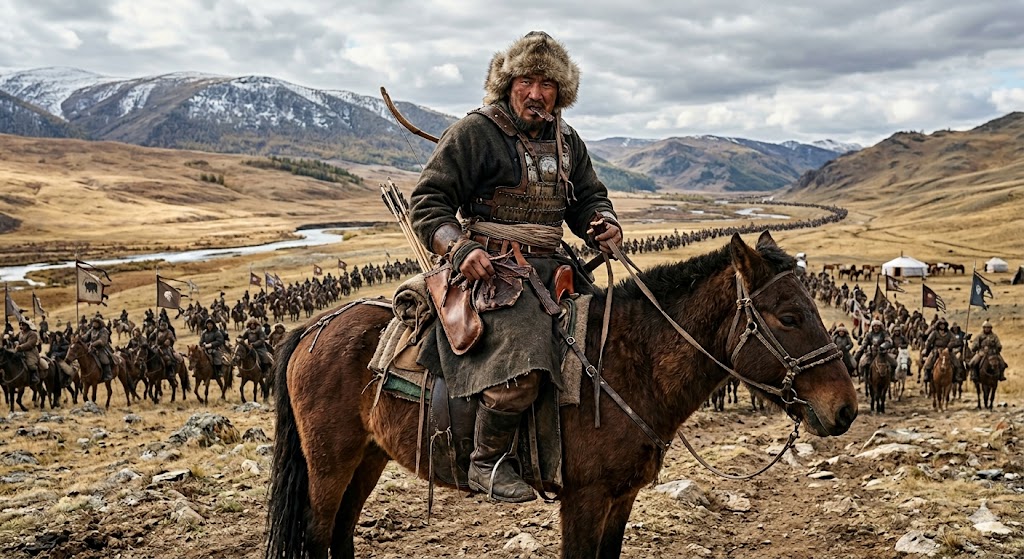
The Mongol Empire conquered sixteen percent of the earth's land surface. Most accounts of how they did it focus on cavalry tactics. Few mention the bag of dried meat hanging from the saddle.
It is called borts.
The technique is brutally simple, which is part of what makes it so devastatingly effective. Take a freshly slaughtered cow. Cut the meat into long strips, two to three centimetres thick, five to seven centimetres wide. Hang the strips on cords inside a ger, where the steppe wind can move freely around them. Wait. After about a month in the dry continental air of Mongolia, the meat is no longer meat in any sense a modern supermarket would recognise. It has become hard, brown, wood-like sticks. All the water has gone. What remains is pure protein, fat, and minerals, in a form that does not spoil and cannot be killed by anything short of fire.
Then they shrank it further.
The dried strips were broken down, sometimes ground to a coarse fibrous powder, until what had once been the muscle of an entire cow could fit, by repeated tradition, inside the stomach or bladder of that same cow. A whole animal, weeks of feeding, condensed into a single sack a man could sling under his saddle.
A pinch of borts powder, dropped into hot water, would yield a bowl of meat broth dense enough to feed three or four people. A warrior with a single bladder of borts on his hip was carrying months of food. He did not need a quartermaster. He did not need a cook. He did not need a wagon. He needed water, fire, and the few minutes it took to reconstitute what was effectively the world's first instant meal.
European armies, by comparison, were dragging baggage trains across the continent. Flour to be milled, then baked. Salt pork in barrels that needed lifting. Wine in casks. Cooking pots, fuel, ovens, the labour of men whose entire job was to keep the fighting men fed. A medieval European army moved at the speed of its slowest cart. The Mongols moved at the speed of their fastest horse, because their food moved with them, on them, weighing almost nothing.
Combine borts with kumis (the fermented mare's milk in the leather flask on the other hip) and the Mongol warrior had complete nutrition strapped to his body. Protein, fat, fermented dairy, vitamin C, B vitamins, calcium, electrolytes. Everything a man needs to fight, ride, recover, and fight again. No fire required. No stop required. No supply line to be cut by an enemy who had not yet realised the supply line was already in the saddlebag.
The Secret History of the Mongols, the only contemporary chronicle written by the Mongols themselves, mentions dried meat as the staple of long campaigns. Friar William of Rubruck, riding with them in 1253, describes the same. He marvels at how little they seemed to require to keep going. He was watching men powered by an entire cow shrunk to the size of his lunch.
Modern nutritionists, reconstructing borts, describe a food roughly 70 to 80 percent protein by weight after drying, with intact fats, full bioavailability of B12 and iron, and a shelf life measured in years.
It is, for all intents and purposes, the perfect carnivore travel food. Designed eight hundred years ago. Carried across half the known world. Used to overthrow the largest civilisations of its day.
The modern soldier, by contrast, eats an MRE. Three thousand calories of seed oil, refined wheat, sugar, and the bleak mathematics of corporate procurement. Cost: roughly $11 a meal. Shelf life: three to five years if you trust the packaging. Nutritional density per gram: a fraction of borts. Effect on the men eating them, by every honest field report in the last twenty years: digestive misery, blood sugar swings, and the sort of post-meal lethargy that is the exact opposite of what an army needs.
The Mongols solved this problem in the thirteenth century. They solved it with a knife, a string, and the wind.
We have spent eight hundred years complicating it.
The bag of dried meat is still the answer.
It always was.
Things I have learned from the movies"
Having watched hundreds of movies, they have taught me many things that I would like to share with you today:
1. If being chased through town, you can usually take cover in a passing St Patrick's Day parade - at any time of the year.
2. All beds have special L-shaped top sheets that reach up to armpit level on a woman but only waist level on the man lying beside her.
3. All grocery shopping bags contain at least one stick of French bread.
4. Once applied, lipstick will never rub off - even while scuba diving.
5. The ventilation system of any building is a perfect hiding place. No one will ever think of looking for you in there and you can travel to any other part of the building without difficulty.
6. Should you wish to pass yourself off as a German officer, it will not be necessary to speak the language. A German accent will do.
7. The Eiffel Tower can be seen from any window of any building in Paris.
8. A man will show no pain while taking the most ferocious beating but will wince when a woman tries to clean his wounds.
9. When paying for a taxi, never look at your wallet as you take out a note - just grab one at random and hand it over. It will always be the exact fare.
10. If you lose a hand, it will cause the stump of your arm to grow by 15cm.
11. Mothers routinely cook eggs, bacon and waffles for their family every morning, even though the husband and children never have time to eat them.
12. Cars and trucks that crash will almost always burst into flames.
13. A single match will be sufficient to light up a room the size of a football stadium.
14. Medieval peasants had perfect teeth.
15. All single women have a cat.
16. Any person waking from a nightmare will sit bolt upright and pant.
17. One man shooting at 20 men has a better chance of killing them all than 20 men firing at one.
18. Creepy music coming from a graveyard should always be closely investigated.
19. Most people keep a scrapbook of newspaper cuttings - especially if any of their family or friends has died in a strange boating accident.
20. It does not matter if you are heavily outnumbered in a fight involving martial arts - your enemies will wait patiently to attack you one by one by dancing around in a threatening manner until you have knocked out their predecessor.
21. During a very emotional confrontation, instead of facing the person you are speaking to, it is customary to stand behind them and talk to their back.
22. When you turn out the light to go to bed, everything in your room will still be clearly visible, just slightly bluish.
23. Dogs always know who's bad and will naturally bark at them.
24. When they are alone, all foreigners prefer to speak English to each other.
25. Rather than wasting bullets, megalomaniacs prefer to kill their arch-enemies using complicated machinery involving fuses, pulley systems, deadly gases, lasers and man eating sharks that will allow their captives at least 20 minutes to escape.
26. Having a job of any kind will make all fathers forget their son's eighth birthday.
27. All bombs are fitted with electronic timing devices with large red readouts so you know exactly when they're going to go off.
28. It is always possible to park directly outside the building you are visiting.
29. A detective can only solve a case once he has been suspended from duty.
30. If you decide to start dancing in the street, everyone you bump into will know all the steps.