In the last few years, I've talked with hundreds, if not thousands, of software developers.
What I've learned: there's a HUGE gap between what developer-influencers are writing about, versus the daily reality of most developers. BUT PEOPLE DON'T TALK ABOUT THE OTHER STUFF. 1/
Update: I have gone from 30+ unreads and 50+ total messages in my personal inbox to zero unread, 12 total.
I even wrote back to personal emails going as far back as 2020!
I now feel I can tackle any problem the world throws at me. Happy holidays everybody. 🎄
@matthew_d_green Yeah the problem with email is anybody in the entire world can give you a task.
I found my professor email account particularly challenging to keep up with because you can't only filter for people you correspond with on a regular basis. 1% of random inbounds are important!
In the last two days, I've processed over 20,000 unread emails from my personal inbox.
Observations:
- I go weeks without opening mail
- I last used email in any functional social way in 2021
- Why don't I unsubscribe from anything
- I worked with a loan officer named Loanne??
I'm curious if professors are keeping up better with email now thanks to AI.
I'm also super curious how people who receive 50-100+ non-spam emails a day (often emails that matter, but from unfamiliar senders) manage their inbox.
People are asking how my email got so broken.
When I was a professor, I easily got 50+ non-spam emails a day:
- Teaching 430+ students
- 7+ dept/review committees
- Inbound emails from aspiring students/postdocs
- Other inbounds
Reading email would have been a full-time job!
@krismicinski I would also argue that part of the GPA and diploma is a certification that you hit a certain bar that everybody agreed on. Being able to get arbitrary modifications to the bar does not seem fair.
When I was teaching 2016-2018, the percentage of students requiring accommodations was already disproportionately high compared to the population.
Students get everything from 4x time on exams to no exams before noon.
At what point did someone just attend a different school?
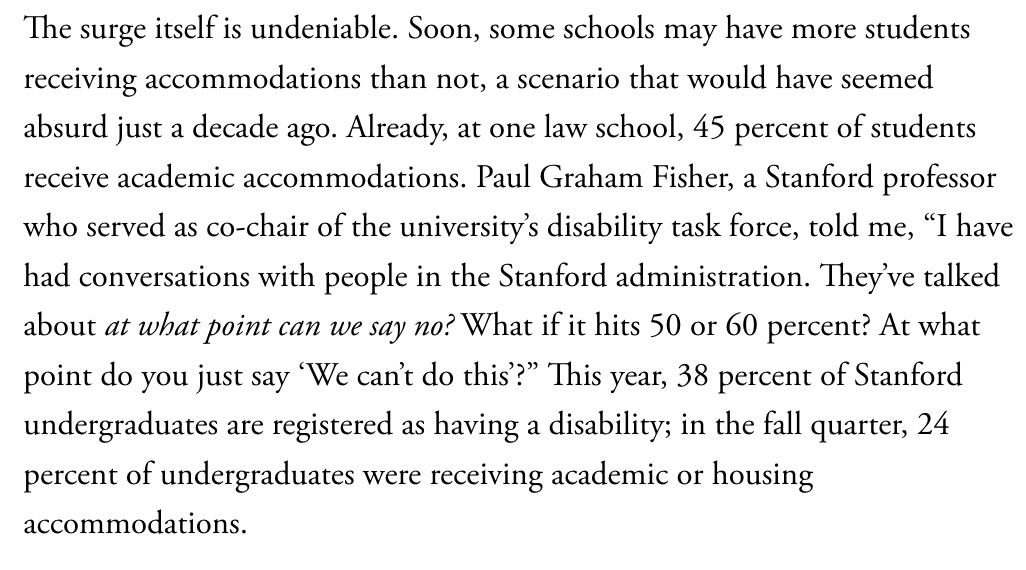
This is a great piece with some mind-boggling statistics.
- At Brown and Harvard, more than 20% of undergraduates are registered as disabled
- At Amherst: more than 30 percent
- At Stanford: nearly 40 percent
Soon, many of these schools "may have more students receiving [disability] accommodations than not, a scenario that would have seemed absurd just a decade ago."
As students and their parents have recognized the benefits of claiming disability—extended time on tests, housing accommodations, etc—the rates of disability at colleges, and especially at elite colleges, has exploded.
America used to stigmatize disability too severely. Now elite institutions reward it too liberally. It simply does not make any sense to have a policy that declares half of the students at Stanford cognitively disabled and in need of accommodations.
@krismicinski I was only counting the medically approved exam accommodations. I'm sure some students do need it and it helps them a lot, but the fact that such a high percentage of students got it felt strange.
“Never send an LLM to do a linter's job. LLMs are comparably expensive and incredibly slow compared to traditional linters and formatters. We think you should always use deterministic tools whenever you can.”
🎯
It's become clear that code generation is going to be one of main use cases of the agentic era. But for code generation to make sense in real-world workflows, teams will need a way to validate the generated code.
Towards this, I'm super excited about what @wuweiweiwu and team are doing at Momentic for testing! Let's go 🚀
Today, teams ship AI-generated code faster than they can verify it.
AI will write most of the world's code, Momentic will make sure it works.
We've raised a $15M Series A led by Standard Capital to build the definitive source of truth for software.
@michaelhilton I agree natural language can't be the only way to generate code.
Natural language is great for the workflow of modifying something in a blackbox way until it does what you want it to do, but for anything where you need more control, folks will want more toolchain determinism.
Been having lots of conversations about how software engineering is no longer about the craft of code.
AI has raised the abstraction barrier, but this is also not new.
The big question is how to make it easier for humans to specify and review AI-generated functionality.
Ok I was off X for a while and I just want to know one thing: how do I reliably see the posts from people I actually follow and care about?
And how do I organize this into lists like I did with Tweetdeck 🪦?