Most engineers have seen this formula.
P(A|B) = P(B|A) × P(A) / P(B)
Almost none can explain what it actually does.
Here's Bayes' Theorem in plain English, and where it's hiding inside systems you use every day.
The core idea in one sentence:
Bayes' Theorem updates your belief about something after seeing new evidence.
That's it. Four terms:
Prior → what you believed before the evidence
Likelihood → how probable the evidence is, given your hypothesis
Evidence → how common the evidence is overall
Posterior → your updated belief after seeing the evidence
A concrete example:
Say 40% of all emails are spam (your prior).
You see a new email containing the word "lottery."
10% of spam emails contain "lottery." Only 1% of legitimate emails do.
Plug into Bayes:
P(spam | "lottery") = (0.10 × 0.40) / P("lottery") ≈ 87%
The word "lottery" updated your belief from 40% → 87%.
That's Bayes in action. Prior belief + new evidence = updated belief.
Where it lives in AI:
1/ Spam filters
The Naive Bayes classifier, the algorithm behind most spam filters - applies this exact calculation word by word across an entire email. Each word shifts the probability up or down. It's called "naive" because it assumes each word is independent of the others, which isn't realistic, but works remarkably well in practice.
2/ Medical diagnosis AI
A patient has symptom X. What's the probability of disease Y? Bayes updates the base rate (how common the disease is) with the likelihood of seeing that symptom in patients who have it. Same formula, different domain.
3/ Your LLM's uncertainty
Modern language models don't just predict the next token, they assign a probability to every possible token. The sampling process (temperature, top-p) is directly working with those probability distributions. Bayesian reasoning is embedded in every response your model generates.
The insight most engineers miss:
Bayes doesn't give you certainty. It gives you a rational way to update uncertainty.
That's exactly why it's foundational to AI - real-world systems are never certain. They're always working with incomplete, noisy, probabilistic information.
Every model that learns from data is, at its core, doing some version of this:
Start with a belief. See evidence. Update the belief.
That's Bayes. That's machine learning.
Future-ready your security. Red Hat Enterprise Linux 10.2 and 9.8 bring post-quantum cryptography and AI-driven migration tools to help you scale across the hybrid cloud. Learn more about the upcoming GA: https://t.co/7RYusVUxs7 #RHSummit#RHEL
⚠️Hackers Use Microsoft Teams to Steal Credentials and Manipulate MFA
Source: https://t.co/vP8XcWXkkW
The intrusion began with unsolicited external chat requests sent to employees via Microsoft Teams. Once contact was established, the threat actor initiated interactive screen-sharing sessions, leveraging direct visibility into user desktops to execute discovery commands including ipconfig /all, whoami, and net start.
Victims were then explicitly instructed to type their credentials into locally created text files named credentials.txt and cred.txt and to add attacker-controlled devices to their MFA configurations.
#cybersecuritynews
Been working on a RAG package for Laravel that takes a different approach than the existing options on Packagist.
The problem: Most RAG packages chunk your files by character count, embed the chunks, and do a vector similarity search. That works for documents, but for code it
misses the relationships that actually matter — which model belongs to which controller, what events fire from where, which services bind to what. What this does differently: Instead of treating PHP files as flat text, it uses nikic/php-parser to build 12 AST extractors that
We’ve launched the first UNITE — BRAVE NATO competition, connecting Ukrainian and NATO companies to build joint battlefield solutions.
Priority areas:
FPV defense, anti-Shahed, SIGINT, autonomous guidance, high-altitude platforms.
€10M total fund.
Visit https://t.co/UQ65rMrzEE
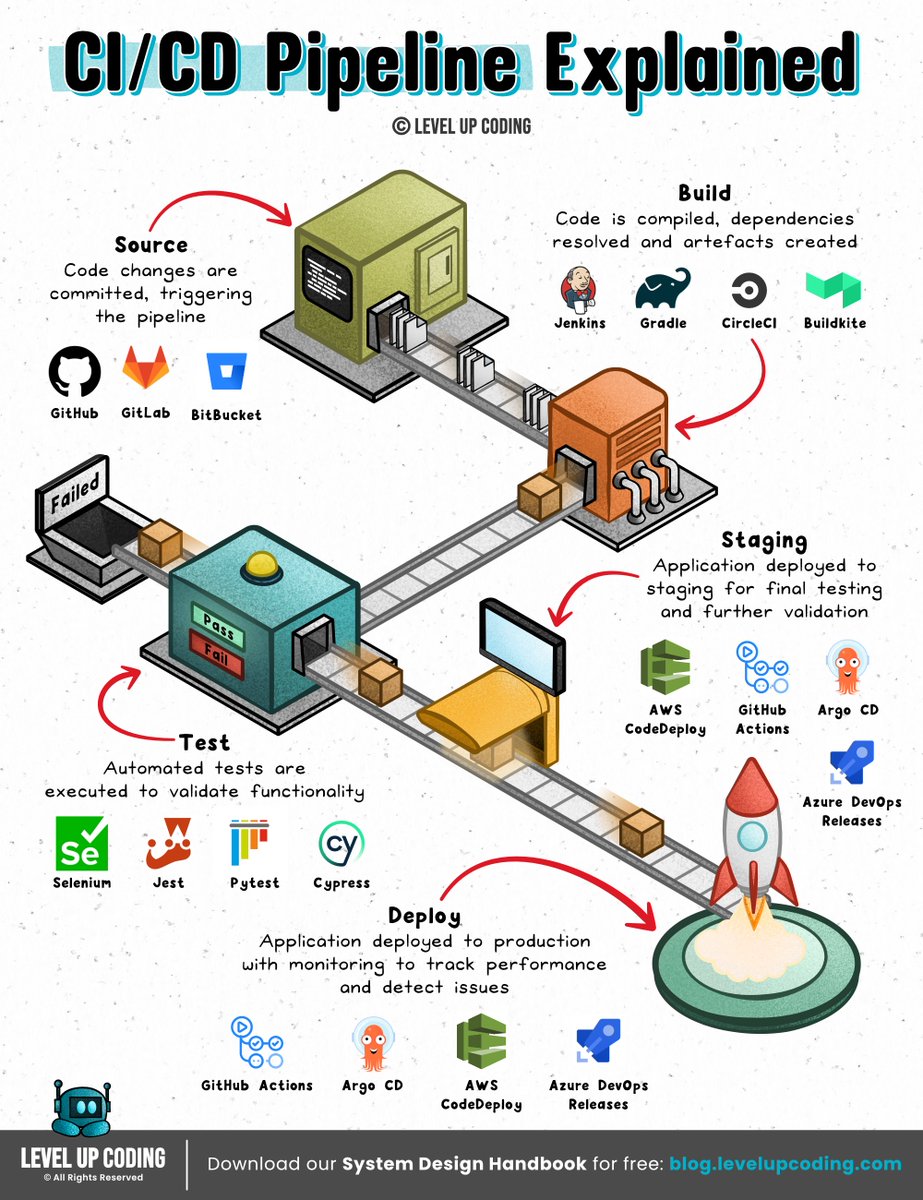
How CI/CD pipelines work
(explained in 2 mins or less):
A CI/CD pipeline is an automated workflow that facilitates continuous integration (CI) and continuous delivery or deployment (CD) by managing code building, testing, and release processes.
It integrates the various stages of the software development lifecycle (SDLC) into a seamless, repeatable process.
These stages include source code management, automated testing, artifact creation, and deployment orchestration.
Continuous ‘delivery’ and ‘deployment’ are sometimes used synonymously.
But there is a clear and important distinction between the two.
Delivery is about ensuring the software can be released at any time.
It requires manual intervention to deploy to production.
Deployment, on the other hand, does the release through automated workflows.
Learn more here: https://t.co/pPPVI1DEfC
What else would you add?
--
👋 PS: Get our System Design Handbook FREE when you join our newsletter. Join 30,001+ engineers: https://t.co/8uVCeyVa1w
--
📌 Save for later.
♻️ Repost to help other engineers learn CI/CD.
➕ Follow Nikki Siapno + turn on notifications.
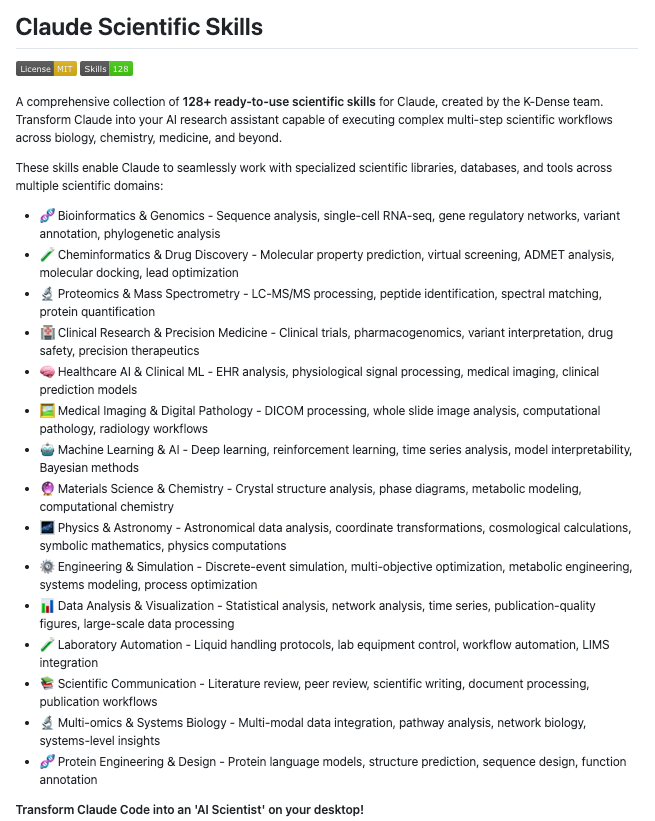
Wow, such a great open-source drop!
Put Claude on steroids with 120+ scientific skills spanning maths, biology, chemistry, medicine, engineering, & more 🤯
If you’ve ever wanted Claude to act like a research assistant, this gets very close.
Free and open source.
Repo in 🧵↓