With the outstanding teamwork of Brendan Benedict and Michael Altebrando, Evan Bernick & I proudly filed this originalist amicus brief defending birthright citizenship in Trump v. Barbara:
https://t.co/JUxRXSMEV9
@ilan_wurman Non-responsive.
These are serious questions about the use of historical sources to decide major legal cases - and the convenient omissions from those sources.
Daily Supreme Court Historical Fact-Check #4:
In Slaughter, Roberts Omitted the Parts of Jefferson's 1780 Notes that Contradicted His Theory https://t.co/u0hB24vLkD
@ilan_wurman I did not chase down the Jefferson note from 1780 until Chief Justice Roberts cited it.
Lo and behold, you both omitted key context, and you both omitted the rest of the note that contradicted your unitary executive theory.
https://t.co/u0hB24vLkD
@ilan_wurman You were commenting on my draft.
You then misinterpreted my research in your later paper, "The Original Presidency," which I specified in the SSRN draft above, posted to specify how your amicus brief in Slaughter was misleading.
Again, no 1789 presidentialist supported your view.
@mls1776 This "whole" sentence is dicta, merely restating the basic structure of powers before focusing on legislative and judicial (& not executive) powers.
Of course, it did not include the word "alone."
A go-to unitary executive move.
Textual precision matters, except when it doesn't.
@ilan_wurman And @ilan_wurman, can you explain your use the First Congress & of my evidence on the symmetry rule in your article & Slaughter amicus?
Specifically:
Did a single presidentialist in 1789 actually interpret the Appointments Clause as you suggest?
https://t.co/cufSxmwgI6
@ilan_wurman, care to comment on your use of Jefferson's 1780 note in your article and amicus brief?
Why did you omit the context and passages that contradicted your interpretation of the letter and your overall argument?
#BULawProf@JedShug joins Sam Bagenstos (@michiganlaw) on Dahlia Lithwick’s Amicus podcast to deconstruct SCOTUS decisions that will affect millions of Americans for years to come.
Listen: https://t.co/OXzM5KK38o https://t.co/yzCbgKq1C1
2/ Our conversation on "Bad History":
The Robert Court, presidential power & birthright citizenship
Posted on Independence Day... poetic justice, given the Roberts Court's royalism & misuse of historical evidence from the Founding.
More fact-checking TK
https://t.co/Ls8tEpr3Ie
Daily SCOTUS Historical Fact-Check, Part 1:
I'm starting a daily SCOTUS fact-check after a whopper term, full of erroneous historical whoppers.
1. Justice Kavanaugh concurred in the result. Why did he bend over backward to call it a dissent?
https://t.co/UhgqX6BS9A
Last week, the Supreme Court endorsed an extreme view of inherent presidential power (Slaughter), but then made an exception for the Federal Reserve (Cook). Here are some thoughts on the ruling and how things might unfold from here: https://t.co/3n9FDBm9q4
1/n
@ARKloster I guess it is just as hard for you not to continue the same (wrong) snark.
One last time: My article did get cited - by Jackson.
That's not the point. The problem: Kavanaugh did not address the countrary evidence to his main argument.
But keep going with the snark. Goodnight.
Frankly, I am stunned reading Kavanaugh's dissenting view: the 14th A. does NOT guarantee birthright citizenship.
He did not read the amicus briefs.
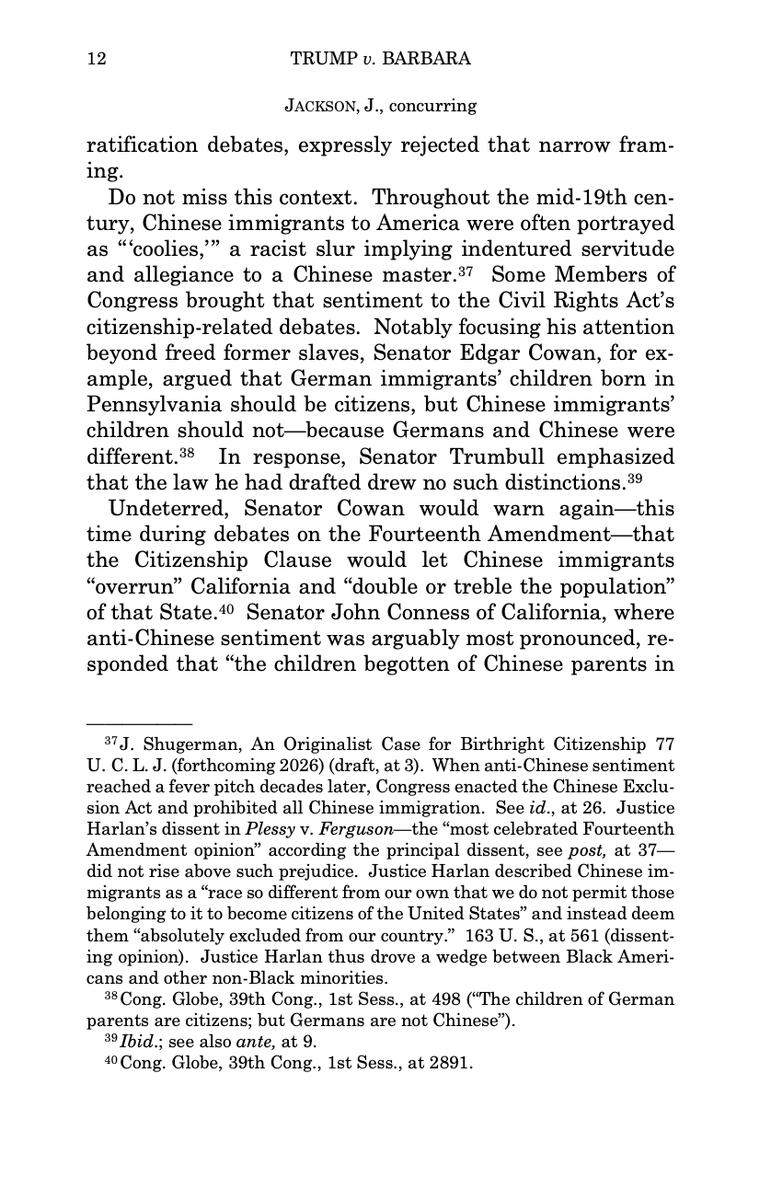
He did not even read Jackson's concurrence, which relied on my research to refute Kavanaugh's unsupported assertions (p. 8)
The Supreme Court STRIKES DOWN Trump's anti-birthright executive order.
I was honored that Sotomayor cited 5 of my articles in her Slaughter dissent yesterday.
It's a sweeter honor today as Jackson cited my historical work supporting birthright, p. 12-13, forthcoming in UC L.J.
In Slaughter (slip op at 21), the Court finds great significance in Osborn v. Bank of United
States, 9 Wheat. 738, 819 (1824), where "we
recognized that the Constitution 'vests the whole executive power in the President' alone."
Interestingly, Chief Justice Taft, who spent years scouring for authority to support the holding in Myers v. United States, doesn't seem to have found Osborn that important since he doesn't mention it. Nor is apparently cited in any other unitary executive case, including Free Enterprise Fund, Seila Law, Collins, etc.
It is cited in a number of Prakash and Calabresi articles though. 🤔
https://t.co/0RFS86Vdpm
@charlescwcooke Everyone has a right to their own opinion.
My point is that Kavanaugh thinks he has a right to his own selective echo chamber of facts.
He relied on a historical assertion that was directly debunked by Jackson (and me). It is revealing that he didn't acknowledge that problem.
@dillojackal Seems problematic that he would make a historical assertion on page 8, without even acknowledging the amicus briefs and a colleague's opinion that directly rebutted that assertion.
@Schneider_CM Read Jackson's opinion and read Kavanaugh's opinion. Jackson offers such a clear and direct rebuttal that it is charitable to assume Kavanaugh did not know it...
because frankly it is worse if he read it and failed to understand it or deliberately ignored it.