The problem is its reasoning makes no sense. It says:
"The Federal Reserve is a uniquely structured, quasi-private entity that follows in the distinct historical tradition of the First and Second Banks of the United States.”
Great show this week with @LevMenand & Josh Younger who discuss how Treasury market liquidity is a policy choice! They have a new paper covering the legislative and regulatory history that have led to the current fragility in Treasury markets. (1/5)
https://t.co/4SA0AeSpSH
15 years after the financial crisis, Wall Street banks are bigger than ever and still depend on taxpayer bailouts to avoid an economic meltdown.
Powerfully important op-ed by @LevMenand & @MorganRicks1 on structural changes to end Too Big to Fail. https://t.co/4sCmgqwfXa
"It’s time to separate depository banks from other financial businesses and treat them as public utilities," @LevMenand and @MorganRicks1 write in a guest opinion. https://t.co/sOLlXfoWOm
Making & remaking the most important market in the world. Or why everyone should read Menand and Younger on Treasuries.
Chartbook Newsletter 238 just dropped.
Check it out and sign up for more: https://t.co/ROJ98SVeQD
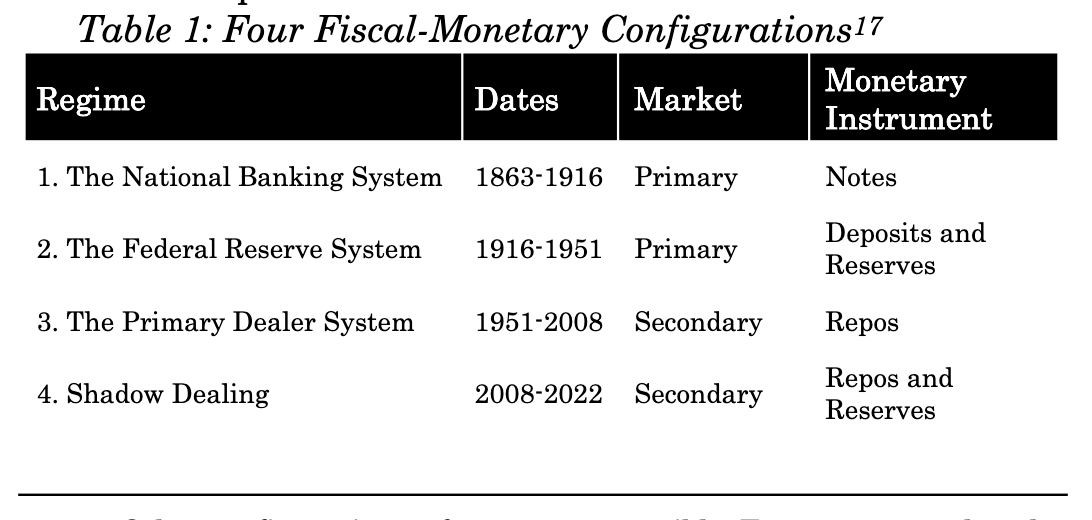
The four historical phases of the US Treasury market.
Chartbook 238 summarizes the fantastic paper by Menand and Younger on the world's most important market.
Check it out and sign up here:
https://t.co/7yYep71LyI
1. On this Labor Day, a reminder that @FTC is committed to protecting all Americans—including workers—from unfair methods of competition & unfair or deceptive practices.
Our proposal to ban noncompetes could raise workers' earnings by up to $300 billion.
https://t.co/Wt7dDkMsCn
Starting to get annoyed with people describing the 2010s as the "low interest years" rather than "the depression years" or "the stagnation years". It's a right wing framing. If the 1930s years were described as the "low rates years" the U.S. would have been a far worse place
Inspired by this year's banking crises (and all the twitter content that followed), I wrote about the emergent range of deposit insurance reforms for @rooseveltinst
https://t.co/3Bv1b3ltzI
@superwuster Some grist for the mill: Riegle-Neal (1994), Gramm Leach Bliley (1999), NationsBank v. VALIC, contrariwise Federal Deposit Insurance Act (1933/35), Federal Reserve Act of 1913
Back from conferencing, I have a fresh piece on the deeper systemic consequences of the cap on deposit insurance through the lens of rereading the deeply insightful work of UBS-Credit Suisse's Zoltan Pozsar.
https://t.co/jcDYas7gyK
Providing all Americans with a public banking option—namely FedAccounts—would allow universal access to a free, safe, and reliable place to hold and manage your money. https://t.co/gxdt8FgWyA
Why 13-3 to lend to banks? My guess is its about the 1 year term which allows for a lower interest rate than on DW loans (which are max 4 mos). Terming out funding *helps* banks when the yield curve is negative sloping.