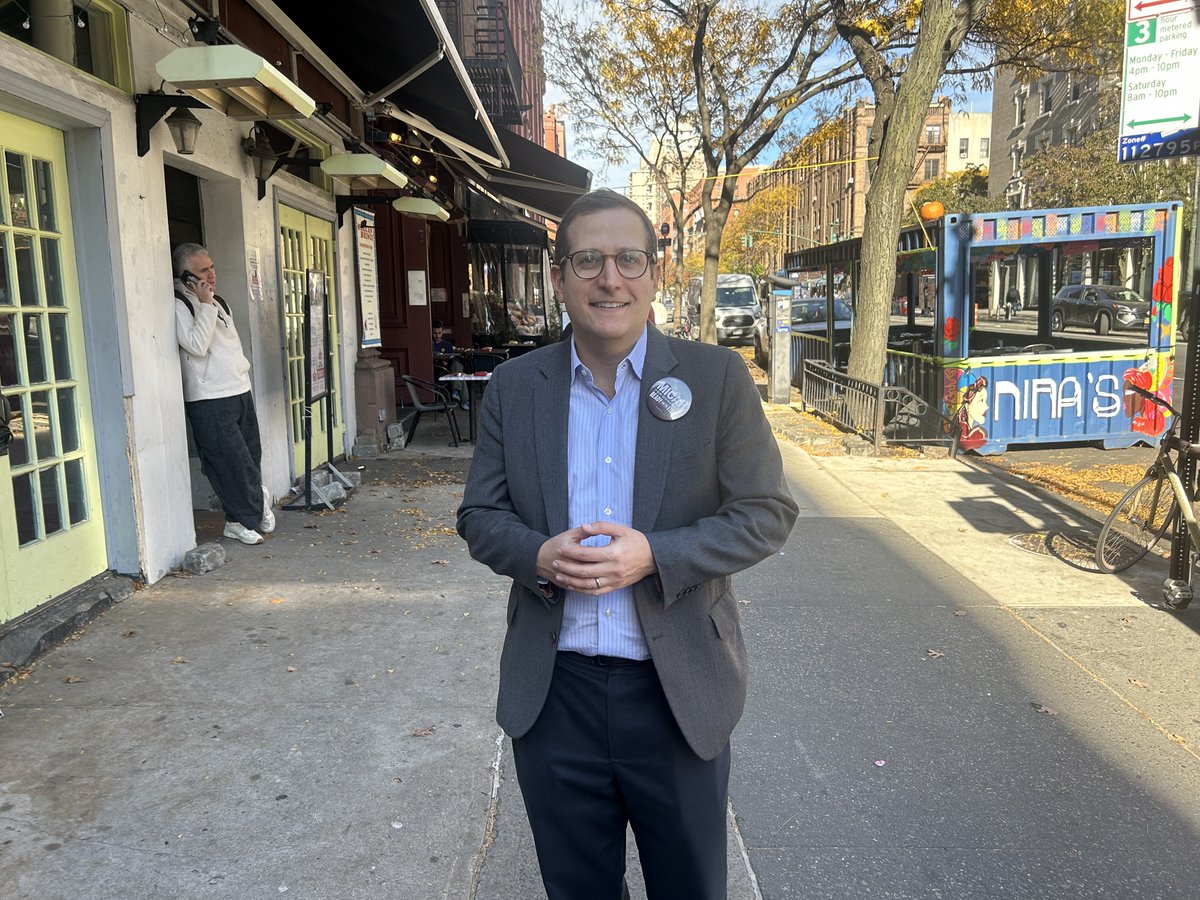
I've interviewed Micah Lasher dozens of times over the past few years. Never have I heard him get emotional.
Today, on the day he is expected to be elected to Congress, to represent the district where he grew up, his voice wavered multiple times while answering the following question.
WSR: You are of the district. You are from the Upper West Side; you’ve worked on the Upper West Side, Jerry Nadler, your mother, the West Side Dems, Riverside Park, City Diner, all of these touchstones of who you are. What does it mean to be so close to representing the place you are from, while at the same time holding so much reverence for it?
Lasher: It’s remarkable. Yeah. You know, I got my mother involved in politics. People think she got me involved. I signed up for what was then the Community Free Democrats in front of the Barnes & Noble on West 82nd Street in 1996. Jerry, at the time, who was a relatively recently elected congressman, was already an icon in the neighborhood and became one nationally over time. I have been involved and have seen generations of elected leaders represent this neighborhood. The notion that, at the end of his extraordinary time in office, I’m now going to represent this most amazing community is overwhelming and a privilege of a lifetime. That is a phrase that gets thrown around in politics and is really apt in this circumstance for me. Yeah.
I'm thrilled to be launching Econvitals today. It's been the main way in which I have been tracking and understanding the economy over the last several months. And I decided I might as well share it with all of you--for free.
Has a combo of website, email lists & social media.
Fed Chair Kevin Warsh has a task force to reconsider the balance sheet and the Ample Reserves operating system.
My new Brookings paper proposes Elastic Reserves: dependable lending facilities, paired with reforms that reduce banks’ need to hold reserves.
https://t.co/eBQFWP8Q14
“I think AI is an incredible, transformative technology that I use obsessively every day, but it needs to be regulated by somebody besides Sam Altman and Dario Amodei,” says Facebook Co-Founder @chrishughes. https://t.co/nVgklTmhuo
Piece in the FT from Facebook co-founder Chris Hughes arguing that the bank supervision model is the right template for AI regulation https://t.co/j6trSI3XO6
The government forced Anthropic's most capable models offline for 18 days. OpenAI delayed GPT-5.6 when asked. Intel gave Washington a 10% stake. My latest in @theprospect on how the industry that swore it didn't need the state learned to work with it. https://t.co/StNbzyVlhv
Greenspan’s obituary writers want to credit him with a single, flattering flaw: He trusted markets too much. That charge is too generous, because Greenspan never left markets to run themselves. https://t.co/9H7MR7u8W1
Greenspan’s flaw wasn’t trusting markets too much. He used the Fed to cultivate a faster and looser financial sector … then counted on government to catch the fall. My latest in @theprospect https://t.co/Ux0IlVd5D7
How to build almost 200,000 new affordable houses a year by returning the FHLB system to its original housing mission from what it’s become, profits for financial firms. My latest w/@chrishughes in @BrookingsEcon
https://t.co/RSOPuka3Un
More details on a low-cost way to quickly build ourselves out of the housing crisis. And no, it doesn't involve zoning reform. New report I co-authored with @Aarondklein from @BrookingsInst
https://t.co/AQjlMx4RCm
Love this piece by @chrishughes on leveraging the Federal Home Loan Banks to invest in housing construction, including affordable housing. @MikeFellman and J.W. Mason made the same case in their @Groundwork paper:
Fantastic must read article by @chrishughes in @nytimes laying out an aggressive, progressive vision to tackle housing and turn the FHLB from a source of bank profits to an engine powering homeownership for young Americans. My gift to you:
https://t.co/fpUoWWOF1B
AI systems are now writing code, diagnosing diseases, designing buildings, and even generating art. Tools like @ChatGPTapp, @claudeai, @GoogleDeepMind, and autonomous robots are reshaping industries once thought immune to automation. Will AI usher in a new era of prosperity and leisure or a future of unemployment and inequality?
Featured Debaters:
Dr. @ruchowdh, @chrishughes (@economicsecproj), Simon Johnson @baselinescene
(@MITshapingwork), and @AndrewYang. Moderated by @JohnDonvan.
This is the fifth debate of The Hopkins Forum series, co-presented by @snfagora of @johnshopkinsu and @opentodebateorg. Photo credit: Poll Bravo of @JHUBloombergCtr.
Watch now on YouTube, or listen on Spotify and Apple Podcasts.
Live Debate: @AndrewYang, @chrishughes, Simon Johnson (@baselinescene), and Rumma Chowdhury on AI & the Future of Work
Tools like ChatGPT, Claude, and autonomous robots are transforming industries once thought automation-proof — fueling fears of widespread job loss. Will AI Make Work Obsolete?
📅 Wednesday, February 25 | 6:45 PM
📍 @JHUBloombergCtr | Reception to follow
Presented by @SNFAgora and @opentodebateorg
Reserve your free tickets before they sell out: https://t.co/MpcIPyHj9M
How much value does the Fed's operating system create for commercial banks? In a new @BrookingsInst paper, Josh Younger and I quantify two channels of transfer from the public to the private sector under ample reserves, peaking as high as $200bn annually https://t.co/R7grkHLEO6
Bank regulation and monetary policy are inextricably intertwined. The Supreme Court should let both stay independent from the White House https://t.co/BHLKTTN5Ve