CONTAMINATION BIAS IN LINEAR REGRESSIONS:
This paper studies identification problems in linear regressions with multiple treatments and rich control sets intended to eliminate omitted variable bias. The central result is that, even when controls are sufficiently flexible, standard OLS regressions with multiple treatment variables generally fail to recover meaningful convex combinations of heterogeneous treatment effects. Instead, each estimated coefficient is a contaminated mixture of the true causal effects of all included treatments.
The key insight is that in a multi-treatment setting, partialling out controls induces a re-weighting of variation in treatment variables that is not orthogonal across treatments. As a result, the coefficient on any given treatment reflects not only its own causal effect but also linear combinations of the effects of other treatments. These weights can be negative or exceed one, implying that regression estimands are not convex averages and may lie outside the support of true treatment effects. This phenomenon is termed contamination bias.
The authors derive the exact algebraic representation of OLS coefficients under multiple treatments, showing how the projection of one treatment onto others enters the estimand. They characterize conditions under which contamination disappears—essentially requiring orthogonality or special designs where treatments vary independently conditional on controls. However, such conditions are rarely satisfied in observational data, especially in applied economics where multiple policy variables are often correlated.
To address the problem, the paper proposes alternative estimands that target interpretable weighted averages of treatment effects. One approach involves constructing weights that explicitly account for the covariance structure among treatments, ensuring that identified estimands correspond to meaningful convex averages. Another approach focuses on estimating “easiest-to-learn” or most precisely identified linear combinations of treatment effects, trading off interpretability and statistical precision.
The authors also conduct a re-analysis of nine empirical applications from the applied microeconomics literature. They find substantial contamination bias in observational studies, often leading to sign changes or magnitude distortions in reported treatment effects. In contrast, randomized experimental settings exhibit less severe contamination due to more balanced treatment assignment and reduced correlation among treatments, though some bias can still remain when propensity scores vary.
Overall, the paper highlights a fundamental limitation of standard regression-based causal interpretation in multi-treatment environments. It shows that even with rich controls, OLS coefficients may not correspond to any meaningful average treatment effect unless additional structure or alternative estimators are used. The results motivate caution in interpreting multi-variable regressions causally and provide practical tools for more robust estimation strategies.
Paper: https://t.co/KSrZGVNJVd
Goldsmith-Pinkham, @instrumenthull, Kolesár (2024)
IMSのreview誌のStatistical Scienceにアクセプトされた論文
A unified approach to penalized likelihood estimation of covariance matrices in high dimensions
https://t.co/5GYfy55E3N
By adaptively adjusting randomization probabilities via Thompson sampling, the method efficiently identifies the contexts in which the focal attribute has its most positive and most negative effects. You can read the paper here: https://t.co/vM8Wdsijgn
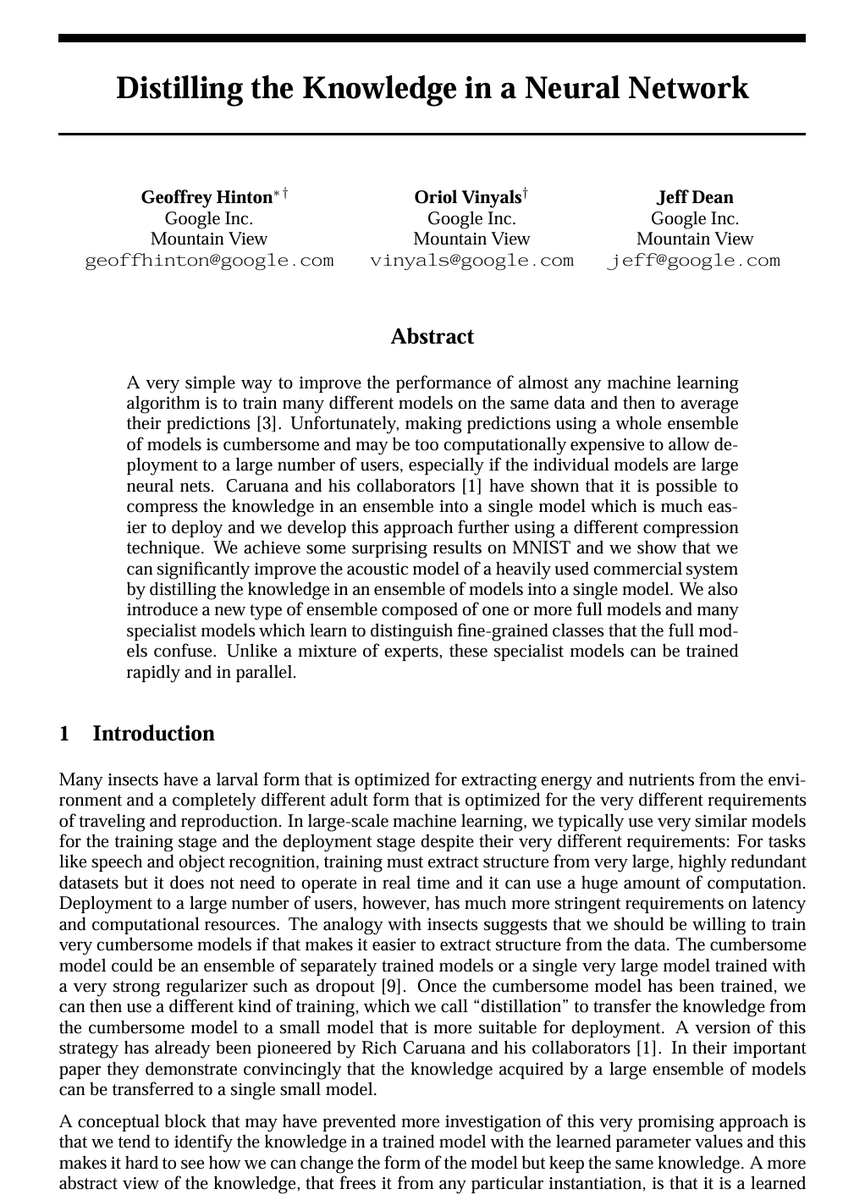
Today, neural network distillation is a technique that drives all commercially successful LLMs. Modern inference speed and low cost would be impossible without distillation.
Authored by Google's Geoffrey Hinton, Oriol Vinyals, and Jeff Dean, the paper was rejected by the reviewers at NIPS 2014 (now NeurIPS) as "unlikely to have a significant impact."
The paper was published on arXiv and has gotten more than 30,000 citations.
Learn from this foundational paper on ChapterPal: https://t.co/WGDibzk3xE
PDF: https://t.co/1SyoQiqeaJ
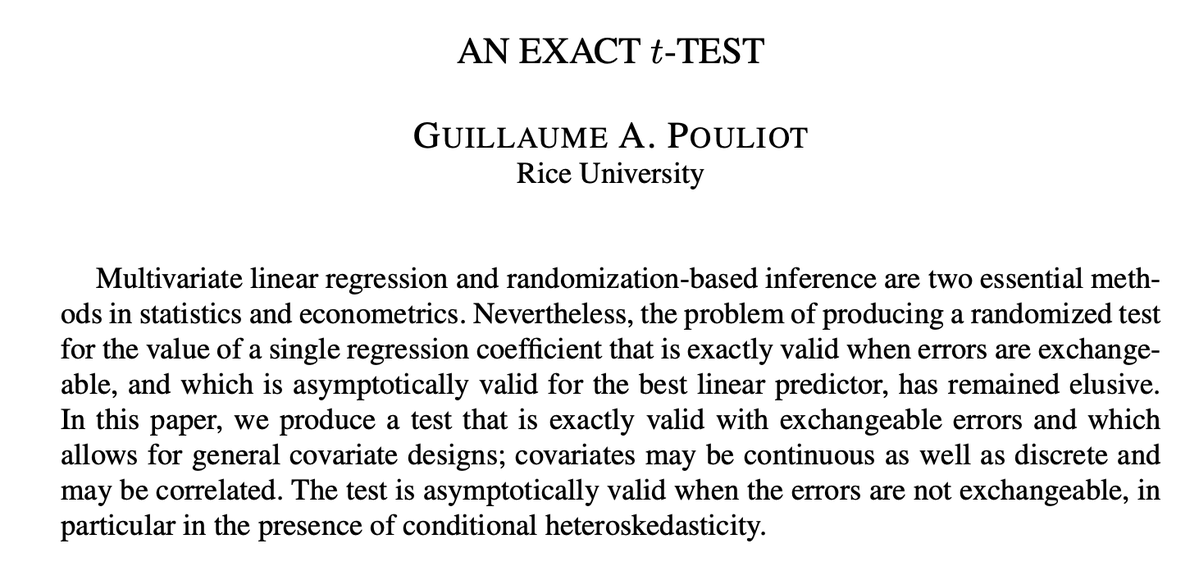
🚨 New paper alert 🚨
Are you also torn between small sample performance and robustness to heteroskedasticity? You can have both!
One can produce an exact test for subvectors that is asymptotically robust to heteroskedasticity.
Forthcoming Econometrica
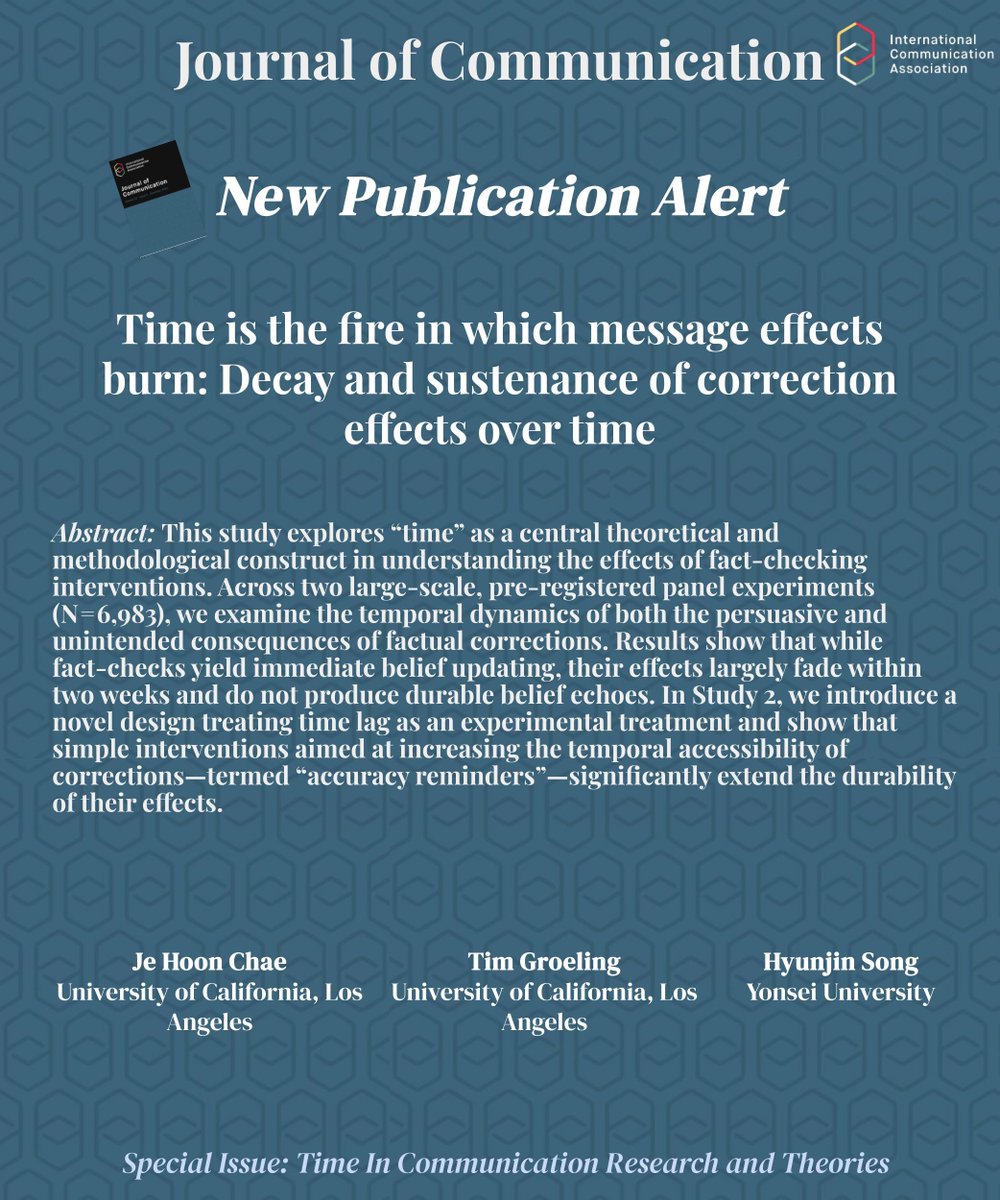
Pub Alert! Introducing new JoC SI publication: “Time is the fire in which message effects burn: Decay and sustenance of correction effects over time”, by Je Hoon Chae , Tim Groeling , Hyunjin Song. Read here: https://t.co/37P14JYqKe
I'm recruiting PhD students this year with strong interest in NLP @UCLA! If you are interested in understanding how we use language to effectively communicate, and how those insights translate to NLP models, apply to join the @CoalasLab. Continue reading for details! (1/5)
Political communication #polcomm scholars: I hope you’ll join me in being very excited about TWO new @CUP_PoliSci Elements in Politics and Communication, relevant to the current election campaign - one by @emilythorson and the other by Brian Weeks. (1/4)
[8/8] This paper is forthcoming in the journal New Media & Society and will be presented at the top paper session of the top paper session of @NatComm's political communication division this November in New Orleans (https://t.co/BxG7fzNKRz).
Preprint: https://t.co/ktSPX2mWWH
[1/8] @snopes has released LLM-powered FactBot (https://t.co/zQK05cf3SC). While AI has been used in fact-checking before, using text generation is a big leap.
Q: Will the previously observed effects of fact-checking persist when readers know AI is involved in the process?
[7/8] However, automated fact-checking is still new and doesn't always work ideally (see this thread: https://t.co/N5GIMWxQqH, or this paper: https://t.co/vaGkqkmROG). The impact of our findings depends on how automated fact-checking improves, balancing accuracy and transparency.
AI search engines use LLMs to summarize results for you, but can LLMs discern low-credibility sources from credible ones? Our paper measures the accuracy of LLMs' credibility ratings on news sources and political biases.
With @OSoMe_IU
🔗https://t.co/LfUoZZcQvH
1/9
The Cline Center is pleased to announce the 2024-2025 David F. Linowes Faculty Fellows: JungHwan Yang of @illinoiscomm and Yun Huang of @iSchoolUI
You can learn more about their projects and the Linowes Fellowship here: https://t.co/Em6qomdohy






![JehoonC's tweet photo. [1/8] @snopes has released LLM-powered FactBot (https://t.co/zQK05cf3SC). While AI has been used in fact-checking before, using text generation is a big leap.
Q: Will the previously observed effects of fact-checking persist when readers know AI is involved in the process? https://t.co/NhozqTWn2F](https://pbs.twimg.com/media/GXnzomSb0AAAVnC.png)