LATEST: ⚡️ Vitalik Buterin is pushing EIP-8288 for Ethereum's I-star fork, which he says would enable ultra-cheap quantum-safe signatures and private transactions at a fraction of current gas costs.
1. How important could this asset be in the finished global crypto system?
That is the blue Structural Importance Score.
2. How much of that potential has the market already priced into the token?
That is the green Relative Opportunity column.
That distinction is why the chart can simultaneously say bitcoin:native is structurally #1, while $LINK may offer vastly more uncaptured opportunity from its current valuation.
This 50-minute lecture by Jeff Bezos will teach you more about business than a 2-year MBA program.
Bookmark it and give it 50 minutes today, no matter what.
That's the main reason why you shouldn't trust anyone with so-called "predictions" and DYOR and analyze market yourself. Be patient, don't overcomplicate things and invest systematically.
P.s. It's also worth mentioning so-called YoungHoon Kim The "$220,000 Target"
LATEST: 🇺🇸 CFTC Chair Michael Selig says the CLARITY Act is the best way to prevent "another Gary Gensler from running a rogue campaign of lawfare" against the crypto industry.
BREAKING: Senator Cynthia Lummis says the CLARITY Act is scheduled for a Senate vote on Sept. 15 at 2 p.m.
POV: The 4 people still left in Crypto when it finally passes.
Strategy is no longer just a Bitcoin treasury.
It has built a capital structure around BTC — and now Bitcoin can be sold to support dividends, debt and liquidity.
That changes the risk completely.
More research →https://t.co/dtlmqup0Ug
Cost to run 1,000,000 Transactions 👇
( June 2026 )
algorand → $140
xrpl → $230
stellar → $240
aptos → $290
sui → $540
avalanche → $570
ton → $870
hedera → $1,500
solana → $1,990
base → $8,060
arbitrum → $8,820
polygon → $13,000
bnb → $57,960
cardano → $84,600
ethereum → $130,300
near → $163,200
bitcoin → $303,900
tron → $602,830
tron costs 4,306x what algorand does for the same million transactions.
data : @tokenterminal
Not every 100x carries the same risk. And not every "safe" bag actually protects you.
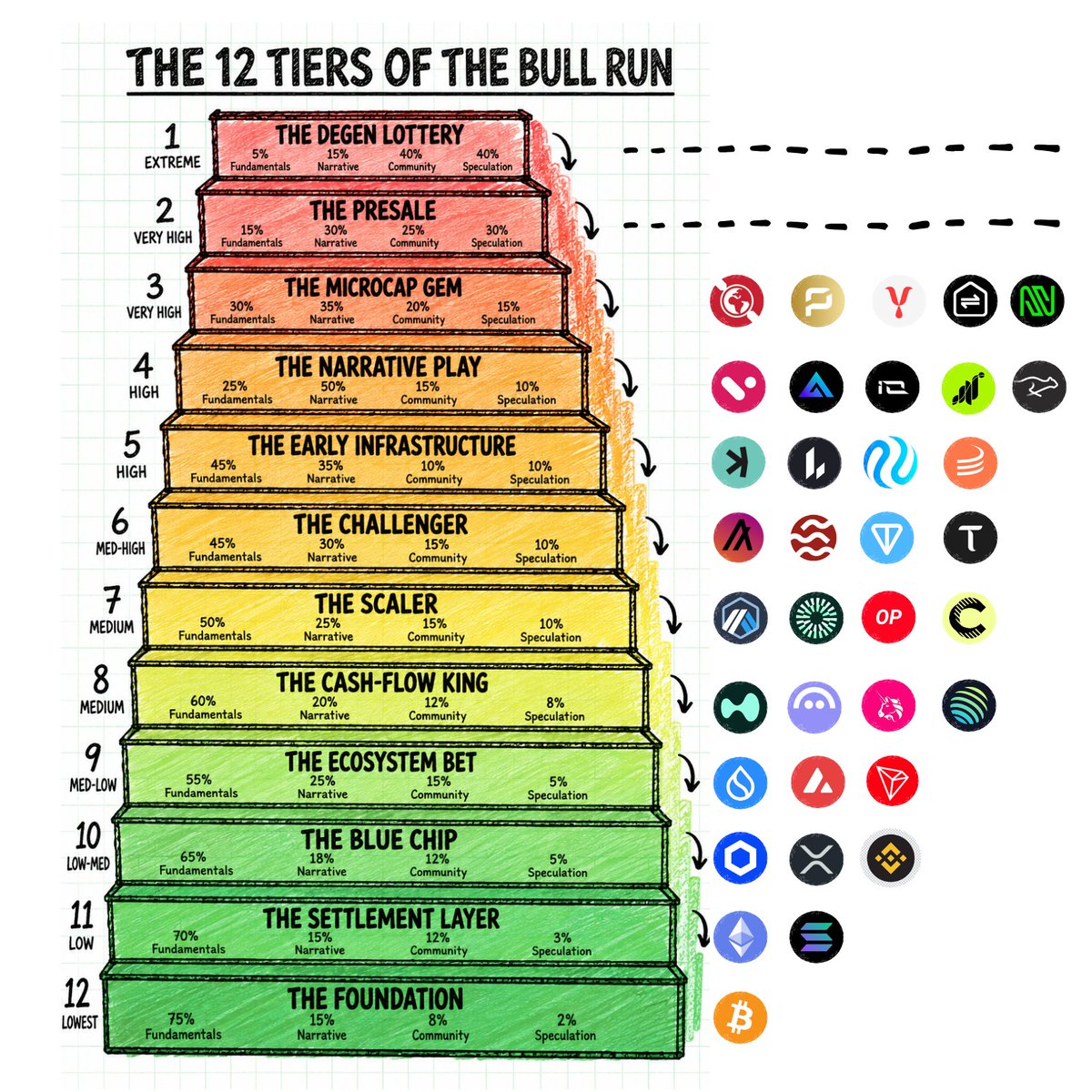
We mapped the market into 12 tiers - from Bitcoin bedrock to pure degen lottery ticket.
Where's your portfolio sitting? 👇
🟢 THE FOUNDATION - Risk: Lowest
The bedrock the whole market is priced against. Slowest mover, hardest floor.
Examples: $BTC
🟢 THE SETTLEMENT LAYER - Risk: Low
Ethereum and its staking/restaking economy, the base everything else builds on.
Examples: $ETH , $SOL
🟢 THE BLUE CHIP - Risk: Low-Med
Established top-20 with real product-market fit. Your sleep-at-night 2–5x.
Examples: $BNB, $LINK , $XRP
🟢 THE ECOSYSTEM BET - Risk: Med-Low
Large-caps - you're buying an entire economy, not one app.
Examples: $SUI, $AVAX, $TRX
🟡 THE CASH-FLOW KING Risk: Medium
Protocols that actually print fees. Revenue > emissions. Survives bears.
Examples: $HYPE, $AAVE, $UNI, $JUP
🟡 THE SCALER - Risk: Medium
L2s and smaller chains with live users and fee revenue. Beta on their ecosystems.
Examples: $ARB, $MNT, $OP, $CC
🟡 THE CHALLENGER - Risk: Med-High
Mid-caps trying to flip an incumbent. Traction proven, dominance isn't.
Examples: $ALGO, $SEI, $GRAM, $TAO
🟠 THE EARLY INFRASTRUCTURE - Risk: High
Picks that are either early or way below their ATH and still have potential.
Examples: $KAS, $LIT, $INJ, $SYRUP
🟠 THE NARRATIVE PLAY - Risk: High
Riding whatever meta liquidity is rotating into this cycle. Timing is everything.
Examples: $VELO, $GMX, $IO , $GRASS, $KTA
🟠 THE MICROCAP GEM - Risk: Quite High
Small cap gems with a real thesis. Where "early" actually means something.
Examples: $GEOD, $ARRR , $SN3, $PROPS, $NOS
🔴 THE PRESALE - Risk: Very High
Buying the story before the chart exists. Unlock-heavy, FDV matters most.
Examples: live IDOs on Legion, Buidlpad, AlphaMind
🔴 THE DEGEN LOTTERY - Risk: Extreme
50–1000x dreams, ~99% go to zero. Pure community + speculation.
Examples: today's https://t.co/QGARFYDN0c runners, LetsBonk launches, fresh Believe coins
Two weeks ago, Ethereum researchers met in Berlin to continue charting the protocol's long-term trajectory, following along discussions with client teams in Svalbard in April.
The updated strawmap is at https://t.co/9e2AQ6rhz6, and I attached a picture of it to this post.
My own high-level takeaways:
* "Lean Ethereum" is not a single one-shot upgrade, it is a collection of improvements that will come online to the Ethereum network over the course of three or four years. But make no mistake, this IS the third major iteration of Ethereum in the same way that the Merge was the second. Almost every major piece of the protocol will be replaced:
- Verification through recursive STARKs, rather than direct re-execution. Recursive STARKs become an enshrined first-class core component of the protocol
- Replacing everything quantum-vulnerable with quantum-safe alternatives
- Consensus: decoupled available chain and finality, one or two-round finality. Theoretically optimal security properties, simpler than today, and faster than today
- Multidimensional gas
- State: not just tree structure, but what *types* of state are available
- Changes to client architecture
...
At the same time, simplification, cleanup and future-proofing. And this will all be done in a way that minimizes disruption to existing application. We've done this before (the Merge), we can do it again.
* H-star (aka Hegota) is probably Ethereum's last thematically "pre-Lean" fork. Starting from I-star, most of everything we do will have a very strong "Lean" feel to it in one way or another.
* Privacy is no longer an afterthought, it is a first class goal. When designing Frames, the mempool, additions to the state tree, we explicitly ask the question "okay, how do quantum-safe, intermediary-free privacy protocol transactions go through this, and what is the overhead?"
* Formal verification of everything for security.
* FV also makes us much more comfortable with canonicalization (having pieces of the protocol that are directly defined as a piece of bytecode expressed in some language). evm-asm is being written in part to become a canonical proof system for the EVM.
* Quantum safety has shifted up a LOT in priority. This adds a lot of work (eg. finalizing a quantum-safe blobs design has become urgent; this work has already been ongoing for months)
* Probably the single most disruptive part of the plan is the changes to state. There is growing consensus around leaving present-day-style "dynamic state" mostly unchanged, but scaling it only a medium amount, and adding new types of state that are more scalability-friendly (eg. no need for builders to sync/store all of it) but more restrictive, and that will scale a large amount.
eg. possible Ethereum in 2030: 2 TB of present-day-style (dynamic) state, and 100 TB of new-style (scalable but restrictive) state
This "new-style" state would work very well for ERC20s, NFTs, many defi use cases, but not eg. highly "central" objects like Uniswap contracts, or onchain order books, or other complex things (which are crucial for Ethereum but which only take up a small percentage of state)
Hence, it will not be *necessary* to rewrite any apps, but it will be *very cost-effective* to eg. rewrite an ERC20 token into a newer design that uses a new type of UTXO storage that is currently being explored, so that it will have >10x lower txfees.
Design of these new state types (current ideas: keyed nonces, ring buffers, UTXOs, statically accessible state, temp state) is an area where we will need a lot of feedback from application developers (incl. privacy-friendly application developers) and probably several rounds of rethinking and iteration.
* In the context of a much larger total state size, we need to figure out the incentive issues around who stores this state and what motivates them to. Even saying "each node stores 1%" is not good enough - why do they store that 1% and why are they willing to serve it? This is being elevated as a first-class research area.
* Ethereum will need to have a "VM" other than EVM in one form or another - at the very least, we need something like leanISA for recursive STARKs - and the gains are large in exposing it to users so that we support programmable privacy and better scalability. Right now, the most likely contenders are leanISA and RISC-V.
My own ideal is that in this world, we adjust the protocol so that the EVM becomes a high-level-language compiler-level feature, and the protocol only "sees" RISC-V / leanISA directly. But this is still far away.
* Gas limit increases, blob increases and slot time decreases will happen many times over the next ~5 years. We expect a large gas limit increase with Glasterdam. Each step of increased scale or decreased slot time is a matter of getting to the point where it is safe to do it, which comes from a combination of client optimization and protocol changes.
Ethereum is CROPS.
Ethereum is scaling.
Ethereum is reinventing itself.
Onward.
MOST PEOPLE WILL REGRET IT
Even I realised it this week after seeing this chart.
In June 2022, Bitcoin hit $17K.
Everyone was waiting for $10K.
It never came, Bitcoin moved up and Altseason 2023 started.
The people who started DCA-ing around $17K to $20K won the cycle. The people waiting for the perfect bottom watched Bitcoin leave without them.
And we may be seeing the same setup again.
Two days ago, I posted about Bitcoin possibly revisiting $30K. I was wrong, and I want to say that clearly.
The $60K floor has held much stronger than I expected, and the accumulation signals around this range are starting to tell a different story.
👉 THE REAL STRUCTURE
In 2022, $30K was the previous cycle’s all-time high.
Bitcoin crashed below it, found a floor near that zone, spent months going sideways, and then never looked back.
Today, $60K is the previous cycle’s all-time high.
And Bitcoin is sitting right on top of it.
That is not random.
That is market structure.
👉 THE SAME MISTAKE AGAIN
The people waiting for $25K are making the same mistake the $10K crowd made in 2022.
They are anchoring to a number that feels safe because the market panic makes it sound possible.
But the chart is not supporting that idea right now.
The $60K range is behaving less like a weak support and more like a stronghold.
Institutional accumulation is not happening at imaginary lower levels.
It is happening here.
👉 THE TAKEAWAY
Could Bitcoin dip further?
Of course.
A move toward $50K is still possible, and honestly, that would probably be a gift.
But $25K looks very unlikely unless the entire macro structure breaks.
The winners in 2022 were not the people who called the exact bottom.
They were the people who recognized the accumulation zone and acted.
That zone might be right here.
Do not wait for a number that probably never comes.
BITCOIN JUST BECAME IMPOSSIBLE TO SHUT OFF!
Jack Dorsey built an app that moves it with zero internet.
Bitchat uses Bluetooth mesh.
You sign offline, it hops phone to phone.
Kill the internet. The money still moves.
Legend!
Dear crypto enthusiasts and all people who want to invest. Remember please some unspoken rules when it comes to investing:
- Dyor systematically
- Never invest amount of money you cannot afford to lose (etc. debt)
- Be patient and rebalance when receiving profits...