Thanks my co-advisors Pietro Perona & @yisongyue & committee (@Antihebbiann, @swarat, @klbouman)!!
I'm grateful for the opportunity and everyone's support through the challenging & rewarding journey. I'm looking forward next steps in collaborative AI for Scientists!
Introducing Live Interactive Training for Video Segmentation (#CVPR2026)
User corrections help fix errors in challenging scenarios, but current interactive systems typically use this feedback to refine predictions rather than learn from it.
Can we make these corrections help the model adapt and reduce repeated user effort?
We introduce LIT-LoRA, a lightweight plug-and-play module for interactive test-time adaptation through human feedback. When a user corrects an error, LIT-LoRA updates on the fly and helps fix similar future errors.
Highlights:
📉 18–34% fewer user corrections on challenging VOS benchmarks
⚡ ~0.5s online update overhead per correction
🧩 Plug-and-play across different models and tasks
Excited to share FormulaCode, a continually updating benchmark for evaluating the holistic ability of LLM agents to optimize codebases. Our current dataset consists of 957 tasks curated from 245477 pull requests in 70+ repositories (and growing!).
🌐 https://t.co/bmUgfZkvsw
🧵👇
.@Cornell is recruiting for multiple postdoctoral positions in AI as part of two programs: Empire AI Fellows and Foundational AI Fellows. Positions are available in NYC and Ithaca.
Deadline for full consideration is Nov 20, 2025!
https://t.co/HHzyB7vNCB
Thrilled to share our latest work on SciVid, to appear at #ICCV2025! 🎉
SciVid offers cross-domain evaluation of video models in scientific applications, including medical CV, animal behavior, & weather forecasting 🧪🌍📽️🪰🐭🫀🌦️
#AI4Science#FoundationModel#CV4Science
[1/5]🧵
Check out our LMLM, our take on what is now being called a "cognitive core" (as far as branding go, this one is not bad) can look like, how it behaves, and how you train for it.
https://t.co/gxrDVSkcZE
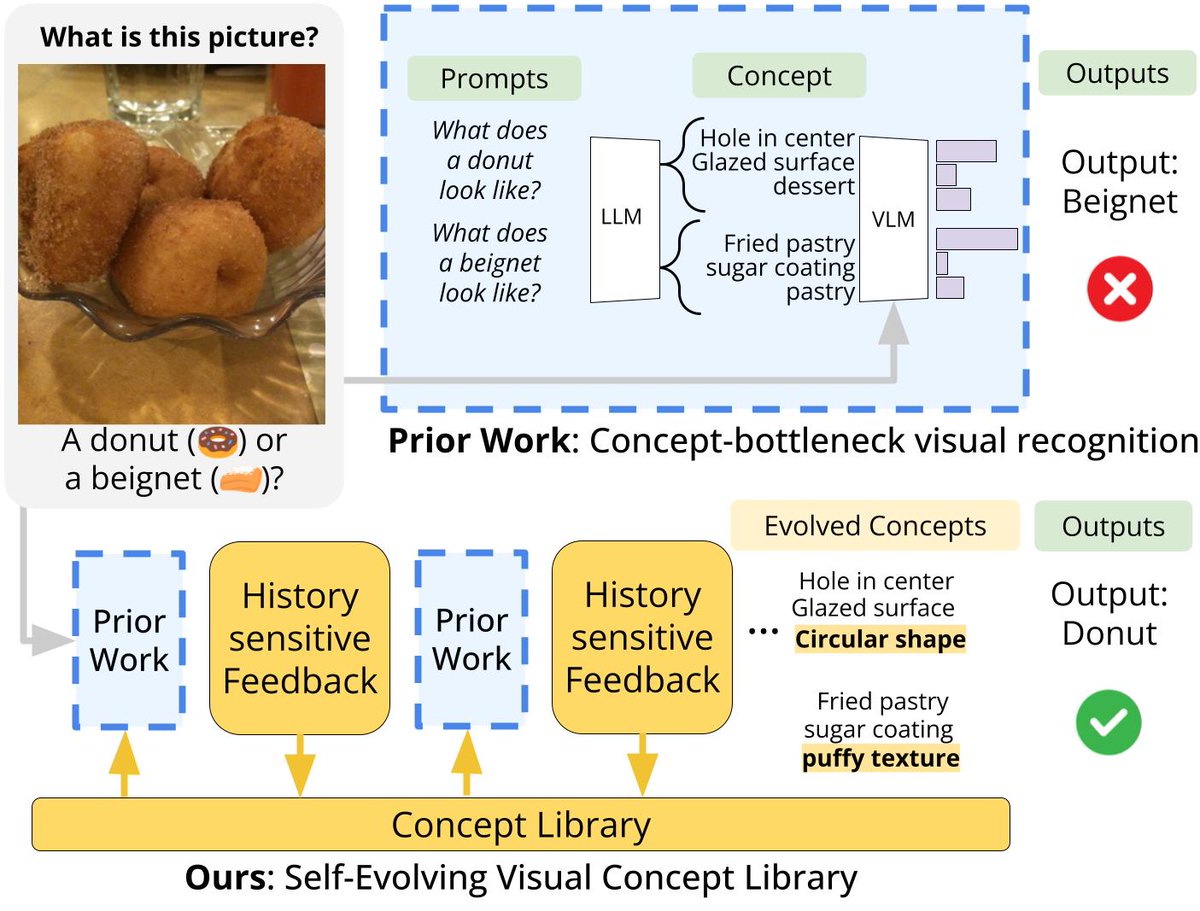
I’m presenting Escher (https://t.co/oNYHQeUaBH) at #CVPR2025 Saturday morning (Poster Session #3; #236). Escher builds a visual concept library with a vision‑language critic (no human labels needed). Swing by if you’d like to chat about program synthesis & multimodal reasoning!
Introducing VideoPrism, a single model for general-purpose video understanding that can handle a wide range of tasks, including classification, localization, retrieval, captioning and question answering. Learn how it works at https://t.co/vAVqXo8g4j
After over 15 months, we are excited to finally release VideoPrism! The model comes in two sizes, Base and Large, and the video encoders are available today at https://t.co/imLrPYAnEk.
We are also working towards adding more support into the repository, please stay tuned.
🚀Excited to share our latest work:
LLMs entangle language and knowledge, making it hard to verify or update facts.
We introduce LMLM 🐑🧠 — a new class of models that externalize factual knowledge into a database and learn during pretraining when and how to retrieve facts instead of memorizing them.
🧠Why LMLM?
• Learning to look up facts is easier than memorization
• Externalizing knowledge improves factual precision
• Enables instant machine unlearning by design
LMLM opens new directions for how future language models can manage and access knowledge.
📄 [ArXiv] https://t.co/CJFzyBtoiM
🌐 [Project Page] https://t.co/dt2t9m656V
💻 [Code] https://t.co/vIx1vKPNXC
🎤 [Talk] https://t.co/60CiOXfdEO
Huge thanks to my amazing collaborators:
@linxizhao4@sofianzalouk Christian Belardi Justin Lovelace @JinPZhou
And to our incredible advisors @KilianQW, @yoavartzi, and @JenJSun for their generous support and insight.
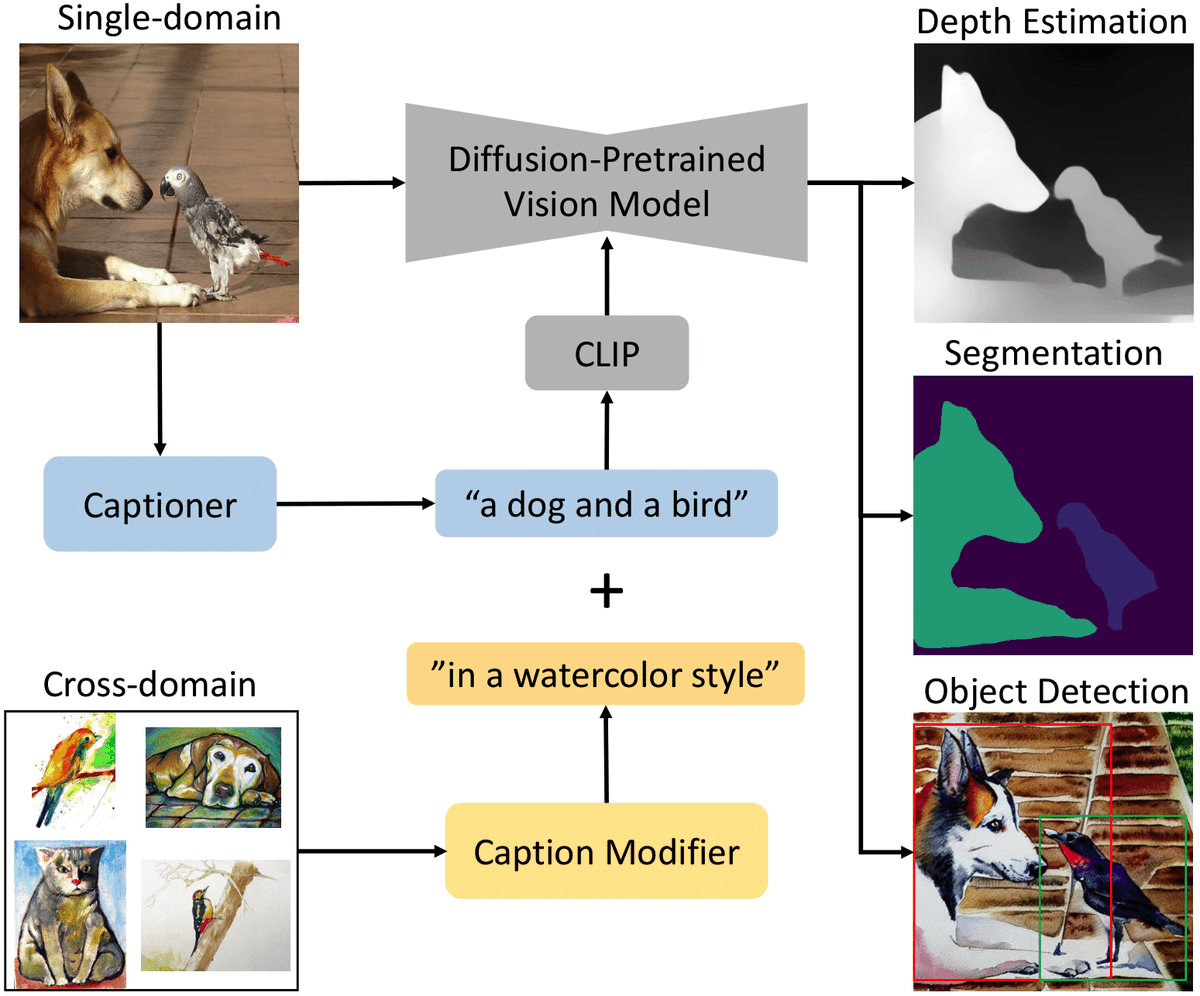
We're excited to share our latest work! We achieve SOTA results in segmentation, detection, and depth estimation, in single and cross-domain, by exploiting image-aligned text prompts in a pretrained diffusion backbone repurposed for vision tasks.
See https://t.co/fGI2UfvJwS
🧵👇
Won't you be my neighbor? Northwestern Neuroscience in downtown Chicago is running a broad faculty search:
https://t.co/KYH63sE27e
Come join a large and growing neuroscience community!
Huge thanks to additional co-authors: Andrew Ulmer who helped develop our benchmark, @__dipam__ for developing the eval framework, and MABe22 Challenge winners Ed Hayes, Heng Jia, Sebastian Oleszko, Zach Partridge, Milan Peelman, Chao Sun, Param Uttarwar, and Eric Werner!😊
We are presenting our MABe22 dataset at ICML!
Our dataset studies representation learning of video and trajectory data - the representations are evaluated on a large set of downstream tasks.
MABe22 organisms include mice, flies, and beetles!
Paper: https://t.co/QV1Kyny4yZ
Thanks to @Antihebbiann and @KristinMBranson for co-organizing the MABe 2022 Workshop & Challenge and their work on the MABe 2022 benchmark!
And to @yisongyue, Pietro Perona, and @_tingliu for advising our workshop hosted this year at CVPR.
https://t.co/d18NS30KRb




![yanahasson's tweet photo. Thrilled to share our latest work on SciVid, to appear at #ICCV2025! 🎉
SciVid offers cross-domain evaluation of video models in scientific applications, including medical CV, animal behavior, & weather forecasting 🧪🌍📽️🪰🐭🫀🌦️
#AI4Science #FoundationModel #CV4Science
[1/5]🧵 https://t.co/ICrf0OzVtU](https://pbs.twimg.com/media/GvVCfOmW0AEIPzy.jpg)