President and CEO, Collecdev-Markee Developments. Former Chief Planner, Toronto. Distinguished Visitor in Planning Emeritus, University of Toronto. Optimist.
Love to see it. When I was Chief Planner I had a picture of my once 86 year old grandmother blissfully cycling to visit friends (in Holland, of course). It was a source of inspiration for what might be possible in our city. So your note is a full circle moment for me. Thanks for sharing.
@jen_keesmaat@TorontoStar I’m so grateful for your planning of lanes in Toronto. Here’s my 84 year old father utilizing active transit every day. Traffic is moving well for the increase in density. Bike lanes are a 6-60 essential mode of healthcare and transport.
There’s no mystery behind Mayor Olivia Chow’s budget record. Just math that is readily available for all to see in 100's of pdf's available on line. The budget is public.
The candidates complaining about the increases should tell us what they plan to cut: Of the $882 million in new spending under Chow, about 30%, or $266 million, went to an increase in the police budget. Libraries are now open on Sundays. Crisis response teams now work alongside police to help people in distress on the street. Traffic agents. Wheel trans to improve accessible transit.
There is also proof in the pudding: less homelessness in Toronto (8%) at a time when everywhere else in the Province there have been surges (23% Province-wide). Spending strategically and surgically, and measuring outcomes, has been working. We need more of this, not less.
If candidates have a beef with spending, they should point out what they would cut, specifically.
https://t.co/rzAEMqXuH3 via @torontostar
Doctors for Safe Cycling - you know, the people who treat the consequences of unsafe streets in the ER - gathered in Toronto today to protest provincial interference in our street infrastructure.
Spending $43 million to make our streets less safe will put even more pressure on our ERs. They know it.
https://t.co/4sf4PwvQzC
Doctors for Safe Cycling - you know, the people who treat the consequences of unsafe streets in the ER - gathered in Toronto today to protest provincial interference in our street infrastructure.
Spending $43 million to make our streets less safe will put even more pressure on our ERs. They know it.
https://t.co/4sf4PwvQzC
What will it take to move more housing projects from ambition to construction?
Join us at Canada Builds Modern, October 7–8 at The Globe and Mail Centre, Toronto. Meet the people working on the financing, partnerships and construction methods to make it happen.
In the room: Build Canada Homes, Building Ontario Fund, Toronto’s Housing Development Office, BC Housing, Toronto Community Housing, and not-for-profit housing providers ready to build.
Bring your delivery challenges. Find people to help solve them.
New processes. New delivery models. Modern methods of construction.
If you develop, finance, approve or build housing, join us to help shape a roadmap for action—and the partnerships to put it to work.
Limited tickets left! Register now:
Register: https://t.co/fsAeE8UnJs
There’s no mystery behind Mayor Olivia Chow’s budget record. Just math that is readily available for all to see in 100's of pdf's available on line. The budget is public.
The candidates complaining about the increases should tell us what they plan to cut: Of the $882 million in new spending under Chow, about 30%, or $266 million, went to an increase in the police budget. Libraries are now open on Sundays. Crisis response teams now work alongside police to help people in distress on the street. Traffic agents. Wheel trans to improve accessible transit.
There is also proof in the pudding: less homelessness in Toronto (8%) at a time when everywhere else in the Province there have been surges (23% Province-wide). Spending strategically and surgically, and measuring outcomes, has been working. We need more of this, not less.
If candidates have a beef with spending, they should point out what they would cut, specifically.
https://t.co/rzAEMqXuH3 via @torontostar
My first choice is always to bike to work, which is how I get to work for about 7-8 months of the year (depending on the weather). It is fast, reliable and enjoyable.
When safety was a serious issue on the TTC a few years back, I either cycled or I drove.
Now that safety on the TTC has improved considerably (not perfect, but much improved), my second choice is TTC.
I think a lot of people underestimate how many people on bikes or the TTC are choosing to leave their cars at home. Every time this happens, it is a win for the city and for public life.
So making transit and cycling great should be a priority. Reduced congestion, quieter streets, healthier residents, a safer city. It’s only good.
@jen_keesmaat These stats seem irrational to me and I’d love your thoughts. I live near Jane station so typically take subway to work. Occasionally take a bike (depending on weather) but if no bike lane, I would TTC. Just can’t seem to believe how someone who bikes to work will now drive.
@jen_keesmaat Toronto is a winter city. Many cyclists are violent and angry people who won’t follow the rules of the road. Rip the lanes out and let’s stop this kumbaya lunacy.
Yes I had a boss once who told me my downfall will be that I am too logical and the world is not a logical place.
Now I build housing and all of the business people that I once thought were ruled by data, evidence and logic are so emotional that they almost run on fumes.
So I have learned.
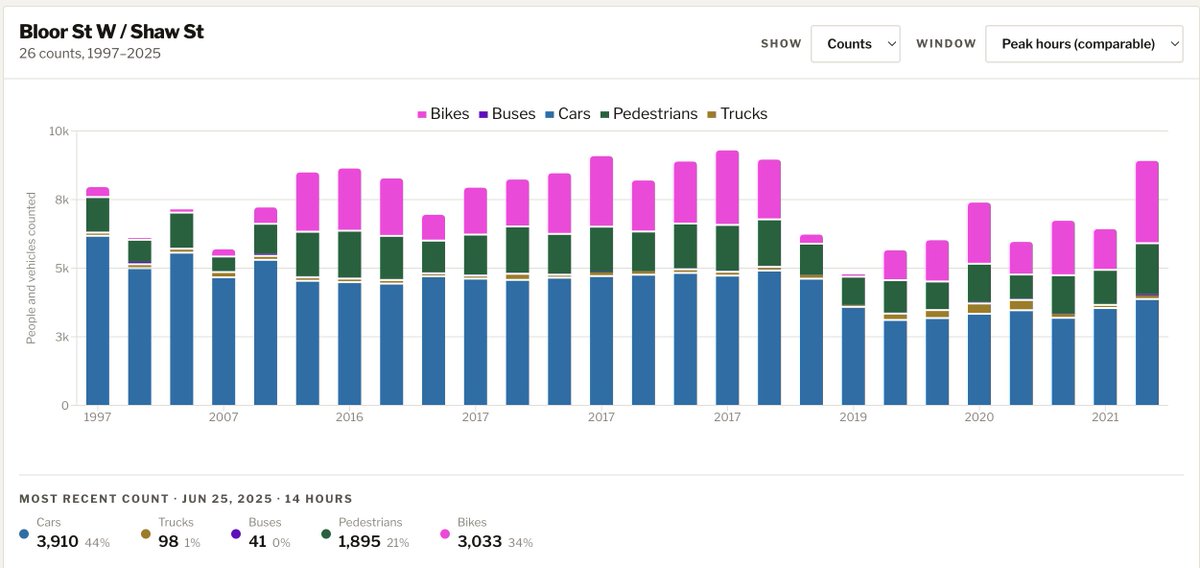
Only around 40% of rush hour traffic at Bloor and Shaw in Toronto is made up of cars. Before the bike lanes on Bloor, over 80% of traffic was cars. Now more commuters pass through the intersection, although raw number of cars has decreased. If you build it, they will come.
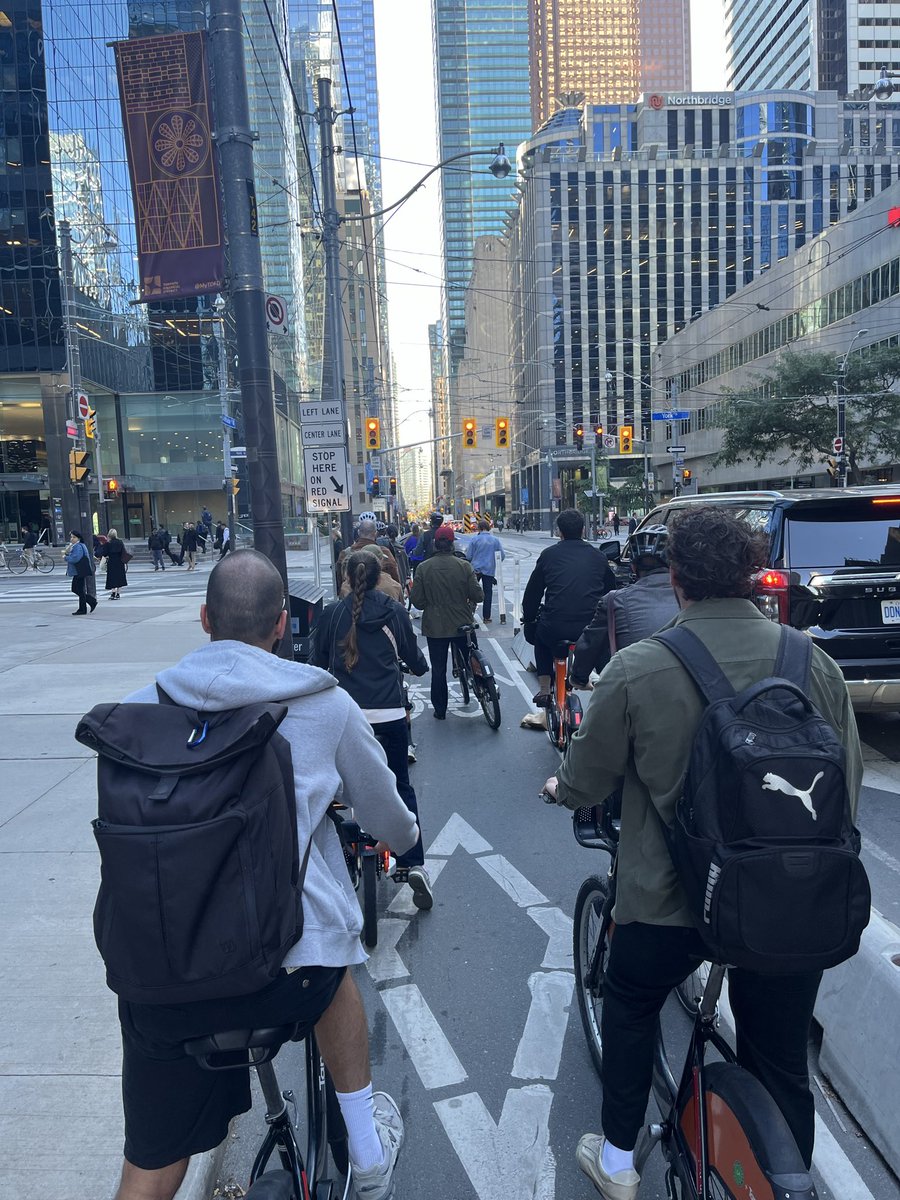
The case for bike lanes in dense cities is actually pretty simple: there’s no room to build more roads. Want to ease congestion? You either reduce the number of cars (congestion pricing) or use existing road space more efficiently.
This is what the latter looks like.
A deserved compliment to the City of Toronto: our downtown is thriving.
But we also know there is more visible despair on our streets and across our transit system than there was before COVID. That is the reality.
Homelessness, addiction and mental illness are also intensifying in cities across North America. These are not uniquely Toronto problems.
So how are we doing?
Good work was done during COVID under Mayor John Tory, and it has continued and been expanded under Mayor Olivia Chow, to promote Toronto as a place to work and invest, while responding more effectively to homelessness.
In October 2025, a point-in-time count found a 21% year-over-year reduction in homelessness, with declines in both sheltered and unsheltered homelessness. The number of encampments also fell significantly as thousands of people moved into shelter and permanent housing.
This didn’t happen by accident. It was the result of strong public policy and action by the Mayor, Council and the Toronto public service. We need to notice it, applaud it and make sure the work continues.
That does not mean the crisis is over. Far too many people are still living without safety or dignity. They need help.
There is also an enormous amount left to do on cleanliness, public safety, transit reliability, service levels and affordability.
We should be honest about what we can fix at the municipal level and recognize what the City has done that is working.
Downtown LA office buildings are over 40% vacant. Class A office buildings in the downtown Toronto financial district are 90% full. Don’t blame COVID or back-to-work rules for Downtown LA’s decline. Blame our elected officials. They drive through Downtown LA every day to get to City Hall and see the crime, blight, and encampments. A tough environment to work in. Are they blind or incompetent?
You may disagree with how the City spends money. But it is demonstrably false to suggest that Toronto’s budget has gone unscrutinized - internally or externally - for 15 years.
Toronto’s budget process is rigorous, public and independently recognized. It is not merely an internal administrative exercise as you imply. Mayor Tory deserves credit for much of this rigor. Mayor Chow has maintained the award-winning process over the past three years.
Every division and agency submits detailed operating and capital budgets covering service levels, staffing, revenues, expenditures, performance measures, equity impacts and proposed savings. Staff conduct line-by-line reviews using three to five years of actual spending.
The public can examine divisional budget and briefing notes, watch committee deliberations, make written submissions and speak directly to the Budget Committee. More than 25,000 residents participated in the 2026 process.
The process integrates an $18.9-billion annual operating budget with a $63.1-billion, 10-year capital plan and the City’s long-term financial strategy.
ALSO, Council receives public operating and capital variance reports throughout the year, supported by divisional dashboards and in-year adjustments.
There are also multiple layers of independent oversight. The Auditor General conducts value-for-money audits, while an external auditor examines the City’s annual financial statements. KPMG issued clean audit opinions on Toronto’s 2025 statements.
Toronto’s budget has received the Government Finance Officers Association’s Distinguished Budget Presentation Award for 15 consecutive years. The award assesses whether a budget excels as a policy document, financial plan, operations guide and public communication tool.
The process also reflects internationally recognized OECD principles of sound budget governance, including long-term planning, transparency, public participation, performance measurement, effective execution and independent oversight.
Bradford has been on Council since 2018. He has served on the Budget Committee, chaired a budget consultation subcommittee and served as vice-chair of the Budget Committee.
He knows how rigorous and public this process is.
Disagree with the spending decisions, that is fair game.
But don’t pretend the scrutiny doesn’t exist.
Why misrepresent a process you know firsthand?