“What do you think happens when we die, Keanu Reeves?” That answer brought tears—didn’t expect it. Keanu Reeves, you beautiful man.
https://t.co/tRXu9YOcs6
Amol Rajan, "Britain today is stuck, isn't it?"
Alan Sugar, "It's stagnant"
Amol Rajan, "Declining?"
Alan Sugar, "It's got a lot to do with Brexit"
"Brexit is the biggest disaster I have experienced in my whole lifetime, business career"
"Brexit was a total absolute disaster, and anybody who says it's not is deluded"
Amol Rajan, "What do you think it would take to get this country growing again?"
Alan Sugar, "Go back into the European Union"
"I've never met Starmer but if I ever did I'd ask if it's possible? What mechanism would it take to effectively get down on our bended knees and beg to be allowed back in again"
"That's what I would do. If I was in charge, I'd beg to get back in again"
Amol Rajan, "I've never really associated you with begging"
Alan Sugar, "Exactly. That's how bad it is"
Congrats on your win, Colin Farrell!
Here's to winning the #GoldenGlobes award for Best Male Actor – Limited Series, Anthology Series or Television Motion Picture for The Penguin 🍿
164 years ago today a Belgian designer called Victor Horta was born.
You probably haven't heard of him, but he was one of the most important architects in history.
Why? Because Horta created Art Nouveau...
Seth Meyers vanished for 3 weeks, and it just so happened to be the exact time Trump’s campaign decided to implode in slow motion.
Last night, Seth returned with a recap so savage, even his clip needed a trim. My bad for the edit, but trust me, it's worth it! 😂😂😂
My thoughts on $LMND from a June News of the Week article:
Lemonade as an Investment:
Lemonade trades for about 2x enterprise value to 2024 gross profit (EV/GP). It has a $1.50 billion market cap, with $925 million in cash and equivalents on its balance sheet. That gives it an enterprise value of $575 million – and the cash pile is actually safe. Through its synthetic financing agreement, it has consistently moved up its path to breaking net cash flow positive, with the end to its now modest cash burn coming this year. It also continues to move up its schedule to FCF and EBITDA, as it now expects those milestones to come in 2025. Furthermore, it recently hinted at its 25% annual top-line growth forecast being raised in the near future.
This company is better at managing growth and margin than any young, $1 billion enterprise should be. It has a masterful ability to control spending, manage headcount with more automation and deliver more profit when it needs to. That was demanded throughout 2022 and 2023 as cost of capital rose, investor preferences changed and it awaited regulatory approvals to hike premiums amid rampant inflation. It pulled back heavily on growth to reach profitability and to wait for the regulatory backdrop to enable profitable expansion. It did so beautifully, and managed to maintain 20%+ premium growth despite the aggressive cuts.
Now? It’s ready to start leaning back in with the same added spending scrutiny that it has embraced. This GenAI-native company has obsessively infused more AI into everything it does to unlock greater scale… without headcount or OpEx growth occurring in tandem. This should enable more explosive operating leverage, more profit beats and more progress to breakeven – all while it accelerates demand growth considerably through 2024. This will play out as entrenched incumbents have vacated some markets like California. This is also playing out as inflation rates cool, premium approvals flow in and Lemonade enjoys much larger portions of the country to profitably sell its products to.
Let’s do some extremely speculative and overly simplistic modeling for more context. Say Lemonade compounds revenue at a 25% clip for the next 4 years. Assume its gross margin does not improve at all from the 30% level where it sits today. Then assume it reaches a 5% EBITDA margin in 2028 (similar FCF margin). That’s still materially worse than incumbents, conservative on growth estimates and conservative on gross margin. This scenario would leave us with $65 million in 2028 EBITDA. Even if we assume its EBITDA multiple is far below its EBITDA growth rate, call it 20x, that puts it at a $1.3 billion enterprise value in 4 years vs. $575 million today.
This investment is still extremely speculative and the company still has a lot to prove. I'm 27 and have no kids or debt (renter). If I were 47 with kids and debt, I'd likely be less aggressive here. Different circumstances call for different approaches.
Things could always turn sour, underwriting progress could revert, growth could slow more sharply than I expect and this investment could always fail. If they continue to execute exactly how they have since the end of 2022, I think there’s a lot to like here. CFO Tim Bixby does too as he bought some share recently.
A Review of How Lemonade Tries to Stand Out within Insurance:
For years, Lemonade has been arguing that its tech-native, AI-first, cohesively-designed infrastructure and app form its edge. It has been telling investors that its ability to ingest and utilize vast sums of data differentiates it from other insurance disruptors. It has been explaining how legacy incumbent systems are too manual, too siloed and too entrenched for competition to appropriately utilize data scale advantages… with it also being too costly for them to rip and replace systems. And? It has been insisting on this set-up powering immediate claim handling, compelling unit economics, and the beginnings of a giant corporation.
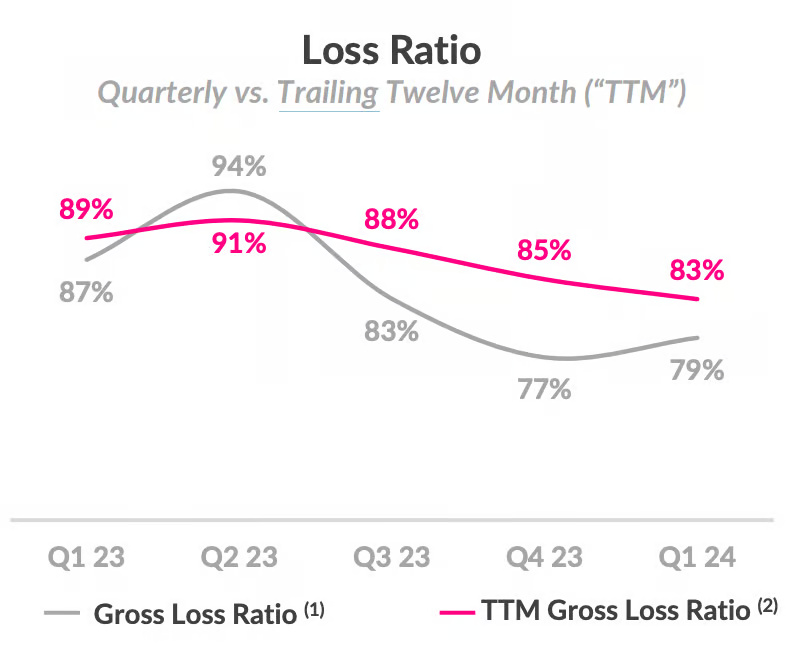
We're starting to see real proof beyond internal NPS claims and asserting that its underwriting models are better. Proof-point number one is the wonderful loss ratio trends that we’re now seeing play out as of last quarter:
For the chart above, focus on the trailing 12-month improvement more so than the gray line. Weather and catastrophic (CAT) events are seasonal; looking at annualized progress helps to eliminate this noise. The main source of improvement here was encouragingly not CAT event favorability. Instead, it was premium rate filing approvals and its discipline to wait out these approvals before it leaned back into originations. It wasn’t willing to originate cash-burning plans for the sake of growth. With approvals coming in for key states like California, growth opportunities are becoming profitable once again (more on this later). Excluding CAT events, a 63% GLR improved 10 points Y/Y and 9 points Q/Q to offer more proof of this improvement being structural in nature.
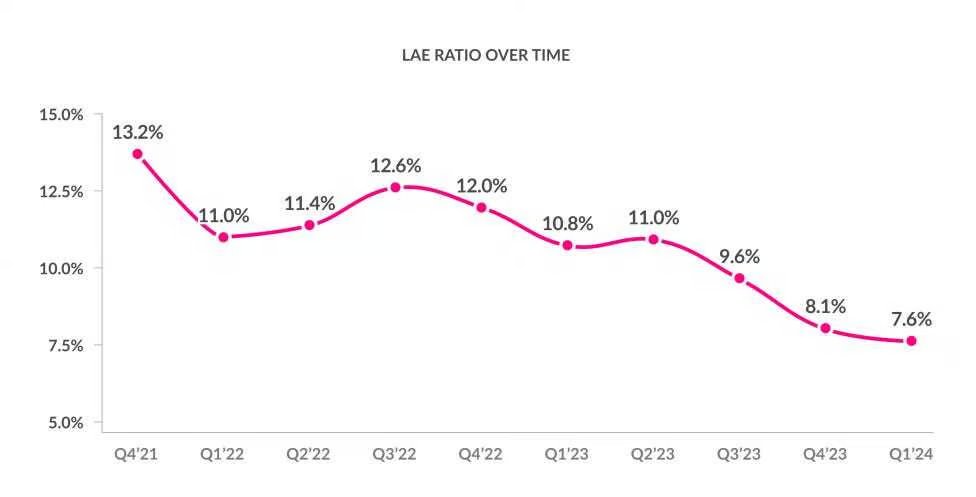
Proof-point number two is a favorable cost to serve vs. others. Insurance is a commodity. Lemonade does stand out within customer service and app interface, but the best way to differentiate within insurance is via cost advantages. Last quarter, Lemonade offered new disclosures showing its advantage in these areas. Loss Adjustment Expense (LAE) measures cost associated with handling claims and operating efficiency. It’s one thing to say Lemonade’s tech-native ecosystem offers cost edges. It’s another thing to show it in LAE. Per Capital IQ, a typical LAE is about 10% for a mature brand with fully realized economies of scale. Lemonade is far from mature, yet boasts an LAE of 7.6% (lower is better). The compelling trend is expected to continue.
This is intuitive. It has no agents to pay perpetual commissions to; its real estate footprint is comparatively tiny. Its AI-first product suite automates a large chunk of claims and customer service responses… and that automation frees Lemonade to grow its business while avoiding costs scaling in tandem. The margin trend charts above are evidence that as OpEx growth stays near 0% and the business expands. Lemonade is forming a defensible, structural competitive advantage in a sector where that’s tough to pull off.
Where else does an overall cost-to-serve edge help? I’m so glad you asked. It allows Lemonade to rationally undercut competition, boost growth spend or simply harvest more margin from its book of business. It already offers best-in-class rates on renters insurance; lower fixed costs allow Lemonade to rationally pursue these tiny premium plans. That has made Lemonade a share leader for young, first-time U.S. renters. These customers will need much more insurance over time, and Lemonade’s customer delight gives it a great chance of securing that added business.
Other signs of (real, tangible) GenAI prowess:
-- 98% of policies are sold with no human intervention.
-- More than 50% of claims are issued and processed with no human intervention.
-- 33% of all customer service inquiries are handled with no human intervention.
-- Lemonade continues to briskly compound top line numbers with barely any cost growth.
$TDOC is one of the biggest losers I sold. I paid an average price of $97.5 and sold at $33. That's a loss of 66%. 😭
Since I sold, the stock is down another 72%.📉🤯
It's essential to learn from your mistakes. And this is what I learned from $TDOC:
1. Huge acquisitions are an orange flag.
2. Huge acquisitions at obviously inflated prices are big, hairy red flags.
3. Most acquisitions are value-destructing. This also applies if you hold the acquired company, like I did with Livongo. As a reminder: $TDOC paid $18 billion for Livongo and its current market cap is (wait for it) $1.5 billion.
4. Management matters, even a lot more than your maximum impact guess. If management feels bad or mediocre, it probably is.
5. I didn't do enough research on $TDOC. I was a Livongo shareholder and that's how I got into the stock and $TDOC "looked" good. I had done deep research on Livongo, but not on Teladoc.
We should not just focus on the negative, though, but also look at the positive, as it will double the amount of what you can learn. What I did well:
1. I didn't add too much to my position. Therefore, that big 66% loss is just 0.5% of my total portfolio, which shows you the power of diversification and adding to the stocks of companies that keep doing well, like $CRWD, $NVDA, $TTD, etc.
2. When it became apparent in my analysis that I was 100% wrong about $TDOC and its integration of Livongo, I sold. I always err on the side of holding too long, not selling too early. But once you are sure, there's no reason to keep holding.
3. I have learned valuable lessons, like I show in this message.
Feel free to spread this message. It's much better and a hell of a lot cheaper to learn from someone else's mistakes (mine in this case) than from your own.