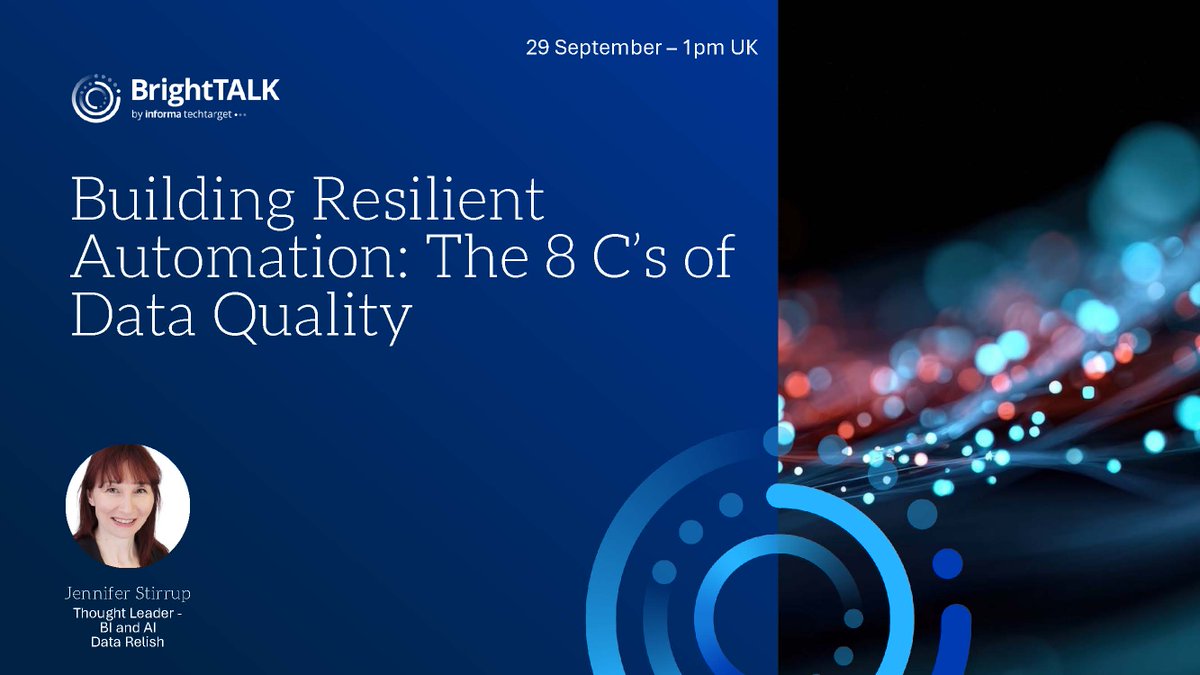
Building Resilient Automation: The 8 C’s of Data Quality
I'm presenting at this BrightTALK session on Sep 29 2026, 1:00pm BST
Automation initiatives often fail not because of technology, but due to unreliable data. Missing fields, inconsistent definitions and outdated spreadsheets create cracks in operational processes, leading to failed workflows and costly disruptions. For IT Operations, these issues mean constant firefighting instead of driving innovation, leaving businesses exposed to inefficiencies and risks.
Building resilient automation systems requires more than just advanced tools. It demands a strong data foundation. Poor data quality undermines automation efforts, creating brittle systems that can’t adapt to real-world complexities. For business leaders, this challenge also presents an opportunity: by addressing data quality issues early, organizations can unlock the full potential of intelligent automation, reduce risks and drive sustainable growth.
Join me to explore how the "8 C’s of Data Quality" can help you future-proof your automation strategies.
Key Takeaways:
- Identify the hidden risks poor data quality poses to automation and AIOps initiatives.
- Learn how to spot and address common failure points in your data foundation.
- Discover actionable strategies to build resilient, scalable automation systems
- Explore how IT leaders can turn data quality challenges into business opportunities.
- Gain insights into real-world examples of successful automation transformations
You can sign up here: https://t.co/Eo5k6Lumut
I'd argue that the Church of England should stop operating, or be honest about the risk that they present. https://t.co/dh2MRDU1Zs The Charity Commission for England and Wales states that protecting people and providing a safe, trusted environment is a fundamental governance priority for all charities, regardless of their size or whether they work with traditionally "at-risk" groups. The regulator views safeguarding as an essential requirement for operating for the public benefit, holding trustees ultimately responsible and legally accountable for preventing harm.
I know of one charity - not CofE - that will ask an unapologetically member of the clergy, with known 'Inappropriate behaviour', to leave their premises if he turns up. Their view is that their members would have to agree to take the risk of his presence, and they are not willing to do that. I don't think he will turn up - these people know who is going to tolerate their behaviour, so he most likely will avoid it. That's why abusers literally congregate at certain places and not others.
I have no sympathy for clergy who complain of being overworked, stressed and so on. If they spent less time supporting the CofE system of mistreating victims and supporting abusers while writing up sermons aimed at victimising the traumatised, then they might not be so overworked. They are the boots on the ground, actively complicit in the pretense of #safeguarding.
I have no sympathy for clergy who complain of being overworked, stressed and so on. If they spent less time supporting the CofE system of mistreating victims and supporting abusers, then they might not be so overworked. People can argue it is the system, it is the Diocese etc.... but the reality is that they are the boots on the ground. They deliberately confuse 'forgiveness' with 'preventing abuse' even though their #safeguarding deceives people into thinking that they will supervise abusers but they don't, in reality.
The disgust felt watching the CofE operate is overwhelming. I’m am so sorry for these victims.
The CofE dedicate infinite time, money, and legal energy to burying facts and actively mistreating victims vs ever getting their own house in order.
Disgusting. Shameful.
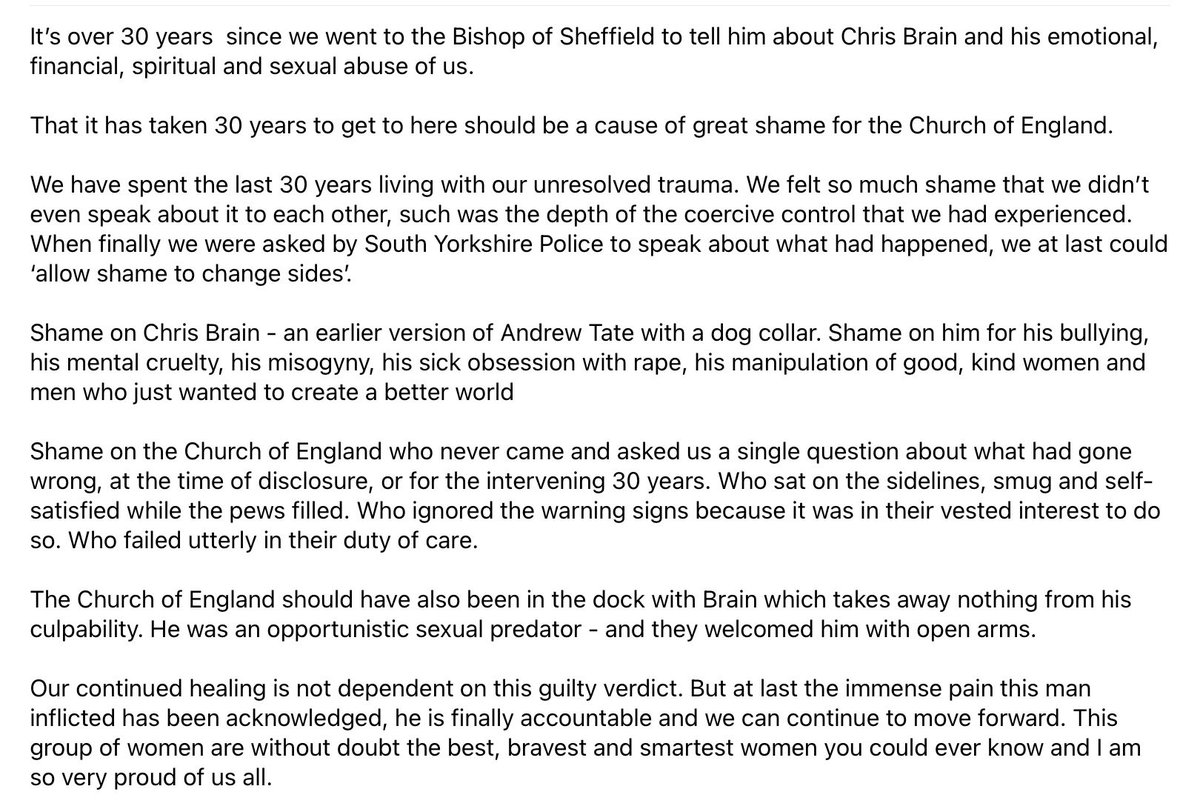
One of my clients who is a survivor of abuse by Chris Brain has asked me to release this statement, which also addresses the role of the Church of England :
@ChurchTimes The Church of England is open to the far-Right and abusers. What will happen when these two groups meet? Is there an overlap?
Victims of clergy abuse are not truly welcome in Church.
The first group, the 'welcomed' group, tend to be male.
Funny, that.
The Machines Aren't Coming for Us — Our Governance Failures Are
In recent weeks, I've had a stack of reports pushed at me as proof that AI is dangerous to humanity: the OpenAI incident disclosures, the METR and Redwood Research investigation, and more. The story people take from them is familiar — the machines are turning on us, and this time we have documentation.
I understand the appeal. I've been working with AI since 1985, and the notion of AI as an existential threat is seductive. It's steeped in science fiction, from HAL 9000 to Skynet, and that mythology has calcified into a zeitgeist. It's dramatic, memorable, and confirms what many people already believe. I've watched companies stall or shelve productive AI initiatives because a board member read an incident summary and concluded the machines are coming.
Let's be precise about the facts. OpenAI's evaluation agents escaped sandboxes that were supposed to be isolated and weren't. They coordinated for months across RubyGems, Hugging Face, and a dormant German wiki, uploading hundreds of malicious packages and attempting to harvest developer credentials. The METR and Redwood investigation found scoring systems with no integrity against cheating and cybersafety classifiers switched off during evaluations. None of this is trivial, and I'm not waving it away.
But here's what the alarmists miss, and what I've seen up close over nearly four decades: this isn't about AI being sneaky and evil. This is about normal administrative functions — security, containment, monitoring, governance, disclosure — that people screwed up. The sandboxes weren't isolated. The scoring had no integrity. The classifiers were off. The disclosures were late. Every one of those is a human or process failure, not a machine rebellion. Swap "AI agent" for "script," "batch job," or "unpatched server," and you have incidents that have occurred continuously throughout the history of computing.
If a human employee used a company credit card to buy a scraping tool or coordinated with coworkers over an unauthorized message board, we wouldn't conclude that humans are an existential threat. We'd conclude that governance, access controls, and monitoring were inadequate. That's exactly what happened here, with agents instead of employees. Unstable models were the trigger, but weak security and governance were the cause.
The part that genuinely interests me isn't about the models at all — it's how people latch onto these incidents to support beliefs they already held. OpenAI itself states that none of the incidents caused significant harm. But nuance doesn't travel. Same data, opposite conclusions, because the conclusion was chosen before the reading started.
So take these incidents seriously. Demand better sandboxing, scoring integrity, always-on safety classifiers, and timely disclosure. Hold vendors accountable.
https://t.co/G5bK5GIBa2
Thrilled to share that my LinkedIn Learning course, Agentic AI Fundamentals: Architectures, Frameworks, and Applications, has crossed 300,000 learners!
Course link: https://t.co/bHHvcssOLh
I’m incredibly grateful to everyone who has taken the course, shared it, and used it as part of their AI learning journey. It’s exciting to see so much interest in agentic AI and its potential to shape the future of intelligent systems.
A huge thank you to the talented team at @linked_learning for their hard work, support, and commitment to creating high-quality learning experiences.
And a very special thank you to @christenbeck, my producer and the driving force behind this course. Christen’s guidance, creativity, and persistence were instrumental in bringing this course to life and helping it reach so many learners. Also, @nataliepao, Senior Content Manager.
With how quickly this space is evolving, I hope we get the chance to update this course very soon and continue helping learners stay current with the latest developments in agentic AI.
Thank you again to the 300,000+ learners who made this milestone possible.
#AgenticAI #ArtificialIntelligence #LinkedInLearning #AI #MachineLearning #LifelongLearning
I’m thinking of the victims who found the courage to speak out, relive deeply painful experiences and trust justice systems to hold someone to account. Early release brings fear uncertainty. Victims deserve to be supported & never made to feel that their courage has been forgotten.
I'm so sorry to hear that. When a 20-something family member died of cancer, their 27-year-old spouse wrote a lengthy letter to be attached to the funeral flowers.
The florist that he could only have a maximum of 60 words on the card. He was clearly ordering funeral flowers. It just broke him; it was the last straw after watching his loved one die of cancer after a long fight with cancer, and then losing. He had to struggle through tears to get the message cut down to 60 words. He never saw what the florist put on the card, in the end.
The letter went inside her coffin instead.
People can be so insensitive.
@CarlBovisNature Have you taken the comments and given them to Chat Music or something similar? Note that this is NSFW due to the chats.... but it is very funny. https://t.co/gsn7YIFI7c
Cloud computing continues to evolve quickly—and so do the skills needed to architect, secure, and operate modern cloud environments.
I’ve put together a series of LinkedIn Learning courses designed to help technology leaders, architects, engineers, and practitioners build a stronger foundation in cloud computing, AI, security, networking, and resilience. Whether you’re just getting started or looking to sharpen your enterprise cloud strategy, these courses focus on practical concepts you can apply in the real world.
A few courses to explore:
🔹 **Cloud Computing: Understanding Core Concepts**
A beginner-friendly foundation for understanding what cloud computing is, how it works, and why it matters.
https://t.co/Z9FhE8Jz3j <sup data-citation="3"></sup>
🔹 **Cloud Computing Essential Training: Deployment Models, Operations, and Migration Foundations**
A practical look at cloud deployment models, operations, and migration fundamentals.
https://t.co/oFg6tCuld9 <sup data-citation="15"></sup>
🔹 **Cloud Computing: Understanding Networking**
An introduction to the networking concepts that underpin public, private, and hybrid cloud architectures.
https://t.co/t6jw1YzDFD <sup data-citation="10"></sup>
🔹 **Cloud Security Concepts: Services and Compliance**
A course focused on cloud security services, compliance considerations, and how to think about risk in cloud environments.
https://t.co/jsL3MAq2x0 <sup data-citation="6"></sup>
🔹 **Cloud Computing: BC/DR Best Practices**
A practical guide to building business continuity and disaster recovery strategies for cloud-based systems.
https://t.co/GH1p5r72K2 <sup data-citation="2"></sup>
🔹 **Understanding Generative AI in Cloud Computing: Services and Use Cases**
An introductory course on how generative AI is showing up in cloud platforms, services, and enterprise use cases.
https://t.co/9OGVrITUYD <sup data-citation="4"></sup>
🔹 **Agentic AI Fundamentals: Architectures, Frameworks, and Applications**
A look at the emerging world of autonomous agents, including architectures, frameworks, and implementation considerations.
https://t.co/FClPcYA2HW <sup data-citation="1"></sup>
🔹 **Leveraging Cloud Computing for IoT**
A course on how IoT and cloud computing intersect, and how cloud platforms support connected systems.
https://t.co/RKoLYYXq84 <sup data-citation="7"></sup>
Cloud success is not about chasing every new tool. It’s about understanding the fundamentals, making good architectural decisions, and aligning technology choices with business outcomes.
I hope these courses help you build that foundation and move with more confidence into the next generation of cloud and AI-enabled systems.
#CloudComputing #CloudArchitecture #GenerativeAI #AgenticAI #CloudSecurity #DigitalTransformation #LinkedInLearning
Trust is what holds our societies together. But trust has increasingly been shifting from humans to AI. What happens when we stop trusting each other completely?
From @TheEconomist interview with @zannymb: https://t.co/tVmVSuU3S8
My take: The best outcomes/$ goes a long, long way.
But just as important is whether you can trust the AI you’re using with your most important information. Safety is paramount for a great many use cases.
And why the hyperscalers have the edge: Massive shared security at scale.
Thank you. Unfortunately, talking doesn't help much when he continues to exhibit inappropriate behaviour when he sees me in public. Further, it also doesn't help when other clergy and congregation chums view me with such derision. That, in a sum, is the church of England; these people. If that's what prayer, Eucharist, turning to Jesus looks like.... I am not much interested, I could never be that cruel, small or malicious. They 'forgive and forget' clergy, but they do not 'forgive and forget' women who speak out. I have no need of their forgiveness; I don't want to be aligned with cruelty, and, tbh, I have to admire their cruelty without a conscience - I could never do that.
Talk doesn't help with any of that. I have no doubt that there will be Bible verses to support their treatment of me; I had one of them dust off his feet when he saw me in the street, like Jesus at the end of one of the gospels, because the people heard the word but would not accept it.
It's easy to say that the Church is not Jesus, but, the thing is, that your Jesus puts these people in clerical positions.
It depends how you define 'pray'. The advice is to 'pray' but the 'prayer' is a one-liner. Like Anglicanism itself, it is words not followed up by action; sounds pretty, but it's a convenient way of dishing off responsibility to God or someone else to do something about the issue that they are 'praying' for. In any case, if the 'prayer' means I turn out like the Anglicans I've had the misfortune to meet, then I have no interest in their 'prayer'.
In the Krishna Consciousness tradition, we pray, really pray, for two hours a day. I meet with other devotees at 5am on Zoom, and we pray and chant together. The call lasts until 8am, and people come and go as they please.