The fallacy of this is that more creates more. More hours, more hiring, more something.
And it is true in a sense. If you put in more work, more work will happen. But I think for most startups, the leverage is really in how differently you approach the problem, how well you cultivate your team, and the strategy.
Any large company can outspend you on hours. They have thousands or tens of thousands more people, spending more hours. If hours worked were the metric, every large company and government organization would always win and do the best work. More hours, better output.
This thinking is often representative of younger founders, where the startup becomes their identity and life. They have a hard time doing anything else, and cannot understand that your work is not the person that is you. But activities outside of work can grow you as a person too and make you do better work.
I��ve never worked this way. As a designer, I always saw the need to take a step back, to take a break. At times, I might work 12 hours or 16 hours, or whatever amount was needed, but it wasn’t the norm. You just can't grind design, you need inspiration. But taking that step away from the work, would give me more perspective, inspiration and I could approach the problem differently or I could just see the solution.
Grinding is never good for any creative problem, and startups or creating new products are often mostly about creative problem solving. Grinding works ok for email jobs, or where you just executing on very clear playbook.
With Linear, we’ve never worked this way. We work reasonable hours, 5 days a week. All of us founders have families. Many of our employees have families. I personally stop every evening, spend time with the family, cook dinner for the family, eat dinner together, and focus on things outside of work. Sometimes I work in the late evenings or weekends, but to me the pride is that I don’t need to. Company should be succesful without it.
My goal is to build a company that is sustainable in the long term, and doesn’t require heroics or personal sacrifices every single day.
There are times when our team is heroic. Launches, incidents, some other work that just needs to be done. They will work late into the night because they know it is the right thing. But we don’t require that every day or every week, and the more this happens, the more I think it is a failure of our company and leadership. The team and the leaders should always keep a reserve to use when something is needed.
Our thinking was also that quality, which we value, doesn’t emerge from working more or stressing people more. It emerges when you create the conditions for it to emerge. Often it is the appreciation, space, time, and how the person feels. A person who is rested will do better work.
I wouldn’t attribute much of our success to working a lot. The success came from having clear thinking, ideas, and focus to do the right things.
I sometimes wish we could move the culture more toward a Zen master.
Real mastery is not exerting the most effort. It is achieving the outcome with the least necessary effort.
https://t.co/UkybNZB9iv
Naval: In most interesting, difficult things in life, the solution is indirect.
That was part of the How to Get Rich tweetstorm, which is, if you want to get rich, you don’t directly just go for the money. I suppose you could like a bankster, but if you’re building something of value and you’re using leverage and you’re taking accountability and you’re applying your specific knowledge, you’re going to make money as a byproduct.
And you’re going to create great products, going to productize yourself and create money as a byproduct. The same way, if you want to be happy, you minimize yourself and you engage in high flow activities or engage in activities that take you out of your own self and you end up with happiness.
By the way, this is true in seduction as well. You don’t seduce a woman by walking up and saying, “I want to sleep with you.” That’s not how it works. Same with status. The overt pursuit of status signals low status, it’s a low status behavior to chase status because it reveals you as being lower in the status hierarchy in the first place.
It’s not the fact that everything has to be pursued indirectly. Many things are best pursued directly. If I want to drive a car, I get in and I drive the car. If I want to write something, then I just sit down and write something. But the things that are either competitive in nature or they seem elusive to us—part of the reason for that is that those are the remaining things that are best pursued indirectly.
@alexpospekhov@adityaag Experiments have constraints and are hypothesis-driven - 10,000 trials on a niche industrial problem >> the 10,000th AI-notetaking app
Skiing is broken in our country.
Been waiting in line for three hours waiting for the shuttle to get to Palisades. These are lines at the PARKING LOT. At least a thousand ppl + not a single shuttle in past hr
@palisadestahoe this is a major f*ck up.
@1015KTKE@TTCTV6@KTVN something needs to be done
#palisadestahoe #truckee
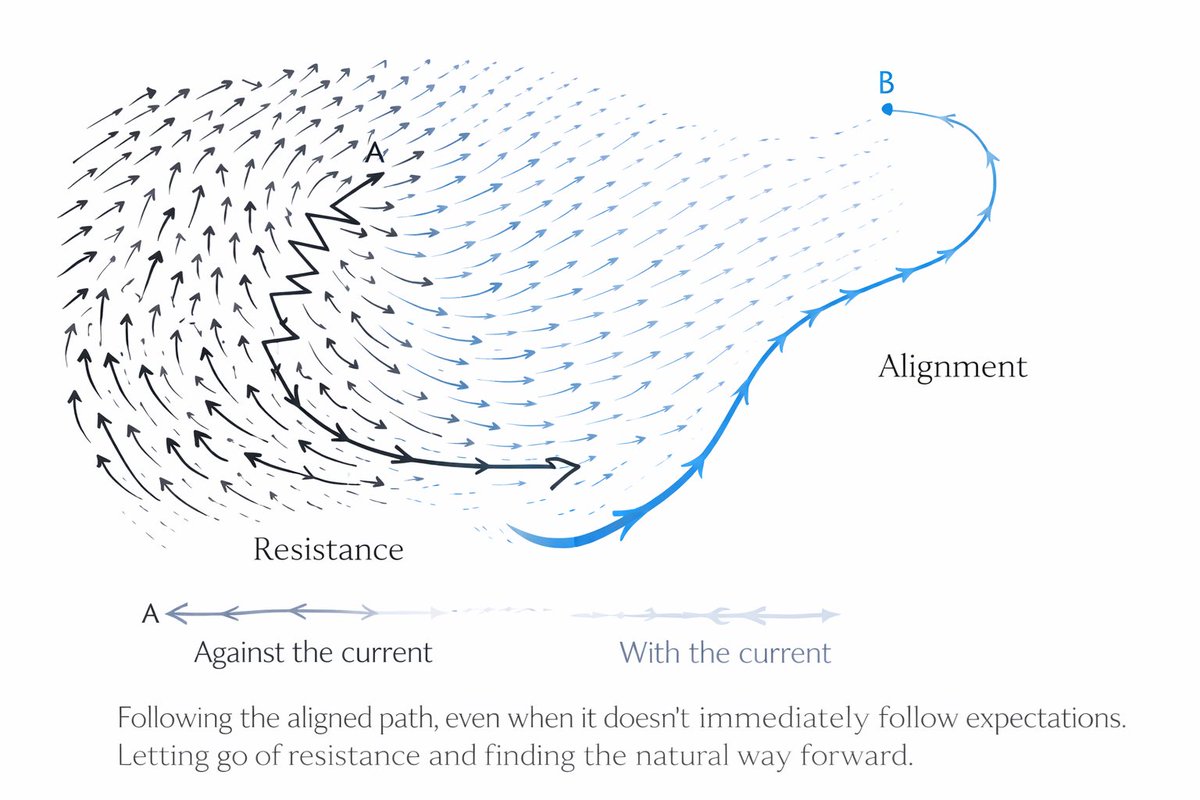
It seems contrary to the success narrative, but letting go of conditioned beliefs and directions may actually enable greater embodiment of your unique path.
In the Zen tradition, alignment and trust will naturally guide you.
(The sketch was my own, but final image was AI-assisted)
Your brain has a hard cap on what it can process. About 50 bits of conscious information per second, adding up to roughly 125 billion bits across your lifetime. That’s your total cognitive budget. Every notification, every open tab, every unfinished task burns through that number permanently. You’re spending down a fixed account every day and most people never realize it.
This is why focus isn’t about willpower. It’s about allocation. When your mind runs background processes (emails to send, conversations replaying, forgotten tasks), you’re fragmenting a scarce resource across competing demands. The inability to concentrate isn’t a character flaw. It’s a processing bottleneck. Your RAM is maxed out before you even sit down to work.
Flow states solve this by collapsing attention onto a single target. The formula is challenge slightly above current skill level. Too high triggers anxiety. Too low triggers boredom. Both break focus. The sweet spot creates cognitive lock-in where the task absorbs full capacity and everything else disappears. Video games figured this out decades ago with dynamic difficulty. Most people’s actual work never does.
The counterintuitive piece is rest. When you stop focused work, your brain doesn’t power down. It shifts into the Default Mode Network, connecting regions associated with creativity and future planning. Energy consumption barely drops. Your subconscious is processing everything your conscious mind couldn’t fit. This is why walks and showers produce breakthroughs. But only if you let the network run. Fill every gap with podcasts and scrolling and you never give it space to work.
The rhythm matters more than the hours. Intense focus, then genuine rest. Building, then processing. Most people either grind constantly and starve the system that generates their best ideas, or rest constantly and never build anything worth processing. The people who transform fastest alternate between both, letting each system do what it’s designed for.
Someone who is impossible to beat:
> has fun
> owns who they are
> confident & takes risks
> embraces failure
> doesn’t get embarrassed
> doesn’t care what you think
> optimistic
> energetic
> curious
> willing to look like a beginner for a bit
> work ethic + discipline
> talented
> intelligent + emotionally intelligent
> good family & friends
> powerful network
> unlimited capacity to express love
> magnetic energy
Real world super hero
most interesting traits imo:
- absence of neurosis, anxiety, unnecessary strain
- good taste and an accurate relationship to reality
- self acceptance & security in love, respect, belonging
- comfortable with the unknown
- spontaneous
- motivated by growth, not deficiency
- focused on problems outside of themselves
- continued fresh appreciation of the world
- love alone time
correct, every ✌️996✌️company I've been in was actually
9-5: real work
5-7: eat soggy doordash in the office while pretending to work
7-10: socializing while getting work done for ~10 minutes of every hour
10-12+: literally just drinking beers and playing a stupid status game of "be the last guy to leave"
the fastest way to become useful:
pick one hard domain and tear it apart until the pieces feel obvious.
you don’t need talent.
you need immersion.
bury yourself in the primitives.
understand the lowest-level units of the craft so deeply that higher layers become trivial.
every real skill is built this way:
circuits → hardware intuition
calculus → control systems
mechanics → robotics
algorithms → systems design
once the primitives click, complexity collapses.
most people run from difficulty. they jump to frameworks, shortcuts, abstractions. then wonder why they never become dangerous.
stop stacking conveniences.
strip everything down.
learn the fundamentals until the world becomes transparent.
the people who win aren’t faster or smarter.
they simply know the roots, not just the branches.
Hey man, first of all thank you so much for sharing this. I’ve encountered sickening experiences in my own startup journey - but this cannot even compare.
I’m glad to hear you are mentally in a better place, and are prioritizing the right things. There are too many ppl in SV like this, and I’ve myself questioned what the ends are if they harm others.
Keep on fighting the good fight - I admire your courage and resilience.
robotics is the future.
not apps.
not content.
not another SaaS wrapper around an LLM.
robots.
machines that sense, think, and act in the physical world.
machines that move energy, matter, goods, people.
machines that collapse labor, expand productivity, and rebuild entire industries.
the future isn’t digital-first anymore — it’s physical-first with intelligence embedded.
manufacturing → robotics
logistics → robotics
agriculture → robotics
construction → robotics
defense → robotics
healthcare → robotics
homes → robotics
every sector that still depends on human hands becomes a robotics problem.
and the demand is bigger than the talent pool by orders of magnitude.
learn perception.
learn control.
learn actuation.
learn embedded.
learn kinematics.
learn systems engineering.
learn how to make machines move.
the next trillion-dollar companies will be built out of metal, motors, sensors, and code.
don’t stay stuck in 2D screens.
the future is 3D, autonomous, and mechanical.