AI Editor at @Fortunemagazine, award-winning journalist, and author of "Mastering AI." Formerly at @business. Writing in NYT, Atlantic. Based in Oxford, UK.
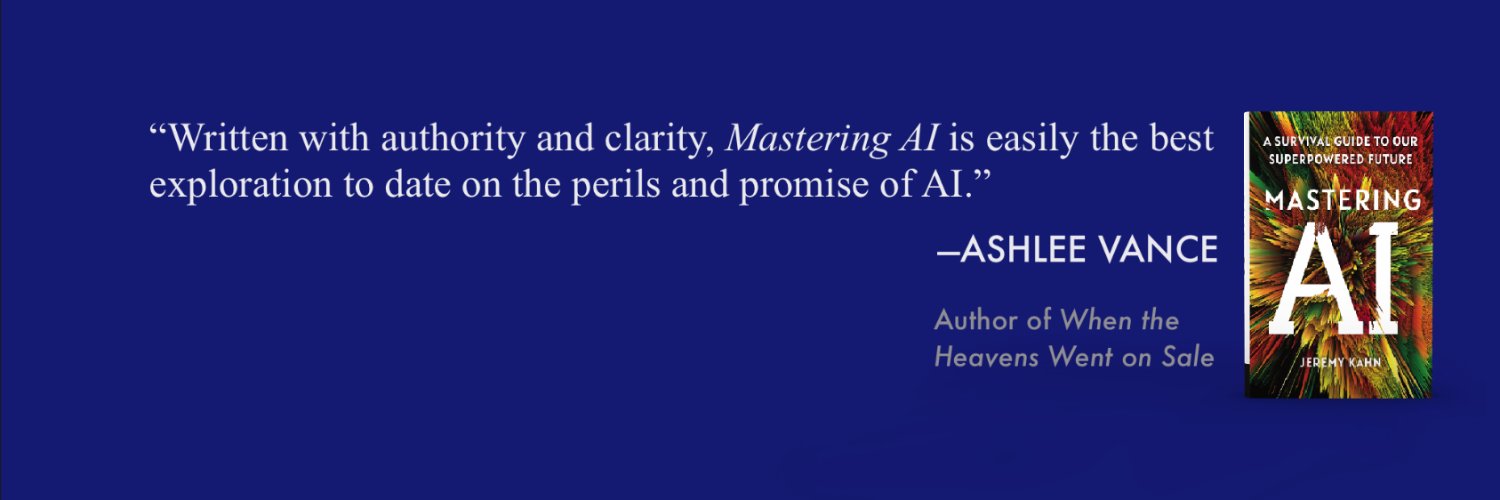
My #NewBook "Mastering AI" is out today! It’s a comprehensive look at #AI’s transformative impact on work, relationships, and society. I hope it helps readers navigate AI’s promise and risks. https://t.co/9g5wbCrGsb
@simonschuster, @bedsqpublishers, @FortuneMagazine#innovation
@levie how would a regulatory regime on applied AI address the cyber risk or the bio weapons risk @levie? Or would you outlaw all general-purpose models?
The jailbreak was easy, an independent researcher says. But she and other cyber experts say defenders need Fable and ask export ban to be lifted. https://t.co/aOXEu39EkE
@hlntnr What about if the customer is govt? Seems inevitable that govt will want capabilities that are not widely released elsewhere. (Diff than only internally deployed but very easy to imagine models with only one external customer—the government.)
@srinathkrishna@levie Sure, but again we managed to create a drug regulation regime that works for both safety and the market (mostly.) no reason we could not create something similar here.
@levie Not necessarily. It is easy to imagine model layer regulation that would be based on more transparent criteria, with predeployment testing, and specific rules for what kind of post deployment concerns would get a model pulled. That is how our drug regulation works!
@KeeganMcB People are taking about exactly that (ie GPS and payment rails.) the interesting thing is that the populist right in Europe, which talks up sovereignty all the time, remains pro-US. This sovereignty push will have to come from the populist left.
@APompliano@DavidSacks Wrong @APompliano. At its best, journalism writes the first draft of history. Your version is about throwing primary documents at a public untrained in journalism or historiography and asking them to write their own history. We see what happens next in our current politics.
Why is it so hard to get ROI from AI? Because building from first principles isn’t easy. My latest in @FortuneMagazine's Eye on AI newsletter: https://t.co/Me7xlqRO8e
@jachiam0@David_Kasten I don't know. That's a bit like saying the assets of the Catholic Church are owned by the public -- just because it too has charitable status under US tax law. The equity may be held "for public benefit" in theory, but it is clearly not "owned by the public."
Another small scoop from me here.
Exclusive: Geordie AI raises $30 million Series A to be ‘air traffic control’ for your company’s AI agents https://t.co/r6SRystvmR
Exclusive: Perceptic, a startup automating drug discovery end-to-end for Big Pharma, emerges from stealth with $12 million in seed funding https://t.co/t6PEhdct3C
@sophiayoga_r@FortuneMagazine It certainly lost the commanding lead it had in 2023 and 2024 as the big tech player best poised to win from the AI platform shift.
Microsoft lost its way in the AI race. Can Copilot get it back on course? My latest feature story in @FortuneMagazine explores Microsoft's AI travails and its strategy for getting its AI mojo back. https://t.co/qPzlvqaPWJ
World models are critical to creating AI that can act in the real world. But there are many different approaches to building them. My @FortuneMagazine colleauge @sharongoldman explores why world models are the talk of AI lately and the debate over how to make them.