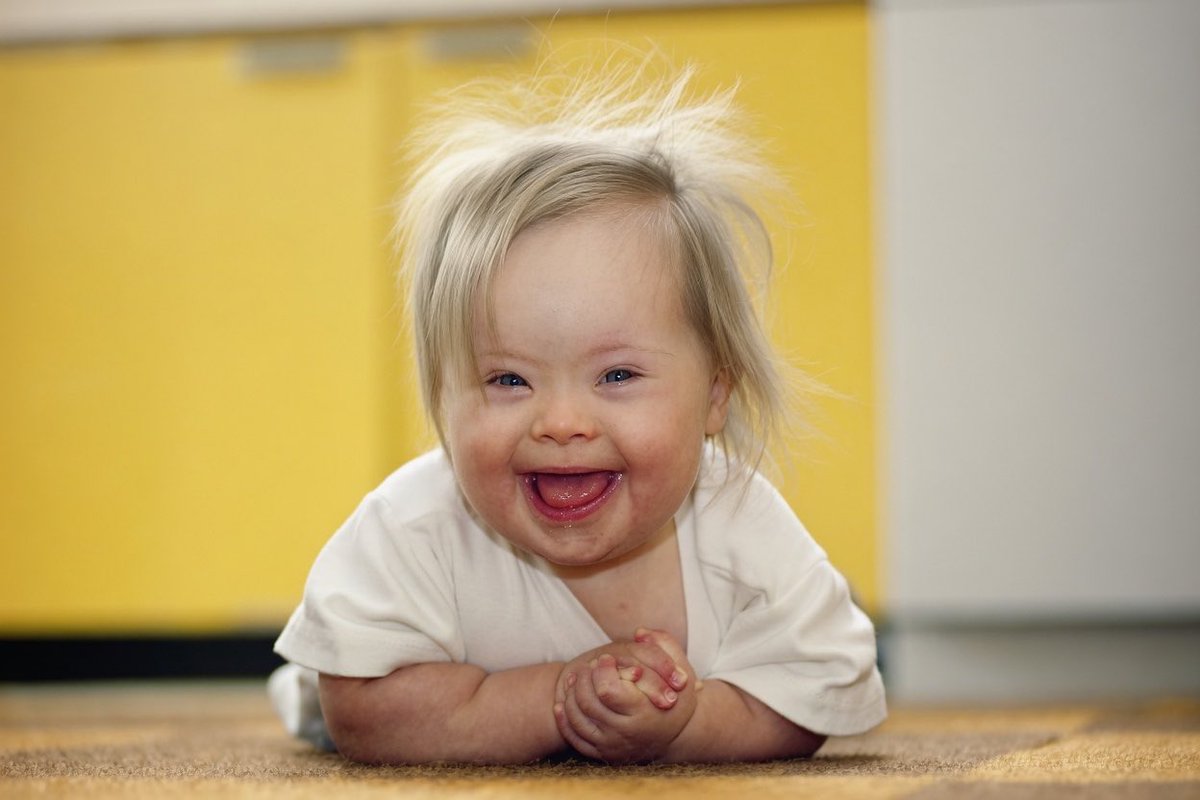
Every single child with Down syndrome is a gift from God, who deserves life.
These children have just as much value, and deserve life just as much as a child without DS.
Down syndrome children aren’t a curse to parents.
Pass it on.
Officially 1 month since I switched to a flip phone.
- Everyone is more severely addicted to their smartphones than I thought. Once you have a dumbphone, you'll frequently find yourself as the only person in the room not on their phone. It's not just teenagers, it's parents and adults of all ages. It's like everyone is stuck in a trance. 75+ year olds might be the only exception.
- All the objections I previously had for getting a dumbphone have turned out to be overblown and/or solvable. My iPhone addiction had fed my brain excuses to not do this earlier. If you really want to make the switch, you can.
- I've felt embarrassed to pull out my flip phone in public at times, for fear of being different or drawing too much attention to myself. But I have learned to just own up to it. Most people end up saying something like "Oh, I probably should do that too."
- I am using my brain more. Even though my flip phone has Waze, I find myself memorizing maps and roads. I'm more bored and get lost in my thoughts. I'm using paper and pen more. Increased desire for tangible things > digital things.
Overall, it has been a great experience and I plan on never going back.
“Set an example. Treat everyone with kindness and respect, even those who are rude to you - not because they are nice, but because you are.”
-Jonathan Lockwood Huie
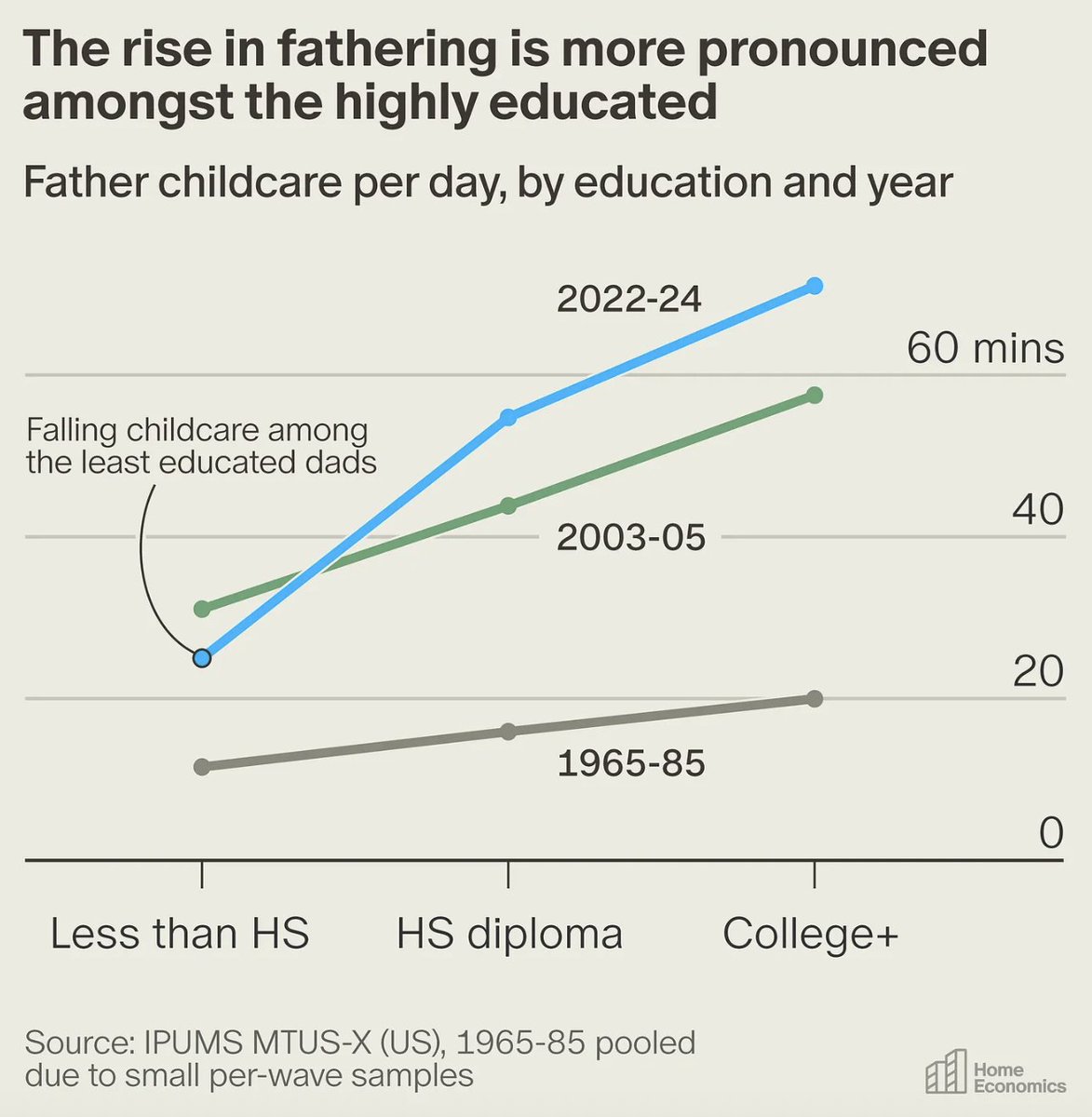
Modern fatherhood would be unrecognisable to a 1950’s dad.
“Compared to their Boomer parents, childcare time among Millennial dads has more than doubled.
Compared to their Silent Generation grandparents, it’s nearly quadrupled.
You will be hard-pressed to find any part of day-to-day modern life that has changed more in the last half-century than the way today’s parents—and fathers, in particular—spend their time.
The new American dad is more present and more exhausted—but also, more satisfied with life.” — @DKThomp
“Work hard, do the best you can, don't ever lose faith in yourself and take no notice of what other people say about you."
Noël Coward
English playwright
New newsletter: MODERN FATHERHOOD WOULD BE UNRECOGNIZABLE TO A 1950'S DAD
Compared to their Boomer parents, childcare time among Millennial dads has more than doubled.
Compared to their Silent Generation grandparents, it’s nearly quadrupled.
You will be hard-pressed to find any part of day-to-day modern life that has changed more in the last half-century than the way today’s parents—and fathers, in particular—spend their time.
The new American dad is more present and more exhausted—but also, more satisfied with life. What's behind this half-century transformation? Today's piece combines history, economic analysis, and gorgeous charts galore from @AzizSunderji
Ben Sasse: "What’s really happening is these superdevices in our pockets — the largest tools any median individual’s ever had access to in all of human history — allow our consciousness to leave the time and place where we actually live, the places where we break bread, the people who are living next door to us, the people that you can physically touch and hug, the small platoons of real community, and we allow our consciousness to go really far away"
Marcus Aurelius wrote this over 1800 years ago:
“When you arise in the morning think of what a privilege it is to be alive, to think, to enjoy, to love.”
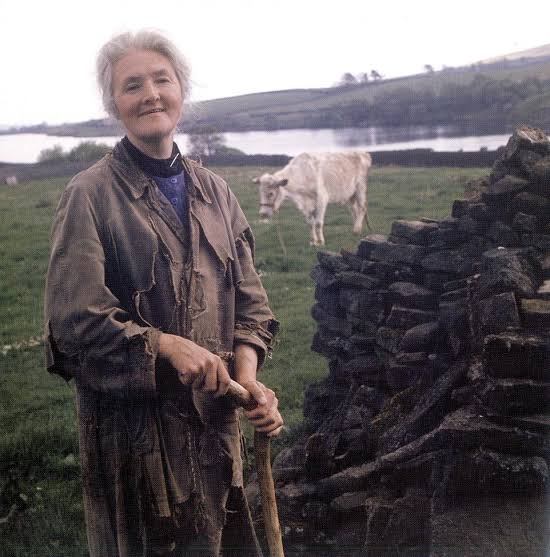
In the winter of 1972, a television crew climbed the high ground of the Yorkshire Pennines to film what they believed would be a story about rural decline. Instead, they found Hannah Hauxwell.
She lived alone at Low Birk Hatt Farm, a stone farmhouse exposed to wind and long winters. There was no electricity, no running water, and no modern heating. Light came from daylight and a single coal fire. Water had to be carried by bucket from a distant spring. In cold weather, it froze indoors.
Hannah was in her mid-forties when the cameras arrived. To her, nothing about her life seemed unusual.
Born in 1926, she had been raised on the same 80-acre hill farm. As a child, she rose before dawn to help with cattle and sheep. Winters were harsh, and the work never stopped. At first, she lived with her parents and an uncle. One by one, they died. By 1958, after her mother’s death, Hannah was alone.
She continued running the farm.
The income was small. Hill farming in the Pennines offered little profit even in good years. Selling the land would have meant abandoning the only world she had ever known. So she stayed, tending cattle, cutting hay, breaking ice in troughs, and walking through snowdrifts to reach barns in storms.
Her home remained unchanged well into the twentieth century. Without refrigeration, food was basic and limited. Bathing required heating water on the stove. If the coal fire went out, relighting it in freezing conditions could take an hour. Some nights she slept in her coat.
Isolation was constant. Weeks could pass without seeing another person. Snow often blocked roads. There was no telephone and no radio. Silence settled heavily over the hills.
In 1973, the documentary Too Long a Winter, produced by Barry Cockcroft, aired on British television. Around 20 million viewers watched. The film did not exaggerate. It showed Hannah rising in darkness, carrying water, feeding animals, and eating at a bare wooden table. She spoke calmly about her routine. She did not complain.
The reaction was immediate. Letters arrived in large numbers. Donations were sent. Viewers were shocked that such conditions still existed in modern Britain. Within months, electricity was installed at the farm. For the first time, Hannah had electric light and basic heating.
The improvements eased daily hardship but did not transform her character. She remained practical and reserved. The animals still required care every morning and evening. The land still dictated the rhythm of her life.
Additional documentaries followed over the years, tracing her gradual transition. By the late 1980s, decades of physical labor had taken a toll on her health. In 1988, she left Low Birk Hatt and moved to a cottage in the village of Cotherstone. There she experienced central heating, indoor plumbing, and consistent human company.
She adapted cautiously to these changes. Though she became a familiar public figure and wrote books about her life, she resisted being portrayed as heroic. She often said she had simply done what was necessary.
Hannah Hauxwell died in 2018 at age 91.
Her story resonated because it revealed something many had not seen. Modern Britain contained lives still shaped by pre-industrial hardship. Her endurance was not theatrical. It was daily and repetitive. It came from duty rather than ambition.
The documentary did not create her strength. It revealed it.
For years, she carried water through snow and kept a farm alive on a windswept hill because there was no one else to do it. When the public finally saw her, they recognized a form of resilience that rarely appears in headlines.
She had not changed history. She had simply endured it.
#drthehistories