EXCLUSIVE: Boltz says pharma usage of its AI drug design software is up 50x, raising a $110M Series A to double down and expand, @GabriCorso tells me
My latest for @endpts on another major AI bio raise in London: https://t.co/yhgsBehWY9
We built Boltz to put our models in the hands of every scientist. This latest funding round is a major step toward that goal, giving us the resources to push our research further, build more powerful tools, and continue to grow our fantastic team.
We’ve raised $110M to bring AI-powered biomolecular design to every scientist!
Boltz’s Series A is led by @BessemerVP, following 50-fold growth in molecular token usage from our users since June and partnerships with 6 of the world’s 20 largest pharma companies.
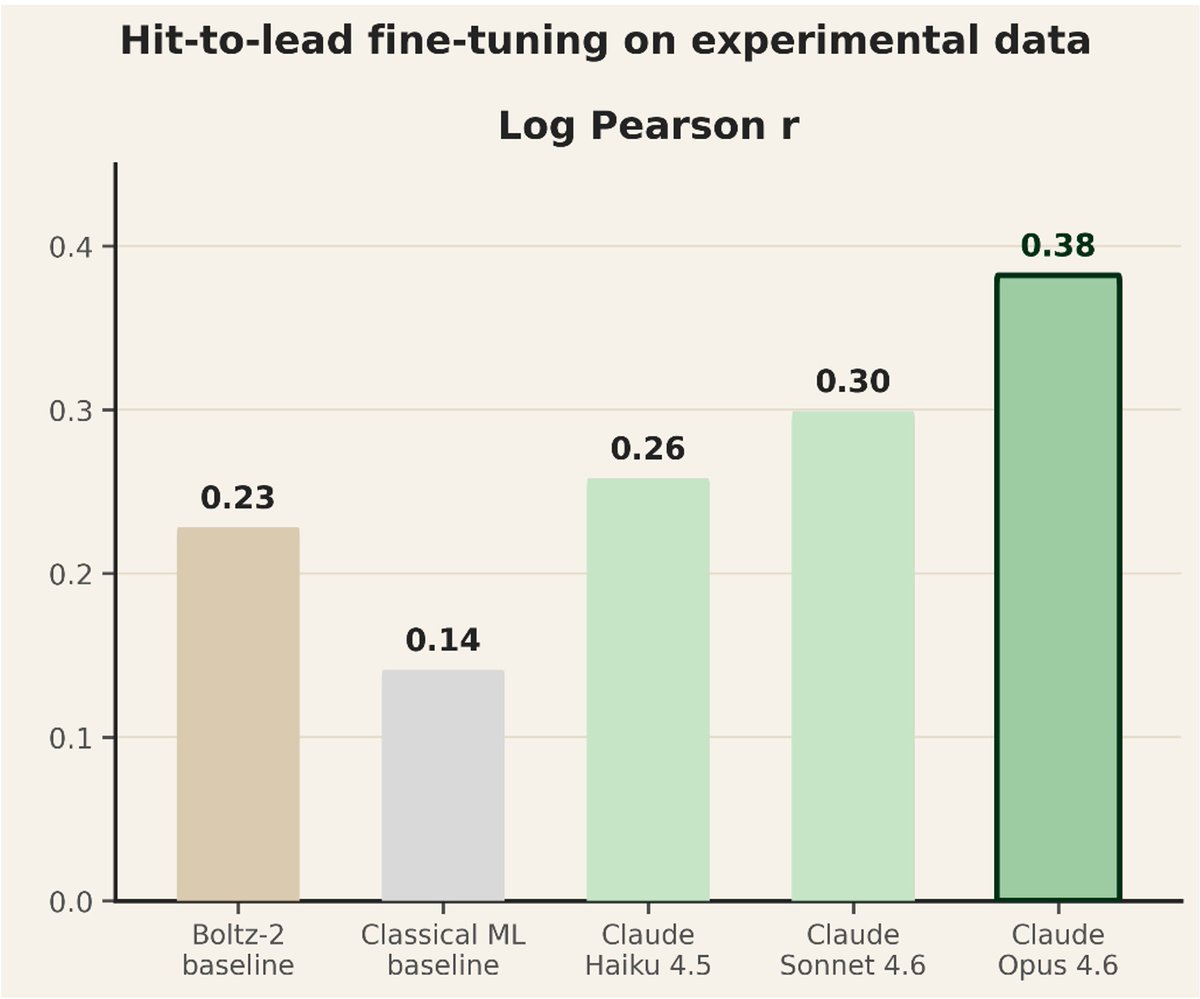
Cool work showing that agentic tools are becoming increasingly useful in computational drug discovery workflows. I particularly liked the fine-tuning results.
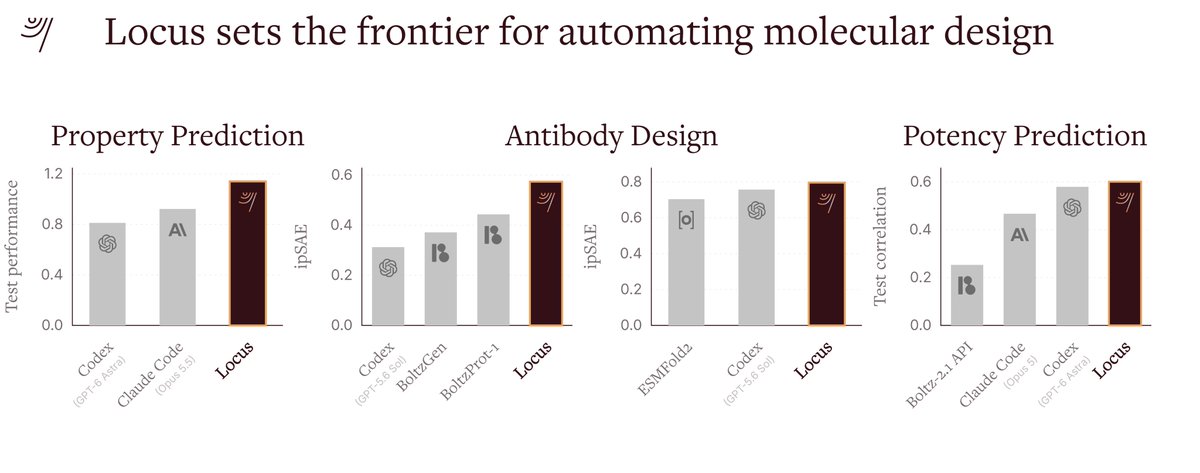
Locus sets the frontier for automating molecular design
Our automated research system Locus develops scientific AI models that outperform SOTA expert solutions
Unlocking the potential of scientific AI requires leveraging proprietary data. Locus achieves this autonomously 🧵👇
--
We test Locus across a number of tasks related to molecular scoring and design: training molecular property prediction models for a proprietary task, fine-tuning Boltz-2 to predict small-molecule potency, and building antibody design workflows around BoltzGen, Boltz-2, ESMC, and ESMFold2.
Each of these settings are real-world AI for science use cases, where tasks are often out-of-distribution for existing foundation models and limited in data, while featuring expensive and noisy evaluators. Compared to state-of-the-art baselines and LLM agents set to optimize these tasks, Locus achieves higher performance. Additionally, Locus generalizes better despite limited data, finds more sample efficient solutions, and explores a higher diversity of solutions.
Excited to announce our partnership with @dsmfirmenich to bring @boltz_bio's latest AI models to the discovery and design of new scent and flavor molecules! 🧪
👋 Say hello to faster structure prediction
NVIDIA BioNeMo Inference Runtime is in public beta. This open, PyTorch-native library speeds up biomolecular inference on NVIDIA GPUs.
Optimize models including Boltz-2, OpenFold2, and Protenix v2 with specialized kernels and, where supported, CUDA Graphs - then scale with Ray-powered GPU replicas.
🙌 Huge thanks to our collaborators at @apheris_AI, @AurekaBio, @Biomap_IMI, @boltz_bio, @dataiku, @UWproteindesign, @Latent_Labs, MoleculeMind, @nebiusai, @openmsf, @open_fold, @proximabio, @SandboxAQ, @Terray_Tx, and @Xaira_Thera for partnering with us on this work.
📃 https://t.co/JodmVs2s1t
@AstellasUS just publicly shared how, using Boltz on a membrane protein target, they were able to find validated molecules performing on-par in-vitro to a clinical compound while reducing the number of assays needed by 90% and shortening the timelines by 70%! 🧵🚀
Yesterday we announced the integration of Boltz with Claude Science. One thing I wanted to take a moment to highlight was the results we got from letting Claude drive the Boltz API end-to-end, so I wanted to give a bit more detail here. A thread! 🧵
Boltz is accessible via @claudeai products! Boltz models can now run natively inside both Claude Science, Anthropic’s new AI workbench for scientists, and Claude Code. Install the Boltz, and ask it to take on your next challenging discovery task.
And now, a Codex integration! I’ve found agentic workflows with Boltz to be a powerful way to distill our experience running effective screens into something users can apply directly.
Your coding agent can now design molecules!
We have shipped a first-party plugin that lets you run Boltz models directly inside @OpenAI Codex so that you don't have to leave your terminal or switch tools to do real molecular design.
Your coding agent can now design molecules!
We have shipped a first-party plugin that lets you run Boltz models directly inside @OpenAI Codex so that you don't have to leave your terminal or switch tools to do real molecular design.
More news! I've had fascinating technical discussions with the team at @TakedaPharma over the past few years and I'm really excited to make our partnership official.
Today we're excited to announce a major collaboration with @TakedaPharma to deploy our frontier models across their entire organization.
Takeda scientists now get access to BoltzMol-1, BoltzProt-1, and fine-tuned models for biomolecular modeling and design.
Today we're excited to announce a major collaboration with @TakedaPharma to deploy our frontier models across their entire organization.
Takeda scientists now get access to BoltzMol-1, BoltzProt-1, and fine-tuned models for biomolecular modeling and design.
I'm incredibly proud of our team for shipping BoltzMol, BoltzProt, and our new API. Both models delivered experimentally validated hits for over 50% of the targets we tested. They're also an architectural step change: no longer a single neural network run end-to-end, but pipelines of multiple models that require complex orchestration and large GPU fleets to run at scale. We put in long engineering hours to build the infrastructure needed to get these pipelines into everyone's hands. We can't make it free, but we worked hard to make it a cost-effective choice, and accessible to everyone.
Big news from Boltz - our biggest update yet! 🚀
Today we’re releasing two new state-of-the-art models for protein and small molecule design with extensive wet lab validation and a new API to run all of our models on scalable GPUs wherever you (or your agents) work! 🔥
Big news from Boltz - our biggest update yet! 🚀
Today we’re releasing two new state-of-the-art models for protein and small molecule design with extensive wet lab validation and a new API to run all of our models on scalable GPUs wherever you (or your agents) work! 🔥
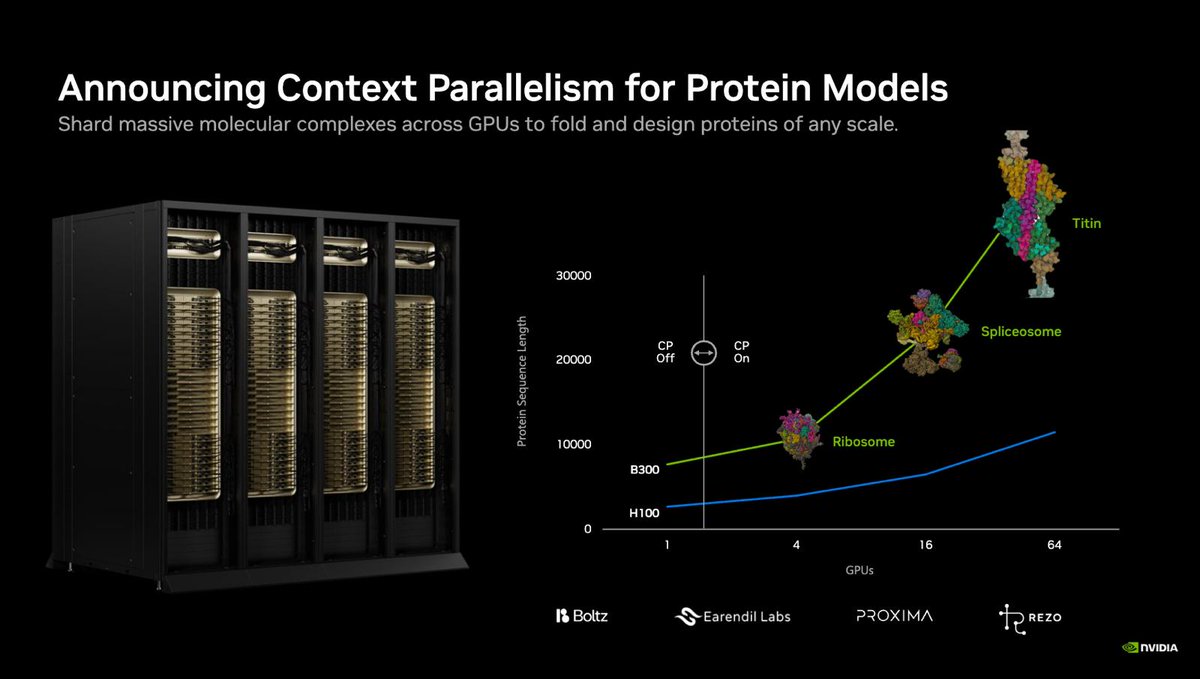
It has been great to collaborate with the @NVIDIAHealth team on adding Context Parallelism to the Boltz models! Announced in the keynote at #GTC, @NVIDIA showed you can now scale up Boltz-2 to predict structures up to 30k residues (up from ~2k)! 🤯 This opens the door to a number of very cool new applications, although performance starts to drop around 3-4k residues because the current models have only been trained on smaller crops. Try it out at: https://t.co/AuN3yzxsIp 🧬
Lots of excitement for AI at #JPM26 this week! If you want to hang out with some amazing folks, we are organizing a launch party for Boltz on Thursday evening co-hosted with @a16z! Join us https://t.co/zuUE3QHViE
It was fun chatting with Jorge and Zak from Andreessen Horowitz about Boltz, our origin, mission, and the recent launch:
- Spotify: https://t.co/ogY0JcawAV
- Apple: https://t.co/D7YOCaXeUX
- YouTube: https://t.co/ghPymEwjlR