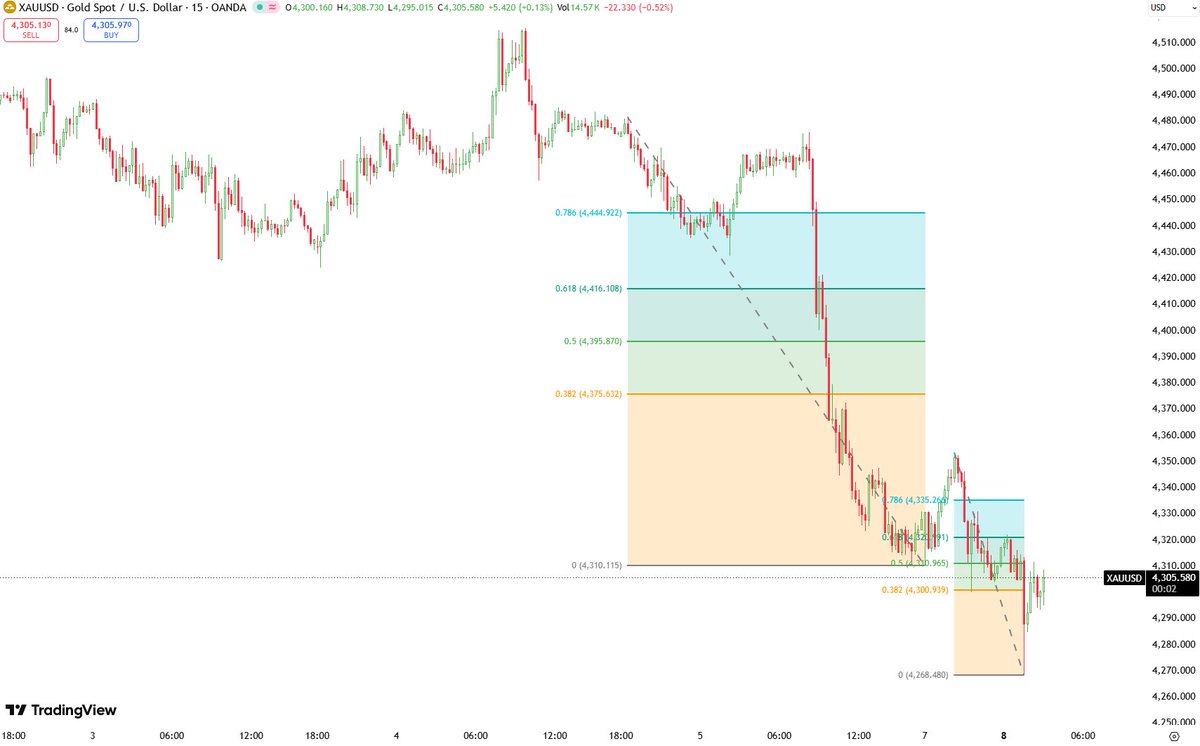
XAUUSD Gold Market Update 📊
Gold has already fallen approximately $85 from today's high 📉
Although some rebound momentum appeared during the afternoon session, it is still too early to conclude that the broader downside trend has ended.
From a fundamental perspective, overall market sentiment remains risk-off ⚠️
U.S. equities are also under significant pressure:
• $SPY (S&P 500 ETF) 📉
• $SPX (S&P 500 Index) 📉
• $QQQ (Nasdaq-100 ETF) 📉
All continue to face selling pressure.
Technology stocks, in particular, are seeing aggressive profit-taking, leading investors to become increasingly cautious.
When major equity indices decline simultaneously, volatility often spreads across multiple asset classes, including Gold.
From a technical perspective, the 4375 area remains a critical battleground between buyers and sellers 📊
Whether price can hold above this level may determine the next major move.
For now, patience is key. Watch how the U.S. market reacts before making aggressive trading decisions 👀
More detailed analysis and trading plans will be shared in our evening update 📩
@MissBehave2121 That's wild money even for Google. Makes you wonder how many other companies are quietly relying on each other for cloud compute without admitting it.
So SpaceX and Google are doing this deal, and it’s way bigger than another AI headline. 🚀
Google is paying SpaceX $920M per month for AI compute until 2029.
That includes about 110,000 NVIDIA GPUs in SpaceX data centers.
This really shows me one thing:
Even Google doesn’t have enough compute.
The real fight in AI isn’t just chatbots or models anymore.
It’s about who controls:
GPUs
Data centers
Cloud capacity
Power
Infrastructure
SpaceX was always rockets and satellites, but now they’re turning AI compute into a cash machine.
After the Anthropic deal, SpaceX’s AI compute contracts could make around $26B a year.
That’s wild.
Stocks I’m keeping an eye on:
$GOOG
$NVDA
$AMD
$AVGO
$MSFT
$AMZN
$ORCL
$TSLA
$TSLA isn’t direct SpaceX, but the whole Elon AI infrastructure story will still matter.
My take is simple:
AI isn’t just software anymore.
It’s an infrastructure arms race.
Don’t chase hype.
Follow the compute.
I clearly warned a long time ago that Gold still had room to move lower 📉
Yet many traders continued buying simply because price looked cheap or was sitting near support.
Markets do not reward hope or emotions ⚠️
What matters is understanding the trend and following the flow of capital 📊
This is a market that requires patience, discipline, and objective analysis.
Anyone who has been following my charts closely should understand why I repeatedly warned about further downside risk 👀
$MU is quickly turning into a major player in the AI infrastructure space.
The basic idea is pretty straightforward:
AI models keep getting bigger.
Data centers are growing fast.
Memory bandwidth is hitting a wall.
That's where Micron comes in.
Micron deals with HBM, DRAM, NAND, and storage for data centers—all essential for AI servers and cloud setups.
That's why I don't see $MU as just a regular memory cycle stock anymore.
To me, it's an AI infrastructure supplier now.
Stocks I'm keeping an eye on:
$MU — AI memory
$NVDA — AI processing
$AVGO — networking / custom silicon
$TSM — chip manufacturing
$ASML — lithography gear that's a bottleneck
My plan:
Don't blindly chase after strong moves.
Wait for dips.
See if buyers show up at key support levels.
Only jump in when the risk-reward feels right.
Not advice.
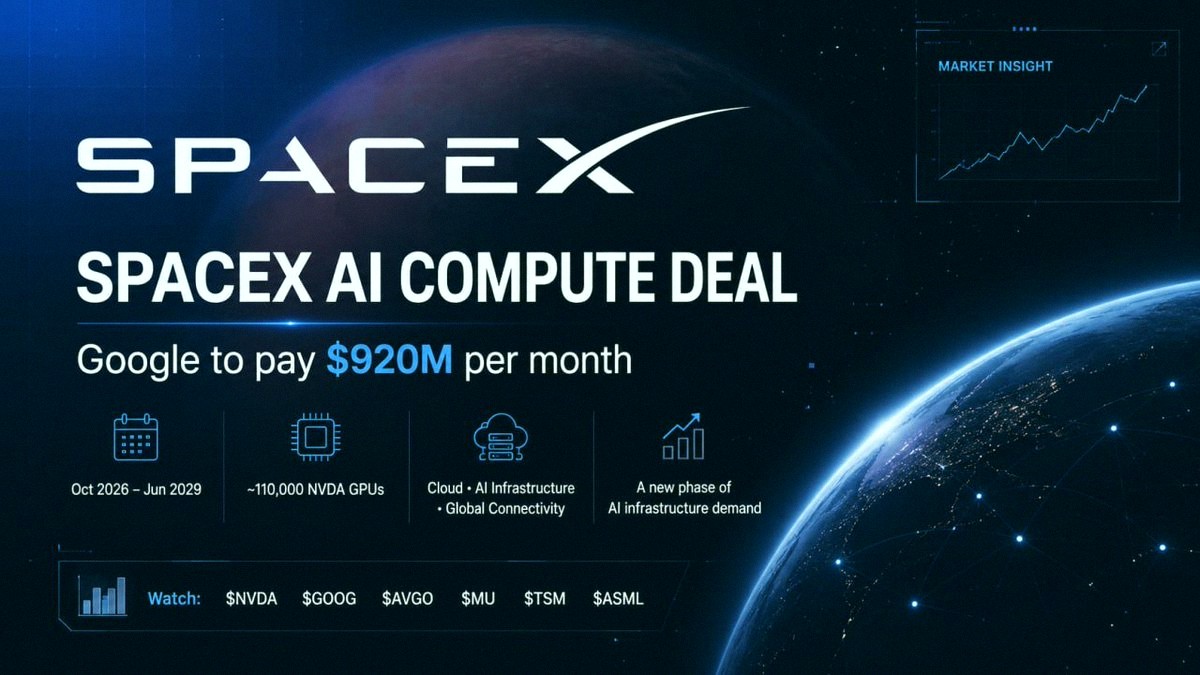
🚨 SPACEX just locked in a huge compute deal with Google.
SpaceX revealed a cloud contract where Google pays $920M each month from October 2026 through June 2029.
That’s not a small agreement.
That’s nearly $11B yearly for AI compute power. 🔥
The deal reportedly covers about 110,000 $NVDA GPUs, plus CPUs, memory, and other gear.
People keep thinking SpaceX is just a rocket company.
Nope.
SpaceX is becoming:
space infrastructure
Starlink internet
AI compute demand
satellite data networks
next-gen cloud systems
This deal also shows one thing:
AI demand is still going strong.
If Google needs this much compute, then the real winners aren’t just SpaceX.
Check out the full AI infrastructure chain:
$GOOG — cloud + AI platform
$NVDA — GPU processing
$AVGO — networking + custom chips
$MU — memory / HBM
$TSM / $ASML — chip making backbone
This isn’t only a SpaceX story.
It’s another sign that AI infrastructure spending is moving into a much bigger phase. 🚀
Not financial advice.
@DavidKWilliams Noticed that wild swing myself. A 30% move in two days on a stock that size feels less like fundamentals and more like algos and options gamma squeezing everything in sight.
$MU volatility has expanded sharply over the past two trading days.
The stock first rallied from around $820 to nearly $1,088, showing very strong short-term momentum. This reflects that the market still has high expectations for AI memory, HBM high-bandwidth memory, and the recovery cycle in DRAM/NAND storage.
However, after that sharp rally, $MU pulled back significantly and once dropped to around $927. This does not mean $MU’s fundamental story has suddenly broken. Instead, after such a fast move, the short-term chart has entered a technical pullback and repair phase.
At this stage, the key is not to blindly chase a weak rebound, but to wait for confirmation near the major support zone.
From a technical perspective, the most important support area for $MU is around $857–$879.
If the stock pulls back into the $857–$879 zone and stabilizes, it would suggest that buyers are still stepping in. This area could be treated as a light-position watch zone.
But if this support zone breaks, the short-term structure may weaken significantly. Considering $MU’s strong previous rally, once key support fails, short-term capital may continue to exit, the stock may search for lower support, and market cap pressure could increase further.
This pullback is not only about $MU itself. It is also related to broader weakness in the U.S. stock market. Right now, $SPX, $NDX, and $QQQ are all facing pullback pressure, while technology and semiconductor stocks are cooling down together.
At the same time, $SMH, the semiconductor ETF, also needs to be watched closely. If $SMH continues to weaken, it means capital is still cooling off in the semiconductor sector, which could put more short-term pressure on $MU.
From a long-term perspective, $MU’s core logic remains intact. AI servers and data centers do not only need $NVDA GPUs. They also require massive amounts of high-speed memory and storage support.
HBM demand growth, DRAM/NAND price recovery, AI data center expansion, and the recovery of the semiconductor cycle remain the key long-term drivers behind $MU.
My view is simple:
Do not blindly chase in the short term.
Wait for support confirmation.
Watch the $857–$879 support zone closely.
If support holds, a rebound opportunity remains possible.
If support breaks, short-term risk may continue to increase.
$MU’s fundamental story has not suddenly disappeared. The stock is simply entering a short-term technical pullback and repair phase. Short term, watch support. Long term, watch AI memory demand and the semiconductor cycle.
⚠️ This is market analysis only, not financial advice. Please do your own research.
@DavidKWilliams Been watching this one too. Feels like a lot of people are piling in late because they missed the run from lower levels. Might sit on my hands until it pulls back to a better entry.