Post-doctoral researcher, Lund University. Research interests: left-right politics, political parties, political participation, and opinion-policy congruence.
What is the core difference between ‘left’ and ‘right’ in politics?
New paper out in @ActaPolitica where I show that acceptance of inequality separates left- and right-wing individuals in both Eastern and Western Europe, contrary to previous research.
https://t.co/ducINCallW
For funding, we thank the European Research Council (ERC, PRD, project number 101077659), Riksbankens Jubileumsfond, Sweden, P20-0359, and Lund University for Open Access Funding.
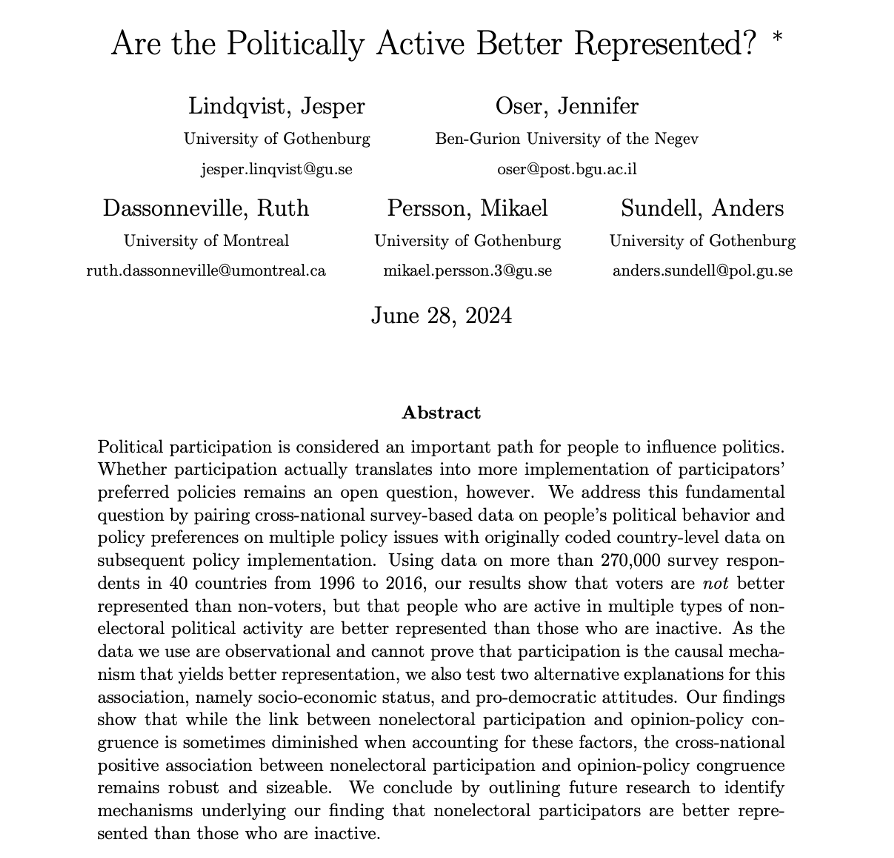
🧵I am happy to announce a new article in Political Behavior @polbehavior.bsky.social, “Are the Politically Active Better Represented?”, co-authored with Jennifer Oser, Ruth Dassonneville, @ProfPersson , and Anders Sundell.
https://t.co/kLUHpQkXQp
The connection between public opinion & policy adoption across 40 countries is stronger for citizens active in multiple types of nonelectoral political activity, though voters are only slightly better represented than non-voters
https://t.co/wR2jqhIvjH
Många verkar inte riktigt medvetna om vilken stor ideologisk flyttkarusell som ägde rum mellan valen 2018 och 2022. Mittenpartierna bytte intensivt väljare med varandra. Du läser alla detaljer om denna rörlighet i boken "Väljarna och valet 2022" från @Valforskning
Vänster eller höger är fortsatt den viktigaste politiska dimensionen i svensk politik. Men den har kommit att få en delvis ny innebörd, framför allt för yngre personer, skriver statsvetare Jesper Lindqvist.
https://t.co/yPdQGeUkka
🆕 Why do high-income voters see more of their preferred policies implemented than less affluent citizens?
🗳️ @JesLindqvist, @ProfPersson, @wouterschake & A Sundell examine the electoral connection behind unequal policy #representation.
👉https://t.co/DoY4oRtAtC #OA
We just published this in @EJPRjournal, showing that unequal opinion-policy responsiveness (that those with higher incomes get more of the government policies they prefer) seemingly cannot be explained by voting behaviour. Great thread explaining the results by @ProfPersson
Just published in EJPR "Poor choices? Examining the electoral connection behind unequal policy representation" with @JesLindqvist , Anders Sundell and Wouter Schakel. (1) https://t.co/Or6Xj1KWLt
I look forward to present our paper "Are the Politically Active Better Represented?", co-authored with @jennifer_oser@ProfPersson@r_dassonneville and @sundellviz, at #APSA2024! 2pm, Thursday, at what looks to be a great panel - "Fun Papers on Democratic Responsiveness"!
Policymaking is biased by both income and education. We shows that both factors cause unequal representation, with education creating a stronger bias toward cosmopolitan policies. New article with @wouterschakel and @sundell in Socio-Economic Review. https://t.co/8uKospC2MN
On my way to #EPSA2024 and looking forward to feedback on four different projects!
On Thursday at 11:00, @JesLindqvist & @jennifer_oser will present joint work on participation and opinion-congruence.
Trending in #PoliticalScience:
https://t.co/sdkFYq10Pz
1) Is opinion-policy congruence rewarded at the ballot box? (@electoralstdies)
2) Are Firms Gerrymandered? (@apsrjournal)
3) Five Decades of Research on Women & Terrorism
4) Attitudinal Consistency in Citizens’ Social Policy Preferences (@the_jop)
5) A matter of time, not generations: rising emotional attachment to the EU 1991–2023 (@jepp_journal)
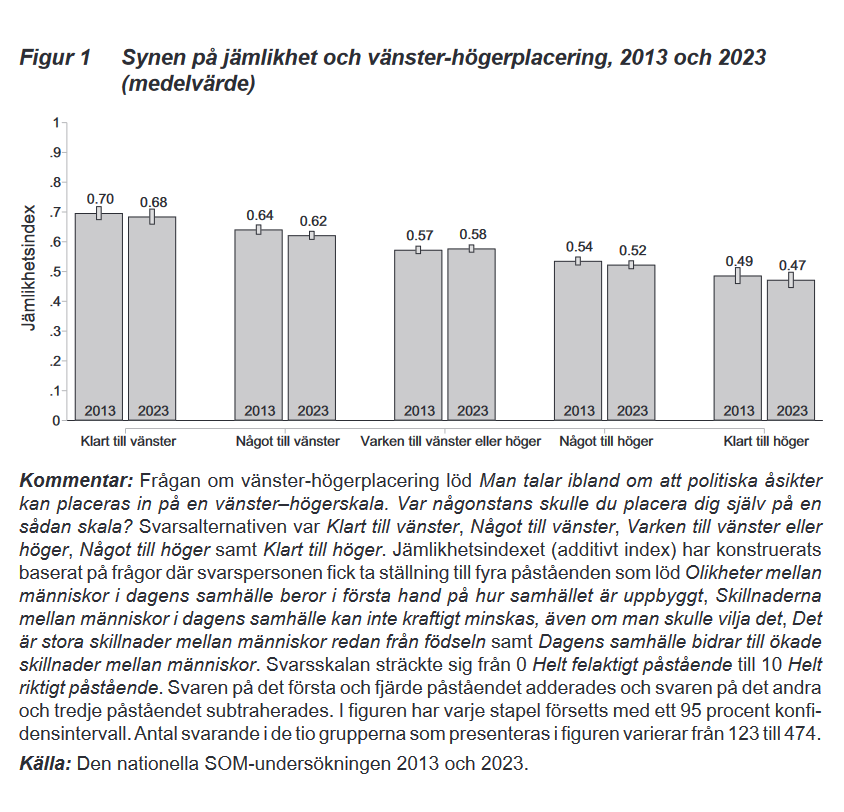
Läs gärna detta kapitel, som jag skriv tillsammans med @SvenssonRichard, där vi utforskar korrelationer mellan vänster-höger-positioner hos väljare och deras attityder mot olika typer av ojämlikhet.
Trots en stor förändring av det politiska landskapet under de senaste tio åren så tycks sambandet mellan vänster-högerplacering och synen på människors jämlikhet vara i det närmaste oförändrad.
Från SOM-antologin Inferno: https://t.co/LmrNKkJdx2