A Congress that legislates & appropriates through regular order has more weapons to deploy & greater ability to force executive branch acquiescence. Insofar as the next round of oversight fights are resolved in court, it will be yet another sign of Congress’s decline.
@jadler1969
Classically, from the standpoint of policy studies and ethics in public leadership, it's not that leaders that have extra martial affairs are likely to cheat elsewhere— it's that they become vulnerable to things like extortion.
https://t.co/FQegvoyeBR
"reading is on its deathbed"
This is real. It's very real.
Professors are limiting readings and textbooks because too many students won't read and one gets the sense that many cannot read at a level necessary to make their way through.
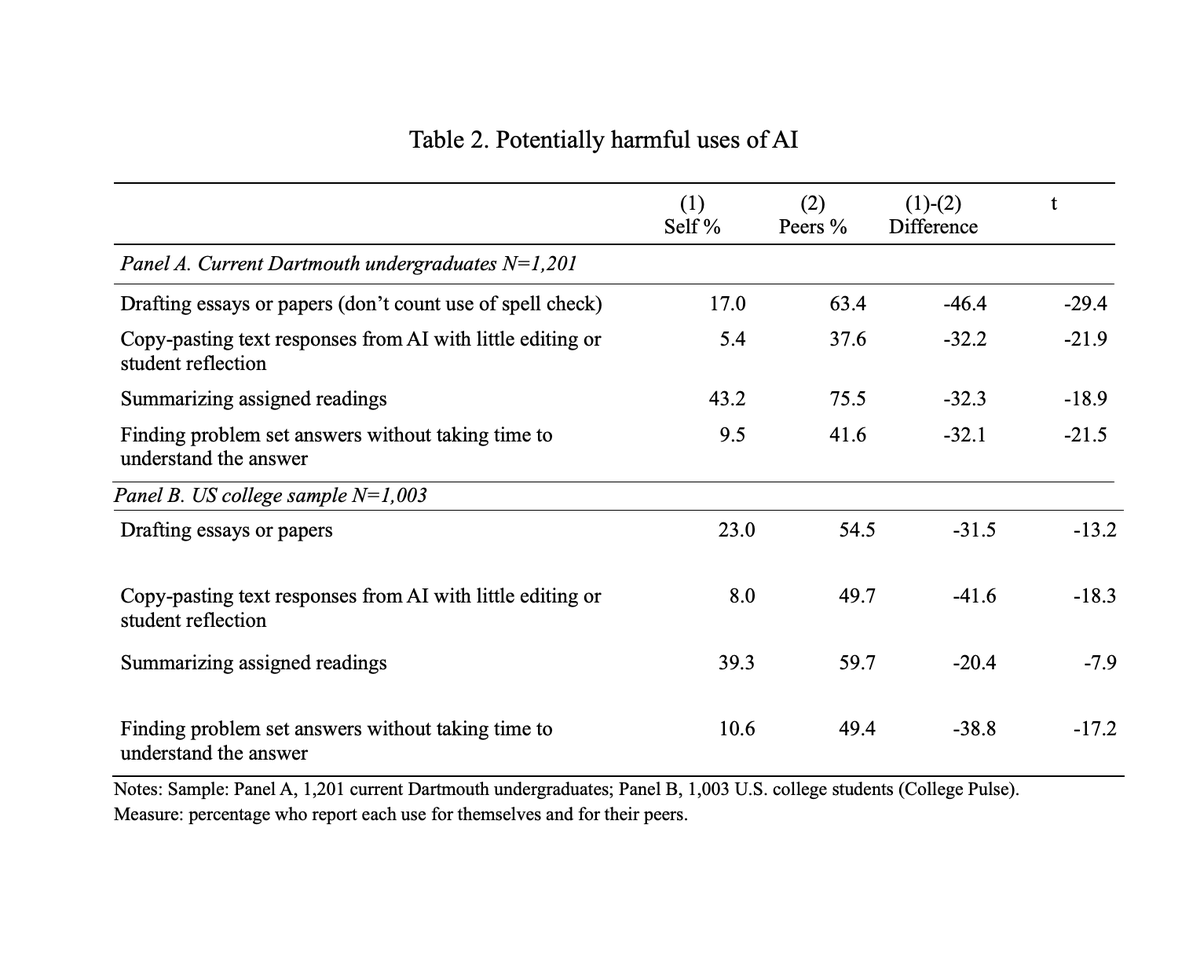
NBER just released a survey on college students and AI. The paper samples a group of Dartmouth students and a group students from around the country. A few interesting results:
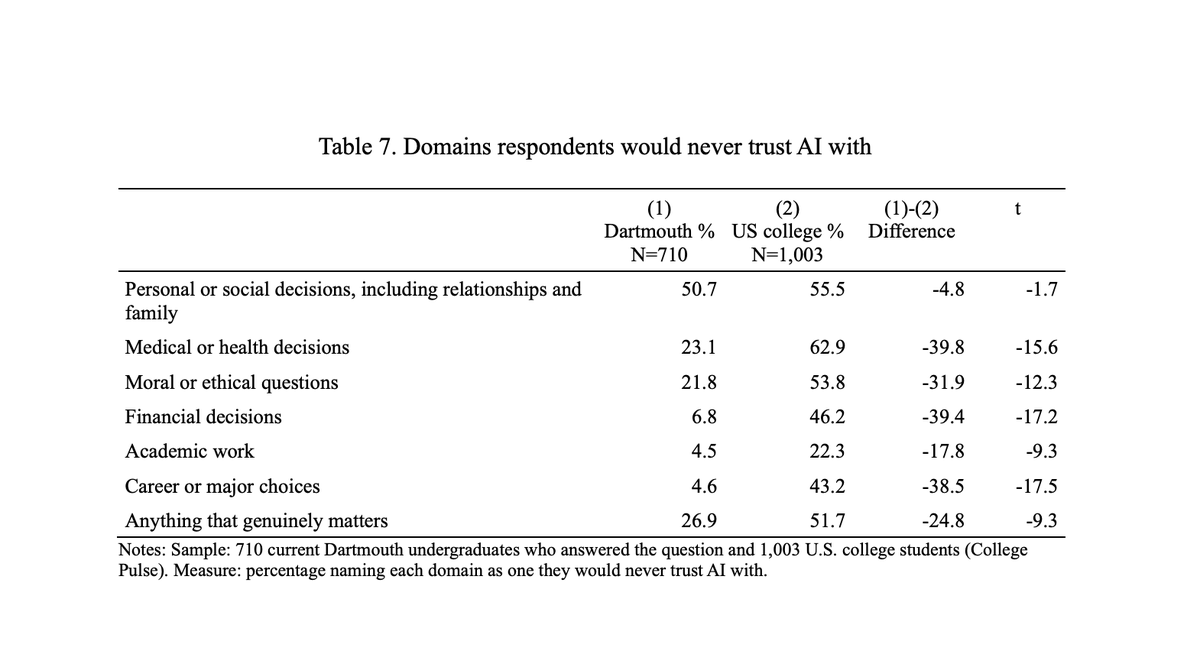
— For both groups, only about half said they'd never trust AI with personal (relationship/family) decisions.
— Only 6.8% of Dartmouth students said they would never trust AI with financial decisions, compared to 53.8% of other college students.
— In general, Dartmouth students reported being much less distrustful: only 4.5% said they wouldn't trust AI on academic work, 4.6% on "career or major choices," and 23.1% on medical or health decisions.
— Across the board, student said AI was bad for writing: 92.3% of Dartmouth students, 84.3% of other students.
— A relatively small number in both groups admit to using AI to write essays (17% and 23%), but a solid majority report thinking their peers do it.
— A greater number of students say they use AI to summarize assigned reading. At Dartmouth, 43.2% say they do, while they think 75.5% of their peers do.
One takeaway: even if the college essay isn't doing as poorly as we might think (I'm skeptical), reading is on its deathbed. And are Dartmouth students using ChatGPT to pick stocks?
The paid influencer campaign is likely done widely.
These appear to be similar and focused on shifting public perception relevant to litigation:
Mapping NGO capture of permissible narratives at the United Nations
https://t.co/azxxN2VNFy
Who should pay?
https://t.co/1GGkaql9uL
I'm seeing increased organization of science academies to push government on issues.
I do not expect it to end well.
If the academies act like just another advocacy network they will deepen public distrust in science and lose government support.
https://t.co/MDO6ngkHkh
NYC has a moratorium on student facing AI for K through 8th grade.
Google says we are going to force you to break your own rules, you can't have search without AI.
NYC must call Google's bluff, kick out search, and refer the case to the AG and DA for illegal tying and abuse of monopoly power.
The idea that any other Ed Tech company could say "you only get the tool you want if you break your own policies" would be nonsense.
"Trouble comes, instead, through other channels: when professors rotate back into academia and embed their research within a political project, no matter how modest or mainstream; when they censor certain findings because of the problems they’ll generate for their chosen cause; when they refuse to ask certain questions for fear of upsetting political allies or pleasing enemies; when they evaluate the benefits of a policy intervention without ever considering its costs, or costs without considering benefits, lest they dignify the objections of political opponents; when they go out of their way to valorize preferred groups while reflexively ascribing malign intent and moral depravity to those in positions of power and privilege; when they selectively recognize the agency, culpability, or mistakes of a certain population according to how its members figure in a larger political project; when they profess that their research serves—not distantly or abstractly, but quite directly—an activist agenda to eliminate injustices, right wrongs, recover heritages, glorify gods, or uphold some particular understanding of the public good."
Spot on.
"The accounting watchdog was started by non-profit groups, WRI and the WBCSD...These two organisations were the “final decision makers” on the governance design and the CEO job description," https://t.co/T5scRX9T5Z
@CharlesFLehman@atrembath Halloween has many versions: kids, family, adult. General cultural tolerance for open display of gore as entertainment and a diminished value of respect is a deeper issue- apparent in the ads for violent games running during TV sport events, bumper stickers & elite speech.
"he described Yale as a 'paradise for minds coming to the age of abstract reason.'"
This is a beautiful and on point sentiment, something I will return to when thinking about the role of universities.
https://t.co/mXJZ2EiG5r
Interesting rejoinder to my institutional neutrality in climate change science paper by @JessicaWeinkle, focusing on COIs.
There have also been some critical comments on my paper accepted, which I will share, along with my reply, when all are out. I like this Dialogues format.