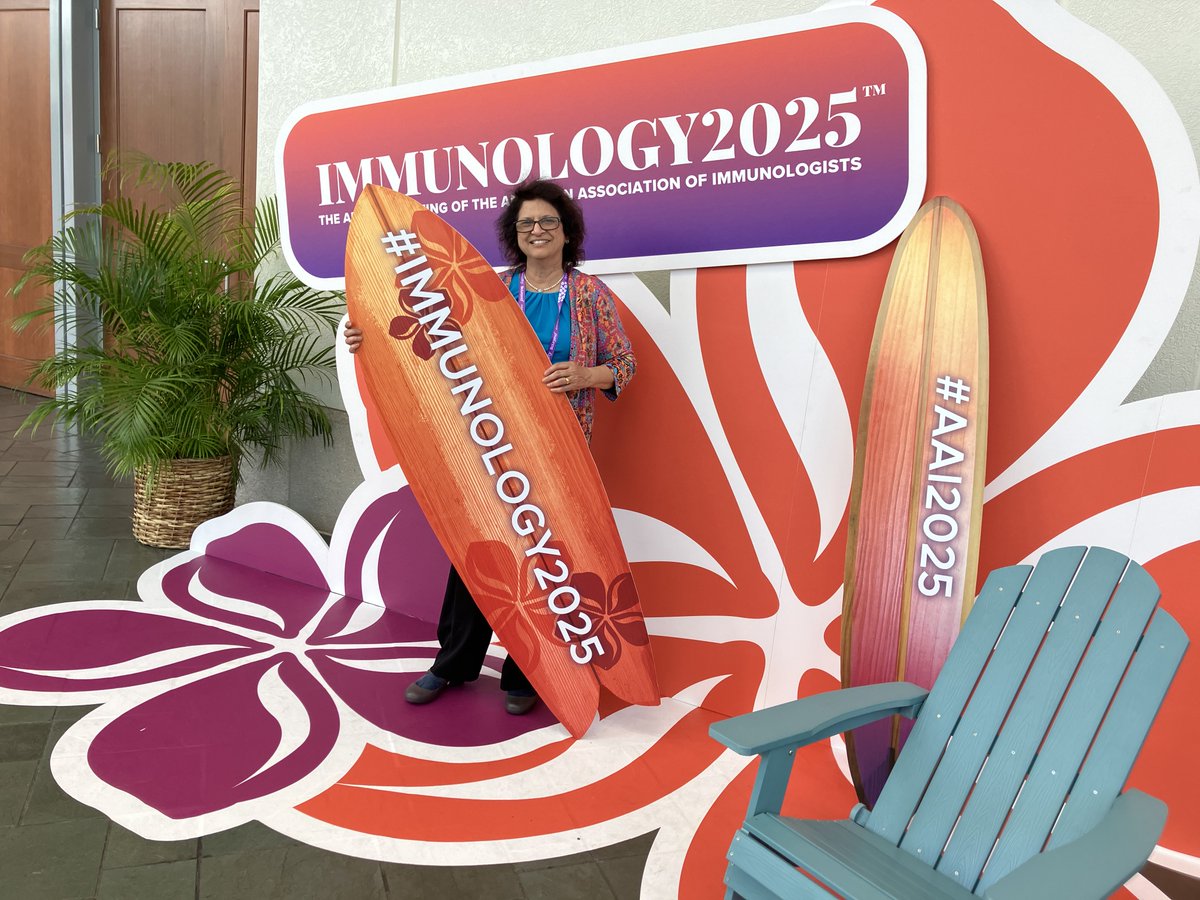
@Alex9Jessy "Complement as a Responder system to Microenvironmental cues" at the AAI 2025 in beautiful Hawaii. Looking forward to many more such sessions
@Alex9Jessy The brain is an engineering marvel , energy frugal, while today’s large AI models consume hundreds of MW hours. AI energy/intelligence ratio is staggeringly high, energy hungry. Questions to ask: When is AI truly needed? How can we make AI more energy efficient?
AI is here and now; some see the promise , others fear the problems that will ensue. The AI tentacles are spreading to all facets of life, from switching on lights to traveling to Mars, also it will continue to reshape education and the academic landscape.@UBuffalo@immunology
AI and babies.
baby: basic brain wiring, learns by repeated interactions and patterns. AI: foundational architecture and dataset, learns from us. The key: you are in the driver’s seat. AI doesn’t replace us, it reflects us. @UBuffalo@complement.
A brilliant student struggled to engage with research projects. By chance, I realized his passion for computers, a pivotal moment that made a remarkable transformation. Mentorship is more than guidance. Its listening, understanding & connecting them to what excites them.
Congratulations @CKemperLab, Erin West, @NicolasSMerle and team!!!
Loss of CD4+ T cell-intrinsic arginase 1 accelerates Th1 response kinetics and reduces lung pathology during influenza infection: Immunity https://t.co/XlTaNYRU0R
Einstein, Curie, Bohr, Planck, Heisenberg, Schrödinger… how many Nobel Prize laureates can you spot?
Some of the world’s most notable physicists participated in the 1927 Solvay Conference. In fact, 17 of the 29 scientists attending were or became #NobelPrize laureates.
Interesting paper on #complementbiology as a potential drug target for vascular dementia & carotid plaques:
- https://t.co/l1gNRIY1J4
🔑✉️:
- Expression of C1q, Factor D, CR3 & CR4 Subunit (=CD14), and C5aR1 were⬆️in both vascular dementia & carotid atherosclerotic plaques.
Excellent overview of everything you need to know about #complementbiology Factor I - structure, function, disease implications and therapeutic use.
👇
Complement factor I: Regulatory nexus, driver of immunopathology, and ... https://t.co/4jFTMTqgmO
Hi all, Join complement biologist and Immunologist at ICW2023 Full programme available - still time to register!
https://t.co/2hdWM1gNB1 @britsocimm@ImmunoNorthEast
#PhD student: Makes $30k a year. Works on weekends as well. Zero life-work balance.
"Do you think I have a chance to become a professor?"
Prof: "Yes, of course! Finish this project and we will publish excellent papers. I am sure you will easily find a faculty position."
▫️
2 years later:
Student finishes the project. Professor writes a report. Papers are published.
Student: "Do you think my CV is strong enough?"
Prof: "Yes, you are the best!"
▫️
Next 4 months:
Student submits 50 well-tailored applications for faculty positions.
Zero interviews. A lot of broken dreams.
▫️
Key takeaways:
1. Make sure you distinguish encouragement from reality.
- By encouraging you, your advisor may unintentionally give you too much hope. Keep a cool head.
2. Always ask other faculties for external opinion on your case.
- Your advisor’s opinion is always biased. Look for more input outside your group.
3. Don’t expect fairness during candidate selection.
- Hiring process is subjective by definition. It is done by people with very different views on who is the best. You may put tons of efforts into a research statement only to find out later that no one really reads it.
4. The reality is brutal.
- Departments can receive 300-500 candidates per opening. Many have excellent CVs and cool ideas. At top- and mid-rank universities, selection criteria can become extremely questionable (like, who exactly was your PhD advisor? Is your recomm. letter 3 pages long? etc).
And there is no need to say “You don’t know anything about it. It’s not like this”.
I went through this myself. Many times. Along with many colleagues.
Do not expect fairness. See luck as a big factor.
Apply broadly but have a backdoor ready.
#AcademicTwitter