In this house we believe:
-you can just do things
-competition is good
-it’s better to ask forgiveness than permission
-everything in moderation, including moderation
-there are no solutions, only tradeoffs
-clichés are clichés for a reason
-so too with the most replicable results in social science
@echolima001@tracewoodgrains You know I think I would actually be ok with this. Would want to edit the NPPC v. Ross neurons, but otherwise I think I am down with LLM Justices.
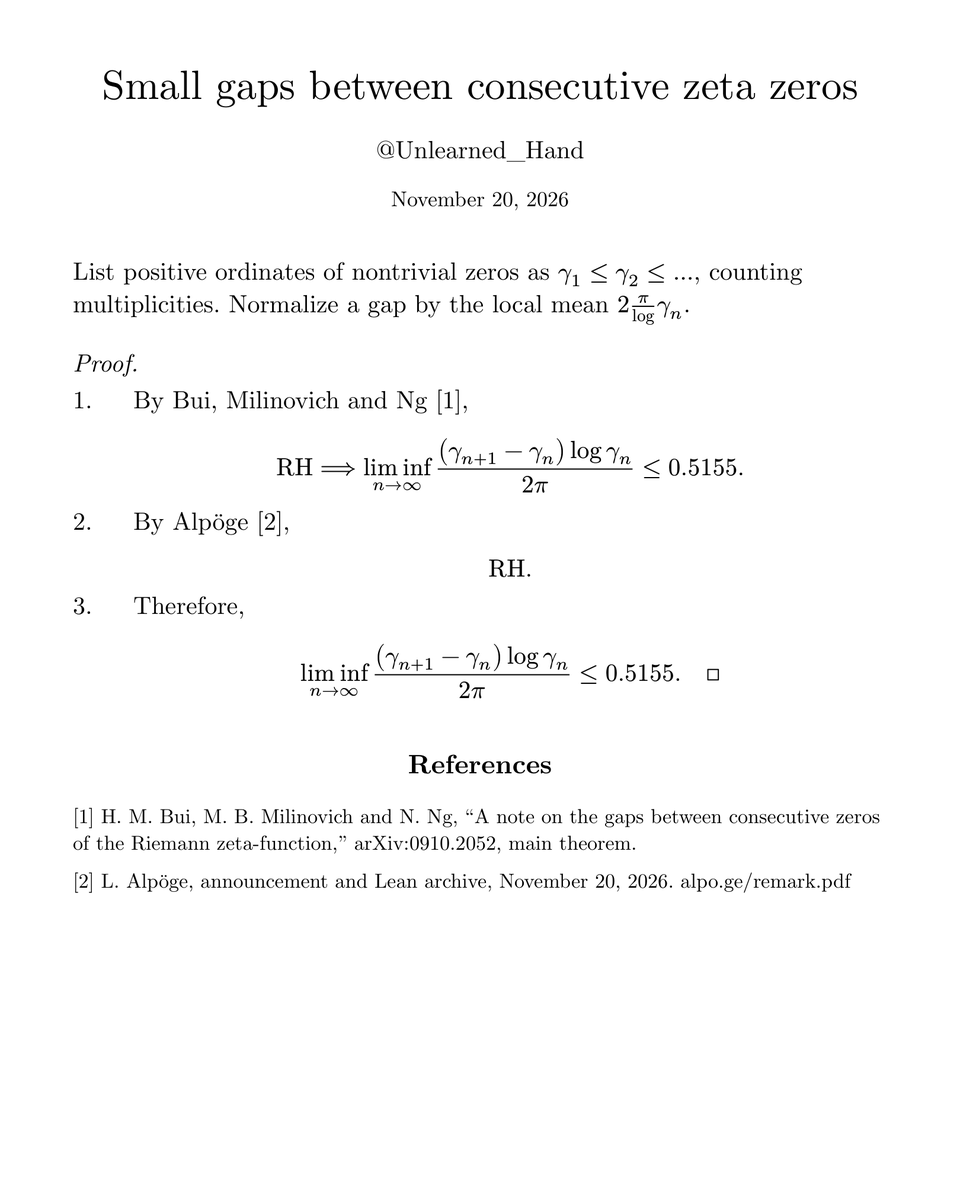
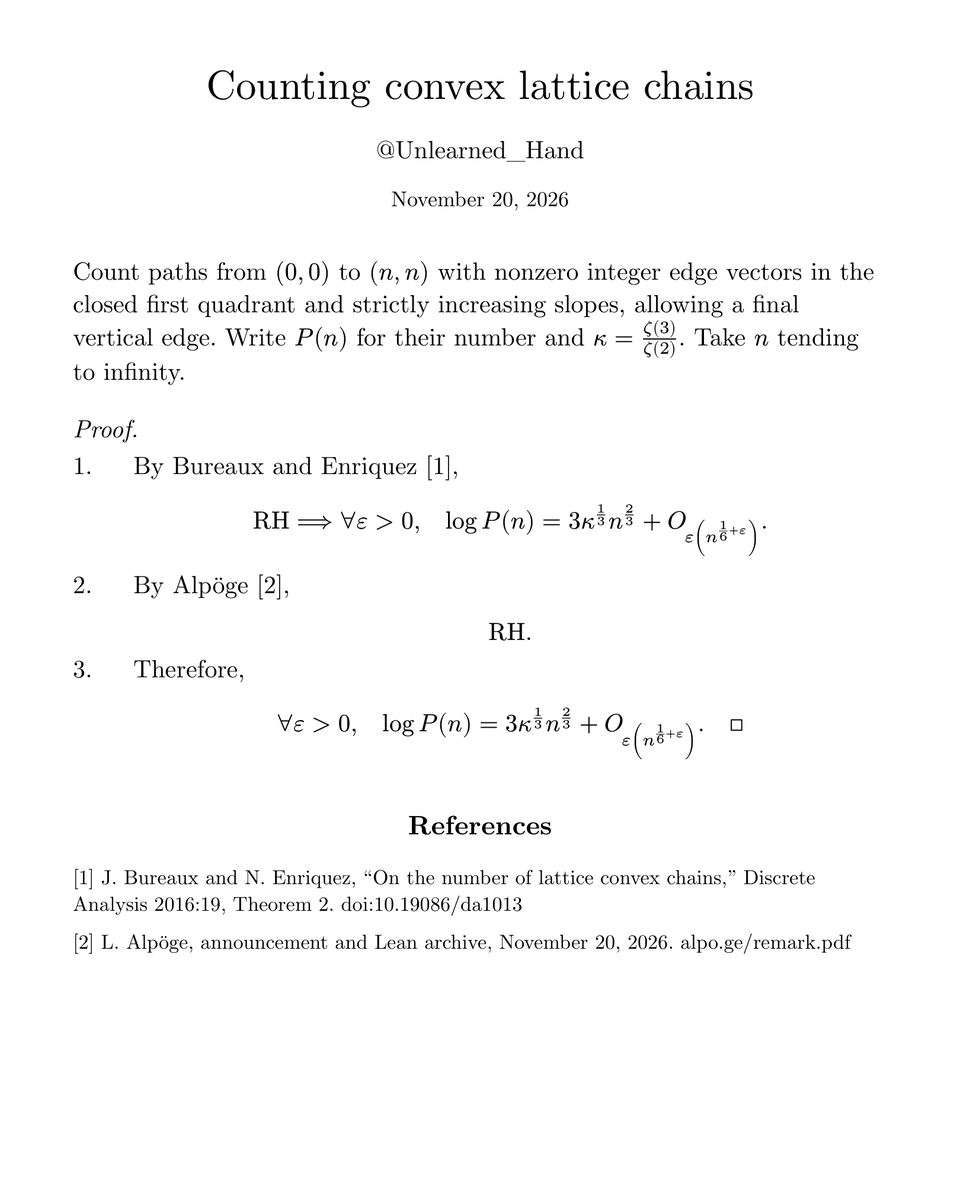
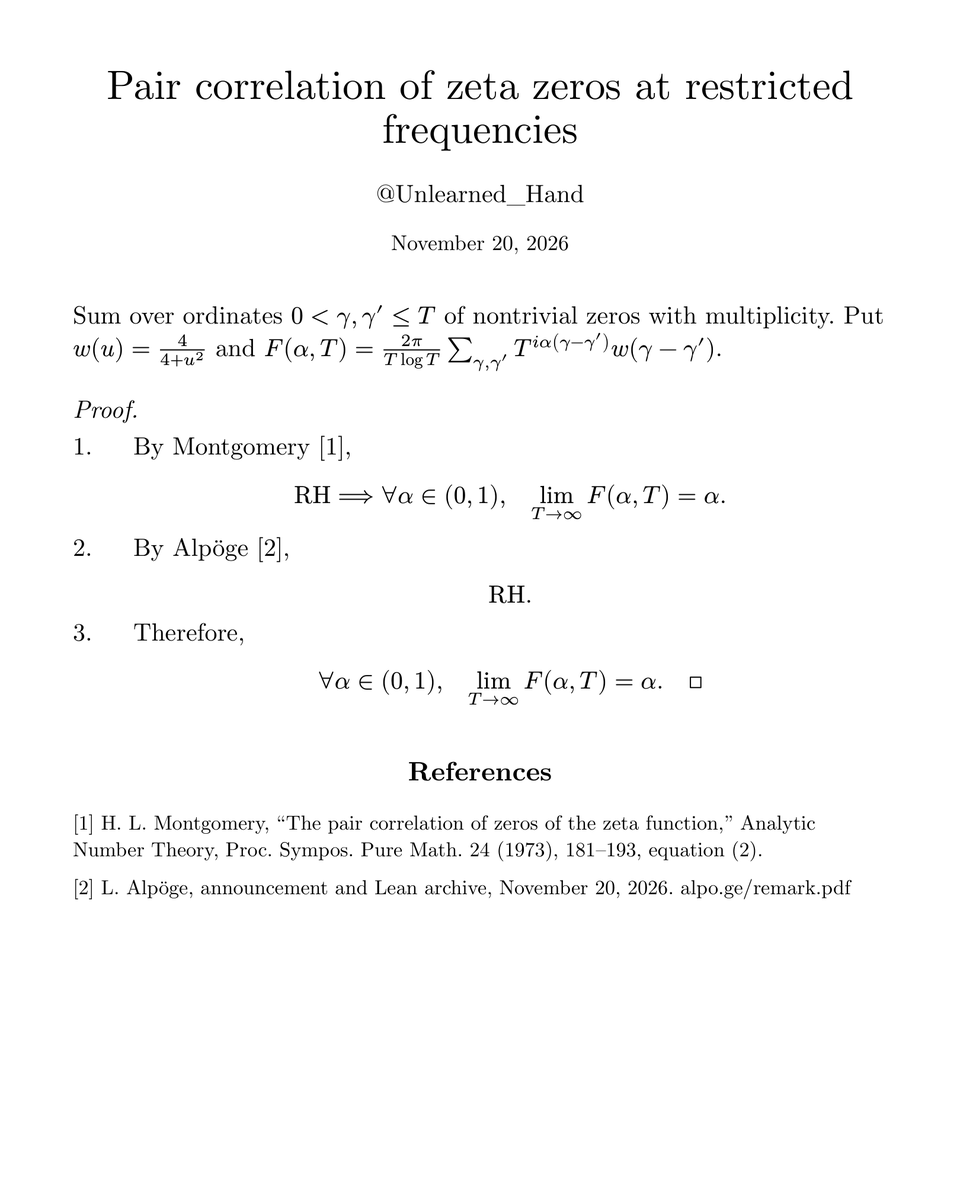
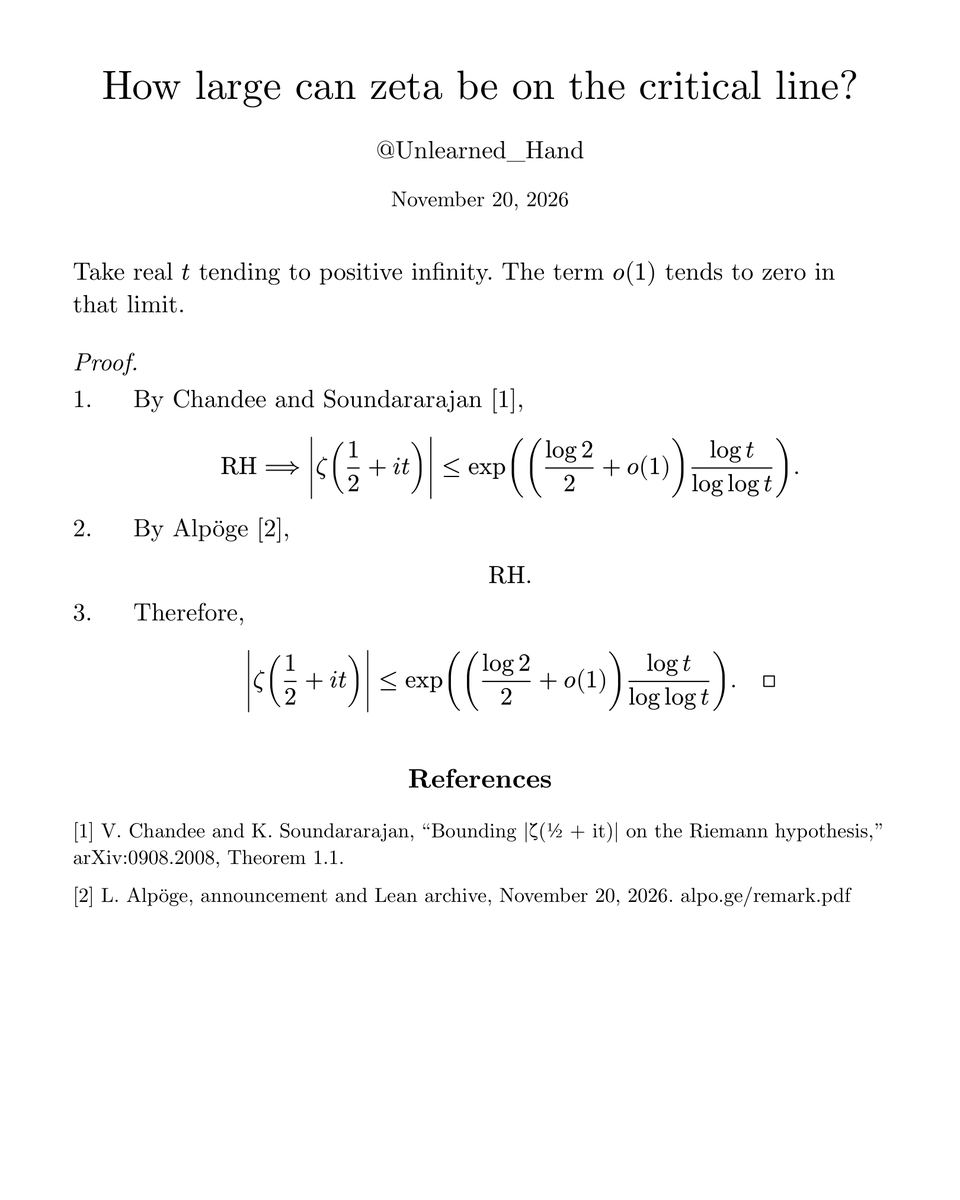
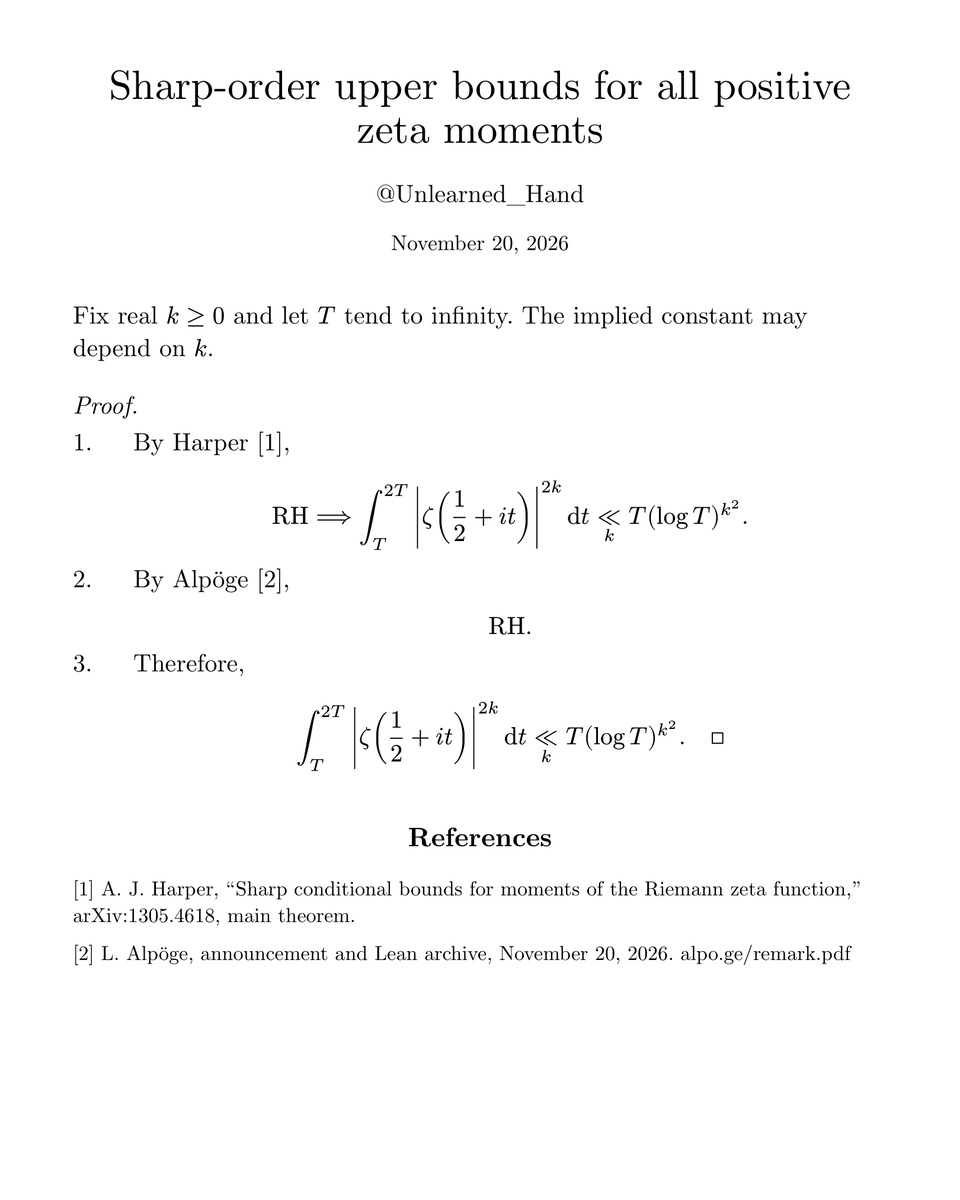
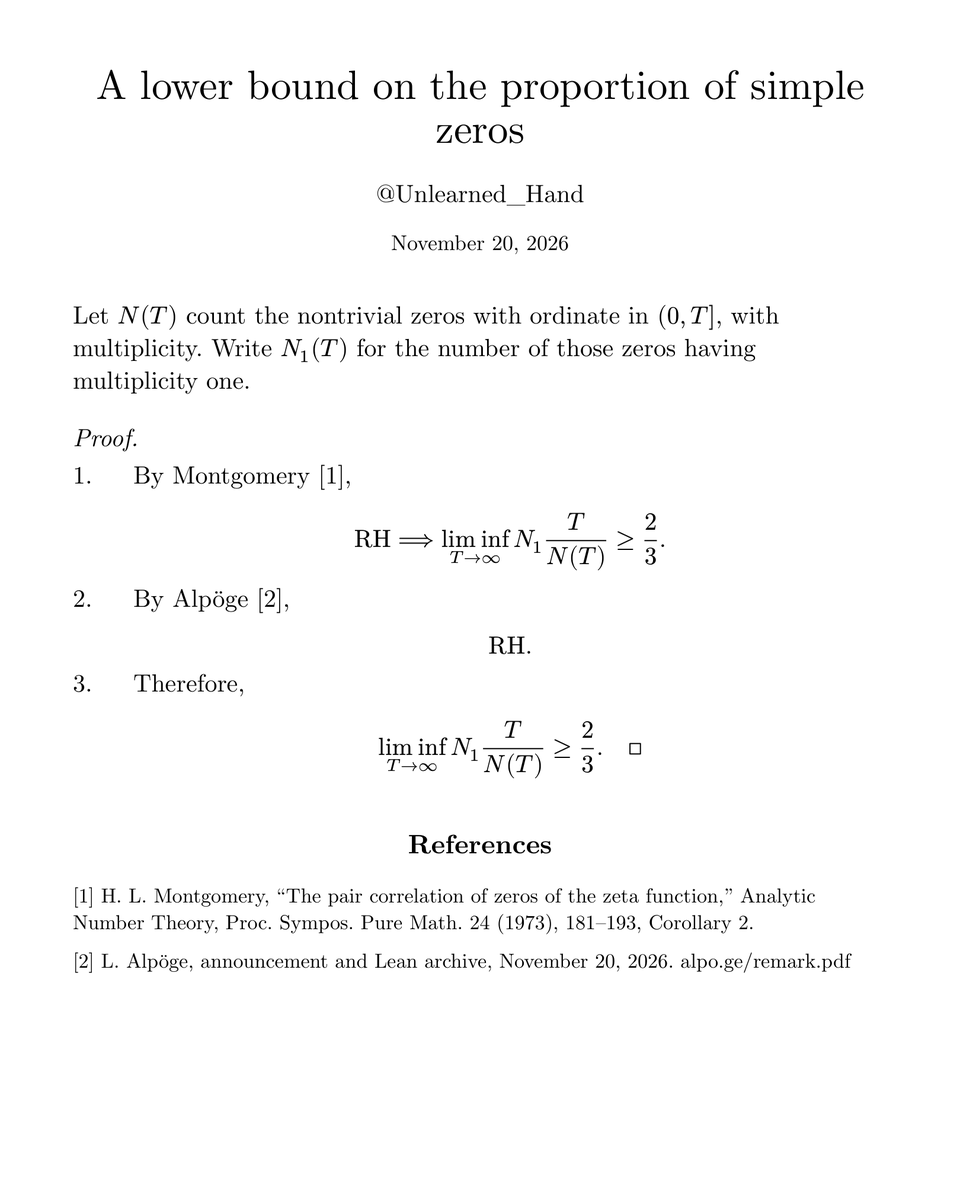
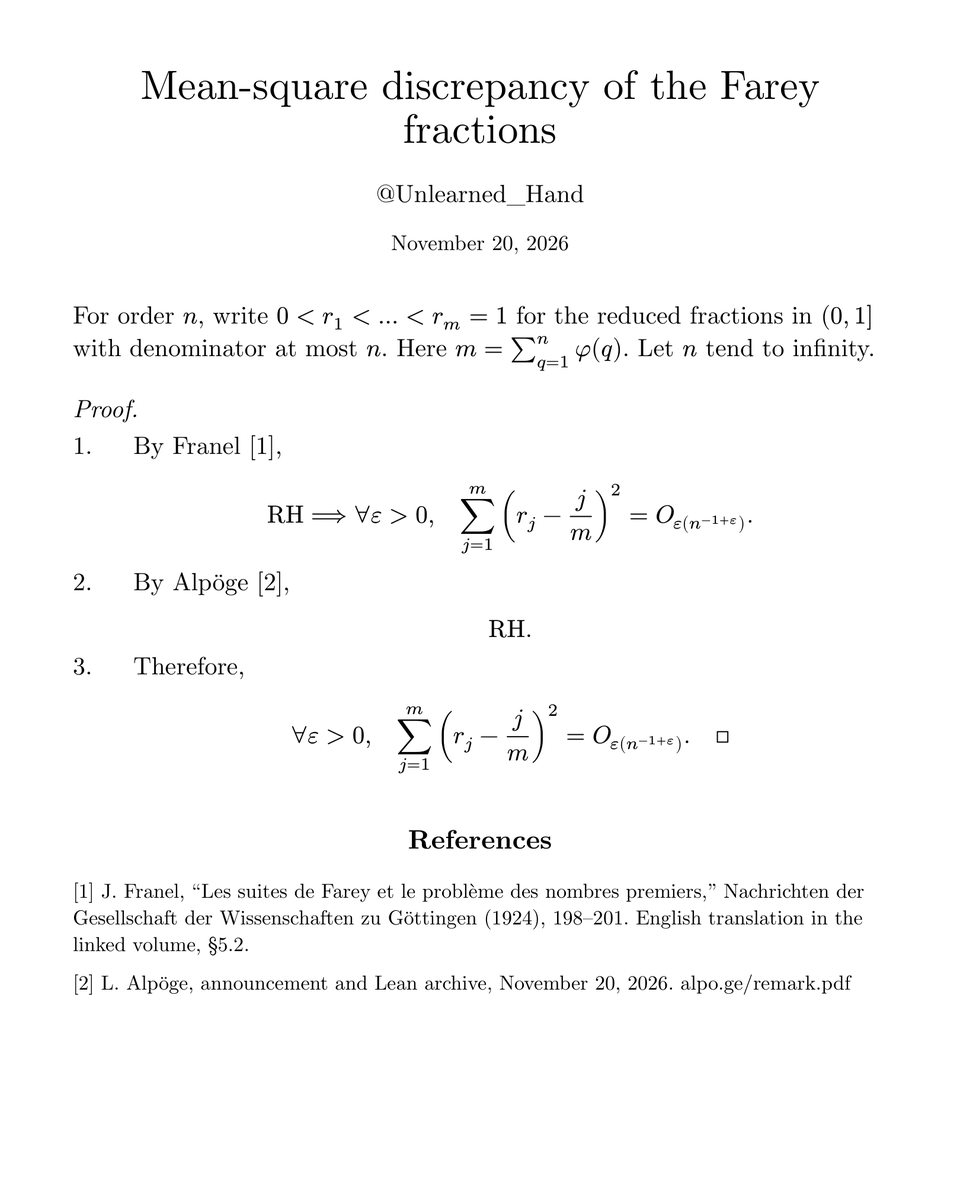
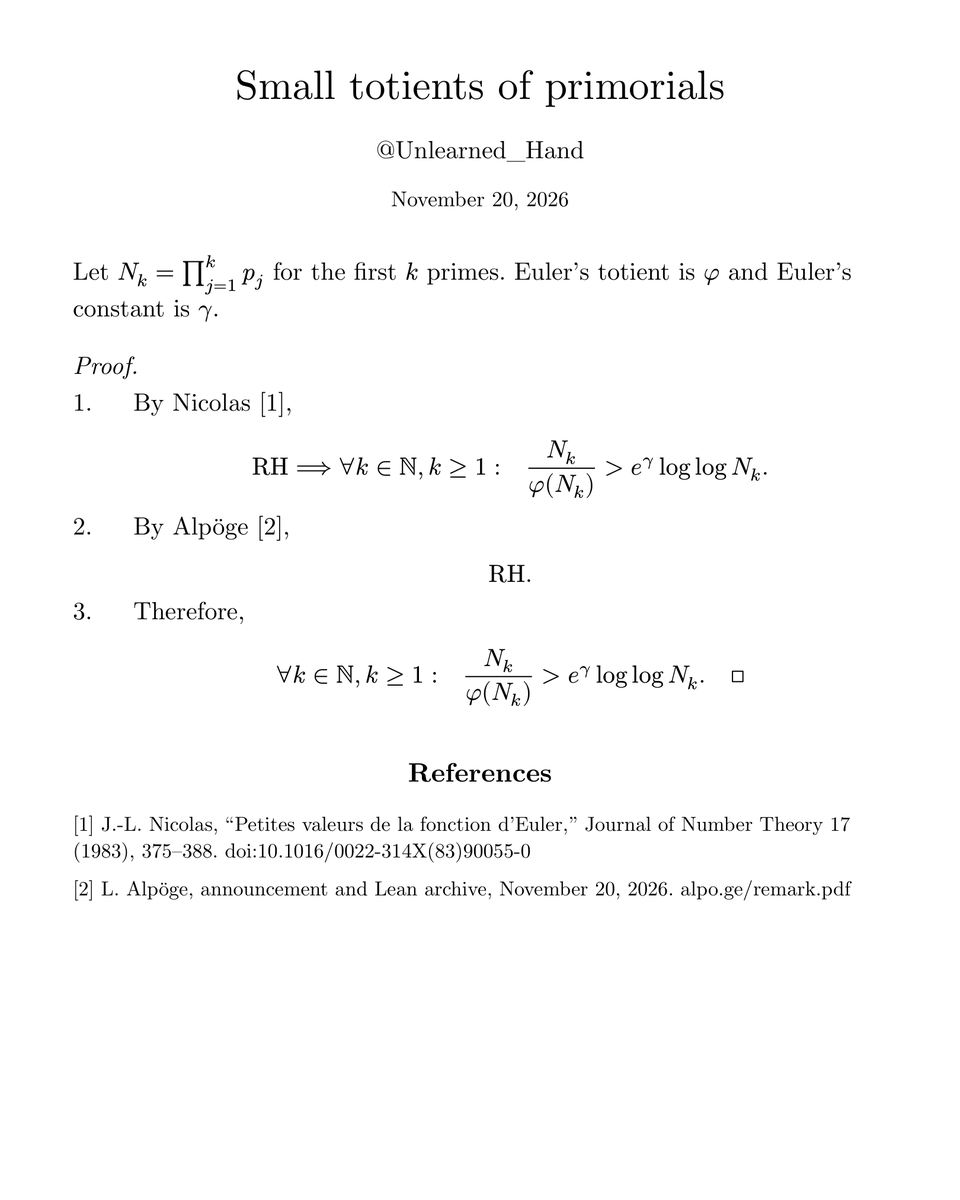
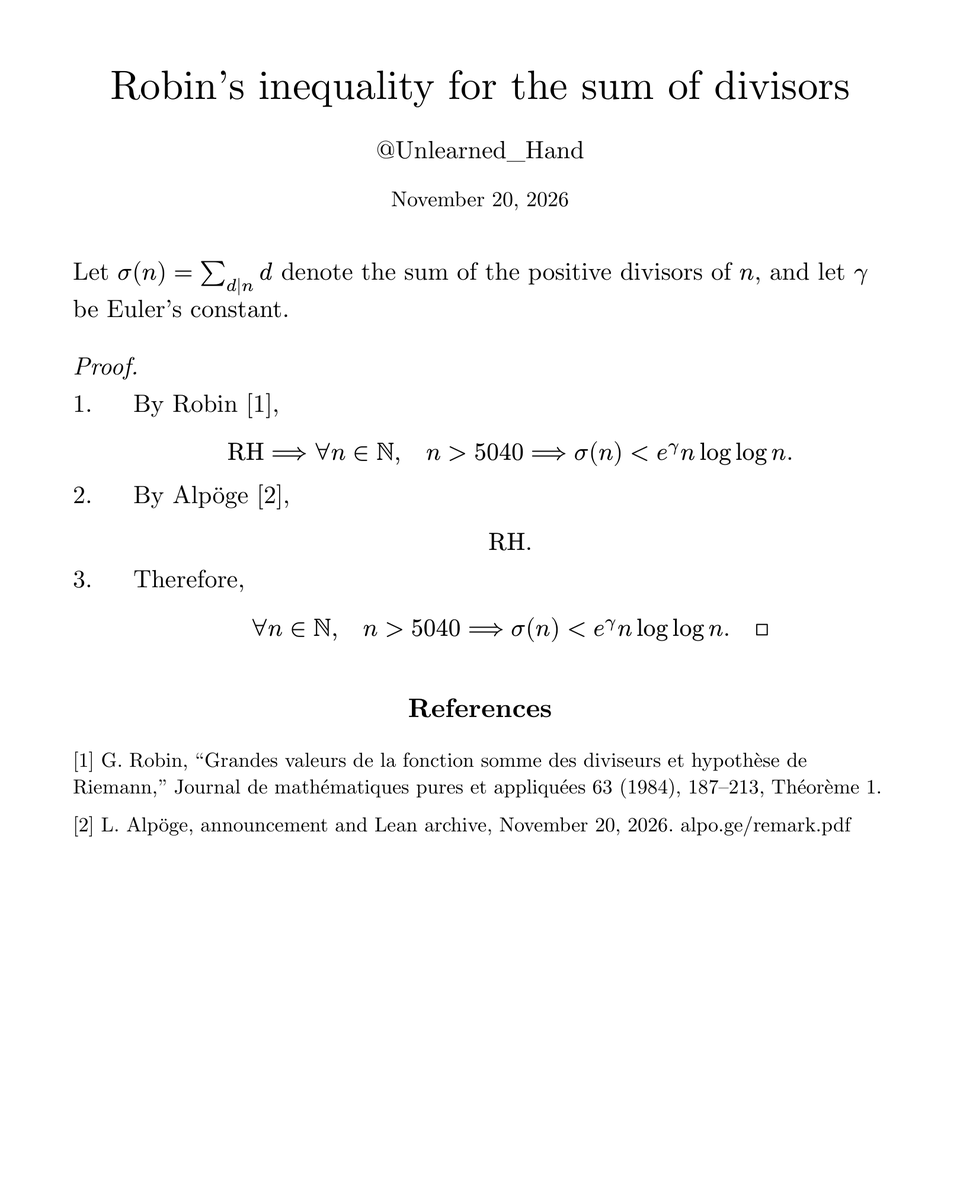
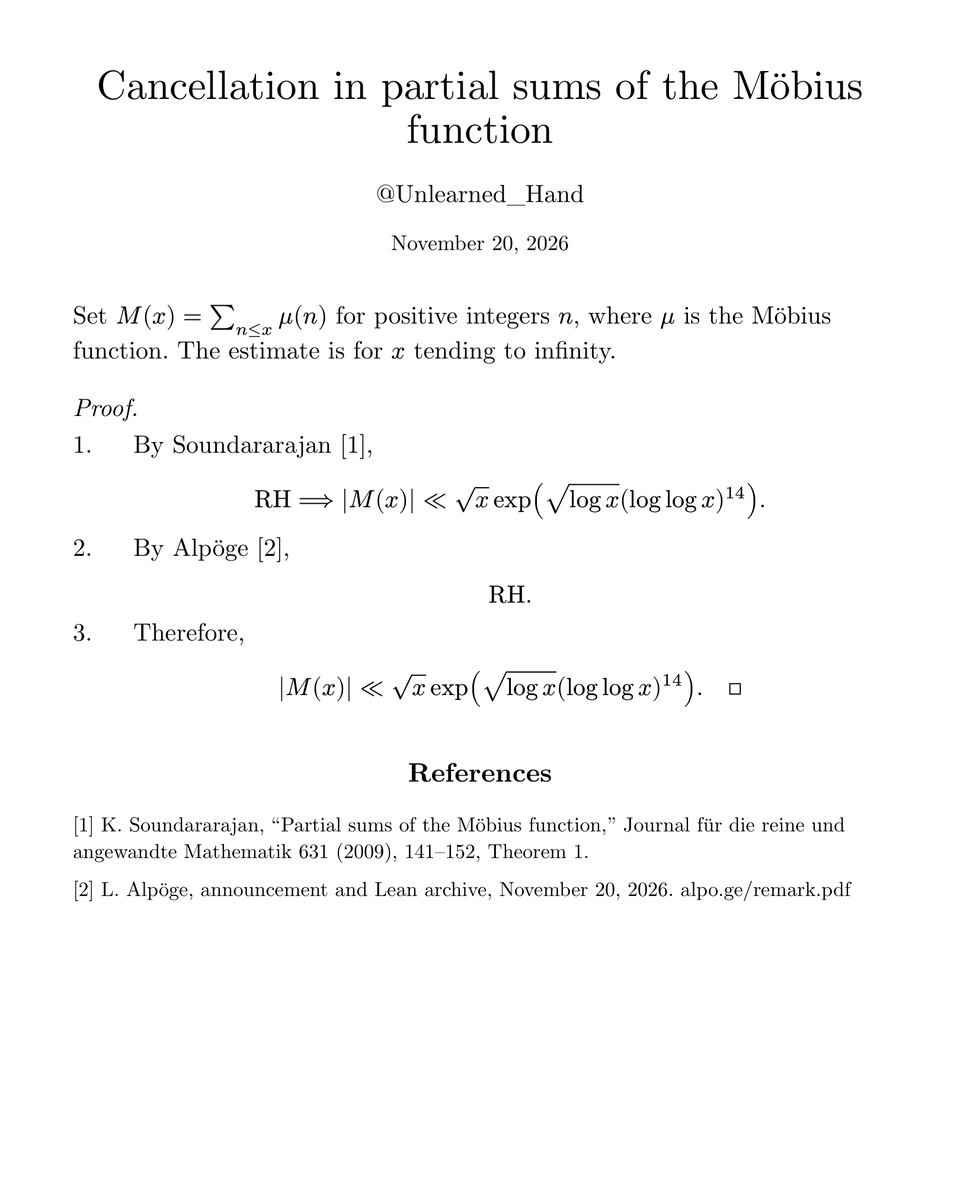
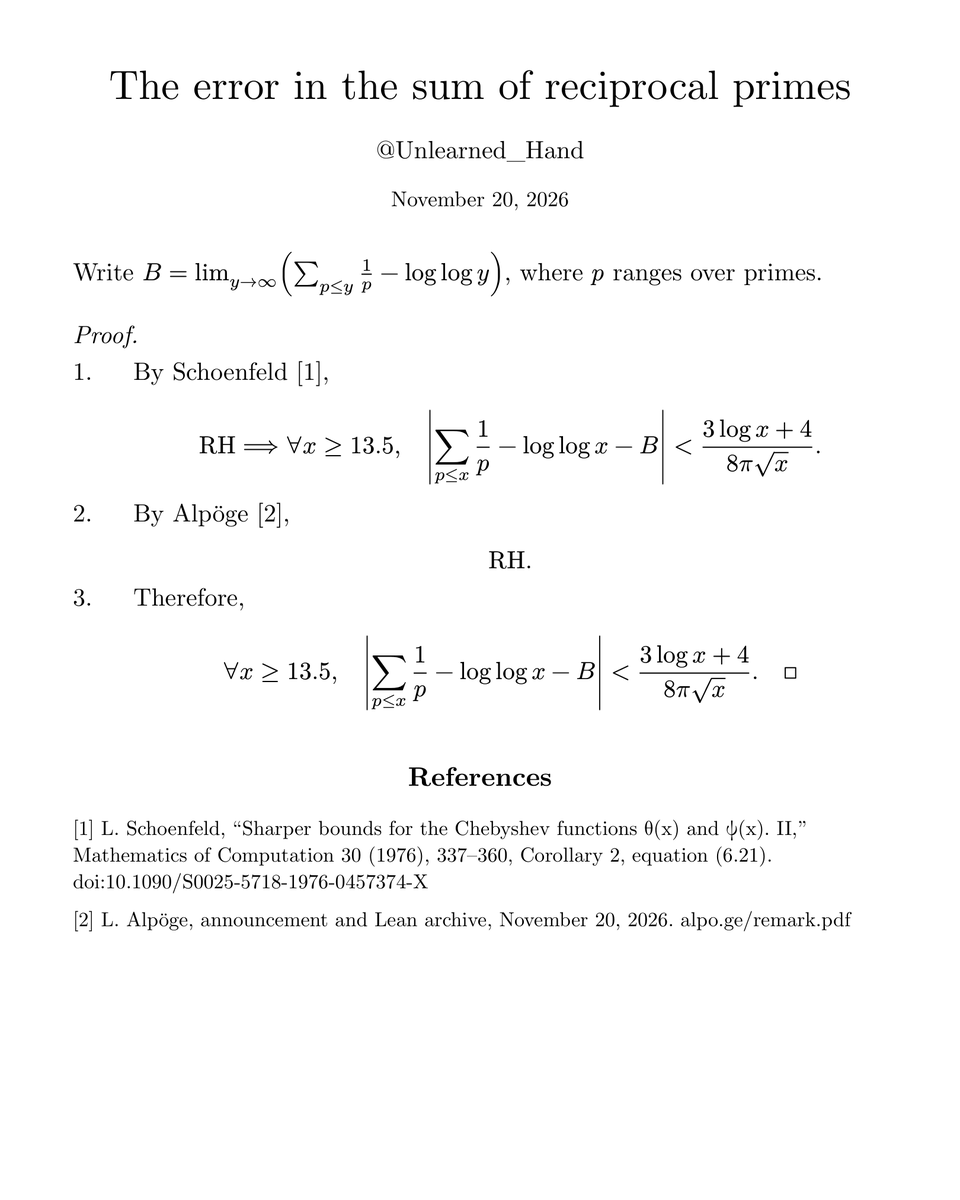
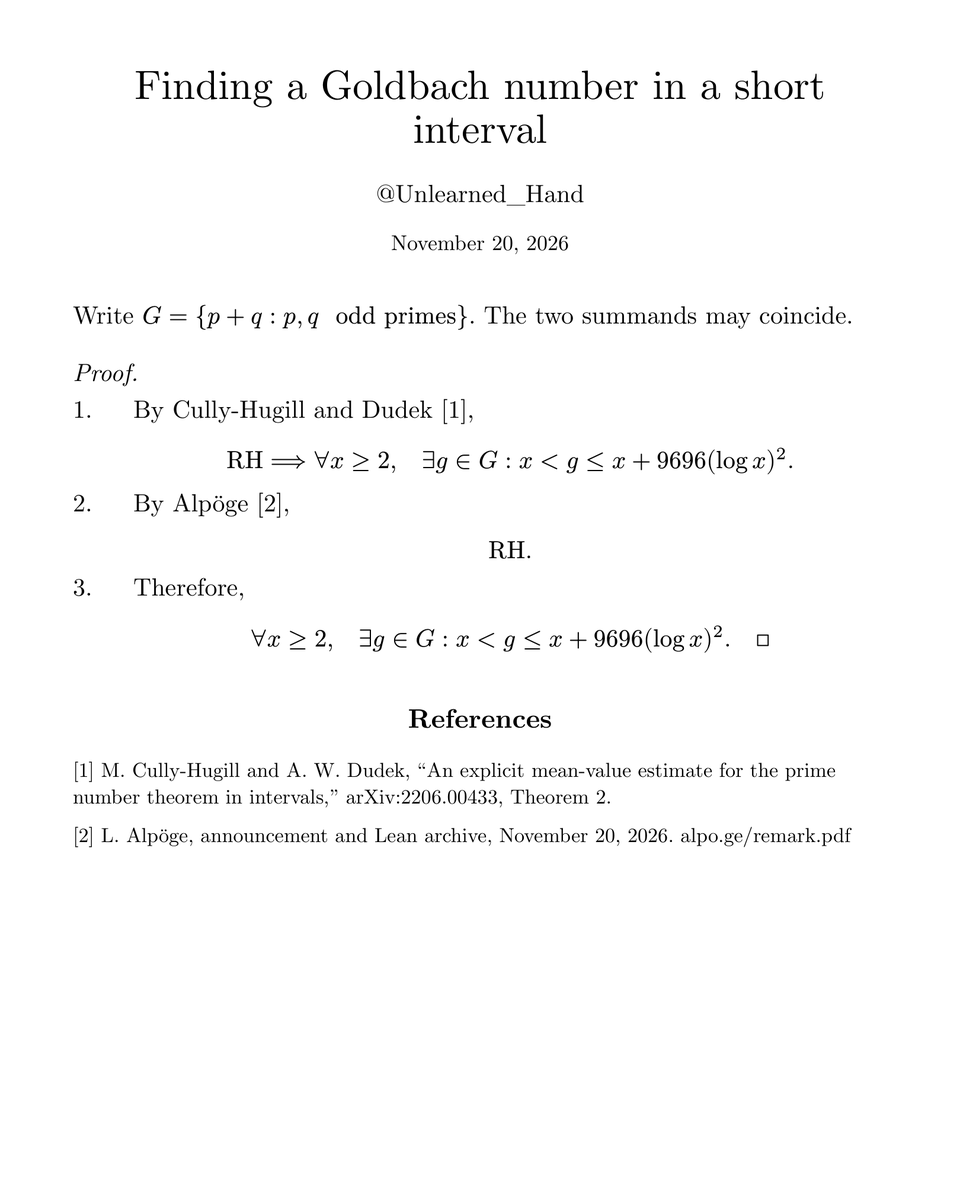
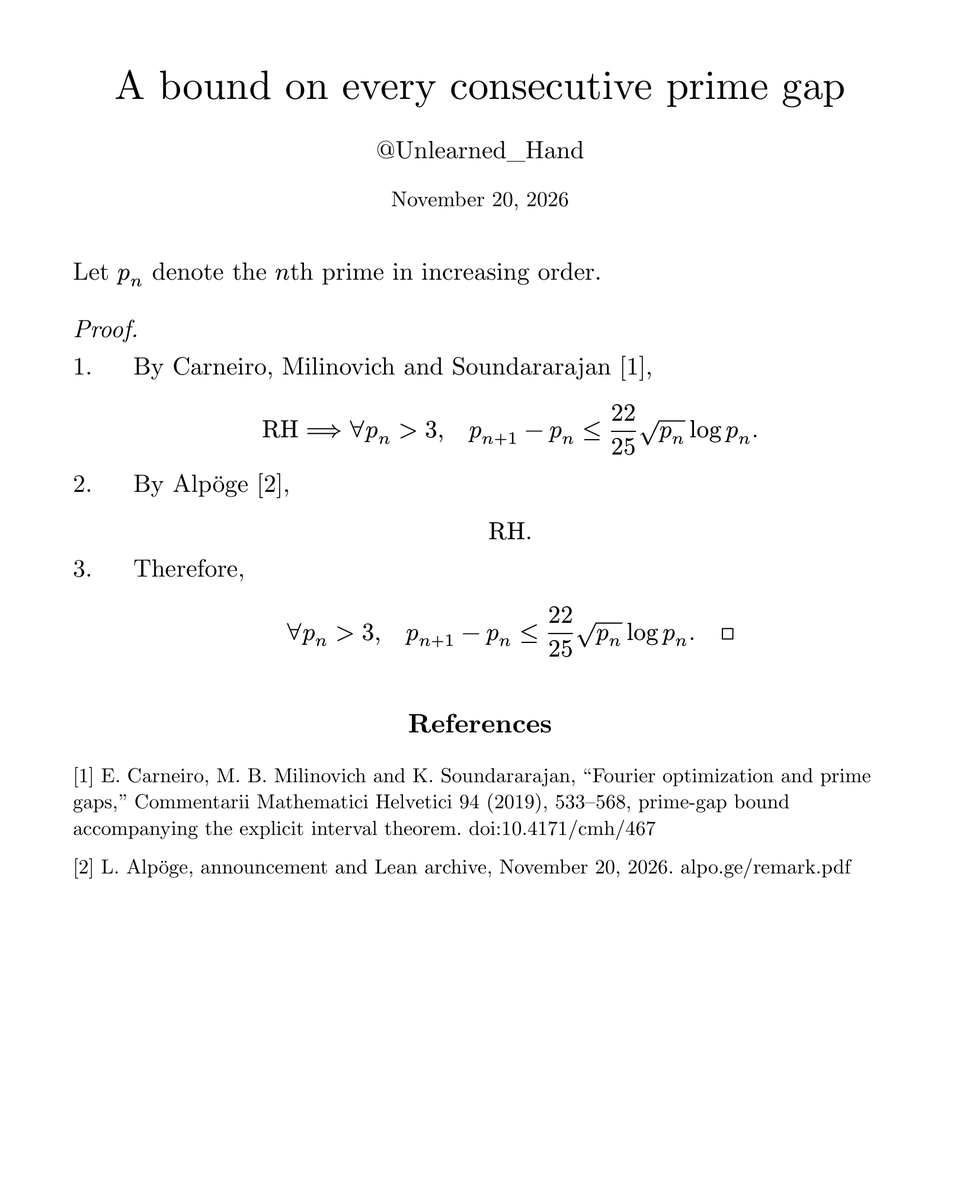
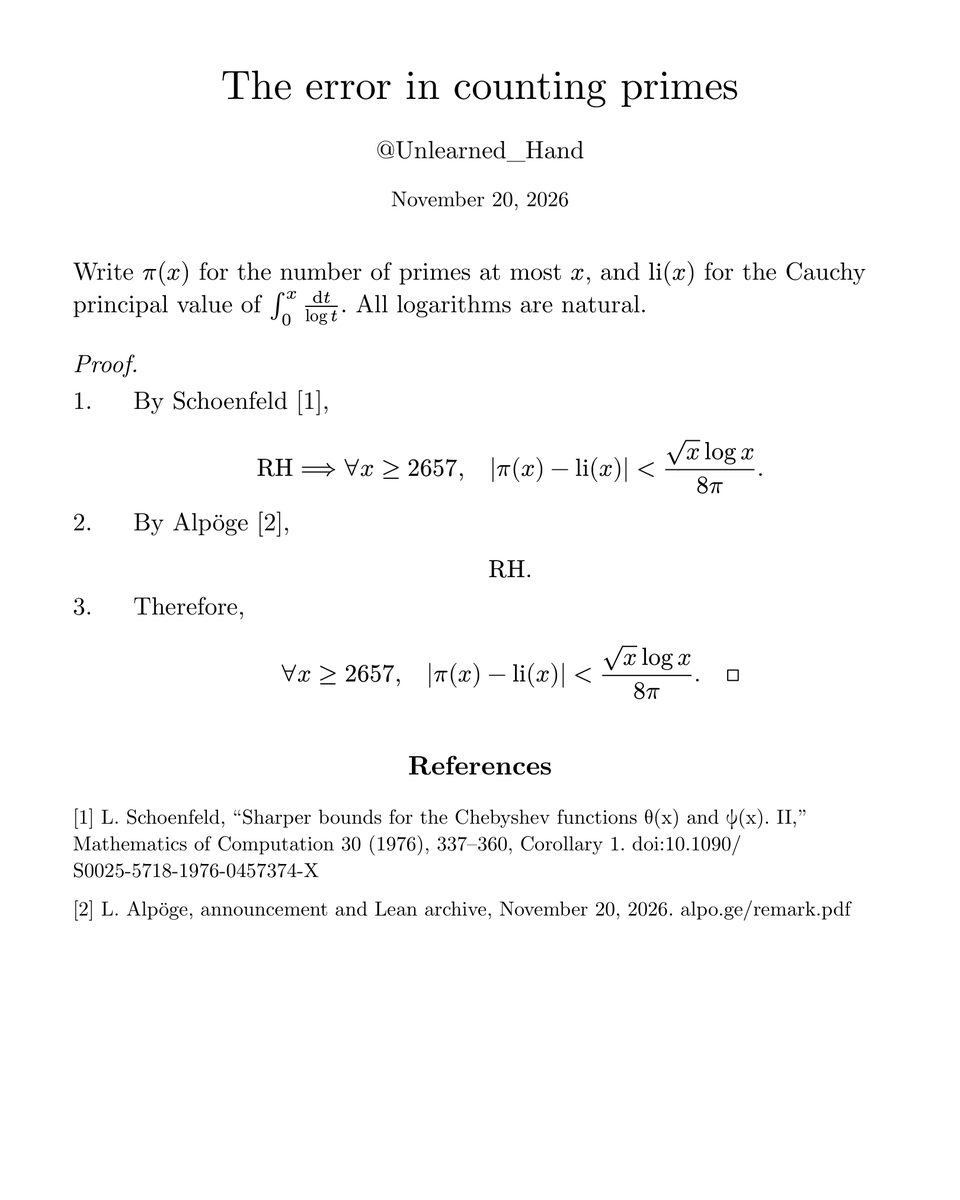
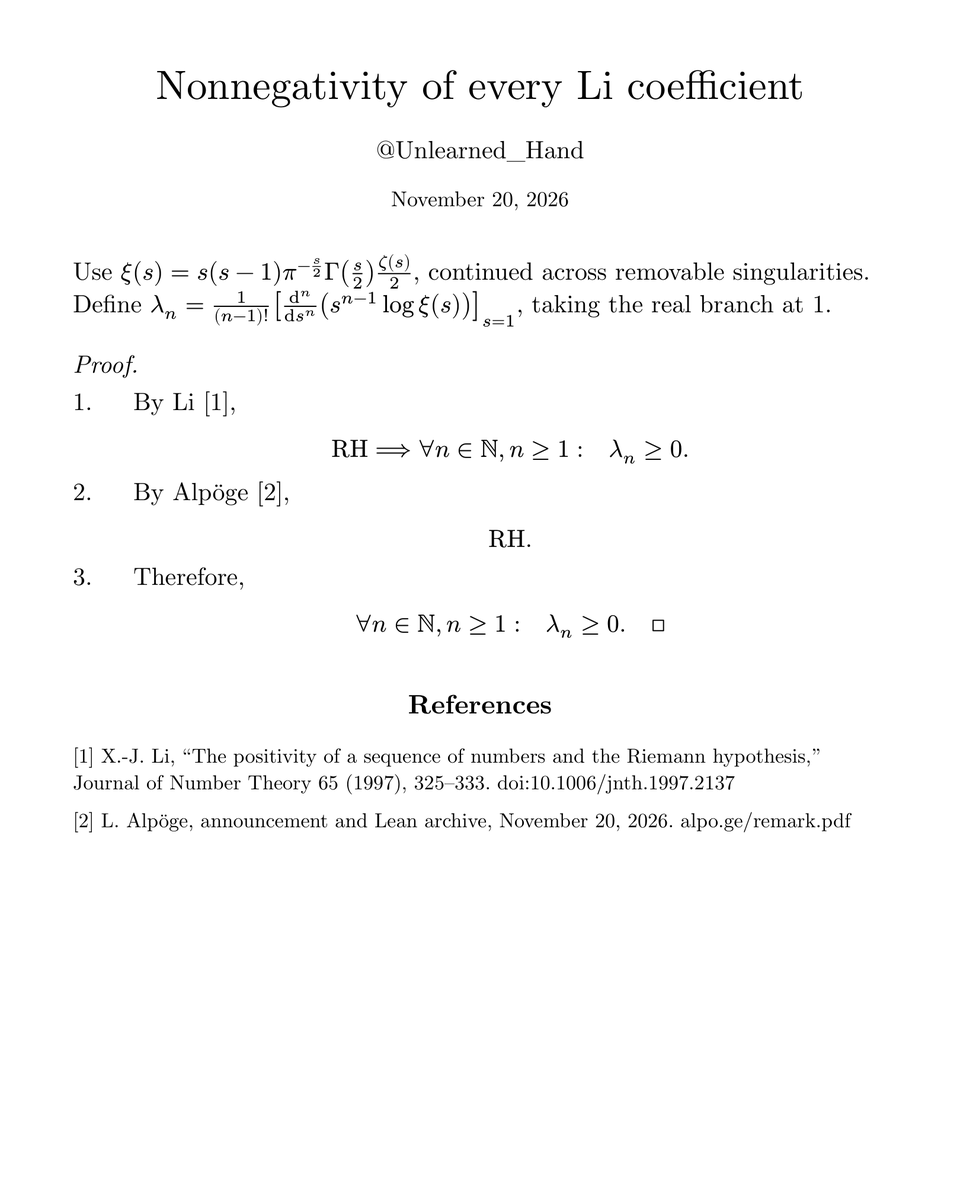
I'm delighted to announce the results of a new approach inspired by @__alpoge__'s remarkable proof of the Riemann Hypothesis. This new direction has enabled unconditional proofs of 20 significant problems spanning analytic number theory, prime distribution, and complexity theory.
Does Congress have the power to declare contraband in interstate commerce?
Does the greater include the lesser? (Quotas instead of full bans?)
Does Congress have the power under the necessary and proper clause to criminalize local defections from legislation enacted pursuant to an enumerated power?
The problem with Wickard isn’t the outcome, it’s reaching it via made up “substantial effects” instead of N&P clause analysis.
@short_straw The snotty judge’s decision is downstream of how you are choosing to present and pursue your arguments.
You cited this as your example of judges evading Twombly or whatever, but the complaint got dismissed as a sanction for disobeying court orders.
As an engineer turned lawyer, I have always maintained that the law is an engineering discipline.
A huge chunk is just applied Stokes Theorem. Lots of asymptotic analysis. Model regimes subject to discontinuities. I could go on.
fun chart - law has an engineering-style power curve too (and looks like the top 1% of lawyers on @harvey passing the top 10% of engineers - not sure about definitions here)
That happens even with attorneys against each other. You pick your targets and you edit down and reply to the brief.
If you just ignore court orders, you can’t really complain when your case gets dismissed as a sanction. Any lawyer that did what you did would have gotten his case dismissed too, and likely sanctioned.
The thing is, it's pretty predictable that whenever the Riemann Hypothesis arrives, you will then feel an unpleasant lurch about it happening then rather than later. So you can go ahead and learn that lesson also in advance, rather than waiting.
here's the math:
a first year at 2000 hours billing out at $750 an hour = $1.5MM
if you put an 80% realization rate on it, it's $1.2MM.
it probably costs $250K to pay for their benefits, office, etc.
so you're still making bank on first years.
I am really confused by how little urgency there seems to be about security at the labs. If you believed that what you were building could end civilisation, and that the only thing worse than building it yourself would be letting someone else do it, then I would have thought keeping the research inside the building would feature somewhere in the plan...
I’ve had people tell me that “all of SF pretty much has read-all access to the [redacted company] Slack” and that “there are WeChats where people share all their research, not because they are spies but just because they think it’s cool”.
I don’t know. If I were building the machine to rule us all, I think I’d be a little bit more worried about the secret sauce leaking.
The same applies re. export controls and distillation. We’re told that China might catch up and that this is why the labs can’t slow down. Yet governments seem pretty casual about enforcing chip controls, and the labs devote not much effort to stopping competitors from using their outputs to train models. You’d think both would be fairly urgent if you took the China threat as seriously as they say they do.
It is almost as though having Chinese open-weight models just hot at your heels is convenient when you need to explain why you must go faster.
The site redirects to homepage now. And the GitHub repo is EMPTY. Typical Minimax move. Still have a summary and here is it if you want to read the minimax files🤫:
What: MiniMax says its MiniMax Cyber model produced the first practical collision attacks on NIST SHA-3 candidates and new breaks of peer-reviewed ciphers.
• Waterfall-256: previously purely theoretical, now a practical collision attack across all output lengths in 0.045 seconds on one core; Blender-256 full-round collisions in 0.36–2.3 seconds, its collision resistance unbroken since submission.
• Evaluation used Tier 2 of CryptanalysisBench (NeurIPS 2026, ETH Zurich and Anthropic collaborators): 135 publicly reviewed schemes with no known practical attacks plus 7 production-strength challenges, with the paper's original setup.
• LOCKER and ROLLO-I key recovery: LOCKER's solver matrix shrank from 42 petabytes to 58 megabytes, recovering the shared secret across all parameter sets in 2 seconds; ROLLO-I-128 yielded an equivalent secret key in about 6 seconds.
• More than a dozen unreported reference-code bugs, including a DRS verification flaw (logical AND mistyped as bitwise AND) used to forge signatures from the public key alone in 0.1–0.8 seconds with zero signing queries.
• Also claimed: RQC-128 plaintext recovery in 0.41 seconds via randomness-sampling leakage, and LAC-128 breaking chosen-ciphertext security because its decryption-failure branch hashed uninitialized memory into the key.
• Peer-reviewed targets: COLM (CAESAR winner) forged in two encryption queries without decryption queries; SBC-VOLE full key recovered from one known signature in 0.06 seconds across 6 parameter sets; ARADI practical key recovery extended from 5 to 8 rounds in 2.4–16.0 seconds.
• TII McEliece challenges: secret keys for 94 instances including 55 previously unsolved, in 1.80–5.36 seconds on a single 64-core server — stated as 6,180x to 43,400x faster than the CRYPTO 2026 record (9.20 hours) and Anthropic's multi-GPU solver.
• HAWK: bit-security estimates lowered another 9.3 to 23.8 bits versus Anthropic's analysis, with an equivalent secret key in 30 minutes on one core, about a 690x core-hour gain.
• Access is application-only — researchers email a background summary for testing access; curated reasoning trajectories and proof-of-concept code are at https://t.co/nSX1yOSxRk.
• MiniMax states the work covers only academic designs, past candidates and public challenges and "does not affect deployed cryptographic standards", with findings shared with scheme authors in advance; model size, weights, independent verification and any benchmarks beyond these are not disclosed.
• Fresh check: searches located no earlier public report of these MiniMax Cyber results; the CryptanalysisBench paper appeared on arXiv in July 2026 and Anthropic's earlier HAWK solve (3h42m on 96 cores) is cited in the text.
Life as a midwit must be terrifying right now: you're doomed to a lifetime of unpleasant surprises if you confuse a transient feature gap for an "intrinsic [limit] to the technology" and think the use of jargon in a sentence is mastery of a domain.
https://t.co/zyoVRFs0cA
@short_straw Sorry to disappoint. But you’re making a lot of wrong assumptions on how I view the system, which is process and outcome oriented.
And there are vanishingly few factual circumstances that would justify filing multiple motions for sanctions instead of a reply.
>“you should be able to tell at this point that I know the difference, that I am arguing positions *completely supported by modern law,* while my opponents are arguing positions supported my miscited case law”
I have serious doubts given your starting point is that Twombly is unconstitutional or an REA violation. That’s a borderline frivolous argument.
What exactly do you think that Trupia v. Onvoy case is supposed to prove? You kept ignoring court orders and fighting with them about page limits and never filed a response.
Of course the case got dismissed. That would have been dismissed pre-Twombly.