We're a team of citizen scientists exploring Jewish genetics worldwide – connecting communities and solving historical mysteries through DNA. Questions welcome.
Jewish ancestry is a tapestry of hidden connections. We’re here to reveal them. ✡️🧬
Every Jew carries within them a story of survival. Elders may recall where their ancestors lived a few generations back — but that’s often where the trail fades. Yet, hidden in our DNA are clues that can reconnect us: telling how we’re related, and how far back those ties go.
But not everyone knows how genetic tests can illuminate their family history. That’s where we come in.
We’re the Jewish Genetic Discovery Foundation (JGDF) — a team of citizen scientists who’ve spent years researching Jewish lineages independently, and have now joined forces to uncover not just personal family stories, but the larger, interconnected story of the Jewish people.
Our mission is simple:
🔹 Educate Jewish communities about DNA testing
🔹 Facilitate tests and upgrades
🔹 Analyze results to reveal forgotten connections
We collaborate with other projects and experts, while holding ourselves to the highest standards of privacy and ethics.
The more people who participate, the clearer this tapestry becomes.
You may be surprised to find that your Ashkenazi lineage has Sephardic—or even Mizrahi—roots. And vice versa.
We’ll be sharing fascinating discoveries, stories, and research in future posts. Follow us to stay updated.
📢 The JGDF is a 501(c)(3) nonprofit. Donations go directly to genetic testing — none of our team members are paid.
But also, there are echoes of the genetic legacy of medieval English Jews in some Anglo-American families today, who have clear DNA ties to modern Ashkenazi, Turkish, Moroccan, or Syrian Jews today.
https://t.co/YMbynmUNkn
Converse sneakers? English converso family. Seriously!
As of now, the medieval Jews of Norwich/Chapelfield are the only direct proxy we have for medieval French Jews.
And it turns out there are close ties, by whole-genome similarity and uniparental lineage, to both Ashkenazim and Sephardim.
One example:
https://t.co/SVXBdmeRZ9
The History of Jews in England.
The documented history of Jews in England begins shortly after the Norman Conquest. William the Conqueror brought Jewish merchants and financiers from Rouen to help develop the economy. From about 1070 they formed communities in London, Lincoln, Norwich, Cambridge, and York. Barred from most trades and from owning land, they became the main source of credit because Christian law forbade lending at interest. They lived under direct royal protection and were treated in law as the king’s property.
Medieval England saw some of Europe’s earliest extreme anti Jewish violence. The blood libel first appeared in Norwich in 1144. In March 1190, during the crusading fervor around Richard I’s coronation, a mob in York attacked the community. About 150 Jews took refuge in the castle keep on the site of Clifford’s Tower. Facing death or forced conversion, most died by their own hands. The attackers destroyed records of the debts owed to them.
By the late thirteenth century the crown had extracted huge sums through special taxes. Edward I’s 1275 Statute of the Jewry restricted Jewish economic activity. In 1290 he issued the Edict of Expulsion, ordering all Jews to leave by 1 November. Roughly two to three thousand people were expelled, the first national expulsion of Jews in Europe. In return Parliament granted the king a large tax. For the next three and a half centuries there was no official Jewish community in England.
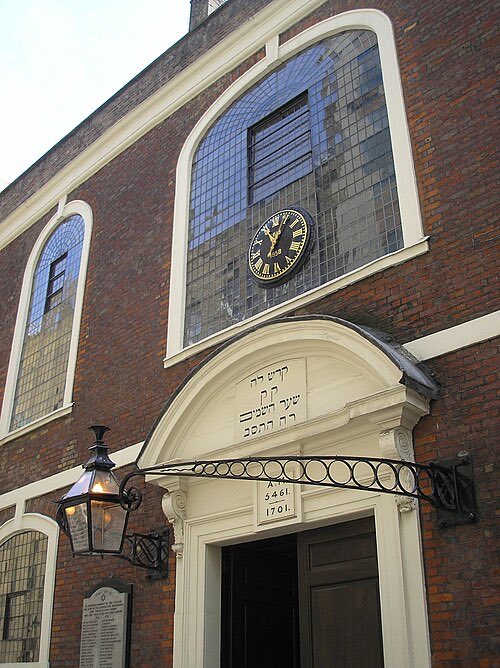
Open resettlement began under Oliver Cromwell. In 1655 Menasseh ben Israel of Amsterdam petitioned for the return of Jews, citing commercial benefits. A conference at Whitehall reached no formal decision, but Cromwell permitted a small group of Sephardi merchants from Amsterdam to stay and worship privately. A synagogue opened in Creechurch Lane in 1657. The community built Bevis Marks Synagogue in 1701, which remains the oldest synagogue in continuous use in the United Kingdom.
Ashkenazi immigrants from central Europe arrived in growing numbers in the eighteenth century. Legal disabilities remained until the nineteenth century. The Jews Relief Act of 1858 allowed Lionel de Rothschild to sit in Parliament. Benjamin Disraeli, born Jewish but baptized as a child, later served as prime minister.
Between 1881 and 1914 roughly 120,000 to 150,000 East European Jews arrived, fleeing pogroms and settling mainly in London’s East End, Leeds, and Manchester. The influx led to the Aliens Act of 1905. In the twentieth century British Jews served in both world wars and the country admitted tens of thousands of refugees from Nazi Germany, including children on the Kindertransport.
Roughly around 260k plus Jews live in England today.
The history includes both early expulsions and blood libels and long periods of relative security that set the English experience apart from that of many other European communities.
What the future holds, who knows?
Follow Jewish History Status, for more.
Ashkenazim and Sephardim are, in the scheme of Jewish population structure, very close to each other.
People usually tend to focus on links through ancient Israel, or post-1492.
But DNA evidence suggests Ashkenazim and Sephardim share most of their ancestry ~1,500 years ago.
What is the difference between Ashkenazi Jews and Sephardic Jews?
Ashkenazi and Sephardic Jews are two major historical branches of the Jewish people. They share the same core beliefs and Torah, but differ in language, customs, Hebrew pronunciation, and food because of centuries of separate settlement.
Ashkenazi Jews originated in medieval Germany (Ashkenaz) and later spread through Central and Eastern Europe. Sephardic Jews lived in Spain and Portugal (Sepharad) until the 1492 expulsion, after which many settled in North Africa, the Ottoman Empire, and elsewhere. Sephardic traditions often overlap with those of Mizrahi (Middle Eastern) Jews.
Ashkenazim traditionally spoke Yiddish and use a distinctive Hebrew pronunciation, while Sephardim spoke Ladino or local languages and use a pronunciation closer to modern Israeli Hebrew. On Passover, Ashkenazim avoid kitniyot (rice, legumes, corn, and similar foods) while Sephardim generally permit them. Their prayer rites, naming customs, melodies, and cuisines also differ, with Ashkenazi food reflecting Eastern European staples and Sephardic food drawing more from Mediterranean and Middle Eastern influences.
Both groups share substantial ancient Middle Eastern ancestry. Ashkenazi Jews have historically been the large majority worldwide, especially in the diaspora, while Israel has more balanced numbers and has blended many traditions. Individual practice varies, and the distinctions are less rigid today than in the past.
Curious about Jewish History?
Follow for more
@DaddyKlaus23 It's likely that more ancestors of the Ashkenazim came from France, as opposed to Italy. Evidence of Jews in Ashkenaz proper goes back to the 10th century, but presence in adjacent areas (like Aachen and Metz) goes back to the 9th.
This is reminding me, one of these days we should do a ‘Jewish lineages by haplogroup’ series. For example, all the branches in R1b-Z2103 across the Jewish Diaspora.
Here's one great example: R-FGC14628 (under the Near Eastern, ultimately Yamnaya-derived, R-Z2103), as described in our post, "The Visigoths and the Rabbis"
https://t.co/Wj9XdMgDdP
This is the tip of the iceberg.
As we've shared before, 5 of the 9 top Ashkenazi lineages have Sephardi connections between c. 200 and 700 CE.
And the rate of such connections is actually higher (whether randomly or not) among medium-to-medium-large Ashkenazi branches.
Here's one great example: R-FGC14628 (under the Near Eastern, ultimately Yamnaya-derived, R-Z2103), as described in our post, "The Visigoths and the Rabbis"
https://t.co/Wj9XdMgDdP
@Malak356775433 R-M12205 (< Y2619) hasn’t been confirmed in any Eastern Jews, if that’s one you mean. But it’s not an unusual situation at all for a lineage to be important in one community and (thus far) absent in others.
@SmithyJohnsi Also: Italy is an important part of the earlier story (that is, early 1st mil CE) for all Western Jews, probably.
But everything suggests that the main axis linking Sepharad and Ashkenaz directly runs through France. Much shared ancestry through S. France + early Iberia.
@SmithyJohnsi You are more or less right in the broad outlines (think 25% is too high for both, but not dramatically so).
In any case: the connection is closer, more substantial, and differently-mediated (by early W. European Diaspora) than most people usually guess.
But: even within the family of "Western Jews" (which includes the pre-Sephardic communities of the Eastern Maghreb, Italy, Greece, and to some degree the Levant), the Jews of Ashkenaz, France, and Iberia seem to have been uniquely closely related.
Not only do we see stuff like a Turkic line in Iraqi Jews and a Mongolic line in Romaniotes, but Berber + Chinese lines in Ashkenazim, Celtic + Germanic lines in Sephardim, and Slavic + Indo-Aryan lines in central North African Jews.
All small parts of the story, but all real!
@SmithyJohnsi There's another clearly Indo-Aryan branch among Syrian and Iraqi Jews.
These lines connect to South Asians c. 1300 BCE and 1150 BCE, respectively. This would seem pretty late to mean a common ancestor in the Near East. I also wouldn't chalk it up to Persian influence, bc these,
@spicuIus Correction: I was wrong to call it minor among Eastern Algerian Jews. But that being said, we're working with a smallish sample size and I'm not aware of any corresponding autosomal signal.