Associate Professor at RIT investigating galaxy evolution. Co-lead of @cosmosastro. Passionate about public outreach, science communication, and inclusivity.
The @RITscience is thrilled to congratulate Sadie Coffin @scoffin_at_you, a fourth-year PhD student in RIT’s Astrophysical Sciences and Technology program, and her mentor, Dr. Jeyhan Kartaltepe @Jeyhan, on receiving a highly competitive NASA FINESST Graduate Fellowship. Sadie’s proposal, “Leveraging Citizen Science Measurements to Efficiently Identify Galaxy Pairs,” was one of only 24 astrophysics projects selected out of 454 applications, a remarkable achievement!
Sadie’s research explores how galaxies interact, merge, and evolve over cosmic time by using large-scale spectroscopic data and contributions from citizen scientists. Her project centers on Redshift Wrangler, a NASA-funded participatory science platform she co-developed and leads, which engages volunteers in identifying spectral features in galaxy data. This innovative approach not only strengthens our understanding of galaxy evolution at high redshifts but also highlights the power of public engagement in advancing scientific discovery.
Originally from Bethesda, Maryland, Sadie earned her undergraduate degree in Physics from Middlebury College. As a NASA-AAPS Citizen Science Fellow, she continues to bridge research, outreach, and inclusive science communication, setting a stellar example for the next generation of astronomers.
Congratulations, Sadie and Dr. Kartaltepe! Well Done!
Good morning!
Quick interview on the release of our @NASAWebb map on COSMOS on @KTLAMorningNews.
Check it out: https://t.co/uAvICzBd5I
And here's a link to our interactive map where you can dive into the vastness of our Universe: https://t.co/zLz9L3lIuj
Thank you for having me!
Last week, NASA and NSF released their FY26 budget requests. We list the detailed impacts on the astronomical sciences in this blog post, and share how you can take action today.
https://t.co/jH4uwcFubv
Astronomers unveiled the James Webb Space Telescope's largest view yet of the early universe in a richly detailed catalog of nearly 800,000 galaxies. https://t.co/fmfZuaRF2V
780,000 galaxies revealed in JWST's largest science operation
With 255 hours of dedicated observing time and a full 0.54 square degrees of sky coverage, COSMOS-Web is JWST's largest deep observing program.
Now released, in full, to everyone.
https://t.co/adQp0QuClI
The international @nasawebb team, led by @RITscience researchers, has made an unprecedented amount of information available for future discovery! Explore the largest view deep into the universe through a searchable catalog now available to the public.
https://t.co/wDhy0f5vVX
It's finally here! We've just released all of our COSMOS-Web images and catalogs, along with an interactive viewer where you can explore the data! Check it out at: https://t.co/ntVNI5eS3M
Our release includes an interactive viewer where you can explore the images, display the spectroscopic redshifts (Khostovan et al. 2025) and information from the photometric catalog (including their full SED, photometric redshift, the cutout images in each filter, and the zPDF).
The image that changed our view of the Universe forever | BBC Global
In 1995, a machine called Hubble peered into a small patch of empty sky for ten days straight. For the scientists on Earth, it was a huge, expensive gamble.
#BBC#space#history#Hubble
https://t.co/L2MY9FGHg8
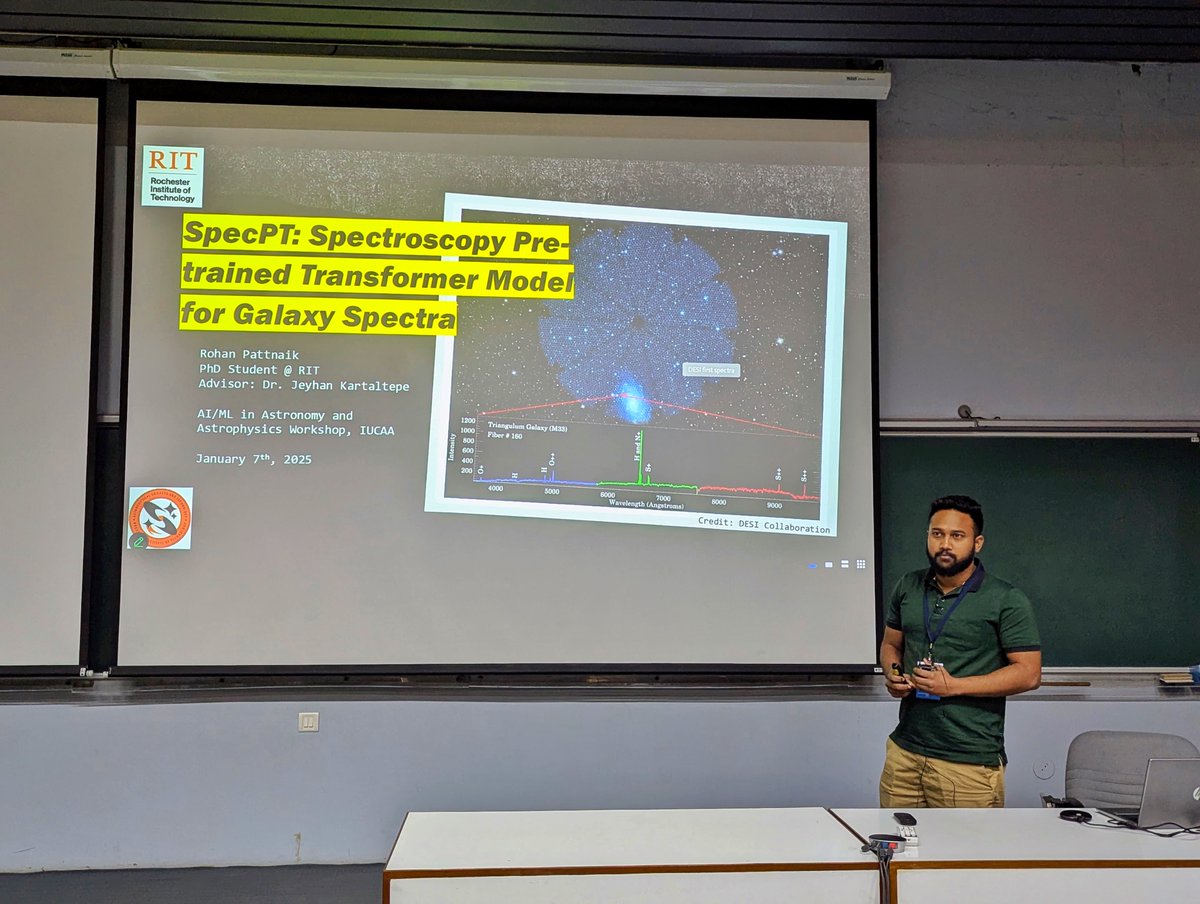
My PhD student @astrohanp 's first paper on the machine learning tool he developed to automatically measure redshifts directly from galaxy spectra, SpecPT. The results are have surpassed my expectations and I can't wait until we extend this to other datasets! Check out the paper!
Excited to share our paper on SpecPT is now on arXiv!! https://t.co/nbCGTmFavP
Using DESI data, we built a transformer model for galaxy spectra, achieving impressive results in spectral reconstruction & redshift prediction. @AcademicChatter#AcademicChatter#phdchat
About a year ago, we pointed the JWST telescope (@JWSTObserver) at what we believed might be one of the most distant galaxies known to date, and detected 13.4-billion-year-old photons emitted by hydrogen and oxygen atoms. You can find the full details in the paper linked below!