The Soldiers Are Gone, but Their Families Remain: The Living Descendants of the Confederate Army
Thomas L. Livermore estimated that approximately 1,269,000 Southern men became eligible for Confederate military service during the Civil War. His figure was drawn from the white male population of military age within the eleven states that formally entered the Confederacy. It was not intended as a precise count taken from surviving muster rolls, which are too incomplete to support such a calculation. Livermore instead treated the available population statistics as the firmest starting point from which Confederate military participation could be reconstructed. Under the assumption adopted here, those 1,269,000 men represent the approximate total number who rendered some form of Confederate military service.
Livermore was aware that this assumption did not correspond neatly with state boundaries. Thousands of Confederates entered service from Kentucky, Missouri, Maryland and other border regions outside the eleven seceded states. Their contribution would have increased the Confederate total beyond the population available within the Confederacy itself. Considerable Unionist populations remained inside the Confederate states, however, particularly in eastern Tennessee, western North Carolina and several other mountain or border districts. Those men either avoided Confederate service or entered Federal organizations. Livermore regarded the two populations as broadly offsetting, leaving the eleven-state eligibility figure as a reasonable estimate of actual Confederate participation.
The calculation also extends beyond men enrolled in the regular Confederate armies. Some served in state troops, reserve organizations, local-defense companies, militias, partisan commands and other formations whose records were never incorporated fully into the Confederate military returns. Others may have served only briefly, been discharged before reaching a major field army, or performed duties close to home. Their service was nevertheless part of the Confederacy’s military effort. The figure of 1,269,000 should therefore be understood as an effective manpower estimate rather than a claim that every eligible Southern man spent three or four years in a regular infantry, cavalry or artillery regiment.
The question is what became of the descendants of those men. No census identifies Americans descended from Confederate soldiers, and no surviving roster is complete enough to trace every family line forward for six generations. The answer must therefore be derived from several historical and demographic assumptions, each of which introduces uncertainty. The method begins by estimating how many Confederate soldiers left children or later established family lines. It then carries those lines through successive generations, allowing for historical fertility, childhood survival and adult mortality. Finally, it corrects for the inconvenient fact that the same living person may descend from several different Confederate soldiers.
Confederate military deaths are traditionally placed at approximately 258,000, although the figure is not exact and was almost certainly undercounted in some categories. Applied against Livermore’s larger participation estimate, wartime deaths would have removed roughly one man in five from the original service population. Death during the war did not necessarily end a man’s family line. Many of the older soldiers were already married, and some had several children before entering service. Younger unmarried soldiers who were killed, however, generally left no direct descendants, while men who survived the war retained a much greater opportunity to marry and raise families.
For purposes of a central estimate, it may be assumed that approximately 45 percent of the men who died left a family line that survives today. Among those who survived, the proportion may reasonably be placed at approximately 82 percent. These are not reported historical figures, but demographic assumptions derived from nineteenth-century marriage patterns and the generally high fertility of Southern families. Weighted across the dead and surviving populations, the calculation indicates that approximately 74 percent of Livermore’s Confederate servicemen may have established lines of descent that continued into later generations. Applied to 1,269,000 men, that produces approximately 937,000 surviving ancestral lines.
That figure does not mean that 937,000 separate families remained distinct. Brothers often served together, married women from neighboring households and produced children whose descendants later married into many of the same communities. The calculation treats each soldier as a separate ancestral starting point because each represents a separate place in a later descendant’s family tree. A man descended from two brothers who served in the same company would therefore carry two Confederate ancestral connections, although he remains only one living person. This distinction between ancestral connections and unique descendants becomes increasingly important as the generations are carried forward.
The first generation following the war was born during a period of relatively high fertility. A soldier who established a continuing family line might reasonably be assigned slightly more than three children who survived long enough to reproduce. Those children, in turn, commonly produced families of their own during the late nineteenth and early twentieth centuries. Fertility gradually declined thereafter, although the baby-boom generation temporarily increased the number of descendants appearing in the middle decades of the twentieth century. Using moderate generational multipliers, one successful Confederate family line might produce approximately 207 living descendant connections by the early twenty-first century.
Multiplying approximately 937,000 surviving lines by 207 living descendant connections produces a total near 194 million. That number is useful, but it is not the answer. It counts genealogical relationships rather than individual people. A person descended from four Confederate soldiers appears four times in the total, just as a soldier with descendants through three separate children contributes through each branch. Without a correction for this overlap, the estimate would imply that well over half of all American citizens descend from Confederate soldiers through only one line. Southern family trees did not spread across the generations without crossing back upon themselves, however, any more than old county fence lines could run forever without meeting at a corner.
Genealogists refer to this repeated convergence as pedigree collapse. In theory, the number of a person’s ancestors doubles with every generation carried backward. Two parents become four grandparents, eight great-grandparents and sixteen great-great-grandparents. Carried back six or seven generations, however, many positions in the tree are occupied by the same individuals. Cousins married cousins, neighboring families intermarried repeatedly, and migrants from the same Southern communities often settled together elsewhere. Among Americans with deep ancestry in the former Confederate states, it would not be unusual to find several Confederate soldiers occupying different positions within the same family tree.
The greatest uncertainty in the calculation is therefore the average number of Confederate soldiers represented among the ancestors of each living descendant. For the central estimate, an average of approximately 2.6 Confederate ancestors per descendant has been used. Dividing the estimated 194 million ancestral connections by 2.6 produces approximately 74.6 million unique living descendants. Rounded to avoid a false appearance of precision, the result is approximately 75 million American citizens descended from at least one Confederate serviceman.
Using the assumed citizen population of 318 million, 75 million descendants would represent approximately 23.6 percent of the nation. Put more plainly, the central estimate suggests that nearly one American in four may descend from a man who rendered some form of Confederate military service. This should not be read as meaning that one-quarter of the population possesses an exclusively Southern ancestry, much less that Confederate ancestry carries any particular modern political or cultural meaning. After six generations of migration and intermarriage, descendants may be found in every region of the country and among Americans of many racial and ethnic backgrounds.
A more conservative set of assumptions produces approximately 55 million unique descendants, or about 17 percent of the assumed citizen population. A more expansive model produces approximately 90 million, or about 28 percent. The defensible range is therefore broad, running from somewhat more than one American in six to somewhat more than one in four. The central estimate of 75 million falls near the middle of that range and appears consistent with the scale of the original military population, nineteenth-century fertility and the inevitable overlap among Southern family lines.
The conclusion is necessarily an estimate rather than a count. Small changes in the assumed number of Confederate deaths, marriage rates or children per family alter the result, but none changes it as much as the adjustment for duplicate ancestry. If the average descendant had only two Confederate ancestors, the total would rise sharply. If the average were closer to four, it would fall below 50 million. Until a large genealogical database permits the family lines to be traced and deduplicated directly, the overlap factor must remain an informed assumption.
Based upon Livermore’s effective service estimate, the most reasonable conclusion is that approximately 70 to 80 million American citizens alive today descend from at least one Confederate soldier. A midpoint of approximately 75 million, representing nearly one-quarter of an assumed citizen population of 318 million, is broad enough to acknowledge the limits of the evidence without reducing the calculation to little more than a guess. The exact number cannot be recovered. Its probable order of magnitude, however, can be estimated.
Notes on Sources
For Confederate military participation, I have followed Thomas L. Livermore’s population-based estimate of approximately 1,269,000 eligible men within the eleven Confederate states. Livermore recognized that this figure omitted Confederate soldiers from the border states while including Unionist populations within the Confederacy. He regarded those additions and subtractions as approximately offsetting. The figure is therefore used here as an effective estimate of total Confederate participation, including regular troops, reserves, militia, local-defense organizations and partisan formations, rather than as a literal count of men enrolled in the regular armies.
For Confederate deaths, I have used the traditional estimate of approximately 258,000 as the general baseline. The precise number remains disputed, and later demographic studies have suggested that total Civil War mortality was greater than the figures compiled during the nineteenth and early twentieth centuries. Because those revisions do not provide an uncontested Confederate total that can be applied directly to Livermore’s service estimate, the calculation uses a general mortality rate of approximately 20 to 22 percent.
The estimate of surviving family lines is derived rather than reported. I have assumed that approximately 45 percent of Confederate soldiers who died left descendants whose lines survived into the present, compared with approximately 82 percent of those who survived. These assumptions produce approximately 937,000 soldiers with continuing lines of descent. The generational calculation applies declining fertility multipliers across the late nineteenth, twentieth and early twenty-first centuries, producing approximately 207 living descendant connections for each successful ancestral line.
The resulting total of approximately 194 million represents ancestral connections, not unique people. To account for descendants who trace their ancestry to more than one Confederate soldier, I have divided that figure by an assumed average of 2.6 Confederate ancestors per descendant. That correction produces the central estimate of approximately 75 million unique living descendants. The overlap factor is the least certain part of the calculation and accounts for most of the difference between the conservative estimate of 55 million and the expansive estimate of 90 million. The analysis does not establish an exact total. It provides a historically and mathematically reasonable range based upon the surviving evidence.
“The Confederacy never forgave him… but history eventually did.”
Few Civil War generals paid a higher price for the war after it ended than James Longstreet.
While many former Confederate leaders were celebrated across the South, Longstreet became a scapegoat. His reputation was attacked for decades, not because of what he did during the war, but because of the choices he made after it.
After Appomattox, Longstreet reached a conclusion that many of his former comrades refused to accept: the war was over, slavery was abolished, and the nation had to move forward.
He urged Southerners to accept Reconstruction and work within the restored Union rather than continue resisting it. Even more shocking to many, he became a Republican and publicly supported his old friend, Ulysses S. Grant, for president in 1868.
To many former Confederates, that was unforgivable.
Organizations and writers promoting the “Lost Cause” narrative needed someone to blame for Robert E. Lee’s greatest defeat at Gettysburg. Longstreet became the perfect target. Despite Lee himself never publicly blaming him, critics accused Longstreet of delaying the attack on July 2, moving too slowly, and even disobeying orders. Over time, these accusations hardened into popular myth, despite much of the historical evidence telling a far more complicated story.
Meanwhile, Longstreet continued serving his country.
President Grant appointed him Surveyor of Customs for the Port of New Orleans. After Grant’s Presidency, Longstreet became U.S. Minister to the Ottoman Empire. He also served as U.S. Marshal for Georgia and U.S. Commissioner of Railroads under Presidents McKinley and Teddy Roosevelt.
One of the most dramatic moments of his postwar life came during the Battle of Liberty Place in New Orleans in 1874. Commanding the integrated Metropolitan Police and state militia against the White League, Longstreet attempted to restore order. Instead, he was shot, thrown from his horse, captured by the very men he had once fought beside, and held prisoner until federal troops arrived.
It was an extraordinary scene: one of the Confederacy’s most trusted generals now fighting to uphold the authority of the United States.
As the years passed, Longstreet devoted much of his time to defending his wartime record. In 1896, he published From Manassas to Appomattox, offering his firsthand account of the war and responding to many of the accusations made against him.
James Longstreet died on January 2, 1904, at the age of 82, making him one of the last surviving senior Confederate commanders. Time has been kinder to him than many of his contemporaries. Modern historians generally rank him among the Confederacy’s most capable corps commanders, praising his tactical skill, defensive brilliance, and willingness to adapt to changing warfare.
His greatest battle, it turns out, wasn’t fought at Gettysburg or Chickamauga.
It was the decades-long fight to defend his name.
What do you think was the biggest reason Longstreet became such a controversial figure after the war—his actions at Gettysburg, his support for Reconstruction, or his friendship with Ulysses S. Grant?
West Point class of 1904 at Little Round Top Gettysburg battlefield. Original large format photo by M.F. Williams from The Gettysburg Museum Of History Archives.
For more on the collections at The Gettysburg Museum Of History see:
https://t.co/6emEEl7Zue
#WestPointGettysburg #LittleRoundTopGettysburg #GettysburgFromTheArchives #GettysburgMuseumOfHistory
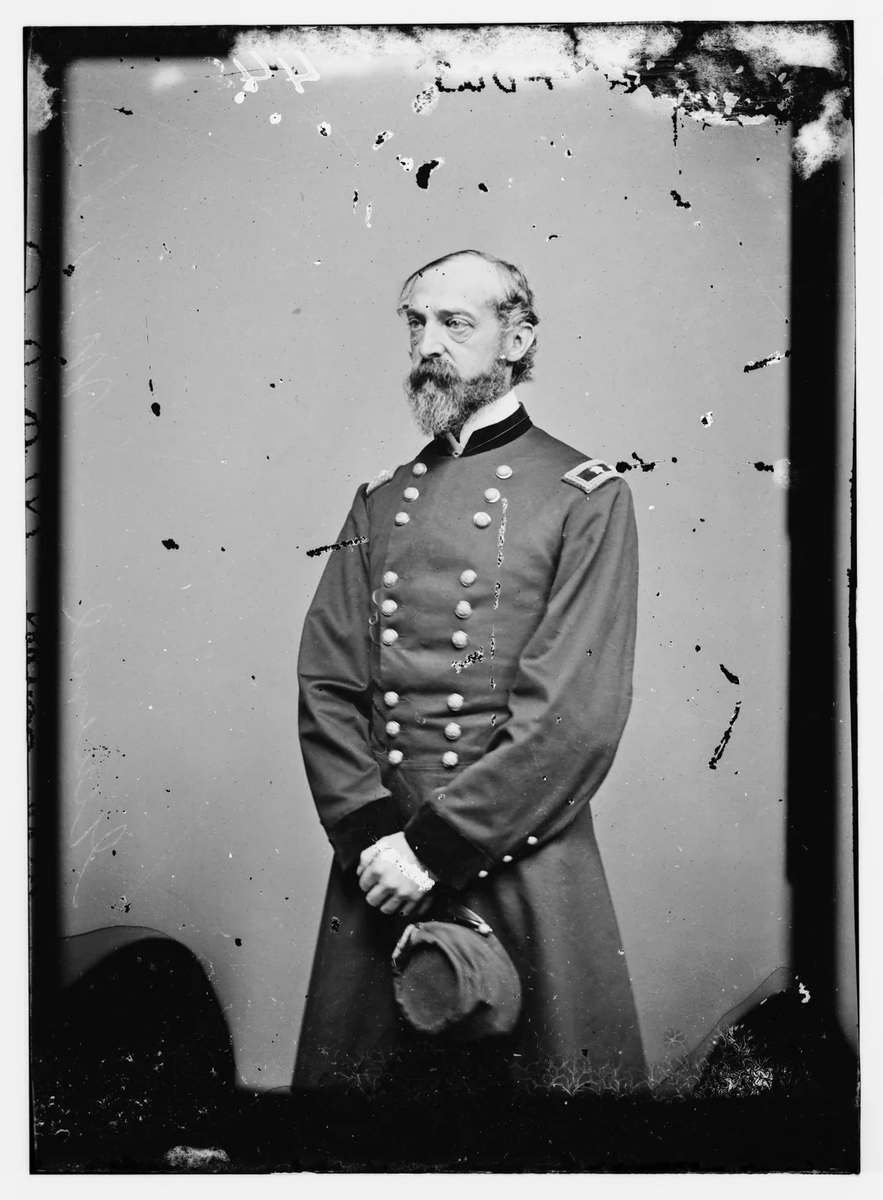
George Meade, the enigma of the Army of the Potomac Generals.
What I mean is, you look at the other leaders of the east, McDowell, McClellan, Pope, Burnside, to a lesser extent Hooker, there's plenty of books about the pros and cons (mostly cons) of all them as Army leaders, and then you get to Gettysburg and Meade...and it always seems like there's a giant Meade shaped hole in how Gettysburg is analyzed. And then once Grant comes East and latches onto the Army of the Potomac, Meade once again disappears into the background
Happy Pennsylvania Day! 🎉
From rolling farmland and local wineries to historic streets and iconic landmarks, Gettysburg is one of the many reasons we love calling Pennsylvania home. Here's to exploring everything that makes the Keystone State so special. ❤️
#gettysburg #visitpa
On this day, July 17, 1863, Confederate Brigadier General James Johnston Pettigrew died near Bunker Hill, West Virginia, from wounds received three days earlier at Falling Waters during the Army of Northern Virginia’s retreat from Gettysburg. He was 35.
Born in 1828 in Tyrrell County, North Carolina, Pettigrew graduated first in his class from the University of North Carolina in 1847. He studied law, traveled extensively through Europe, and wrote a respected book, Notes on Spain and the Spaniards. He practiced law in Charleston, South Carolina, served in the state legislature, and was a strong advocate for Southern rights.
When the Civil War began, Pettigrew entered Confederate service and rose rapidly through ability and intellect. He commanded the 22nd North Carolina Infantry and was severely wounded and captured at the Battle of Seven Pines in 1862. After being exchanged, he was promoted to brigadier general and led a brigade in A.P. Hill’s Third Corps.
At Gettysburg, after Henry Heth was wounded, Pettigrew temporarily commanded the division. On July 3 he led his men in the left wing of Pickett’s Charge. Pettigrew was wounded in the hand and had his horse shot, but he continued directing his brigade.
During the retreat on July 14 at Falling Waters, Maryland, while commanding the rear guard, he was shot in the abdomen at close range by Union cavalry. He was carried across the Potomac but died three days later.
Robert E. Lee called him “a brave soldier and an accomplished officer.”
🇺🇸 Feb. 27, 1859, New York Congressman Daniel Sickles shoots his wife’s lover dead in Lafayette Square, in broad daylight, steps from the White House.
The victim: Philip Barton Key II, son of Francis Scott Key, author of the Star-Spangled Banner, and U.S. Attorney for Washington.
Sickles told Key before he shot him "Key, you scoundrel, you have dishonored my home; you must die"
Then, at his trial, Sickles becomes the first person in U.S. history to be acquitted of murder using a temporary insanity plea.
He walked completely free!
One of his defense lawyers? Lincoln’s future Secretary of War, Edwin Stanton.
She's Alive! Nashville Steam has fired up Nashville, Chattanooga & St. Louis Railway 4-8-4 576 for the first time in 72 years, a major step forward in the eagerly anticipated restoration. https://t.co/jaxE16BJoX
Join us on this edition of the Destination Gettysburg Podcast as we explore Strawberry Hill Nature Preserve, a beautiful 35-acre sanctuary in the heart of Adams County. Learn about its hands-on youth programs, animal ambassadors, conservation efforts, and scenic hiking trails that make it a must-visit destination for nature lovers of all ages.
Click the link below to check it out!
https://t.co/GpA4arja8w
#gettysburg #visitpa
George Patton’s great Uncle was killed at Gettysburg.
Colonel Waller T. Patton commanded the 7th Virginia Infantry which was in Kemper’s Brigade, Pickett’s Division.
During Pickett’s Charge, part of his jaw was blown off by an artillery shell fragment. He died on July 21 at a makeshift hospital at Pennsylvania College (now Gettysburg College).
Waller’s first cousin, Lewis B. Williams Jr., was also killed at Pickett’s Charge. He was thrown from his horse by an artillery shell and landed directly on his own sword, mortally wounding him. He died that day.