It's hard to believe, but the damage of Trump's Iran War could get even worse. He is still contemplating a cataclysmic ground invasion, and his refusal to end the the war keeps Iran in control of the Strait and keeps energy prices disastrously high.
Guam and the Northern Mariana Islands: Even if severe conditions caused by Super Typhoon Sinlaku have weakened in your area, continue to shelter in place until local officials declare your area is safe.
Take emergency alerts issued seriously and don't put yourself in harm's way.
URGENT: 8-year-old Irene J. Lentz vanished from Wisconsin.
Open the page, join the quest, help find her: https://t.co/fKWV5VMfx3.
Don't look away. Let's go.
⚠️ Tornado Warning for Randolph County, IL. We're monitoring a storm with radar-indicated rotation moving NE at 25 mph directly toward Sparta, IL and Coulterville, IL. Move to an interior room on the lowest floor immediately. #ILwx
Face of ancient Buddha images, in different arts across Asia :
In Buddhist art, image of historical Buddha is often labeled Shakyamuni (sage of Shakya clan). This distinguishes image of historical Buddha, Buddha who lived on earth during this present period, from past, future, or cosmic buddhas, bodhisattvas, or other divine beings. There is a significant debate concerning the development of the Buddha image, where it first occurred, why, and when. Broadly speaking, image of Buddha emerged during first few Centuries CE, in two major centers of Indian art during Kushana period. One center of artistic production was ancient region of Gandhara, an area that includes northwestern India as well as parts of present-day Pakistan and Afghanistan. Gandharan images have a style that is reminiscent of Hellenistic sculpture and artists in region were certainly influenced by presence of Hellenistic colonies, and large-scale trade and exchange that occurred in this cultural crossroads.
A second area of artistic production is associated with Mathura, India. Here, artists developed a style that can be characterized as more indigenous, less concerned with naturalistic realism in human form and more with symbolic qualities of spiritual figure. Mathura artists created other kinds of religious imagery as well. It is probable that Buddhist imagery was influenced by the development of Hindu and Jain figures and that various communities were developing images of devotional figures simultaneously.
A very significant gap of several centuries exists between lifetime of historical Buddha and creation of first surviving images of Buddha in stone or any other medium. First surviving Buddhist art in stone was actually created prior to images of Buddha himself. During Maurya period, in reign of Emperor Ashoka (272–231 BC), significant monuments and other artworks in stone were commissioned, apparently for first time. Although stone sculpture, such as large columns surmounted by images of lions and wheels, expressed Buddhist symbolism and motifs, there are no Buddha images from this period. Many scholars have speculated that an aniconic (without idols) period existed in Buddhist art, where there was a prohibition against depicting actual Buddha and various symbols substituted for an explicit anthropomorphic representation. Some scholars have interpreted narrative reliefs at early Buddhist monuments to illustrate early Buddhist processions or festivals, where aniconic symbols, rather than anthropomorphic symbols, represented Buddha.
More than 300 years later, in Kushana era, a strong imperial ruler bringing various outside artistic and stylistic influences to realm, seems to have contributed to further artistic developments and a hitherto unseen profusion of sculpture created in stone. Scholars still not entirely sure how all Buddhist figures were used in ritual and worship. Buddhist images and sculptures originally adorned complexes of stupas as well as monastic structures. Early Buddhist sites also incorporated indigenous imagery such as loving couples and fertility figures. Caves were hewn from rock in parts of India, creating spaces for worship rituals and community meetings, as well as monastic dwelling quarters. These rock-cut cave complexes became increasingly elaborate in terms of imagery and iconography, which was created in painting as well as carved from stone in situ. Votive images also developed for private use, and as souvenirs for pilgrims to sacred sites. Figure of Buddha and attendant bodhisattvas and other divine and semi-divine beings, became objects of devotion themselves. As these divine personages expanded in number and complexity, they required larger stupa and temple structures to house them. Over time, proliferation of great numbers of Buddhist images, in some cases explicitly created through mass production techniques, reflected beliefs in meritorious repetition of various names and phrases.
#archaeohistories
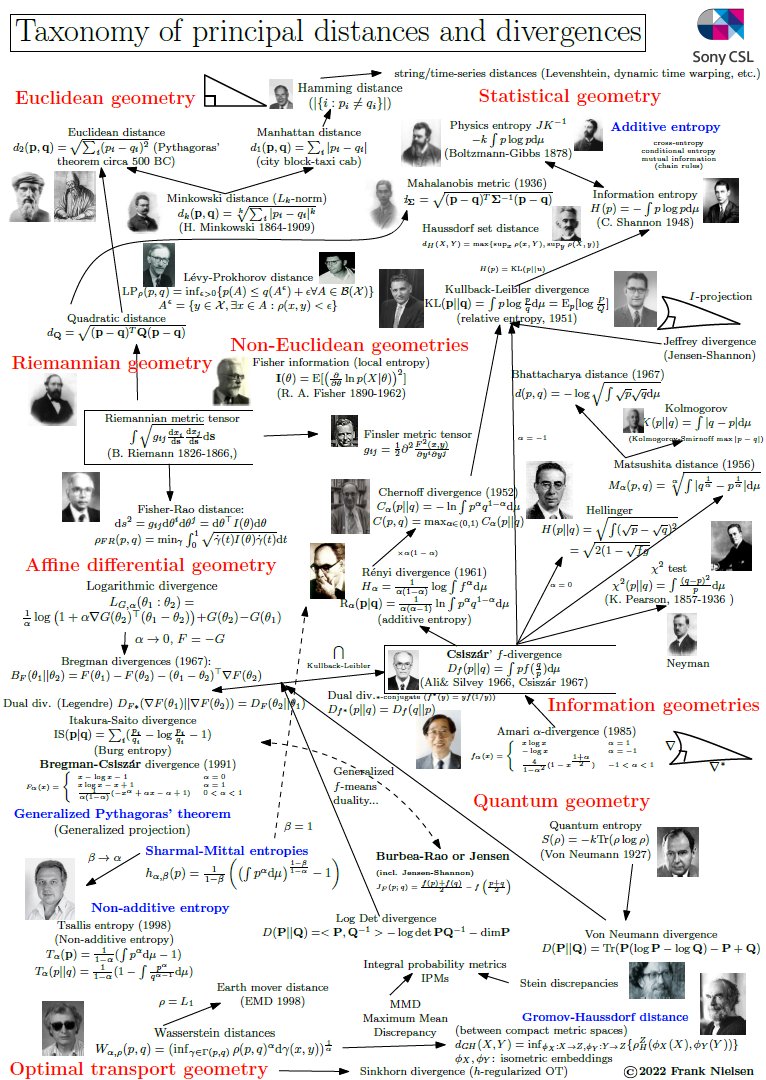
Poster on the taxonomy of main statistical distances with their underlying geometries: Euclidean geometry, Riemannian & Finslerian geometry, information geometry, affine differential geometry, quantum geometry, etc.
https://t.co/yZGCN2dlgD
𝗕𝗼𝗮𝗿𝗱 𝗠𝗲𝗺𝗯𝗲𝗿 𝗛𝗶𝗴𝗵𝗹𝗶𝗴𝗵𝘁: 𝗝𝗶𝗵𝘆𝘂𝗻 𝗟𝗲𝗲 🇰🇷
Why did you join the board?
I joined the IFVP board because I strongly believe in the power of visual facilitation to enhance communication, collaboration, and problem-solving across diverse fields.
𝗖𝗮𝗹𝗹 𝗳𝗼𝗿 𝗥𝗙𝗣 - 𝗜𝗙𝗩𝗣 𝗪𝗲𝗯𝘀𝗶𝘁𝗲 𝗗𝗲𝘃𝗲𝗹𝗼𝗽𝗺𝗲𝗻𝘁 𝗣𝗿𝗼𝗷𝗲𝗰𝘁 𝗔𝗻𝗻𝗼𝘂𝗻𝗰𝗲𝗺𝗲𝗻𝘁
we are excited to announce the initiation of the 𝗻𝗲𝘄 𝘄𝗲𝗯𝘀𝗶𝘁𝗲 𝗱𝗲𝘃𝗲𝗹𝗼𝗽𝗺𝗲𝗻𝘁
𝗥𝗙𝗣 details 👉 https://t.co/r8SZM2jbsW
🚀 launch 𝗲𝗻𝗱 of AUG
It’s surprising that the president is posing for photos with someone making claims with no causal relationship between Bitcoin adoption and a drop in crime rates, in a country where such baseless statements are being taken seriously.
"The person in the driver's seat is only there for legal reasons. He is not doing anything. The car is driving itself"
(Elon Musk, Oct 20 2016)
It's now 2025, Teslas have killed nearly 700 people Including 100+ pedestrians & cyclists
And burned 130+ people alive, doors locked