I had the great honor of speaking at the Majlis Mohamed bin Zayed in Abu Dhabi, on the grounds of the Grand Mosque on The Future of Finance in the Age of Intelligence.
In attendance was His Highness Sheikh Khaled bin Mohamed bin Zayed Al Nahyan, Crown Prince of Abu Dhabi.
Thank you to my family and the teams from Majlis Mohamed Bin Zayed, @provokemgmt, @StreamEvergreen and @FinancialBrand for the ongoing support.
https://t.co/k1xs5aqfRI
@GuntherEagleman Has any president ever been against public prayer? That said, I was taught that it is not about prayer in public, but about your behavior towards others that defines a Christian. Trump doesn't live as a Christian except in a performative way.
True transformation means asking what pain points hurt customers and giving your team the backing to solve them. Manny Ruiz and Chris Bettencourt discuss @CreditUnionWest's commercial growth on Banking Transformed. How do you turn roadmap ideas into fast action?
📌 Watch this episode of Banking Transformed, sponsored by @alkamitech: https://t.co/7WGRAtjfcA
I never woke up one day and launched a media company.
Every piece was added because the audience was already there, in a moment they were already living. Each idea had to earn its place by being useful every single time.
The flashy version would have been to announce all of it at once. Way too slow. What worked was adding one useful idea at a time, until seven years later it became something bankers rely on without thinking about how it was built.
That is our innovation report in one sentence. The best retail banking innovation becomes almost invisible. Not the loudest launch. The one that fits a moment people already have and quietly earns its way into the routine.
The clearest example did not come from a megabank or a lab. Chime grew by taking the friction out of being paid and out of the fees people resented. Not by being clever. By making something people already did a little bit better.
The lesson is not to copy Chime. It is to copy the move, and that has nothing to do with your size.
💡 𝐓𝐡𝐞 𝐛𝐚𝐧𝐤 𝐭𝐡𝐚𝐭 𝐥𝐞𝐚𝐝𝐬 𝐢𝐬 𝐧𝐨𝐭 𝐭𝐡𝐞 𝐨𝐧𝐞 𝐰𝐢𝐭𝐡 𝐭𝐡𝐞 𝐦𝐨𝐬𝐭 𝐢𝐝𝐞𝐚𝐬. 𝐈𝐭'𝐬 𝐭𝐡𝐞 𝐨𝐧𝐞 𝐭𝐡𝐚𝐭 𝐭𝐫𝐮𝐥𝐲 𝐮𝐧𝐝𝐞𝐫𝐬𝐭𝐚𝐧𝐝𝐬 𝐰𝐡𝐢𝐜𝐡 𝐜𝐮𝐬𝐭𝐨𝐦𝐞𝐫 𝐦𝐨𝐦𝐞𝐧𝐭𝐬 𝐚𝐫𝐞 𝐰𝐨𝐫𝐭𝐡 𝐜𝐡𝐚𝐧𝐠𝐢𝐧𝐠 𝐚𝐧𝐝 𝐝𝐨𝐞𝐬 𝐢𝐭.
Nearly 87% of small business owners use the same provider for their business and personal needs, and 61% of those relationships began with personal deposits. The growth is already sitting inside the customer base.
Most of the effort goes into finding it. Identify the sole proprietors and the microbusinesses, move them into a business account, and the job is treated as done.
That is where we stop too early. Opening the business account is the beginning of the relationship, not the finish line.
I run a sole proprietorship. My revenue comes from a dozen different directions, the amounts swing significantly from month to month, and my expenses look nothing like those of a traditional commercial borrower.
The answer is not to train bankers harder on products. When the banker has no meaningful context about the customer's situation, a relationship call can easily sound like a sales pitch.
Treat the conversion as the starting point instead. That is when a bank has a real chance to be useful in the day-to-day realities of running the business.
We have spent years building technology that helps us know our customers. The next step is doing something useful with what we know.
📌 Read the full article on The Financial Brand: https://t.co/GOK2DOXMJI
71% of the banks and credit unions we surveyed call fintech partners important to their business and transformation goals.
7% describe them as central to the digital roadmap.
The gap between those two numbers is the whole finding.
72% run several partner solutions across key areas. That is an honest picture of an organization that has bought competently and integrated selectively. For most institutions, moderate exposure is the right level.
The question is whether it was chosen.
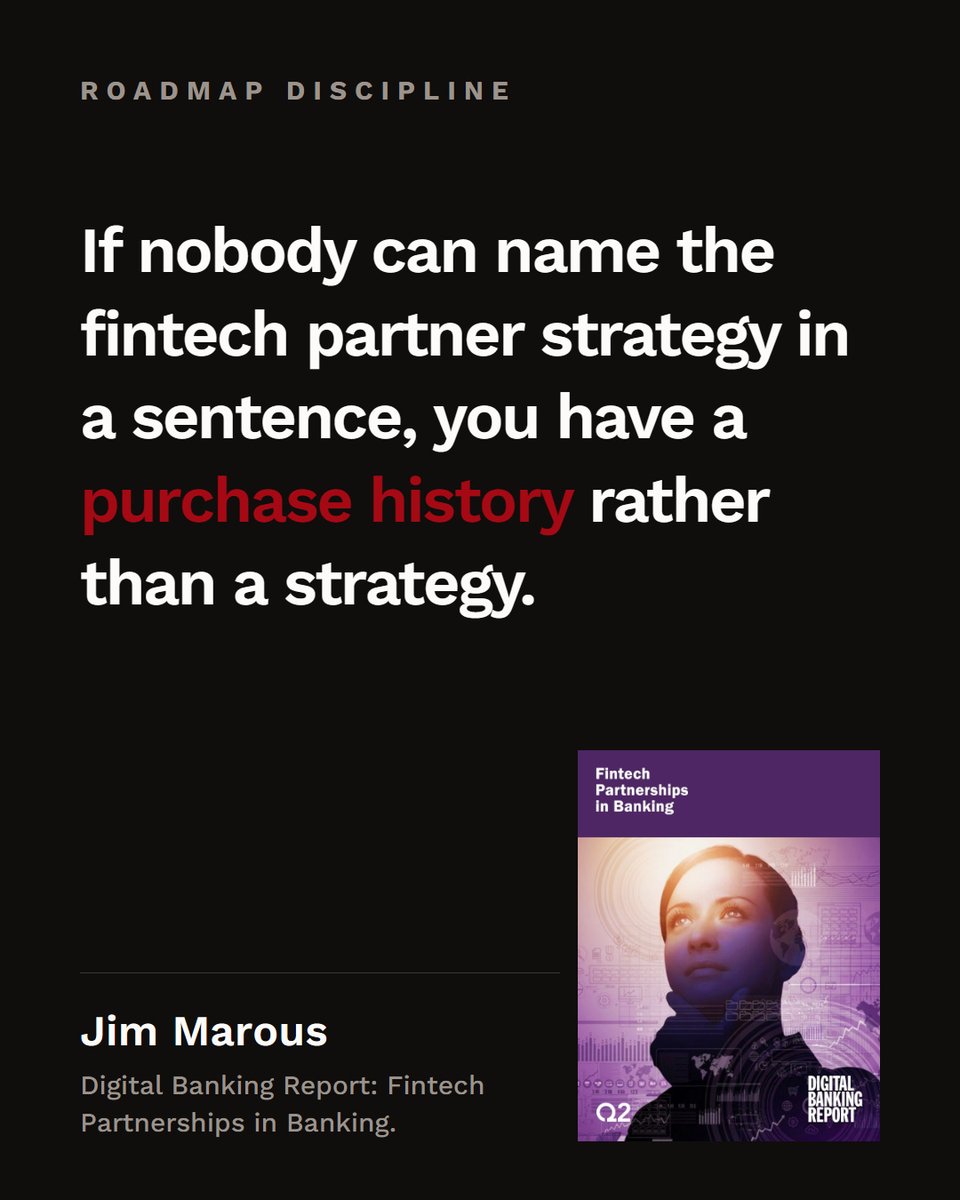
If nobody can name the fintech partner strategy in a sentence, you have a purchase history rather than a strategy.
Three ways to test that this week. Write down the destination the partner roadmap is aimed at, in one sentence, without using the words digital or experience. Name the person accountable for partner strategy across the organization, and if the answer is a committee, the answer is nobody. Then look at the last three partner decisions and ask whether they were aimed or opportunistic.
📌 The 𝐅𝐢𝐧𝐭𝐞𝐜𝐡 𝐏𝐚𝐫𝐭𝐧𝐞𝐫𝐬𝐡𝐢𝐩𝐬 𝐢𝐧 𝐁𝐚𝐧𝐤𝐢𝐧𝐠 report, sponsored by @Q2_Software, is free at the link: https://t.co/D4DwERuyeX
If autonomous AI agents are designed to make spending money completely frictionless, consumer debt could skyrocket. Jane Barratt of @mX shares marketing history and AI insights on Banking Transformed.
❓ How do we protect consumers from overspending?
📌 𝐖𝐚𝐭𝐜𝐡 𝐭𝐡𝐢𝐬 𝐞𝐩𝐢𝐬𝐨𝐝𝐞 𝐨𝐟 𝐁𝐚𝐧𝐤𝐢𝐧𝐠 𝐓𝐫𝐚𝐧𝐬𝐟𝐨𝐫𝐦𝐞𝐝 𝐧𝐨𝐰: https://t.co/FYrcOJG7Ml
@17QStorm Blockbuster briefing? It was like a live version of Groundhog Day, with continual repetition and self-praise.
You spend most of your time hating on people. If you worked in broadcast media, you may understand that she wants the audience to get good visuals.
@TheCharlesDowns@kaitlancollins It's her audience's briefing room and she wants the lighting to be right for broadcast. You spend most of your time hating on people. If you were in broadcast media, you may understand that she wants the audience to get good visuals.
@EricLDaugh And you spend most of your time hating on people. If you were in broadcast media, you may understand that she wants the audience to get good visuals.
Bankers can't see their customers.
In our new Digital Banking Report research, only 14% of banks and credit unions said they have a customer profile that works across the whole organization.
That's a problem. But here's the part that should bother us more.
About six in 10 say their retail and lending leaders can't build a list of their own customers without help from IT or an analyst.
So they file a request with someone else. And then they wait. And wait.
Our new report, 𝐑𝐞𝐭𝐚𝐢𝐥 𝐁𝐚𝐧𝐤𝐢𝐧𝐠 𝐃𝐚𝐭𝐚 𝐚𝐧𝐝 𝐈𝐧𝐬𝐢𝐠𝐡𝐭 𝐌𝐚𝐭𝐮𝐫𝐢𝐭𝐲, has the research behind this. It shows who can reach customer data at institutions like yours, and where the handoff between teams breaks down.
Who at your institution can build a customer list today, without filing a request?
🏆 Special thanks to @ngdata_com for sponsoring this research.
📌 𝐆𝐫𝐚𝐛 𝐲𝐨𝐮𝐫 𝐟𝐫𝐞𝐞 𝐜𝐨𝐩𝐲 𝐨𝐟 𝐭𝐡𝐢𝐬 𝐫𝐞𝐩𝐨𝐫𝐭: https://t.co/TQK0LGUJID
When moving from human to digital workflows, clear communication helps staff see tech as a tool to help them, not replace them. Manny Ruiz and Chris Bettencourt of @CreditUnionWest discuss change management on Banking Transformed.
❓ How do you build team buy-in?
📌 Check out this episode sponsored by @alkamitech: https://t.co/7WGRAtjfcA
We asked 245 banks and credit unions to rate their own ability to deploy new solutions and bring them to market.
53% rated themselves fair or poor. 7% said excellent. Self-assessments tend to be generous, so the real number is probably worse.
Then we asked what matters when they choose a fintech partner. 56% said speed to deployment was extremely important.
Put those two answers next to each other and the picture is uncomfortable. We know we are slow. So we go shopping for speed and expect a provider to hand it to us.
We are shopping hardest for the thing we are worst at.
No partner fixes that. Speed comes from inside the building: a named owner on the deployment date, process changes agreed before anyone signs, and a decision made in advance about what you are willing to give up to hold the date.
That is not a procurement decision. It is a management one.
𝐅𝐢𝐧𝐭𝐞𝐜𝐡 𝐏𝐚𝐫𝐭𝐧𝐞𝐫𝐬𝐡𝐢𝐩𝐬 𝐢𝐧 𝐁𝐚𝐧𝐤𝐢𝐧𝐠, sponsored by @Q2_Software, is out now. 245 institutions on how they evaluate, select and deploy fintech solutions.
📌 𝐃𝐨𝐰𝐧𝐥𝐨𝐚𝐝 𝐟𝐨𝐫 𝐟𝐫𝐞𝐞: https://t.co/D4DwERuyeX
While banks stay on the hook for AI agent activity, deploying secure internal assistants offers the ideal bridge to the future. Jane Barratt of @mX breaks it down on Banking Transformed.
❓ How does your bank balance AI innovation and risk?
📌 Watch this episode: https://t.co/FYrcOJG7Ml
More than half of the institutions we surveyed are already using generative AI in marketing.
Not one said its customer data was immediately available and AI-ready.
We also found a significant gap between what financial marketers call personalization and what customers actually experience. Most personalization still amounts to selecting an audience and sending it a message.
Targeting is invisible to the person on the other end. What they notice is whether anyone was paying attention when something changed in their life.
The real opportunity is using customer intelligence to recognize what is happening in a person's financial life and respond while it matters.
Closing that gap starts with better data foundations, clearer accountability, smarter measurement, and a willingness to invest in capabilities that may be less visible than another campaign or AI-generated asset.
💡 That last one is where this stalls. The least visible capability is the hardest one to get funded, and it is what decides whether the rest of the work lands.
📌 Read the article at The Financial Brand: https://t.co/Awac3zCHcZ
If autonomous AI agents are designed to make spending money completely frictionless, consumer debt could skyrocket. Jane Barratt of @mX shares marketing history and AI insights on Banking Transformed.
❓ How do we protect consumers from overspending?
📌 𝐖𝐚𝐭𝐜𝐡 𝐭𝐡𝐢𝐬 𝐞𝐩𝐢𝐬𝐨𝐝𝐞 𝐨𝐟 𝐁𝐚𝐧𝐤𝐢𝐧𝐠 𝐓𝐫𝐚𝐧𝐬𝐟𝐨𝐫𝐦𝐞𝐝 𝐧𝐨𝐰: https://t.co/FYrcOJG7Ml
Bankers can't see their customers.
In our new research, only 14% of banks and credit unions said they have a customer profile that works across the whole organization.
Here is the part that should bother us more. At roughly six in ten institutions, retail and lending leaders can't build a list of their own customers without help from IT or an analyst. So they file a request with someone else, and then they wait.
A customer opens a checking account at a branch, finances a car, and uses the app most days. To them, that is one relationship. Inside most institutions it is four partial records held by four teams. Marketing knows the segment. The branch knows the last conversation. Lending knows the application. The contact center knows the last problem.
Only 8% of leaders are very confident their customers would say the institution genuinely knows them.
Retail Banking Data and Insight Maturity, our new research sponsored by NGDATA, is out now. It shows who can reach customer data at institutions like yours, and where the handoffs between teams break down.
📌 𝐃𝐨𝐰𝐧𝐥𝐨𝐚𝐝 𝐲𝐨𝐮𝐫 𝐟𝐫𝐞𝐞 𝐜𝐨𝐩𝐲: https://t.co/TQK0LGUJID
Community banks don't need new tech platforms to personalize service; they just need to ask the right questions and verify the answers. I share a 3-step framework on this episode of Banking Insights.
❓ How does your bank capture your financial goals?
📌 Watch this episode: https://t.co/2LVLYKFDem
Every dollar spent on a Venmo card builds a spending profile your bank will never see. I break down the real stakes of super app competition on Banking Transformed.
❓ What's your strategy to protect primary checking?
📌 Watch the full Banking Insights episode here: https://t.co/WFhAqqmMr6