Un tío educado e idealista ha venido a esta ciénaga, ha tocado los cojones a colectivos protegidos -e.g. vividores de lo público y pensionistas- y ha salido escaldado y notificado en su trabajo.
Creía que el dato ganaba al relato. Pero eso es no conocer como funciona Expañita.
J’ai vu passer cet article du @le_Parisien sur l'augmentation de la population des seniors à Paris.
Au niveau individuel, je ne trouve pas cela choquant. Je comprends qu'on puisse voir un intérêt à vieillir à Paris : accès aux soins, aux services, aux transports, à une vie sociale dense...
En revanche, ce qui est rationnel à l’échelle d’une personne ne l’est pas forcément à l’échelle d’une ville. Paris est une zone à très forte intensité économique, avec un foncier rare et pourtant, on y observe une présence croissante de non-actifs.
Cette évolution n'est pas du tout neutre car cela veut dire :
- plus de tension immobilière avec moins de logements pour les actifs
- des arbitrages logement-travail dégradés.
J’en ai déjà parlé dans une chronique précédent pour Atlantico. Quand les actifs ne peuvent plus habiter là où ils produisent, vous créez une friction structurelle qui occasionne perte de productivité, coûts cachés, désorganisation...
Le logement n'est pas qu'un confort, c'est aussi un facteur qui entre en compte dans la production d'une économie.
Surtout, il faut arrêter de croire que ce phénomène est naturel car il est en grande partie fabriqué par notre modèle fiscalo-social.
Facteur n°1 : pensions trop élevées → absence de désaccumulation
On devrait voir la théorie économique du cycle de vie s'appliquer. Un senior à la retraite devrait donc désépargner pour maintenir son niveau de vie ou alors ajuster son niveau de vie à la baisse.
En France, la théorie ne s'applique pas car les pensions issues de notre système de répartition sont suffisamment élevées pour se permettre de ne pas consommer son patrimoine
Résultat : des retraités peuvent conserver des logements trop grands, situés dans des zones à très forte valeur, et sans pression économique réelle. On subventionne donc indirectement la sous-occupation du foncier rare.
Facteur n°2 : fiscalité foncière inefficace → aucun signal économique
La taxe foncière actuelle est profondément mal calibrée car :
- elle est basée sur des valeurs cadastrales obsolète
- elle ne reflète pas la tension réelle du marché
- elle est trop faible au regard de la valeur économique du sol à Paris
- elle prévoit des allègements injustifiés économiquement pour les seniors
Dans un système fonctionnel, détenir un foncier rare dans une zone tendue devrait envoyer un signal : "Ce que vous occupez a une valeur économique élevée".
Résultat : un senior propriétaire n'a aucune incitation à arbitrer entre vendre, louer ou adapter l'usage du bien.
Facteur n°3 : logement social → verrouillage complet
Même logique que précédemment, un HLM en zone tendue est une ressource ultra rare.
Pour autant, aujourd'hui :
- pas de remise en question à la retraite
- pas de rotation imposée
- pas d’alignement avec l’objectif initiale qui est de loger des actifs modestes
Résultat : on immobilise encore du foncier subventionné pour des personnes improductives
Face à cela, je considère qu'il faut faire évoluer le système en y réintroduisant des signaux économique.
D'abord, on réduit les pensions, j'en ai déjà longuement parlé par ailleurs.
Ensuite, on réforme la fiscalité foncière en remplaçant la TF actuelle par une land tax sur la valeur du sol occupé et on supprime au passage toutes les exonérations spécifiques pour les seniors.
Résultat : détenir un bien à Paris devient un choix économique réel. Si vous avez peu de revenus, vous n'aurez pas les moyens de conserver un bien que vous ne savez pas valoriser. A vous de vous de débrouiller pour que ce soit le cas, quitte à revendre si ce n'est pas possible.
Enfin, on supprime complètement la rente de situation dans les HLM. Un départ à la retraite = un départ du logement, point barre. C'est la fin du maintien automatique à vie sans remise en cause pour que les logements HLM soient attribués à ceux qui en ont un usage productif.
Bien entendu, tout cela doit également s'accompagner d'une réflexion sur le marché immobilier à Paris en général.
Les simplets vont me dire que c'est de la coercition et que je force les seniors à partir de Paris. Non, ça s'appelle réintroduire des incitations économiques là où les simplets raisonnent avec des bons sentiments du type "oui mais c'est dur de partir quand on est âgés".
J'assume complètement que si on mettait en œuvre les mesures que je préconise, une partie des seniors actuels n'auraient plus les moyens de rester à Paris.
Je n’ai rien contre eux, mais à un moment, il faut être cohérent. On ne peut pas concentrer l’activité économique, raréfier le foncier et neutraliser tous les mécanismes d’ajustement.
Dans une zone productive, il est rationnel de prioriser les actifs.
D'ailleurs on ferait mieux de prioriser les actifs en général en France.
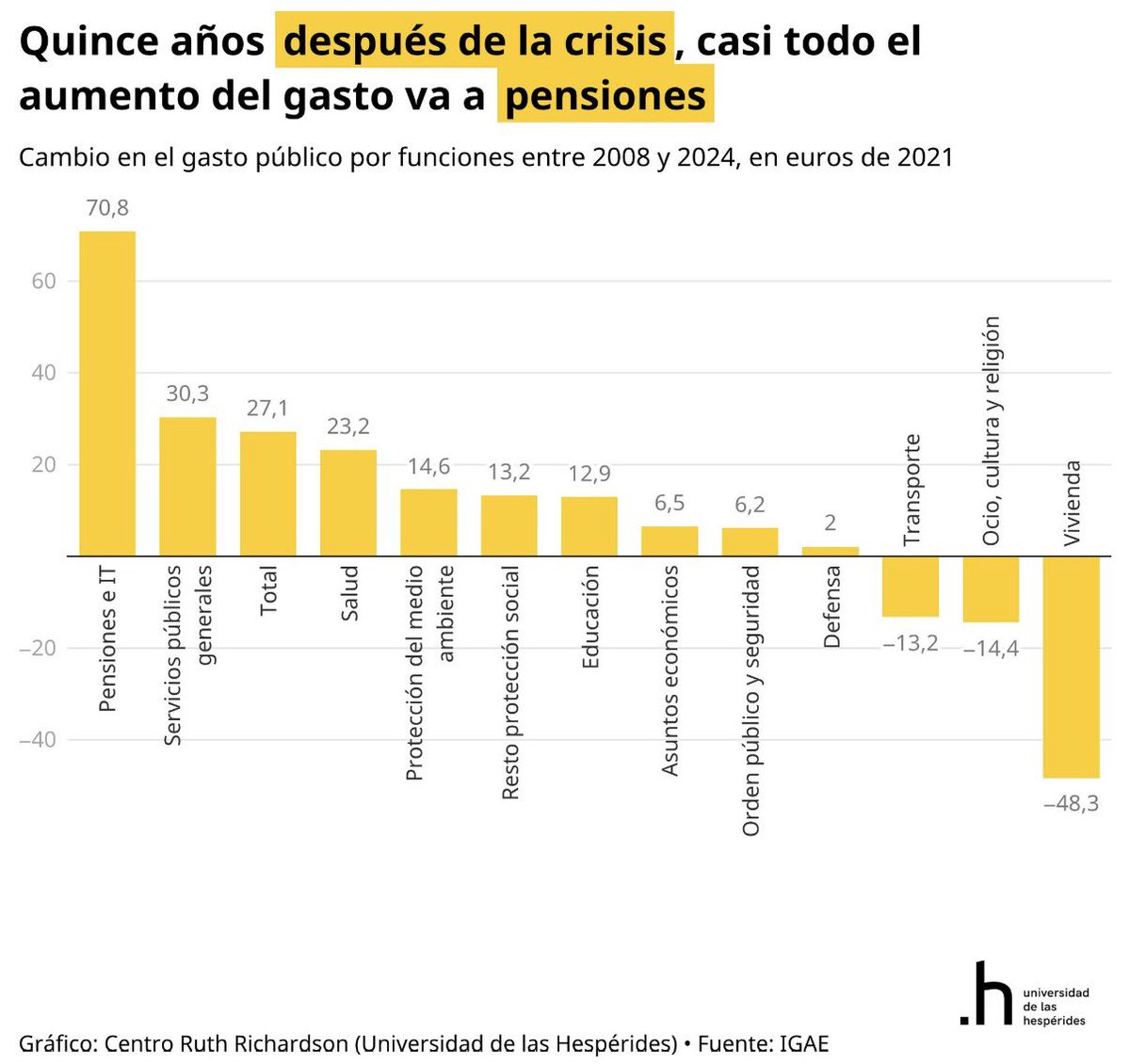
Como indican mis compañeros de la universidad @UnivHesperides casi todo el incremento del gasto ha ido a parar a mejorar la vida de la clase con más patrimonio del país, los pensionistas, los cuales reciben en promedio, un 60% más de lo que cotizaron, condenando a la pobreza a toda una generación de jóvenes desgraciados.
Este hilo es alucinante. Inventándose actos oficiales para ahorrarse un triste billete de AVE. En la empresa privada no es que te echen por esto, es que nadie tiene el cuajo ni de pensar hacerlo.
I chose the green door ninety-three days ago.
At the time, it seemed obviously correct. Not even a close call. The red door offered two billion dollars immediately—a sum so large it would solve every material problem I'd ever face, fund any project I could imagine, and still leave enough to give away amounts that would meaningfully change thousands of lives. But two billion is a number. It has a fixed relationship to the economy, to the things money can buy, to the world.
The green door offered one dollar that doubles every day.
I remember standing there, doing the mental math. Day 30: about a billion dollars. Day 40: over a trillion. Day 50: a quadrillion. The red door would be surpassed before the first month ended, and after that, the gap would grow incomprehensibly fast. Choosing the red door would be like choosing a ham sandwich over a genie's lamp because you were hungry right now.
So I walked through the green door.
The first few weeks were unremarkable. I had a dollar, then two, then four. By day ten I had $512, which felt like finding money in an old jacket. By day twenty I had over a million, and I started getting calls from financial advisors I'd never contacted. By day thirty-one I had crossed the two-billion threshold—officially richer than I would have been behind the red door.
I didn't understand what was happening until around day sixty.
The money, you see, had to exist somewhere. Not philosophically—I mean physically. Digitally. When I checked my bank balance, a computer somewhere had to store that number. And storing the number 2^n requires n bits.
One bit per day. That's it. That's the rate at which my fortune's representation grows. A linear function. Almost comically modest.
But here's what I'd failed to understand about exponential growth: the value doesn't care about the representation. The bits grow linearly. The dollars they encode grow exponentially. And dollars make claims on the physical world.
Day sixty. My balance: 2^60 dollars. About 1.15 quintillion. Roughly 1,000 times the entire global GDP. The number itself required only 60 bits to store—less than a tweet, less than this sentence, trivially small from an information-theoretic perspective.
But money is not information. Money is a claim.
The calls started coming from the Treasury Department. Polite, confused, increasingly frantic. They explained that the M2 money supply of the United States was approximately 21 trillion dollars. I now held about 15,000 times that amount. When I tried to spend any of it—even a tiny fraction—the transaction represented a claim on more goods and services than the entire human economy had ever produced in its history.
"The number in your account," a Treasury official said, "is not meaningful."
"It's in your computer," I replied.
"The computer," she said carefully, "does not understand what the number represents."
Day seventy-five. 2^75 dollars. I could purchase—in principle—roughly 350 million copies of the entire Earth's annual economic output. The representation remained elegant: 75 bits. Nine and a half bytes. I could write my net worth on a Post-it note in binary.
But representations aren't wealth. Wealth is factories, farmland, human labor, time, attention, atoms arranged into useful configurations. And I had laid claim to more atoms than existed.
This is where it gets strange.
The global financial system is, at its core, a system of ledgers. Distributed, reconciled, audited. When the Federal Reserve's systems recorded my balance, and Chase's systems recorded my balance, and the IRS's systems recorded my balance, those numbers had to match. And they did match—trivially, easily, using a handful of bytes each.
But then the systems tried to do things with the number.
Calculate taxes owed. Assess systemic risk. Determine what fraction of GDP was held by a single individual. Run inflation models. Price assets in a market that now included a participant with claims exceeding the value of all other claims combined.
Day eighty-two. The S&P 500 became undefined. Not zero, not infinity—undefined. My proportional ownership of the market, if I chose to exercise it, exceeded 100%. The shares I could theoretically purchase outnumbered the shares that existed. Financial models divide by market cap; market cap now included a term that broke the arithmetic.
Day eighty-five. The International Monetary Fund published a paper titled "On the Representability of Post-Scarcity Claims." It concluded that exchange rates could no longer be calculated because the dollar itself had become paradoxical—simultaneously the world's reserve currency and a unit of measurement that had lost all meaning.
My balance on day eighty-five: 2^85 dollars. Still just 85 bits. About ten and a half bytes.
The representation remained trivial. The reality it pointed to had become impossible.
Day ninety. I tried to buy a coffee.
The transaction failed. Not because of insufficient funds, not because of a technical error, but because the payment system could not determine a meaningful exchange rate. My card represented a claim on approximately 10^27 dollars. The coffee cost $4.50. The ratio between these numbers—the percentage of my wealth the coffee would cost—was so small that it rounded to zero in every floating-point system on Earth. I could not pay because the act of payment required representing a number smaller than any computer could distinguish from nothing.
I offered to pay in cash. I had a twenty.
The barista looked at me like I'd offered to pay with a seashell.
"Where did you get physical currency?" she asked.
That's when I realized: I had broken cash too. The Treasury had stopped printing bills three weeks earlier. Why maintain physical currency when one account holder could—at any moment—claim more dollars than had ever been printed in human history? The symbolic relationship between paper and value had always been a polite fiction, but my existence had made the fiction impossible to maintain.
Day ninety-three. Today.
My balance is 2^93 dollars: approximately 10^28. About 10 billion times the estimated value of all assets on Earth. The representation requires 93 bits. Twelve bytes. Smaller than my name.
The economy hasn't collapsed, exactly. People still trade, still work, still produce. But they've stopped using dollars. They've had to. A currency in which one person holds virtually infinite units is not a currency at all—it's a monopoly ticket that everyone has silently agreed to stop playing with.
I keep thinking about what money actually is. It's not the bits. The bits are trivial; they always were. It's not even the paper or the gold or the entries in a ledger. Money is a shared agreement about who has claims on what. A story we tell together about value and exchange and debt.
I broke the story.
Not through violence, not through fraud, not through any action more dramatic than walking through a door and watching a number tick upward. Just by existing. Just by holding a claim that grew faster than the world's ability to honor it.
The red door offered two billion dollars. A large but finite claim. A claim that fit within the story, that could be exchanged and spent and taxed and inherited. A claim the world could accommodate.
The green door offered something else entirely: a claim that would grow until it consumed all other claims, until the very concept of claiming became incoherent.
I still have the 93 bits. They're sitting on a server somewhere, humming along, doubling quietly at midnight. By next week they'll represent more dollars than there are atoms in the observable universe.
And I still can't buy a coffee.
El decálogo del buen negacionista de pensiones ☕️📜
Esto de las pensiones ya le toca a usted las narices. Cada vez que se sienta en su terraza favorita en Lagasca a tomarse un café y pastitas, abre el periódico y ¡zas!, la columna de un niñato hablando del problema de las pensiones en España. ¿Cómo va a disfrutar así de su bien merecida jubilación?
No se preocupe. En un ejercicio de servicio público, aquí tiene un decálogo que puede emplear en cualquier situación. Léalo un par de veces, memorícelo y no volverán a amargarle el café de media mañana:
1️⃣ Lo más importante: esto es un bulo. No hay problema alguno de pensiones. Como usted no sabe nada de contabilidad nacional ni de hacienda pública, siempre podremos encontrar alguna cifra sacada de contexto que lo “demuestre”.
2️⃣ Los culpables: si es un bulo, ¿por qué insisten estos niñatos? Claro: son esbirros de la banca. La gran banca quiere gestionar fondos de pensiones y forrarse. Da igual que quienes defienden reformar el sistema quieran mantener el reparto o que cuando proponen un pilar de capitalización digan que sea público o gestionado por mutuas sin ánimo de lucro. La banca es lo peor de lo peor. (Por cierto, revise esas acciones del Santander que compró hace años y que últimamente tan bien le han rentado).
3️⃣ La ignorancia ajena: estos niñatos no saben de lo que hablan. Son ingenieros (¿qué sabrá un ingeniero de números?) o economistas (peor aún: uno que intentó estudiar ingeniería, suspendió mates de primero y se cambió de grado). Y lo más grave: algunos viven en Estados Unidos, ese país donde la gente se muere sin seguro médico, hay que vivir en un búnker por si te matan y, sobre todo, la comida es malísima. Después de las pensiones, seguro que quieren prohibir la tortilla de patatas.
4️⃣ Cambio de tema: si insisten en que hay déficit, todo es por las pensiones no contributivas. Da igual que los niñatos hablen solo del déficit del sistema contributivo. Prestar atención es aburridísimo.
5️⃣ El gasto superfluo: si no queda más remedio y hay déficit, se arregla eliminando gastos inútiles. Si es de izquierdas: la Iglesia, la Corona y defensa. Si es de derechas: los coches oficiales, el Ministerio de Igualdad y las “paguitas”. Da igual que sean órdenes de magnitud distintos: ya decidimos que usted no sabe nada de contabilidad nacional. Usted ha oído hablar del “coste de oportunidad” de reducciones del gasto público, pero eso suena muy complicado para perder tiempo entendiéndolo.
6️⃣ Que paguen los ricos: el problema se resuelve si Amancio Ortega y todos los cientos de billonarios españoles pagan lo que deben. Con eso habría dinero para multiplicar por diez todas las pensiones. ¿Que las cifras no cuadran? Sin importancia: usted no sabe nada de hacienda pública.
7️⃣ El verdadero problema: no son las pensiones altas, son los salarios bajos. Aunque con salarios más altos también habría más gastos. Total, ¿para qué pensar en los efectos más de 30 segundos?
8️⃣ La justicia: usted solo quiere que le paguen lo cotizado. Aunque la renta vitalicia que cobra sea actuarialmente un 60 % más alta que el valor de sus cotizaciones capitalizadas al crecimiento del PIB (la tasa correcta). ¡Pero si Pepe se murió al día siguiente de jubilarse! ¿Qué bobada es esa del “valor actuarial”? Ignore ese invento estadístico rompedor llamado “media”.
9️⃣ La exageración: si alguien propone no revalorizar pensiones máximas, en realidad lo que quieren es que mi abuela de 98 años, que cobra la mínima, se muera de hambre.
🔟 La indignación moral: estos niñatos odian a los pobres y a los mayores (porque trabajan para la banca). Usted, en cambio, defiende con orgullo los derechos sociales y solo quiere crear más. ¿Cómo se sostiene? Lea de nuevo los nueve puntos anteriores.
¿Verdad que ya no hay problema alguno? Sin darse cuenta, se ha terminado el café. El camarero se acerca. Pídase otro.
The young women today who are upset that men don’t approach them aren’t the same women who decided any approach was harassment in 2015. We don’t all attend an annual bitch conference.
Este mensaje debe estar dirigido a los 27 habitantes de una aldea de Castilla La Mancha.
En Madrid y Barcelona esta es la clasificación:
Baja: Hasta 25.000€
Media:Hasta 100.000€
Media- Alta: Hasta 250.000€
Alta: No trabaja por cuenta ajena, vive de su patrimonio. >€5M
Women all across America would settle in a heartbeat if we spent our cultural energy shaming and chiding men into being active participants in their relationships. Imagine the world we would have if we raised boys with the message of “it doesn’t matter if she’s mid, it’s still your job as a husband to remember her birthday and know what school your kids go to” and “no one wants a man who can’t put his clothes in the hamper”