For predicting genetic perturbation response, some researchers scale vertically with more perturbation data; we chose to scale horizontally -- connecting to DNA.
A memorable milestone for my first postdoc project at @marinkazitnik's ZitnikLab!
Our article "Learning antibody sequence constraints from allelic inclusion" is now published in Cell Systems and freely available from this link until Oct 2, 2025:
https://t.co/qCZERPUMPF
Previous post on the article:
https://t.co/ZEiKBWiWKi
Thanks for posting. I wasn't aware of this beautiful exposition by @rlmcelreath, which I highly recommend for curious statisticians. Primer is now available free of charge:
https://t.co/qvlV7qJaAr
Including Homework and Solution Manual, which we have released for enlightened instructors of statistics. @f2harrell
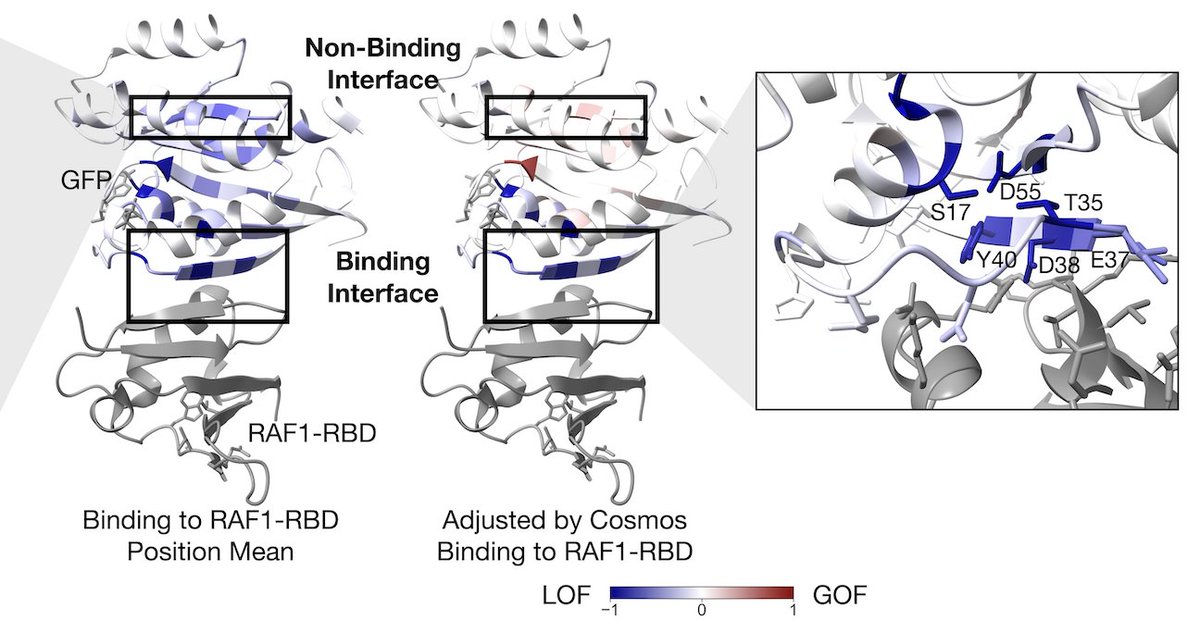
How do we decouple the effects of two functional phenotypes in protein deep mutational scanning (DMS)?
Meet Cosmos, our new statistical framework for causal inference in multi-phenotype DMS.
https://t.co/ZOy32xLJ5T
[1/n]
🧬 BREAKING: Our CRISPR-GPT paper is out TODAY in Nature Biomedical Engineering @natBME !
🤯 We built an AI agent that turns ANYONE into a gene-editing expert in 1 DAY instead of months. An undergrad with ZERO experience achieved 90%+ editing efficiency on their FIRST attempt.
🧵 Here's how we're building expert AI agents for cutting-edge biotechnology:
🎯 The Problem: CRISPR is revolutionary but requires PhD-level expertise, it can take weeks to learn, adopt, and design, analyze a CRISPR experiment for R&D or making life-saving medicine. Even Pro scientists can make small mistakes (e.g. typos in guideRNA or cloning design) that cost months to find out, slowing us down.
💡 Our Solution: CRISPR-GPT - an AI co-pilot from @Stanford@Princeton@GoogleDeepMind that guides you through EVERY step via simple conversation
🔬 Real Results:
-Novice researcher: ~90% editing on 1st go
-Training time: Months → 1 day
-100% success rate in our trials
-Even experts save days/weeks on data analysis & troubleshooting
🤖 How it works: Our multi-agent system handles: CRISPR system and delivery method selection, guideRNA design, Protocol generation, Real-time troubleshooting, Data analysis, and beyond. All through natural language! No coding, no complex software.
📊 We benchmarked it extensively:
-288 evaluation scenarios/cases
-Outperformed GPT-4o on ALL gene editing tasks
-Trained on 11 years of expert discussions
-Covers knockout, base-editing, prime-editing & epigenetic editing
🌍 Why this matters:
-Every lab can now use CRISPR with an AI system distilling expert knowledge and skills.
-Every student can learn faster.
-Every researcher can tackle bigger challenges without worrying about small mistakes.
-Customized CRISPR design can be automated based on your need and the context of R&D workflow.
-Agentic AI ensure safety, privacy, and responsibility
-We're not just automating gene editing - we're using AI to power scientists to cure diseases.
🚀 Try it yourself! Beta access available at: https://t.co/CFQzrdVVPW
Paper: https://t.co/WOgmAjg1Ed
Code: https://t.co/UnPKrxyJuW
Benchmark (companion work, Genome-bench): https://t.co/LIooAXj2op
Co-first and key authors: @YuanhaoQ@KaixuanHuang1@MingYin_0312
PIs: @lecong@MengdiWang10
Key collaborators: @Rbaltman@denny_zhou
The future of biology and science is conversational. The future is now. @natBME@NaturePortfolio
#CRISPR #AI #GeneEditing #Biotech #Science #AISafety
Presenting at #ISMBECCB2025 tomorrow!
GASTON-Mix, a unified model of spatial gradients and domains in spatial 'omics data.
11:20am UK time at RegSys
Also recruiting students for my new lab at @JHUCompSci, feel free to reach out if you want to chat
🚀 Join CongLab @Stanford! We’re hiring postdocs to create lab-in-the-loop self-evolving AI agents, open benchmarks, to design, test & learn—advancing safer gene & cell therapies. Build on CRISPR-GPT, RNAGenesis model, Genome-Bench, for innovative medicines. #PostdocJobs
Thrilled to share that I just successfully defended my PhD! Thanks to my committee, collaborators, and everyone who’d supported me throughout my seven years at UCLA. A special thank you to my PI Harold for his incredible mentorship! @hjpimentel
Happy to share that our work from the @nmancuso_ lab is out in @NatureGenet! We developed SuShiE, a multiancestry fine-mapping method for molecular traits. https://t.co/8gySuJkDEw
I’m honored to join Fred Hutch as Professor and Program Head of Biostatistics, and as the Donald and Janet K. Guthrie Endowed Chair in Statistics. Excited to be part of a deeply collaborative and scientifically vibrant community with a rich legacy of impact.
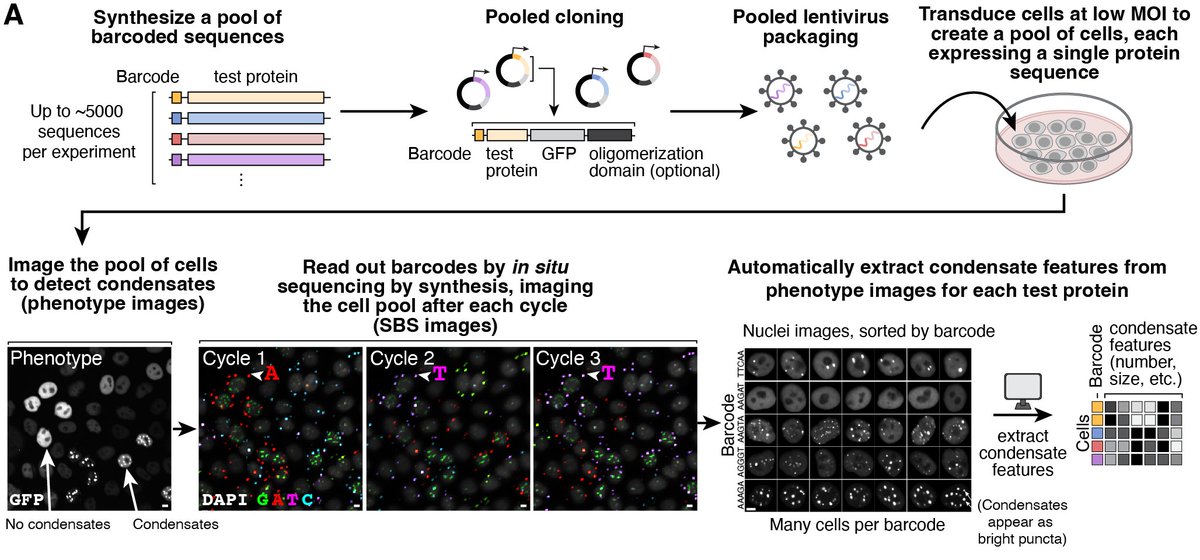
In the nucleus, many intrinsically disordered proteins (IDPs) form condensates. What IDP sequence features drive this behavior? We developed CondenSeq, a high-throughput method to measure nuclear condensate formation & applied it to ~14000 IDPs to find out
https://t.co/qfa8jtvFOp