Stanford Professor | Gene-Editing & AI+Bio & RNA programming | Stanford University School of Medicine, Genetics and Pathology | NIH and ASGCT Genomics Innovator
Introducing the Biomni Lab API: Programmatic access to agentic science.
Run Biomni agents directly from your own code. Analyze datasets in parallel, chain agents into multi-step research workflows, and start scaling your scientific tasks.
Move beyond individual AI-assisted tasks to build and scale entire research workflows.
Explore more at: https://t.co/TXtLru3hdj
Baker is just one headliner among a full day of AI bio heavy hitters:
@AdamRodmanMD@zavaindar@lecong@nc_frey@exnx
& many more
We're sold out for in-person.
But virtual access to livestreams + recordings is free and open now: https://t.co/ZbW0IEvaYK
Excited to share AutoScreen—our AI co-scientist for target discovery that changes how we can work with CRISPR screen, human genetics and genomics data, benchmarked on >320 wet-lab screens and enabled a “AutoScreen AI hub” with AI-extracted insights from >500 datasets across BioGrid CRISPR database, EMBL expression atlas, and UK Biobank GWAS studies.
The multi-agent AI can automate design and analysis of target discovery. We validated 3 novel genes that help cancer cells evade immune attack, using previously unpublished, fresh CRISPR screens across melanoma, leukemia, and colon cancer models. AI predictions → real experiments, closing the loop for discovering novel drug target and insights at scale.
This work started by @YuanhaoQ in collaboration with @MengdiWang10@jure groups, esp @KexinHuang5 now both at @phylo_bio building scientific AI system. With talented members Xuefeng, Xiaotong Wang, Meitong Chen, Xiao Luo, Luna Lyu, Ravi Dinesh, Ming Yin, amazing collaborator including @hcwww_ from Aviv Regev group. Special thanks to our team who drove the wet-lab validation and took this work further into finding cancer immune targets that may one day turn into life-saving drugs.
We are recruiting talents to build models and agentic AI with real lab verifier and discovery impacts to life and medicine, come join us!!!
Preprint: https://t.co/b3GvdWvsUD
Blog from Phylo: https://t.co/ZTqtPO4LNA
Excited to share AutoScreen, the last piece of my thesis work and an AI co-scientist system for target discovery!
I started this in 2024 after CRISPR-GPT. Having spent a lot of time working with CRISPR screens, I saw opportunities for agents to speed up the work of deciding which genes to test. We built agents for literature research, data curation and information synthesis to prioritize screen hits and suggest starting gene libraries. We also wanted to look beyond the familiar genes that tend to dominate these searches.
Really glad to see the work continue through multiple cancer immunology experiments in my mentor Le Cong’s lab. AutoScreen helped prioritize genes whose activation was then shown to increase cancer cells’ resistance to immune-cell killing.
AutoScreen was an early attempt to put agents to work alongside scientists in target discovery. We wanted to make the process faster and improve the quality of target selection, helping researchers pick out real biological hits from noisy experimental data.
Thank you to my mentor, Professor @lecong , Professor @MengdiWang10 , and our co-authors Xuefeng Liu, Xiaotong Wang, Meitong Chen, Xiao Luo, Luna Lyu, Ming Yin, and the rest of the team. Special thanks to the teammates who drove the wet-lab validation and took this work further.
Blog: https://t.co/ROQuwAbJCR
Paper: https://t.co/5hV3hRmJTg
Excited to share AutoScreen, an agentic system for target prioritization. Starting from a CRISPRa screen, AutoScreen re-prioritized lower-ranked candidates for follow-up. We then validated these candidates in the wet lab, where activating the prioritized genes increased cancer cells’ resistance to primary human NK-cell killing. Great collaboration with @lecong lab at Stanford:
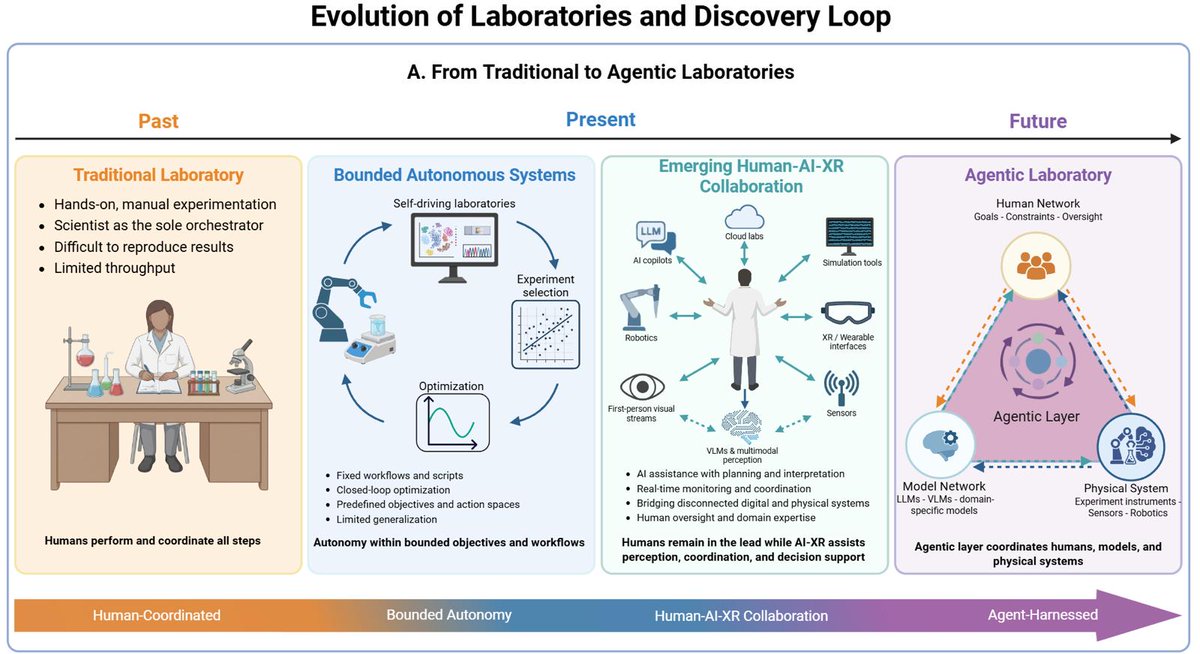
Excited to share a paper I co-authored: Agentic Laboratories of the Future: Towards World Models for Scientific Discovery– joint effort across @Princeton, @Stanford, @Columbia, @nvidia, @MIT, @scale_AI and more.
Our argument: the next generation of labs will be agentic, with scientists, AI, and robots as collaborative discovery partners. But the bottleneck isn't better models. It's that no system maintains a shared laboratory world model — a live representation of hypotheses, evidence, uncertainty, and experimental state. Without it, agents produce plans that read well and fail physically.
We propose an L0–L5 autonomy ladder for labs, adapted from self-driving vehicles. Most systems today sit at L1–L3, even when marketed as autonomous. And a robust L3 beats a fragile L4 that needs constant rescue.
These labs must stay human-led. Agents handle execution and coordination; scientists decide which questions matter.
Thanks to project leads @MengdiWang10 (@Princeton) and @lecong (@Stanford) for organizing such a strong community effort to move AI for science forward.
Preprint: https://t.co/BZovyr6BNJ
Experts in #bioengineering and #ArtificialIntelligence gathered at @omenndarlingbio on Monday for an event that encouraged participants to imagine and prepare for a future with scientists working more closely with artificial intelligence, also known as co-intelligence.
🎙️ Speaker Spotlight #19 | AIAS+ 2026
He helped build the first CRISPR/Cas9 gene editing tools for in vivo therapy. Now he's building AI co-scientists.
Dr. Le Cong @lecong ( @StanfordMed ) leads a lab merging genome engineering with agentic AI, from RNAGenesis to CRISPR-GPT to LabOS, turning the lab itself into a programmable, AI-native environment.
Hear him speak live at AIAS+ 2026, November 5–7 in San Francisco. Registration is now open at https://t.co/mBctmM5LsW
More incredible speakers dropping soon.
Don't miss AIAS+ 2026 👇 🎟️ Get your tickets at https://t.co/mBctmM5LsW
📅 November 5-7, San Francisco
#AIAS2026 #AIASPlus #SpeakerSpotlight #CRISPR
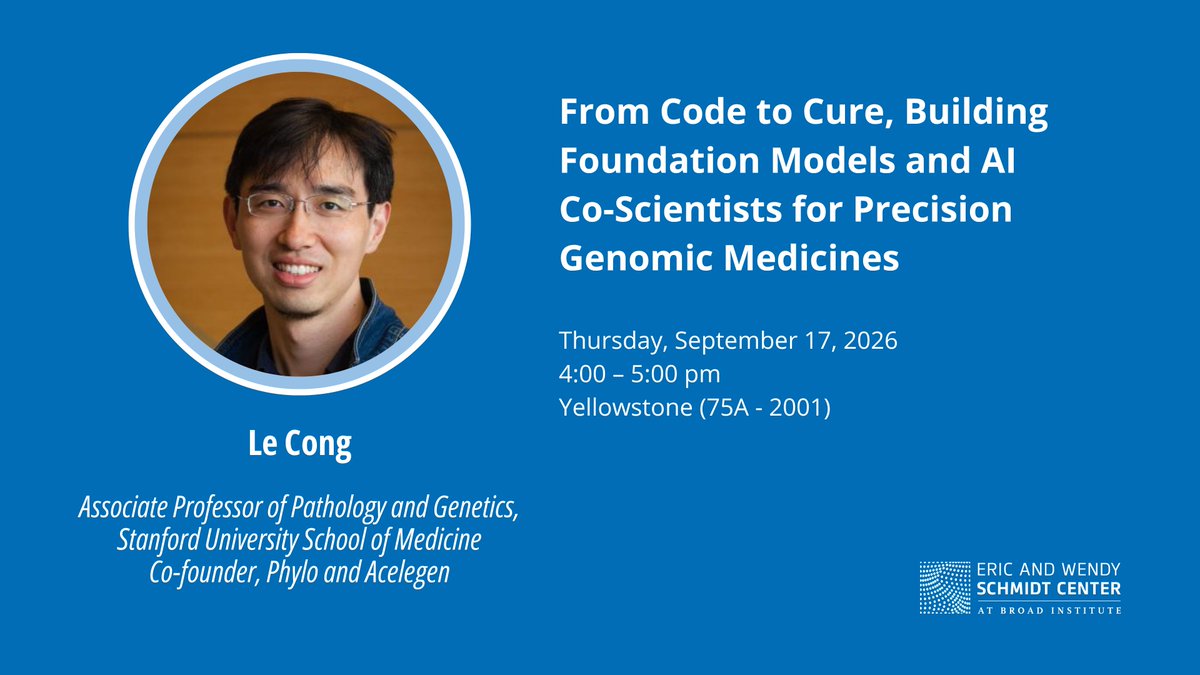
✨ From Code to Cure, Building Foundation Models and AI Co-Scientists for Precision Genomic Medicines
💬 @lecong
🏫 Associate Professor, @StanfordMed; Co-founder, Phylo and Acelegen
📅 Thursday, Sept. 17 (tomorrow)
⏰ 4 - 5 p.m.
📍 Yellowstone at @broadinstitute (in-person only)
When would we have “live streaming” of life science / scientific lab work? Perhaps live streaming a Brain implant surgery from @neuralink could be the closest thing? It would be fun to live stream a CRISPR experiment some day but parental DNA test in live session may have more viewers. These you can see something happening within days hopefully. @elonmusk@djseo
Thrilled to release two new preprints on intelligent labs for driving science and innovation. This is in close coordination with Aviv Regev, Jian Ma (@jmuiuc), Michelle Lee (@michellearning), and the teams at @Genentech, @SCSatCMU, and @Princeton University.
In our perspective, we argue that the next generation of labs should be human-in-the-lead and AI-empowered, integrating human intent, machine reasoning, and physical experimentation through scientific world models and an agentic harnessing layer.
Done responsibly, these systems have the potential to make scientific discovery more programmable, reproducible, adaptive, and scalable while enabling scientists to focus on higher-level scientific reasoning and discovery.
It's been a privilege to pursue this Perspective with @MengdiWang10 and an outstanding group of scientists and innovators advancing the intersection of computation, AI, science, and medicine. We're excited to continue exploring where this vision leads.
Our preprint: https://t.co/aKEkUIaNwb
Preprint led by Jian and Aviv team: https://t.co/yOzQ6cI9XD
This also kicks off a new Gladstone-Stanford AI Hub efforts, led by Katie Pollard at @GladstoneInst and myself, with an amazing team of scientists including Emma Lundberg (@Prof_Lundberg), Brian L Trippe (@brianltrippe ), Anshul Kundaje (@anshulkundaje ), Barbara Engelhardt (@BeEngelhardt), Christina Theodoris (@TheodorisLab), Catherine Tcheandjieu (@ines_catherine), Bruce Conklin, Alexander Marson, Stacie Dodgson (@StacieDodgson), Seth Shipman (@seth_shipman), Vijay Ramani, Danielle Swaney (@dlswaney), and Nevan Krogan. Excited to be building together across two great institutions!
🚀 Excited to kick off the Graphics × Science Workshop at #SIGGRAPH2026!
Computer graphics is becoming a foundational tool for scientific discovery. From computational imaging and molecular modeling to physical simulation, robotics, manufacturing, and AI, graphics is helping us model, understand, and design the physical world.
Looking forward to an exciting program featuring 3 keynote speakers and 58 highlighted papers.
🔗 https://t.co/29zAWyHXKk
#AI4Science #ComputerGraphics #ScientificComputing #Simulation #NVIDIA #NVIDIAOmniverse #NVIDIAAI