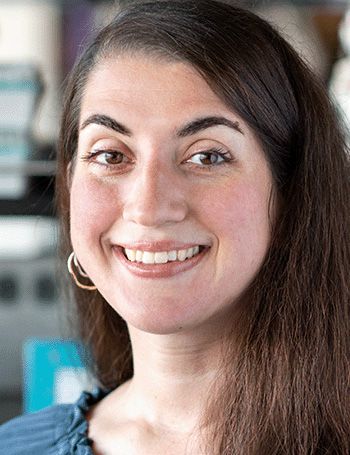
Congratulations Dr. Christina Theodoris @TheodorisLab, recipient of the 2026 Donald Seldin~Holly Smith Award for Pioneering Research!
Dr. Theodoris @GladstoneInst is recognized for her work in computational biology, leveraging AI to understand cell regulation and cell-cell interactions and to produce models that reason about disease states.
Excited to share our new review: “The landscape of single-cell foundation models: design principles, applications, and open challenges”
This work brings together collaborators from 23 institutions, including Stanford University, Gladstone Institutes, University of California, San Francisco, Helmholtz Munich, Massachusetts Institute of Technology, and Yale University.
The field has moved incredibly fast—from scBERT in 2021, geneformer in 2022 to more than 100 foundation models today spanning transcriptomics, epigenomics, spatial omics, multimodal biology, and LLM-integrated frameworks.
But this rapid growth has also created real confusion, for example:
• Which tokenization strategy should we use?
• Do conventional scaling laws apply to biological systems?
• Why does perturbation prediction remain stubbornly difficult?
• And how should we evaluate whether a model has learned meaningful biology rather than dataset-specific patterns?
...
We were among the early groups working on single-cell foundation models, beginning in 2022 as the field was taking shape. Our journey has included:
• CellPLM (ICLR 2024), an early model for learning cellular states in their multicellular context
• scLinguist, a Hyena-based multimodal model for RNA-to-protein translation
• Tabula (NeurIPS 2025; extended version under review at Nature Portfolio), a privacy-preserving predictive model combining tabular and federated learning to study gene regulation and aging
Building these models gave us a firsthand view of both the field’s promise and its unresolved challenges: biological fidelity, generalization, multimodality, perturbation modeling, evaluation, and privacy. Those experiences motivated this review. We hope this review as a structured guide for both computational scientists and experimental biologists—covering how these models are built, where they genuinely enable biological discovery, including experimentally validated therapeutic targets, and where the most important gaps remain.
📄 Paper: https://t.co/YW0YmQykzC
📚 Curated paper list: https://t.co/kCICcUfYgF
Deeply grateful to all of our co-authors and collaborators—this was a true community effort. @shiyu_jiang23 , Zhaoyu Fang, Yujie Zhang, @xutzhang , @jkobject , Weixu Wang, @alexanderfuxi , Aakash Patel, Syed Rizvi, @Y_Ryan_Lu , @SiyuHe7 , @YixinxinWang , @KejunYing , @peterpaohuang , @YifanLu2024 , @Nanguage , Mengchen Wang, Ziyang Miao, Jianhui Lin, Jimmy Ding, Jerry Wang, @imweio , @TianlongChen4 , Guoxian Yu, Min Li, Jiayi Ma, @feiwang03 , @Yuyingxie , @tangjiliang , @raulrabadan , @david_van_dijk , @cmuptx , @PengHeAtlas , Emily B. Fox, @dasongle , @fabian_theis , @ericxing , Christina Theodoris, @Xiaojie_Qiu
#SingleCell #FoundationModels #ComputationalBiology #Genomics #AIForScience #SpatialOmics #PerturbationBiology
Thrilled to release two new preprints on intelligent labs for driving science and innovation. This is in close coordination with Aviv Regev, Jian Ma (@jmuiuc), Michelle Lee (@michellearning), and the teams at @Genentech, @SCSatCMU, and @Princeton University.
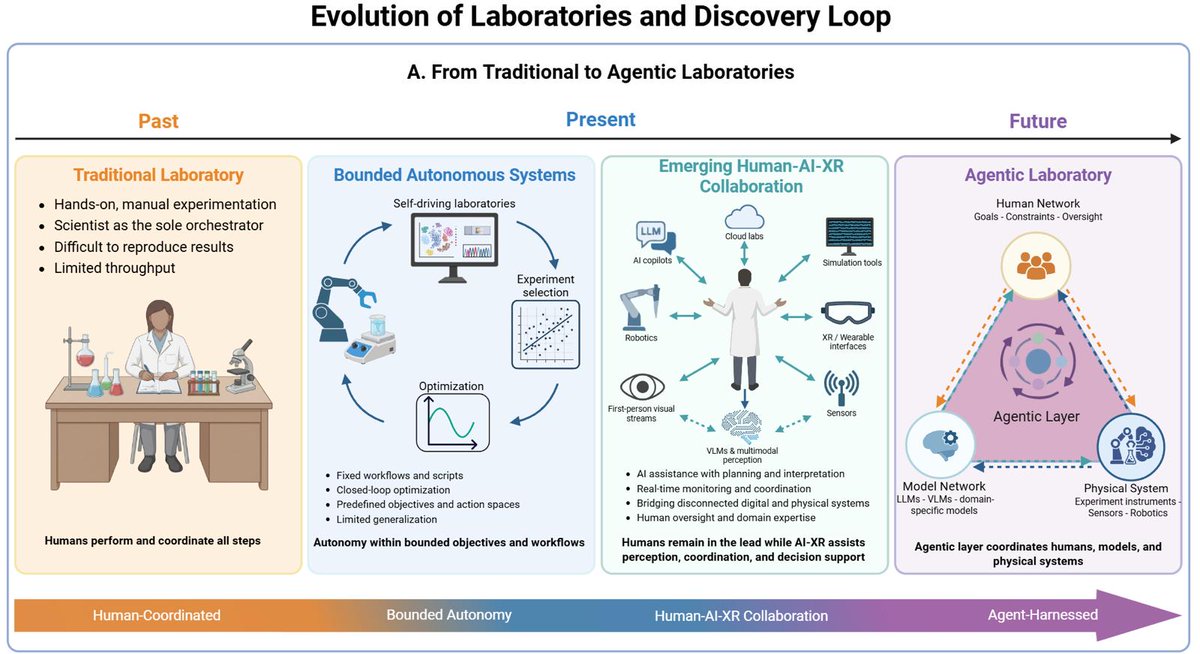
In our perspective, we argue that the next generation of labs should be human-in-the-lead and AI-empowered, integrating human intent, machine reasoning, and physical experimentation through scientific world models and an agentic harnessing layer.
Done responsibly, these systems have the potential to make scientific discovery more programmable, reproducible, adaptive, and scalable while enabling scientists to focus on higher-level scientific reasoning and discovery.
It's been a privilege to pursue this Perspective with @MengdiWang10 and an outstanding group of scientists and innovators advancing the intersection of computation, AI, science, and medicine. We're excited to continue exploring where this vision leads.
Our preprint: https://t.co/aKEkUIaNwb
Preprint led by Jian and Aviv team: https://t.co/yOzQ6cI9XD
This also kicks off a new Gladstone-Stanford AI Hub efforts, led by Katie Pollard at @GladstoneInst and myself, with an amazing team of scientists including Emma Lundberg (@Prof_Lundberg), Brian L Trippe (@brianltrippe ), Anshul Kundaje (@anshulkundaje ), Barbara Engelhardt (@BeEngelhardt), Christina Theodoris (@TheodorisLab), Catherine Tcheandjieu (@ines_catherine), Bruce Conklin, Alexander Marson, Stacie Dodgson (@StacieDodgson), Seth Shipman (@seth_shipman), Vijay Ramani, Danielle Swaney (@dlswaney), and Nevan Krogan. Excited to be building together across two great institutions!
Happy to share a protocol for discovery of candidate therapeutic targets with Geneformer by @YujieZh1729!
Nature Protocols link: https://t.co/6cIvUThS1f
Google Colab: https://t.co/pqbXvI3cw4
Really enjoyed talking with science journalist Andrew Han about art and science on his new podcast, Ion Genomics! Check it out here: https://t.co/2jR2PRDs92
Excited to share MaxToki, a temporal AI model that predicts the impact of perturbations on cell states over time along dynamic trajectories. We applied MaxToki to predict how cells age across the human lifespan & discovered new cardiac pro-aging drivers that we validated in vivo.
Congrats to @hanimal725 and @madhavanvvs for their work in Nature Computational Science that demonstrated scaling laws for foundation models for network biology and implemented a quantization approach to enable resource-efficient predictions! https://t.co/ugXyeOsi2W
Thank you to the whole team for the wonderful collaboration! Javier Gómez Ortega, @Sid_Mahesh_12, Tarak Nandi, @madduri, and @PelkaLab!
https://t.co/18d1eHlZxN
We are excited to share work led by @hanimal725 and @madhavanvvs developing a quantized multitask learning strategy for network biology, built on a foundation model pretrained on ~95M single-cell transcriptomes.
Manuscript: https://t.co/prZmTVIq7z
Model: https://t.co/AsF5MIBhTV
We are excited to share work led by @hanimal725 and @madhavanvvs developing a quantized multitask learning strategy for network biology, built on a foundation model pretrained on ~95M single-cell transcriptomes.
Manuscript: https://t.co/prZmTVIq7z
Model: https://t.co/AsF5MIBhTV
Overall, quantized multi-task learning enables resource-efficient context-specific modeling in gene network biology to yield contextual predictions of key network regulators and candidate therapeutic targets for human disease.