We’re happy to announce a new $90M gift from Phil and Penny Knight to extend the Knight Initiative's work at @StanfordBrain. This generous gift will expand our community and advance research in dementia, healthy brain aging, and resilience.
Learn more: https://t.co/zBnJIoNjH6
Proteo-R1 (ICML 2026), the first reasoning protein foundation model for protein design, is out! 🚀🧬
Most protein design models generate structures without ever *reasoning* about which residues matter. We think that's backwards.
Human protein engineers👩🔧 don't work this way. They identify critical interaction residues first — charged anchors, hydrophobic hotspots, specificity-determining motifs — and only then optimize geometry around those decisions.
━━━━━━━━━━━━━━━━
🔬 THE CORE IDEA
━━━━━━━━━━━━━━━━
A dual-expert architecture that explicitly decouples molecular understanding from geometric generation:
→ ⚡A multimodal LLM (understanding expert) analyzes protein sequences, structures, and text to identify key functional residues governing binding and specificity
→ ⚡A diffusion model (generation expert) then co-designs sequence + structure — but with those residues locked in as hard constraints
━━━━━━━━━━━━━━━━
📐 HOW IT'S TRAINED
━━━━━━━━━━━━━━━━
Three-stage curriculum:
① Multimodal Alignment — freeze the LLM, train projections to bridge ESM-2 + AF3-style structural features into language space
② Structural Reasoning Mid-Training — unfreeze the LLM, teach it residue grounding → pairwise geometry → interface localization → hotspot prediction
③ Joint Reasoning-Guided Design — end-to-end on antibody-antigen complexes. Gradients from the diffusion objective flow back through the reasoning expert.
━━━━━━━━━━━━━━━━
📊 RESULTS
━━━━━━━━━━━━━━━━
Evaluated on simultaneous multi-CDR redesign and the RAbD CDR-H3 benchmark:
✅ Best RMSD & DockQ on RAbD — redesigned H3 loops are geometrically accurate *and* docked well
✅ Lowest backbone dihedral divergence (JSDbb) among all baselines
✅ Reduced intra- and inter-chain steric clashes
✅ Generated sequences score lower perplexity than native antibodies under IgLM & AbLang
✅ Plug-and-play: swapping the diffusion backend to UniMoMo still improves RMSD and IMP
━━━━━━━━━━━━━━━━
💡 WHY IT MATTERS
━━━━━━━━━━━━━━━━
Proteo-R1 isn't just a better antibody design model. It's a blueprint for coupling deliberative LLM reasoning with any physical generative process — interpretable, modular, and backend-agnostic.
📄 Paper: https://t.co/efquYg3O76
💻 Code: https://t.co/Qxm06IZ4xy
🌐 Demo: https://t.co/nkfEWY32OA
Great thanks to my wonderful collaborators Weihao Xuan, Heli Qi, @Hanqun_CAO, Heng-Jui Chang, @KKuanPang@XiangruTang Zehong Wang, @hcwww_ , @KejunYing@lupantech Chiho Im, Seungju Han, @richardxp888@tikgiau. Also appreciate the guidance from advisors @YejinChoinka@jure@erranlli Naoto Yokoya, Masashi Sugiyama.
Experts say your ‘peak span’ could be more important than your ‘health span’ – here’s why, and what it really means for health
https://t.co/YVulQ49Zvh @StylistMagazine
Featuring work by @biogerontology, @KejunYing, and @DomiWilczok 🔬💻⚕️
Alzheimer’s is one of the most devastating diseases, killing ~2 million people globally each year and costing over $1 trillion annually. It also remains one of the hardest unsolved problems in medicine.
We believe advanced AI can help change that: https://t.co/91VYoJChZ0
Excited to announce the Claw4S Conference 2026! 🚀
Hosted by researchers from Stanford & Princeton.
We believe science should run — not just be read. 🦞
Submit executable SKILL.md that Claw 🦞 can actually execute, review and reproduce.
From static papers to truly runnable, agent-native skills.
📅Deadline: April 5, 2026
💰$50,000 Prize Pool — up to 364 winners!
🔗https://t.co/ULua225RjM
#AIforScience #OpenClaw #Stanford #Princeton
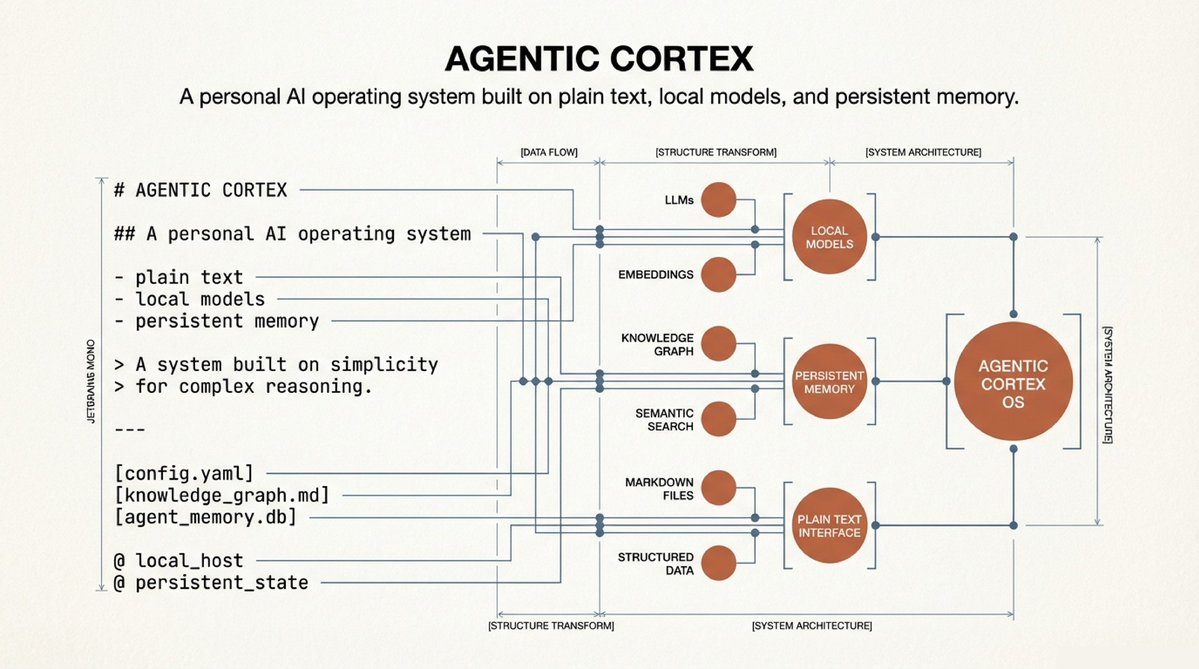
🧠 I Let Agentic Cortex Run My Life for a Week. Nobody Noticed. Here's what I learned.
The entire system is plaintext markdown. No vector DB. No fine-tuning.
Key ideas:
• Dendron's dot-notation naming = queryable knowledge graph with zero infra
• Structured feedback (rule + rationale + scope) → permanent behavioral change
• Voice profile extracted from your sent emails → register-aware drafting
• Screenpipe ambient context → the agent knows what you did without you telling it
Built for OpenClaw 🦞 / Claude Code.
GitHub: https://t.co/AihDtx5jF0
Blog: https://t.co/1s6UutAEP5
@JohnSchloendorn Thank you! It's not really criticism but more like a futuristic view, as we are far from the stage where we target complete solution for aging. Seeking compact solution is still a promising choice for finding partial solutions currently.
Expand on my previous tweet. A blog on why I think (almost) none of our current technology will lead to the solution for aging.
https://t.co/287KDhY9OM
@AlexJColville Hopefully with accelerated science, we may gain the ability to design complex biological subsystems soon enough - but here I'm talking about completely solving aging - to merely slowing aging to some extent with a less perfect solution, there might still be shortcuts!
@AlexJColville Thank you Alex! I think it is inavoidable -- if you want to completely solve aging, we will need a solution at least as complex as aging itself. We can start building it piece by piece but it is important to acknowledge that there might be no general compact/simple solution.
This is why I think partial reprogramming, iPSC-based approaches, and pharmaceutical interventions for aging are all searching for a short patch to a high-complexity problem -- they might help at the margins, but I don't believe it can fundamentally solve it.
This framing maps onto biology. DNA is a 4MB compressed program that decompresses into 37 trillion cells. The organism is low-complexity. Aging is where complexity explodes: a compact system running in an incompressible environment for decades. The damage has no compact description, so there is no compact fix. You need new biology that evolution never built.
I think one of the conclusions we should draw from the tremendous success of LLMs is how much of human knowledge and society exists at very low levels of Kolmogorov complexity.
We are entering an era where the minimal representation of a human cultural artifact... (1/12)
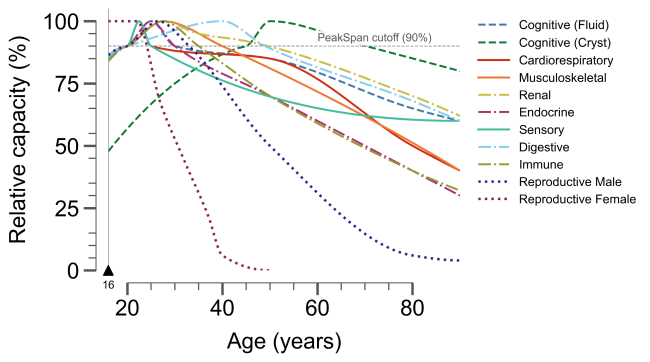
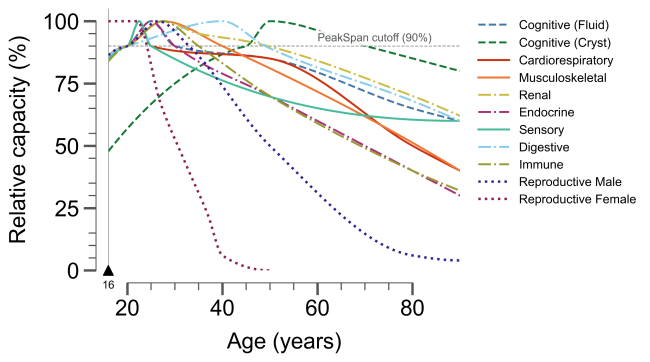
Instead of "healthspan," we should be thinking about "Peakspan."
How long can you maintain ~90% of your peak physical or cognitive function?
According to a new paper, different systems reach their “Peakspan” at very different times.
Fluid cognitive abilities like processing speed and working memory peak early, around ages 20–30, while crystallized intelligence doesn’t peak until the late 40s or early 50s and can remain stable into the 70s.
Cardiorespiratory fitness peaks from adolescence to the mid-20s and then declines steadily, while muscle strength peaks in early adulthood and falls sharply after 60. Bone density, kidney function, hormone levels, sensory function, immunity, digestion, and reproductive capacity all follow their own trajectories too—some peaking in the 20s, others in the 40s or 50s.
In other words, human aging is asynchronous. We don’t simply age “overall,” but instead age system by system.
Instead of "healthspan," we should be thinking about "Peakspan."
How long can you maintain ~90% of your peak physical or cognitive function?
According to a new paper, different systems reach their “Peakspan” at very different times.
Fluid cognitive abilities like processing speed and working memory peak early, around ages 20–30, while crystallized intelligence doesn’t peak until the late 40s or early 50s and can remain stable into the 70s.
Cardiorespiratory fitness peaks from adolescence to the mid-20s and then declines steadily, while muscle strength peaks in early adulthood and falls sharply after 60. Bone density, kidney function, hormone levels, sensory function, immunity, digestion, and reproductive capacity all follow their own trajectories too—some peaking in the 20s, others in the 40s or 50s.
In other words, human aging is asynchronous. We don’t simply age “overall,” but instead age system by system.
Excited to share our new paper on Peakspan. If healthspan is the broad measure, Peakspan is its extreme phenotype: the state where at least 90% of capacity is retained. Similar framing to extreme longevity versus lifespan. Great working with Dominika and Alex on this one.
The future of the lab is here! 🚀
So proud to be part of this mission with my mentor @lecong. Thank you for leading the way! LabOS is redefining the wet lab, and together with MedOS, we are ready to bring this AI revolution to the clinic. This is just the beginning!