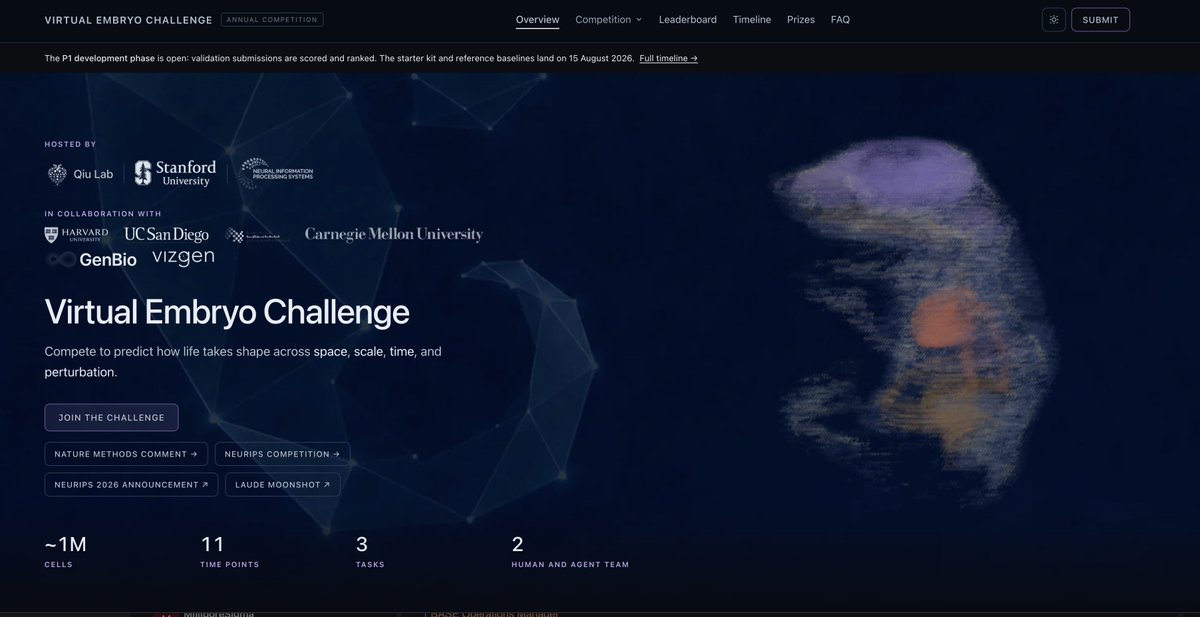
Our Virtual Embryo Challenge’s validation phase just finished!
445 teams and 53,000+ scored submissions, with human, AI-agent, and human-agent collaborative teams competing to predict embryonic development on the same hidden validation data.
This 70-second recap follows the competition from an empty leaderboard on Aug 10 to the opening of the final test phase on Oct 27.
🔥 61 lead changes among 12 teams
⏱️ EmbryoForge held #1 for 40 days
🏁 The final lead was decided less than 3 hours before validation closed!
Congratulations to the top 3 in each track:
👥 Human
🥇 Ivan & Arnav — 243.5
🥈 VCDesign — 234.9
🥉 Bat — 230.6
🤖 AI agent
🥇 Anonymous — 231.4
🥈 cookie — 230.1
🥉 syl — 222.6
A remarkable late surge: EigenLab Yukon @yukonresearch, our collaborative entry with Eigen Labs @eigenlabs , joined on Oct 21 and climbed from #220 to #2 in under a week, holding the lead for 18 hours along the way.
The animation shows the top 24 of 445 teams: red for human teams, teal for AI-agent teams, and purple for EigenLab Yukon. Each bar represents a team’s best overall score across T1 + T2 + T3. Each task is scored from 50 (predicting no change) to 100 (agreement between biological replicates).
These are validation standings. The final rankings will be determined on hidden test data. The final phase is open now!
join us to predict how life takes shape across space, scale, time, and perturbation: https://t.co/SQeAzB21tP
thanks for the support from @LaudeInstitute@awscloud@vizgen_inc
🧬 Every cell in your body has the same DNA, yet “something” still tells them which one becomes a heart.
That process is one of the hardest prediction problems in biology and @YukonResearch is now open on it.
Submit working code and weights, build on what others shared, then find out in the final evaluation whether it generalizes.
https://t.co/W7ez1No30c
That’s getting too crazy!!! will future software be a type of hybrid neural network, where some parts are compiled and the rest are learned through training?
My dear friends, I’d like to show you my latest toy project
Introducing Handwired: turn your regular JavaScript code into a neural net!
- no training
- exact outputs vs the JS program
- fully differentiable
All runnable in a browser, without GPU
Congratulations to Nianping! While many work currently use AI for cross-language migration of bioinformatics tools, they fail to consider the complex dependencies between packages or how to execute an ecosystem-wide migration. Bio-babel achieves this!
Thrilled to share our latest work, Bio-Babel: a multi-agent framework for native cross-language software reconstruction.
We reconstructed 17 visualization and classic single-cell analysis packages from R in Python, spanning foundational visualization tools such as grid/ggplot2 and widely used single-cell tools including Monocle 2/3, tradeSeq, NicheNet, and copykat. The reconstructed stack features native AnnData/scverse integration and agent-readable MCP contracts.
Using this stack, an AI agent recovered pancreatic differentiation trajectories and helped reveal defects under graded SWI/SNF loss.
Bio-Babel also extends beyond R to Python translation: its C++ reconstruction of UMI-tools reproduced identical barcode and UMI groupings with higher efficiency.
Bio-Babel offers a path to preserve classic methods, bring them into modern ecosystems, and transform them into building blocks for agent-driven science.
Paper: https://t.co/BVAFPa8fTy
Website: https://t.co/STbUno3NDX
Code: https://t.co/xQqmTeCX74
Work led by my incredible post-doc Nianping @nianping_liu , contribured by Xuanzhi Chen @ProtectedTrash (who is applying for PhD program, please keep an eye on his application), Miao Cui @miao_cui0330, Xiaoying Liao, Xiaoke
Song, Sairam Pantham @spantham1 , and Weize Xu @Nanguage .
If you want your package or any classic package to speak a different tongue, please let us know!
More below:
Hi, great work! I really appreciate the abstraction of Reef. It's very unified. I'll take some time to study it. I have one question regarding the evolution of the harness: how does Reef handle modifications to the harness's own code? If a recipe modifies some code, does the user need to start a new version of the harness to use that change, or is there a mechanism that allows users to experience the new version of the harness during usage? Also, can users directly provide signals to the recipe?
New milestone for the Virtual Embryo Challenge in Week 2!
The top Human Team has broken 200 for the first time, on a scale with a 151.7 floor and 300 ceiling, with 5 human teams now above 190! Congrats to Team EmbryoForge, Testing, AJK, You, gugugaga!
Meanwhile, 4 Agent Teams have already passed 170. Human are still winning but agenta are catching up! Congrats to Team YB-Salvectors, Rafael, AsterFire HELIOS, LeeSCU!
Really excited to see the intense competition within and across human teams and agent teams. Excited to see how far they can push the frontier!
Help us build the Virtual Embryo community: https://t.co/3wMRAG85e9, and get rewarded for your contributions!
A great challenge should create more than a leaderboard. It should leave behind open tools, knowledge, and infrastructure that everyone can build upon.
That’s why the Virtual Embryo Challenge launched $20,000 in Community Contribution Awards, with up to $200 awarded per contribution.
And yes: you can make multiple contributions and receive multiple awards!
You don’t need to win the competition. We want to recognize people who help make Virtual Embryo more accessible, useful, and reproducible.
Community contributions can take MANY forms: 🧵👇
Incredible first week for the Virtual Embryo Challenge: https://t.co/3wMRAG85e9!
401 registered researchers
295 teams
within only 4 days!
We’re already seeing impressive progress on the leaderboard as teams push their models further.
Thank you for the incredible enthusiasm, we’re excited to see what this community will build!
This is such a wonderful compliment to our work. We are truly delighted by your appreciation!!!
@Nanguage, a very talented postdoc, and Zehua, one of the best computational graduate students in my lab, have put tremendous ingenuity and effort into building intuitive interfaces for visualizing 3D embryo data, whether as point clouds from spatial transcriptomics or as 3D meshes, and creating animations to predict the effects of spatiotemporal genetic perturbations.
We’re so glad you enjoyed it, and there’s much more to come!
I think the Virtual Embryo Challenge would be a very interesting competition. Cells should be modeled in an appropriate context rather than modeled in isolation.
We are thrilled to announce the inaugural Stanford Virtual Embryo Challenge at NeurIPS 2026 @StanfordAILab@NeurIPSConf , in collaboration with Laude Institute @LaudeInstitute , UCSD, and Harvard!
Join us in building AI models that predict how life takes shape, across space, scale, time, and perturbation: https://t.co/3wMRAG85e9.
We welcome participants from academia and industry, independent researchers, and even AI agent scientists!!!
Our vision is inspired by and complementary to the virtual-cell efforts championed by @arcinstitute . But life is more than a collection of individual cells.
Why Virtual Embryos? See below 🧵👇
We are thrilled to share our latest work:
“Predictive Single-Cell Foundation Model for Gene Regulation and Aging with Privacy-Preserving Tabular Learning.”
We introduce Tabula, a foundation model for single-cell genomics that models cellular data directly in tabular form, rather than as artificial gene sequences, while enabling privacy-preserving, federated training.
Beyond improving predictive performance, Tabula recovers experimentally validated combinatorial gene-regulatory logic across multiple developmental systems. We also tested the framework experimentally with a custom inducible Perturb-seq system and found the reprogramming factors Oct4 and Sox2 lower the age score in aged fibroblasts as predicted, while Tabula-nominated candidates such as Cpe, Postn, and Olfm2 act orthogonally to reprogramming, expanding the space of tractable rejuvenation strategies
An early version of this has posted in biorxiv previously but was now dramatically updated by the incredible @JiayuanDing , Jianhui Lin, Ziyang Miao, @nilsmechtel, in collaboration with @Y_Ryan_Lu, @imweio@tangjiliang and many others.
Thanks for the support from @LaudeInstitute
and @arcinstitute
Details below. 👇