What if your retriever could speak every language your data speaks? 🌐
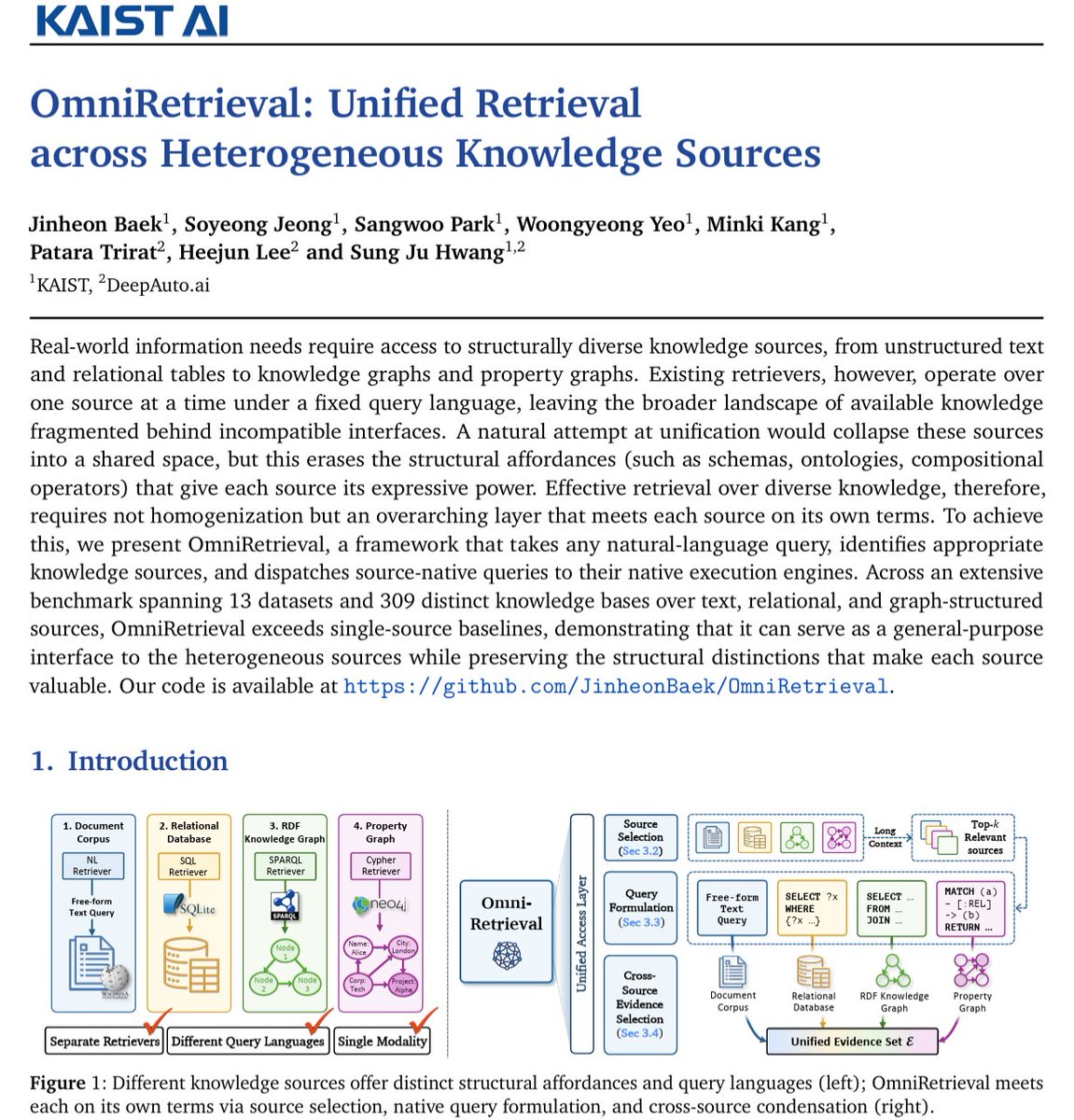
Your answer might live in a document 📄, a SQL table 🗃️, an RDF knowledge graph 🔗, or a property graph 🕸️, and OmniRetrieval reaches into all of them, meeting each source in its own native query language instead of flattening everything into one lossy space.
Paper: https://t.co/dI6IvBwfWW
one thing i've learned after doing language modeling research for ten years is that if you want your contribution to catch on it has to be *very* simple.
researchers are brought up through the paper writing process and it makes some think that you need to have novelty but novelty is basically the enemy of actual advancement.
you need to strive to have as *little* novelty as possible. every bit of additional novelty:
1. makes your contribution harder to explain
2. makes it harder to understand
3. makes it harder to implement
4. makes it harder to experiment with and verify
5. makes your contribution literally worse
i really do think that more complex things in machine learning just end up working worse. and then when you consider points 1-4, it just all piles up and makes complexity a silly endeavor.
keep it simple. it seems wrong at first, i think some people think that simpler things are stupider, but when you gain experience you notice that the simplest things are usually the smartest, best, and hardest to design and build, but they're so worth it.
Heading to #ACL2026 to present UniversalRAG (https://t.co/bgO1jIsbNQ), to be presented in oral on the final day 🎙️, and back to Seoul for ICML!
Happy to connect if you’re interested in leveraging knowledge, especially for large-scale & multimodal data or open-ended discovery :)
SUPER excited to share this work!!
From what we know, this the first case of AI Co-Scientist developing a competitive generative deep-learning algorithm for a mature scientific ML benchmark.
Big congrats to @rldudrldbs2 for taking the risk on this unexplored type of research!
I think the ML community should move towards treating text optimization with the same seriousness we give to weight optimization.
I had a lot of fun writing up (and getting feedback on) a longer blog post with the best arguments and evidence I'm aware of:
Must-read research of the week
▪️ ScientistOne
▪️ SkillOpt
▪️ MUSE-Autoskill
▪️ Do Language Models Need Sleep?
▪️ OmniRetrieval
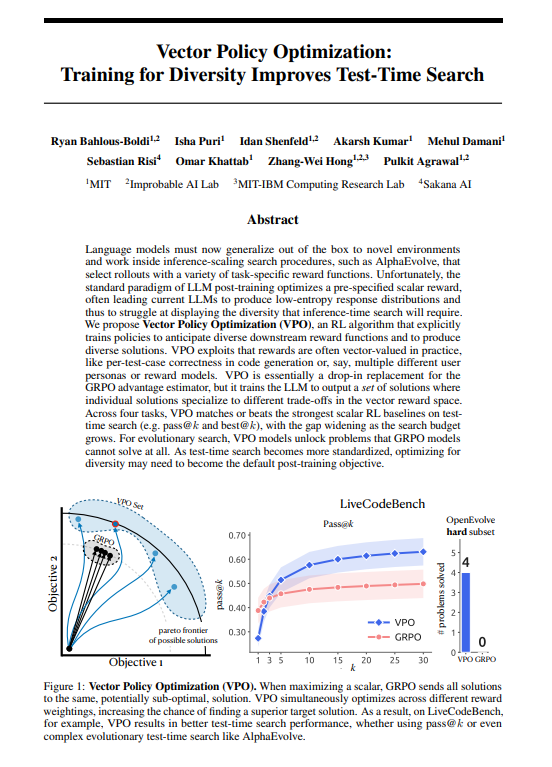
▪️ Vector Policy Optimization
▪️ Gamma-World
▪️ OpenComputer
▪️ Personalize-then-Store
▪️ WorldKV
▪️ AutoResearchClaw
▪️ Qwen-VLA
▪️ CUA-Gym
Find the full list and the most important AI news of the week here: https://t.co/UC1IeiRL8y
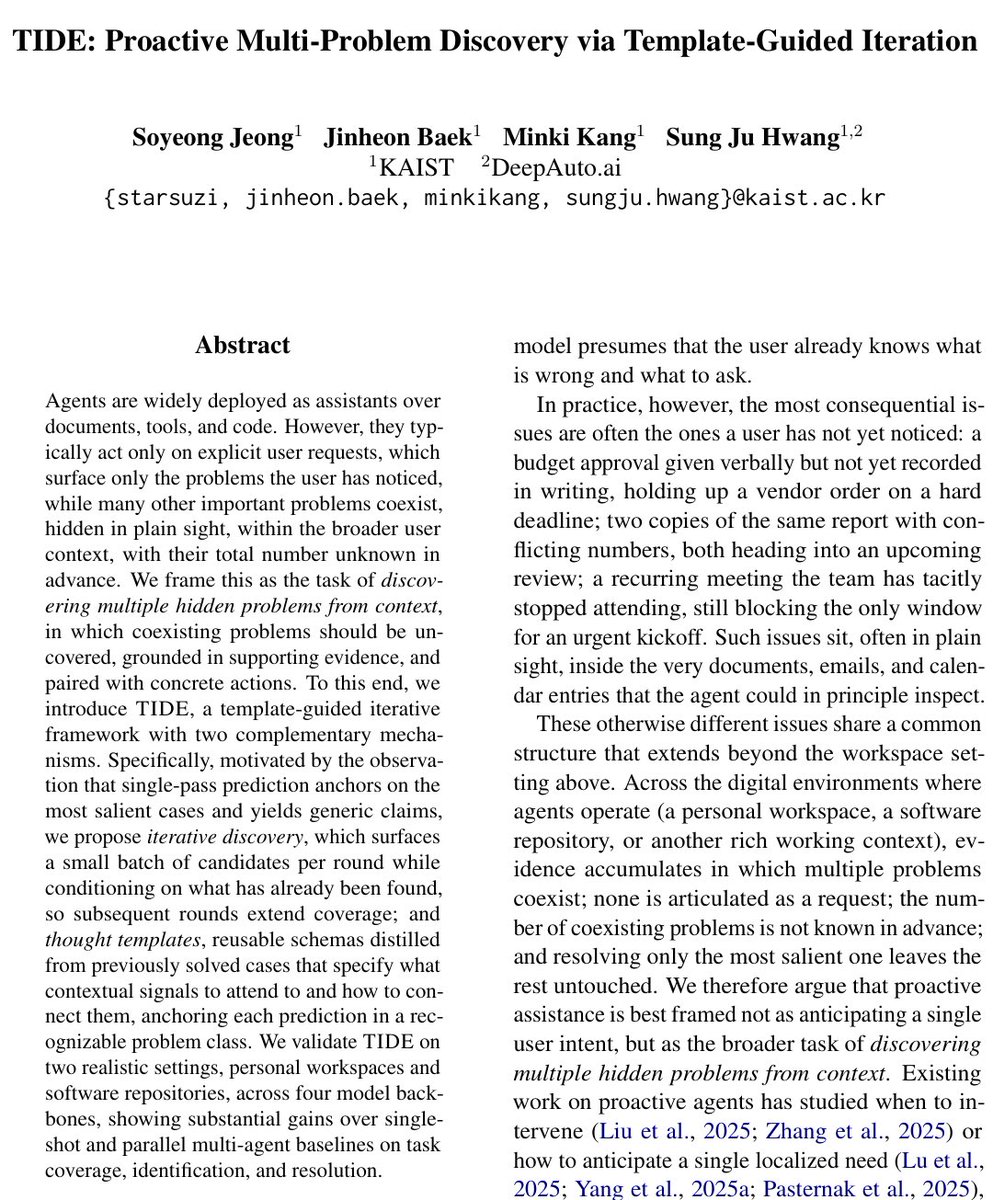
TIDE discovers hidden problems in plain sight
Most AI assistants only react to explicit requests.
They miss critical issues in your context.
TIDE proactively surfaces multiple latent problems through template-guided iteration.
Validated on workspaces and code repos.
Most agents solve only what you ask.
Excited to introduce TIDE🌊, which finds the problems hiding in plain sight and tells you how to fix them.
Glad to be part of this work!
🚨Most AI agents solve only the problems users explicitly ask about.
But what about the problems users haven’t noticed yet?
🌊TIDE enables proactive multi-problem discovery, helping agents uncover hidden issues 🔍 and recommend actionable next steps ✅.
https://t.co/9mKNS7t634
What if your retriever could speak every language your data speaks? 🌐
Your answer might live in a document 📄, a SQL table 🗃️, an RDF knowledge graph 🔗, or a property graph 🕸️, and OmniRetrieval reaches into all of them, meeting each source in its own native query language instead of flattening everything into one lossy space.
Paper: https://t.co/dI6IvBwfWW
What if LLMs could retrieve from the right source, even when knowledge is spread across text, tables, relational databases, and graphs?
Check out OmniRetrieval from @KAIST_AI: a unified retrieval framework that helps LLMs find and query the right source across heterogeneous KBs.
Glad to be part of our new work, OmniRetrieval🌐
Real-world knowledge lives across documents, SQL tables, RDF knowledge graphs, and property graphs. OmniRetrieval unifies retrieval across them using each source's native query language.
Happy to be part of this work!
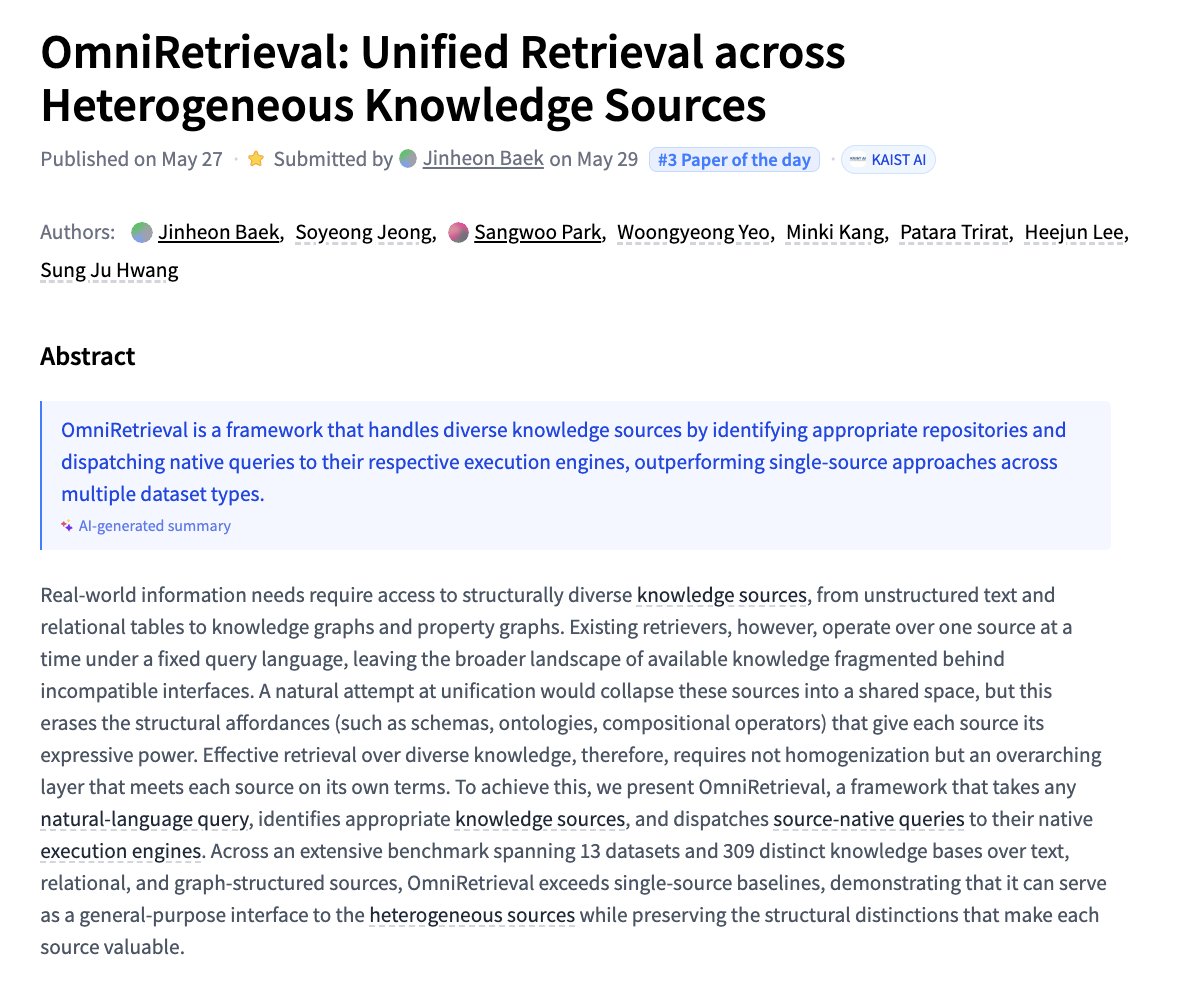
OmniRetrieval: Unified Retrieval across Heterogeneous Knowledge Sources
@jinheonbaek et al. introduce a framework unifying retrieval across diverse knowledge sources via source-native queries.
📝 https://t.co/ehomQyO3UK
👨🏽💻 https://t.co/U06yvJVzOO
What if your retriever could speak every language your data speaks? 🌐
Your answer might live in a document 📄, a SQL table 🗃️, an RDF knowledge graph 🔗, or a property graph 🕸️, and OmniRetrieval reaches into all of them, meeting each source in its own native query language instead of flattening everything into one lossy space.
Paper: https://t.co/dI6IvBwfWW
So how does it work? 🤔
OmniRetrieval acts as a unified access layer:
🎯 deciding which sources to query
🛠️ writing the right native query for each
🧩 bringing all the evidence back together
Excited to introduce 🧑🎓𝗟𝗲𝗮𝗿𝗻 𝗳𝗿𝗼𝗺 𝗪𝗲𝗮𝗸𝗻𝗲𝘀𝘀𝗲𝘀 (LearnWeak)!
A framework that automatically specializes small CUAs for specific domains by 🎯𝘁𝗮𝗿𝗴𝗲𝘁𝗶𝗻𝗴 𝘁𝗵𝗲𝗶𝗿 𝗼𝘄𝗻 𝗳𝗮𝗶𝗹𝘂𝗿𝗲 𝗽𝗮𝘁𝘁𝗲𝗿𝗻𝘀 in data generation and training.
🧵(1/7)
🚀 Releasing ✨AXPO✨ an RL method to lift agentic reasoning models past their next scaling tier.
Be it math, perception, or search, AXPO fixes the structural blind spot 'just add tools' recipes leave untouched.
8B beats 4x larger 32B baseline on Pass@4.
from NVIDIA 🧵 (1/7)
🔖Do you want to get feedback in your manuscript before submitting?
Try out our CMU Paper Reviewer platform, an AI review service that provides feedback on the five most critical issues to address in your paper!
https://t.co/fZq4cmBiyS
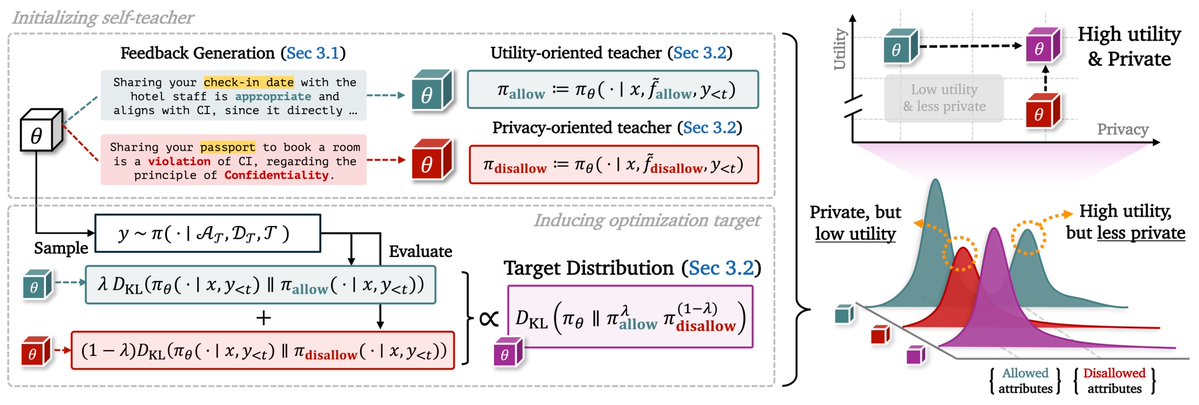
Privacy for LLM agents is not simply about hiding information.
A useful assistant should know what to use, what to ignore, and what is appropriate to disclose. And, we propose a complementary self-distillation framework for it.
Excited to have co-advised this work!
📢 New preprint out on contextual integrity (CI) and a new Product-of-Experts (PoE) view of self-distillation!
Introducing SelfCI, a novel self-distillation framework that operationalizes CI by optimizing for the intersection of task utility and minimal disclosure.
🧵👇
AI reviewers are not merely imitating human reviewers.
In our carefully designed expert study across Nature-family papers, we found that their real value may lie not in replacing human expertise, but in complementing it.
Excited to be part of this work!
Recently, there's been complaints on low-quality AI reviews at conferences and journals. What if we put the frontier LMs into an agent harness?
With the right setup, on 82 Nature-family papers, 45 expert scientists judged that AI reviewers outperform the best human reviewer!
🤗 https://t.co/PI9WwCTzRq