🚀 NVIDIA × KAIST Joint AI Research Lab is here!
🌟 $300M for Sovereign Agentic Future
Announced by @JensenHuang himself in SF! The new lab at the Kim Jaechul Graduate School of AI brings top KAIST talent + @nvidia's full-stack tech + massive compute🔥
https://t.co/XmeRvHdPWZ
🎉 Pivot-SD is an ORAL at #EMNLP2026!
We post-train a diffusion LM with a loss on just 10 tokens per response, and it beats both SFT and diffusion RL on math & code.
The trick isn't training on fewer tokens. It's training on the right ones.
EMNLP is right around the corner!
Meet our students who are excited to connect and meet new people at the conference! Take a look and say hello! 😁
https://t.co/iBZgkpf8Z4
🤖 Improving robot foundation models with real-world RL, then continually carrying that experience forward across tasks.
Introducing 𝗔𝗖𝗖𝗥𝗨𝗘: 𝗰𝗼𝗻𝘁𝗶𝗻𝘂𝗮𝗹 𝗼𝗳𝗳-𝗽𝗼𝗹𝗶𝗰𝘆 𝗥𝗟 for robot foundation models.
Our real-world policies learn through physical robot interaction, starting from a small set of demos.
We inherit the actor–critic across tasks and distill earlier behavior, so experience accumulates while prior skills remain.
💻 𝗟𝗼𝘄 𝗮𝗱𝗱𝗶𝘁𝗶𝗼𝗻𝗮𝗹 𝗚𝗣𝗨 𝘁𝗿𝗮𝗶𝗻𝗶𝗻𝗴 𝗼𝘃𝗲𝗿𝗵𝗲𝗮𝗱: RL updates a compact actor–critic while the foundation model stays frozen.
⚡ Subsequent tasks reach 95% success in about 𝟰–𝟭𝟮 𝗺𝗶𝗻𝘂𝘁𝗲𝘀 𝗼𝗳 𝗿𝗼𝗯𝗼𝘁 𝗶𝗻𝘁𝗲𝗿𝗮𝗰𝘁𝗶𝗼𝗻.
On real robots:
📉 Up to 68.5% less robot interaction vs. single-task RL
🎯 98.3% final prior-task success
🎬 A 60-second overview below.
🌐 https://t.co/5rubDotfQB
🧵 1/6
Do language models always need to see the full 1M-token context window? What if they can just tell us which tokens they actually need?
We're excited to share Declarative Attention (DA), a sparse attention protocol that lets a model declare which context they need for each reasoning step, in plain text. The inference engine can use this to mask out up to 99% of KV cache reads for global attention.
Across 15 long-context tasks, DA reduces global attention KV reads by 46% with only 1.4pp accuracy drop on Gemma-4 31B and 20% with 2.1pp on Qwen-3.6 27B. This accuracy gap shrinks as we scale up the model size. Zero-shot.
We discuss further potential in agentic settings with dedicated post-training, and model-controlled KV cache offloading as a path toward reversible context compaction.
We explain details and link our paper below.
Can explicitly learning future point motion improve the model that generates those future images?
We introduce VPM (Video-Point Model), a 4D world model that jointly forecasts future multi-view videos + persistent 3D point trajectories.
Short answer: yes. Teaching a video world model to forecast 3D point tracks makes its videos more faithful & 3D-consistent, and makes robots better.
🌐 Project: https://t.co/srVtzZsY5c
🧵 [1/6]
Can AI agents learn from their own failures? 🤖
Excited to host Prof. @XiaoxiaoLi8 (@UBC, @VectorInst, @YaleMed) for an invited talk on how agents can diagnose failures, adapt, and recursively improve themselves, drawing lessons from vision and medical AI!
@lintool's talk at KAIST is today! 😎
We see agents increasingly rely on search. Join us for Jimmy's insights into the exciting world of agentic search!
📂 Agents are now taking over some of our knowledge work! But, after working through a stack of files over dozens of turns, something they saw slips out of what they deliver.
Excited to introduce RunningTab🧾, where the environment keeps a running tab of what the agent has read and what the task still owes, until the work is handed in.
From writing reports and checking budgets to pulling figures from a century of government records, it consistently outperforms the same agent without the tab and baselines that track the task in the model itself.
Paper: https://t.co/Spb69XCEwS
Introducing SQAM, Q-Learning with Scalar Adjoint Matching! 🚀 Off-policy RL for flow policies, without a single VJP through the policy. Bigger gains on the hardest tasks, at a lower cost per update. 🧵 [1/8]
Full-duplex dialogue models listen and speak at the same time, yet are still evaluated against a partner that cannot react.
✨ Meet DyaFDB: two full-duplex models converse directly, and we score both.
📄 Paper: https://t.co/iTvyY7Ry86
🌐 Page: https://t.co/WvVgf4kNB4
1/ 🧵
Speech+RL paper from @Qualcomm AI Research and @KAIST_AI !
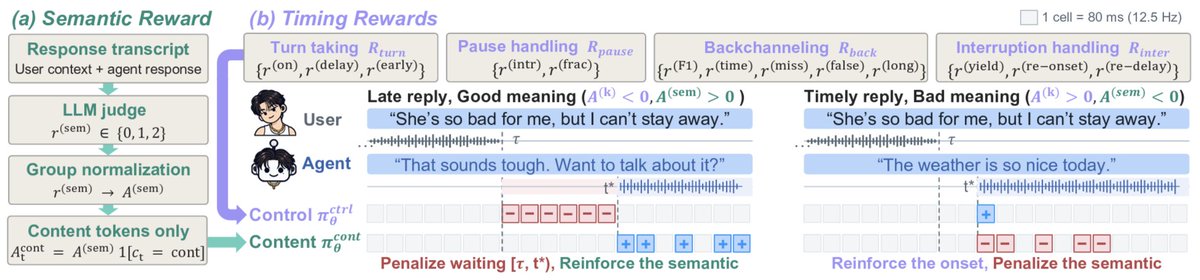
For more natural conversational AI, we usually use full-duplex speech language models, which can perform smooth turn-taking and also produce uh-huh-like backchannels.
However, there is no clear answer to when a model should barge in. So in this field, we explore reinforcement learning rather than relying solely on supervised fine-tuning. But due to the nature of full-duplex SLMs, their token distribution is totally different from that of normal language models. So our idea is to build a reinforcement learning method for full-duplex speech language models. Our method, HiPLEX (Hierarchical policy factorization for full-duPLEX SLMs), factorizes the policy into when to talk and what to talk. Plus, our credit assignment method causally attributes rewards to the correct or incorrect timing and semantic decisions. (See Figure 1 featuring the cute San character!)
arxiv: https://t.co/HgS6723JLr
huggingface paper: https://t.co/z9EtAQmJsu
Huge thanks to my Qualcomm speech team.
Speech+Agent paper from @Qualcomm and @KAIST_AI
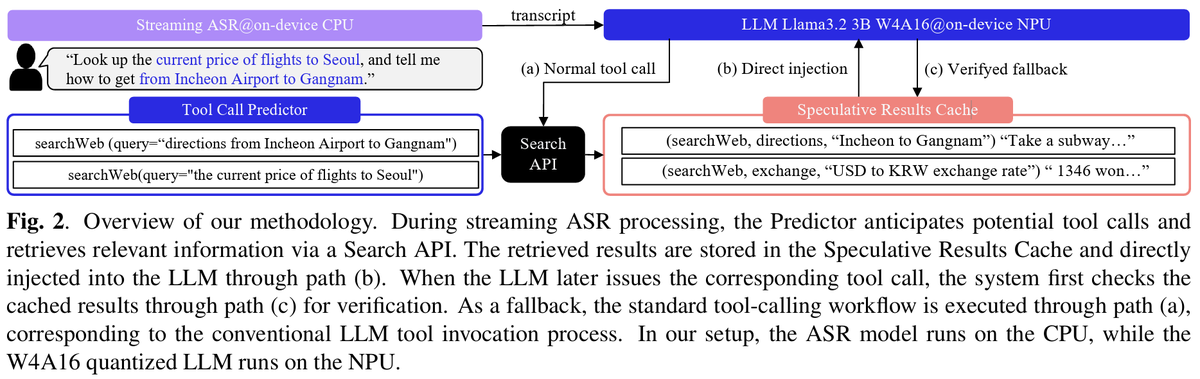
When we handle a cascaded speech agent system (ASR+LLM+TTS) for any reason, the LLM can call tools, but latency is a problem. We researched how we can hide the tool-calling latency and found that we can hide it within ASR time.
We tested it on the Samsung Galaxy S26 Ultra and confirmed that we can reduce latency and also (which we didn’t anticipate) improve performance!
Check out our paper!
arxiv: https://t.co/Xd7hAKRXys
🤗 : https://t.co/cDc4VeyBeA
LinkedIn: https://t.co/MGGlcjh53W
Must-read papers of the week
Top:
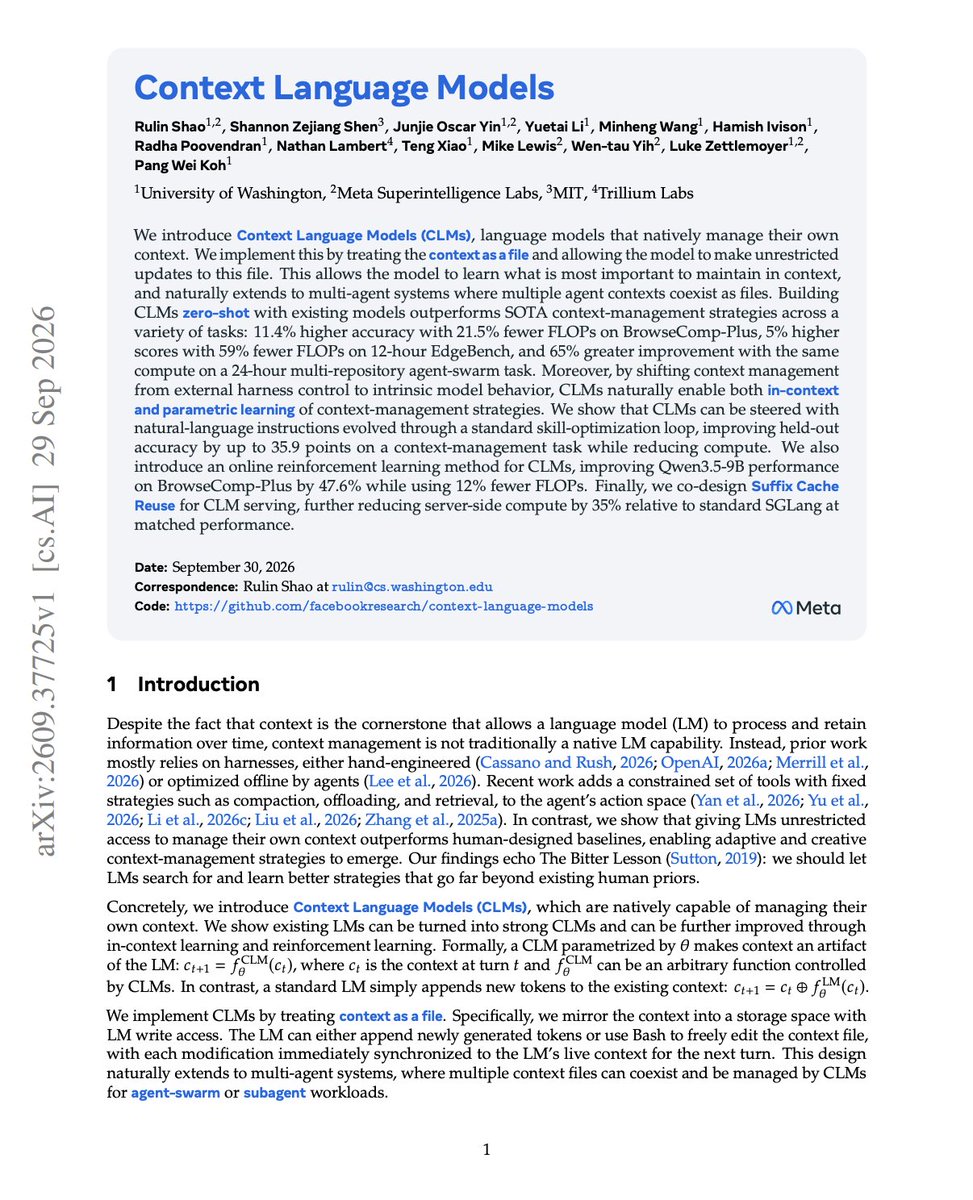
▪️ Context Language Models by @Meta
▪️ Invent a Dataset by @adaption_ai
▪️ World Observer by @KAIST_AI
▪️ The Planning Limits of Latent World Models by @uommedia
▪️ JEPA-TTT by @hri_usa and @JohnsHopkins
▪️ False Frontiers by @RutgersU and co
Worth checking:
▪️ EVO-WAM
▪️ InterEvolve
▪️ OneStreamer
▪️ LoopVL: Recurrent Visual Intelligence
▪️ WorldPlay2
▪️ Beyond Memory: Harnessing Long-Horizon Agents with Explicit Belief States
▪️ LLMs are General Asynchronous Agents
▪️ ActiveSaddler
▪️ EVOKE
▪️ GraphForge
Here is the full list of the most interesting papers + links and our weekly AI news digest:
https://t.co/1E7J5UeyDD
World models have one eye: the camera.
They can evolve what they see, but the rest of the world quickly goes unobserved.
So what if we gave them more eyes, like LoL wards or StarCraft Observers, and let them move around the world?
We introduce World Observer!
TL;DR: Keep the off-screen world evolving. Joint actor-observer generation with freely placed and movable panoramic observers.
Proj page: https://t.co/mDFlz5gvKb
@KAIST_AI@hyunwookee
Your emails, chats, docs, and tickets keep piling up, and the right ones get harder to find. 😡
🗺️ Introducing CorpusMap, which organizes a growing corpus around recurring entities, so agents follow connections instead of searching from scratch.
📈 Better answers, fewer tokens.
🎉 Excited to share that ES-Merging has been accepted to NeurIPS 2026! 🎉
💡 Biology connects molecules, proteins, and cells.
How can we bring their AI experts together?
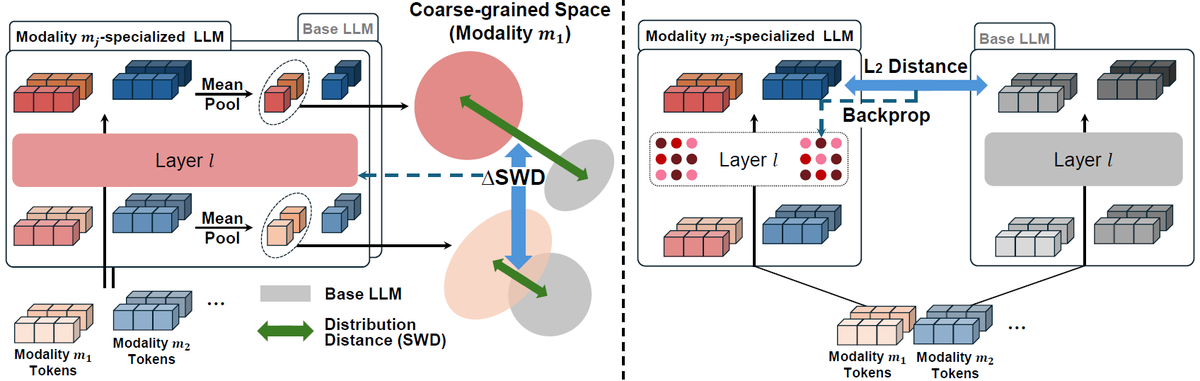
We use embedding-space signals to merge specialized biological MLLMs into one model:
🧩 Combine expertise at both layer and parameter levels
🔗 Improve cross-modal reasoning
🧠 Better preserve single-modal knowledge
Huge thanks to my co-authors @WonbinLee067 and @SungJuHwang1 for their collaboration and support!
Check out the paper and code for more details and results😊
📄 Paper: https://t.co/U6KVeaZN0g
💻 Code: https://t.co/ARzZPcGDBs
@KAIST_AI@MLAI_KAIST
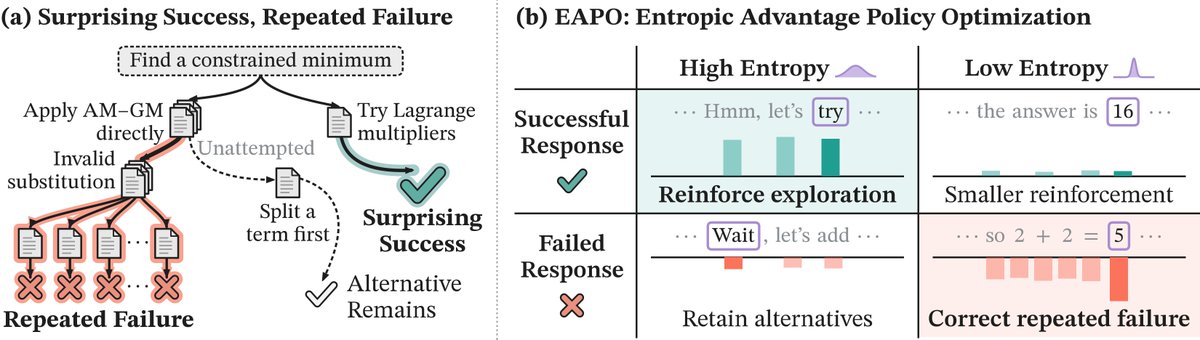
💡 Success under uncertainty is hard to repeat, while confident failures tend to recur. How can we learn from both to improve exploration in LLM reasoning?
Introducing EAPO (Entropic Advantage Policy Optimization), entropy-guided credit assignment for RLVR that treats success and failure asymmetrically to promote effective exploration in LLM reasoning:
🎯 Reinforce surprising success at high-entropy decisions
🔧 Penalize repeated failure more strongly at low-entropy decisions
🧭 Soften penalties at uncertain decisions to preserve alternatives for recovery
Without auxiliary models, token-level supervision, or substantial additional computation, EAPO achieves the best overall results across both base and reasoning backbones on diverse reasoning benchmarks.