Recently accepted by #QJE: “The Power of Proximity to Coworkers,” by Emanuel (@NataliaHEmanuel), Harrington (@emma_k_h), and Pallais: https://t.co/1T4NagW0AO
A 1 in 4 chance of a Republican winning the mayoral election in LA is, frankly, delusional.
Not saying it couldn't happen, just saying the probability should be *WAY* lower, to the point that I wonder whether the people betting on this actually know how the system works?
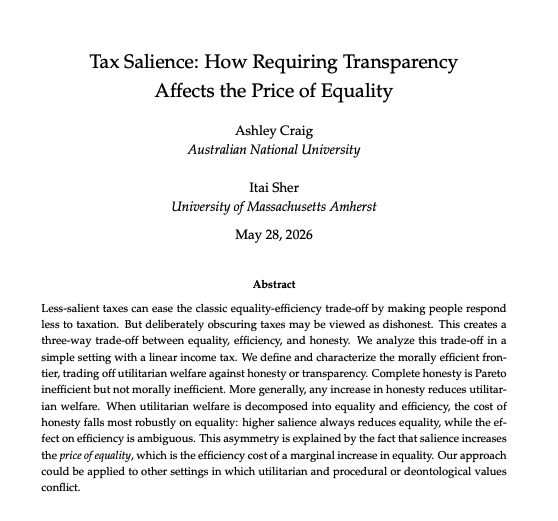
New paper with @ash_craig
Higher taxes promote equality but reduce efficiency. Making taxes less salient, so people respond less, eases this tension. But deliberately obscuring taxes may be viewed as dishonest.
We study the tradeoff between utilitarian welfare and honesty.
In the last mayoral election, Rick Caruso (1) was a Democrat at the time of the election/hadn't been a Republican for a while, (2) had *way* more in terms of independent qualifications for the job, and (3) still lost by almost 10%.
1/ New paper with @WiolaDziuda and @Polborn1: "The AGI Race and Existential Risk."
https://t.co/uPkFBdfcY9
If firms race to build AGI, how do competition, resources, and policy affect the tradeoff between speed and safety?
The hard part of finishing a PhD in economics/finance is not the coursework or the workload, IMO; it's being able to run your own projects from year 3 to graduation, with near-0 supervision. Lots of very good students have difficulty figuring out how to do this
Surprising math fact of the day: a monkey is hitting keys at random (uniformly, independently & at constant speed) on a keyboard. The expected value of the time T₁ it takes to type “abracadabra” is greater than the expected value of the time T₂ it takes to type “abracadabrz”.
@JMenschEcon Sure, but I guess my point was that it’s not clear what this would be if the task is to come up with a new (positive) research program rather than to check that none of the previous potential (negative) counterexamples worked.
I don’t think the question is whether AI will be able to do math better than humans—probably it would—but whether the amount of compute necessary to do this in a way that substitutes for humans is/will be feasible.
I don’t think we’ve gotten much info on the answer to that.
In any case the most important thing I learned from my math undergrad is that humility is valuable. Not sure AI will be able to teach that more efficiently.
Journals have an explicit policy of not publishing AI authored work. So what will that mean here? They can't stop AI contributing to knowledge. Can they stop it being cited?
I’m a little bit bugged by the fact that AI is being used to solve hard problems but the details of how and what they’re doing is a bit mysterious and unclear.
One of my papers (linked below) would suggest that we should just assume that the result is maximum fishing.
It also says this may be socially beneficial since the fact that we *assume* they are fishing gives stronger incentives to actually produce something impressive.
Honestly, this sounds quite plausible to me.
But the model doesn’t say I have to feel good about.
The “even so” here seems underemphasized to me. It seems first-order important to know just how strong selection is here.
It’s a very different story if OpenAI searched over all known problems and could solve one, versus it solved the first one they picked.
@yacineMTB I think it’s almost certain the cost for this one result was way lower than getting a human expert to produce a result of similar quality. Presumably they tried *many* problems but even so…
Prediction markets are our best tool for aggregating dispersed information. In a new piece with @brian_jabarian and Andrew Koh, we explain how to use them to learn about AI's near-term labor market impacts. For these markets to work, donors (including large labs) need to seed capital to break the chicken-and-egg problem. Link below for the article.